
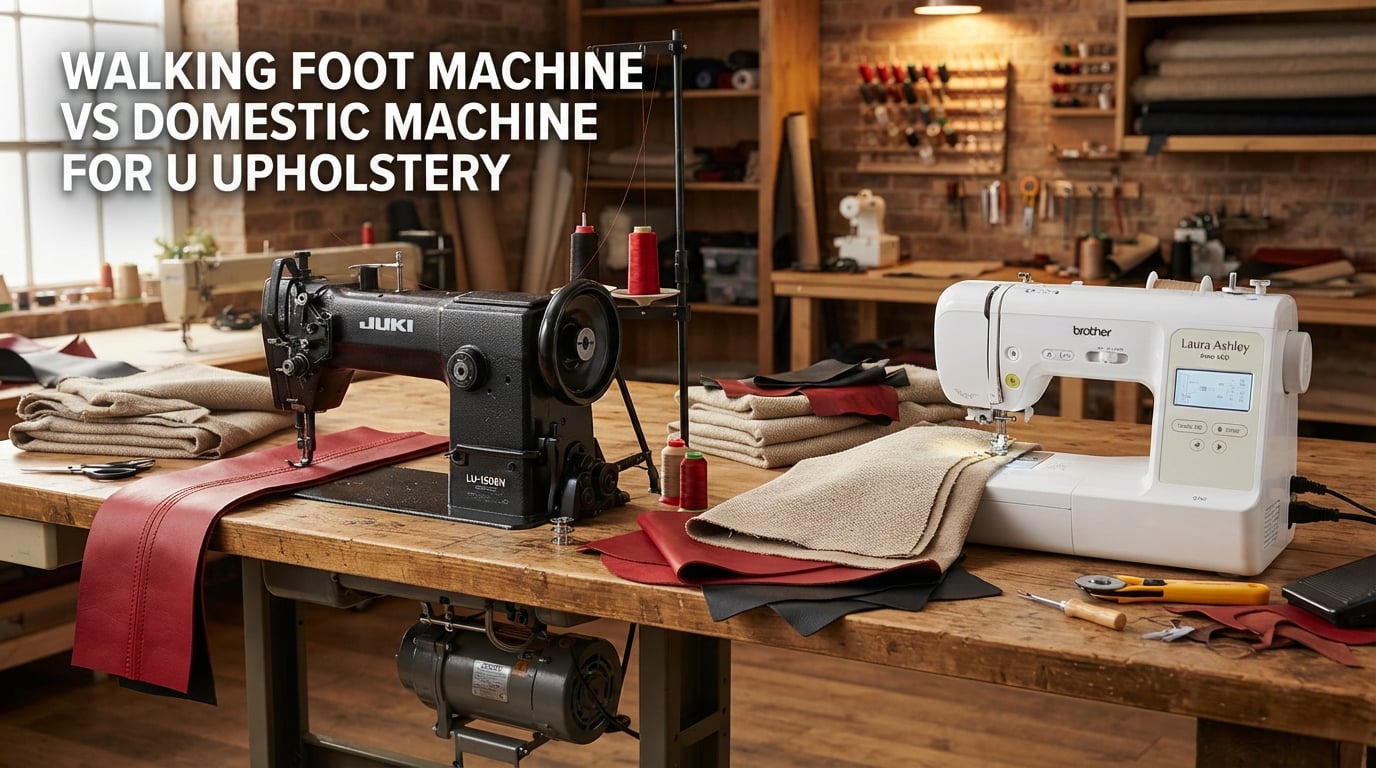
If you sew upholstery, you have probably fought a stubborn seam at some point. The top layer creeps, the bottom layer holds back, and the presser foot rides up on a stack of foam, vinyl, and lining that your home machine was never designed to push through. That is the entire walking foot machine vs domestic machine for upholstery argument in a single seam.
A walking foot machine is built to grab fabric from both the top and the bottom at the same time, then feed that grip in step with the needle. A domestic sewing machine only feeds from below with its feed dogs, so a slippery vinyl layer or a thick welt can stall or shift out of place. That single mechanical difference drives every other contrast: motor strength, frame weight, throat space, even the kind of projects each machine handles well.
I have spent time on both sides of this question, watching hobby machines skip stitches on four-layer denim and watching industrial walking foot machines eat through eight-layer automotive seams without breaking stride. In this guide, I will walk through what each machine actually does, when the upgrade is worth it, which models upholsterers trust, and how to decide for your own shop in 2026.
Table of Contents
- Quick Answer: Walking Foot vs Domestic Machine for Upholstery
- What Is a Walking Foot Machine and How Does It Work
- What Is a Domestic Sewing Machine in the Upholstery Context
- Key Differences Between Walking Foot and Domestic Machines
- Compound Feed vs Simple Walking Foot Explained
- When You Need a Walking Foot Machine for Upholstery
- When a Domestic Machine Is Enough for Upholstery
- Best Walking Foot Machines for Upholstery Work
- Servo Motor vs Clutch Motor for Upholstery
- Features That Matter Most in an Upholstery Sewing Machine
- Transitioning From a Domestic to an Industrial Machine
- Buying Guide: Which Machine Is Right for Your Upholstery Work
- Frequently Asked Questions
- What is the best walking foot sewing machine for upholstery?
- When not to use a walking foot?
- Is it okay to use a walking foot for regular sewing?
- What is the best sewing machine for sewing furniture upholstery?
- Which sewing machine is best for upholstery fabric?
- What kind of sewing machine do I need for upholstery fabric?
- What type of sewing machine is best for car upholstery?
- What is the difference between a domestic sewing machine and an industrial sewing machine?
- Conclusion
Quick Answer: Walking Foot vs Domestic Machine for Upholstery
The short version: a domestic machine is fine for light upholstery and one- or two-layer projects on home fabrics. For anything thicker, layered, or slippery, a walking foot machine wins on fabric control, motor power, and stitch consistency.
Pick a walking foot machine if you regularly sew:
- Leather or vinyl thicker than 2mm
- Multiple layers of denim, canvas, or foam-backed fabric
- Car interiors, marine covers, or heavy furniture work
- Welt cord, topstitching, and piping that demand straight, even seams
Stick with a domestic machine if your work is mostly:
- Light decorative panels, cushions, or pillow covers
- One layer of quilting-weight cotton or light linen
- Occasional repairs, not daily production
What Is a Walking Foot Machine and How Does It Work
A walking foot machine is a heavy-duty sewing machine whose presser foot moves. Instead of just pressing down while the feed dogs below push fabric along, the foot itself walks forward in sync with the needle, gripping the top layer of fabric from above while the feed dogs grip from below.
That synchronized motion is the entire trick. The fabric is held between two moving surfaces that travel at the same speed. Nothing slips, nothing shifts, and thick stacks feed through as if they were a single piece of cloth. The walking foot mechanism is what makes industrial upholstery, leatherwork, and sailmaking practical at production speeds.
Why this matters for upholstery: most upholstery projects stitch through three to eight layers at a time. You might be sewing foam, dacron wrap, burlap, lining, and a decorative cover fabric in a single seam. On a domestic machine, those layers slip against each other, the presser foot tilts, and you end up with puckering or skipped stitches. The walking foot prevents all of that by moving every layer at once.
Where walking foot machines come from: most walking foot machines for upholstery today are based on industrial designs from Juki, Consew, Seiko, and a handful of other Japanese and Chinese manufacturers. These machines were originally built for factories sewing car seats, sofas, leather bags, and outdoor gear. The home sewing world picked up the concept later, mostly through aftermarket walking foot attachments that adapt a domestic machine to behave more like an industrial one.
What Is a Domestic Sewing Machine in the Upholstery Context
A domestic sewing machine is a home-use sewing machine designed for garments, crafts, quilting, and light home decor. It feeds fabric using feed dogs from below only, has a lighter frame, and runs at lower torque than industrial machines.
In the upholstery world, a domestic machine is the starting point for most beginners. Brands like Brother, Janome, Singer, and Pfaff make models strong enough to handle light to medium home decor. With the right needle, thread, and a walking foot attachment, many of these machines can handle moderate upholstery tasks.
The limit shows up when fabric gets thick, slippery, or layered. A standard presser foot only presses down, so the feed dogs do all the work of advancing fabric. With heavy or slick material, that bottom-only grip is not enough. Vinyl slides, leather creeps, foam compresses unevenly, and the seam drifts. Domestic machines also run at lower torque, so the motor bogs down on thick seams. Some can punch through, but the stitch quality drops and the machine strains.
Key Differences Between Walking Foot and Domestic Machines
The biggest differences come down to how each machine grips, drives, and frames the work. Here is a side-by-side comparison of the features that matter for upholstery work.
| Feature | Walking Foot Machine | Domestic Machine |
|---|---|---|
| Feed mechanism | Walking foot plus feed dogs (grips top and bottom) | Feed dogs only (grips bottom only) |
| Motor type | Servo or clutch, often 0.5 to 1.5 horsepower equivalent | DC or AC motor, typically lower torque |
| Frame | Cast iron or heavy steel, designed for vibration damping | Aluminum or light alloy, lighter for portability |
| Throat space | 10 to 18 inches common on flatbeds | Usually 6 to 9 inches |
| Presser foot lift | Up to 16mm or higher, hand or knee lift | Usually 6 to 10mm, hand lever |
| Stitch per minute | 1,000 to 3,000 SPM depending on model | 500 to 1,500 SPM typical |
| Layer handling | 4 to 10+ layers of heavy fabric without slipping | 1 to 4 layers before slipping or skipped stitches |
| Best for | Leather, vinyl, canvas, automotive, furniture upholstery | Garments, light home decor, cushions |
| Skill required | Beginner-friendly once set up, with proper training | Beginner-friendly |
| Footprint and noise | Larger and louder, especially clutch motors | Compact, quieter |
The takeaway is that a walking foot machine gives you a top-and-bottom grip, more torque, more space, and a heavier frame. A domestic machine trades that grip for portability and lower cost. For upholstery specifically, the top-and-bottom grip is the single biggest advantage.
Compound Feed vs Simple Walking Foot Explained
Not every walking foot works the same way. There are four common feed mechanisms you will see on industrial upholstery machines, and the differences matter.
Walking foot: the presser foot walks in sync with the feed dogs. This is the most common setup for upholstery and is enough for most furniture, marine, and light automotive work. It handles thick fabric layers well.
Needle feed: the needle itself moves the fabric forward in addition to the feed dogs. This is great for precise stitching on leather and is often found on leather-specific machines. It can struggle with very bulky seams because the needle mechanism is doing extra work.
Compound feed: combines walking foot and needle feed. The presser foot walks, the feed dogs push, and the needle moves the fabric all at once. Compound feed is the most aggressive setup for very thick or sticky materials. Sewing eight layers of vinyl-coated canvas becomes practical. The trade-off is more moving parts and a steeper learning curve when adjusting timing.
Unison feed or triple feed: another name used by some manufacturers for compound feed setups. Juki’s unison-feed machines (such as the LU-2810 series) are essentially compound feed machines.
For most people sewing upholstery at home or in a small shop, a basic walking foot is plenty. If you sew car interiors, marine canvas, or industrial leather goods daily, the upgrade to compound feed is worth it.
When You Need a Walking Foot Machine for Upholstery
Some projects will not behave on a domestic machine no matter how much you coax them. Here is when a walking foot machine is the right tool.
Automotive upholstery. Sewing car seats, door panels, headliners, and carpets involves vinyl, foam, and heavy cloth layers all at once. A walking foot keeps every layer in register so seams do not twist.
Leather work. Anything thicker than 2mm leather, especially vegetable-tanned or chrome-tanned leather for bags and straps, needs the top-and-bottom grip. Without it, the leather creeps and stitches look crooked.
Marine and outdoor canvas. Sail covers, boat cushions, and awnings use heavy acrylic canvas with UV-resistant thread. The fabric is dense and slippery, and a walking foot prevents bunching.
Furniture upholstery. Reupholstering a chair, sofa, or ottoman means stitching through burlap, foam, and decorative fabric. The walking foot pushes these layers together cleanly.
Welt and piping. Inserting welt cord into a seam requires a perfectly even feed. A walking foot plus a welt foot attachment makes this fast and accurate.
If your projects fall into any of these categories more than occasionally, a walking foot machine will save you time, frustration, and missed stitches.
When a Domestic Machine Is Enough for Upholstery
There are honest cases where a domestic sewing machine is the right tool, even for upholstery-adjacent work.
Light decorative panels. Sewing a single layer of home decor fabric for a headboard or a small accent panel is well within a domestic machine’s range.
Cushion covers. A simple zippered cushion cover or pillowcase uses two layers of quilting-weight cotton or light linen. A home machine handles that easily.
Small repairs. Reattaching a loose seam on a chair cushion or fixing a torn slipcover is light work. You do not need an industrial machine for occasional touch-ups.
Garment-style upholstery fabric. Some upholstery fabric is thin enough to behave like a heavy shirting cotton. A domestic machine will sew it without protest.
If your upholstery work is occasional, on light fabric, and one or two layers at a time, your domestic machine is enough. A walking foot attachment will still help, but a full industrial upgrade can wait.
Best Walking Foot Machines for Upholstery Work
A handful of brands dominate the walking foot machine space for upholstery. These are the names upholsterers trust and the models most often recommended in industry forums and dealer catalogs.
Juki LU-563 / LU-563N. A single-needle, walking foot, top and bottom feed machine that handles light to medium leather and upholstery well. Solid build, easy maintenance, widely serviced.
Juki DU-1181N. A walking foot machine with a larger bobbin and stronger needle penetration for thicker fabric. Often recommended as a first industrial for upholsterers.
Juki LU-2810 series. Unison-feed (compound feed) flatbed machine. Heavier, more powerful, designed for car seats and leather furniture.
Consew 206RB-5. A walking foot machine with a longer cylinder bed, useful for items like boots, bags, and tubular upholstery shapes.
Consew 7360R-1. Heavy-duty walking foot machine with reverse and a high presser foot lift. A workhorse for production upholstery shops.
Seiko STH-8BLD-3. A compound feed walking foot machine with a reputation for stitching cleanly through multiple layers of vinyl and leather.
Cobra Class 20 / Highlead models. More affordable Chinese-made industrial walking foot machines. Quality varies, but a good dealer-prepared Cobra can be a strong value.
The right pick depends on your project type. For furniture and light automotive, a Juki LU-563 or DU-1181N is a safe starting point. For car interiors and heavy leather, step up to a Juki LU-2810 or Seiko compound feed machine.
Servo Motor vs Clutch Motor for Upholstery
Most industrial walking foot machines come with a choice of motor. The two main types are servo motors and clutch motors, and the difference affects how the machine feels and sounds.
Servo motor: an electronic motor with variable speed control via a pedal or dial. It runs quietly, uses less electricity, and lets you sew slowly for detailed work or quickly for long seams. Beginners usually find servo motors easier to learn on because you control the speed precisely.
Clutch motor: a traditional mechanical motor that runs at one speed. You control speed by how hard you press the pedal, but the machine always wants to run at full speed. Clutch motors are loud, mechanically simple, and durable. Many long-time upholsterers prefer the feel and the predictable power.
For upholstery specifically, a servo motor with a speed range of about 200 to 2,000 RPM gives you the most flexibility. You can slow down for topstitching around curves and speed up for long straight seams. Beginners should start with a servo motor. Experienced shops sometimes still prefer clutch motors for the power and the traditional feel.
Features That Matter Most in an Upholstery Sewing Machine
Once you start shopping for a walking foot machine, the spec sheets blur together. Focus on these features first, because they are the ones that show up in real upholstery work.
Throat space. The distance between the needle and the body of the machine. Upholstery projects are bulky, so 10 inches or more of throat space is helpful. Anything less than 8 inches feels cramped on cushions and car seats.
Presser foot lift. How high the foot rises so you can slide thick material under it. Look for 12mm to 16mm of lift. Lower lifts force you to fight the fabric into position.
Feed mechanism. Walking foot is the minimum. Compound feed or unison feed is better for the thickest layers.
Motor power and speed control. A 0.75 to 1.5 horsepower equivalent servo motor with adjustable speed is the sweet spot for most shops.
Frame weight. A heavy cast iron or steel frame dampens vibration and keeps the machine stable at high speed. Light frames walk across the table.
Reverse and stitch length adjustment. Standard features, but worth confirming. Reverse is essential for locking upholstery seams.
Warranty and dealer support. Industrial machines need occasional oiling, tension adjustments, and the occasional repair. A reputable dealer with service support is worth more than a small discount.
Knee lift. A knee-operated presser foot lifter frees both hands to position the fabric. Most industrial walking foot machines offer this as standard or as an option.
Transitioning From a Domestic to an Industrial Machine
I have talked to several upholsterers who made the jump from a domestic machine to a walking foot industrial. The honest story is that the first month feels strange. The machine is louder, the table is bigger, the speed feels different, and the foot pedal responds differently from what you are used to.
The most common surprises: industrial machines often arrive without a table or motor, so the true cost includes a tabletop, a motor and pulley, and setup. Noise and vibration take a week to get used to. Stitch tension settings are different from home machines and need a fresh test on scrap fabric before you start a project. And the bulk of an industrial walking foot machine means you cannot just tuck it into a closet when you are done.
The good news is that most of these adjustments are front-loaded. After a few projects, the controls feel natural and the seam quality goes up. Users on r/sewhelp and r/SewingMachineEdu regularly report that Juki and Consew machines last 12 to 16 years with basic maintenance, which makes the upfront cost easier to justify.
Buying Guide: Which Machine Is Right for Your Upholstery Work
To pick the right machine, work through these questions in order. The answers will point you toward the right category without needing to memorize every spec.
What is the thickest material you sew?
- Cotton, light linen, single-layer quilting fabric: a domestic machine is enough.
- Light denim, canvas, two to three layers: a domestic machine with a walking foot attachment can handle it.
- Vinyl, leather, four or more layers: you need a walking foot industrial.
- Heavy leather, automotive vinyl, eight or more layers: a compound feed industrial.
How often do you sew upholstery?
- A few times a year: a domestic machine plus a walking foot attachment is fine.
- A few times a month: a used walking foot industrial starts to make sense.
- Weekly or daily: a new walking foot industrial with dealer support is worth it.
What kind of project are you sewing?
- Cushions, pillows, light panels: domestic machine territory.
- Furniture reupholstery, marine canvas: walking foot industrial.
- Car seats, leather bags, marine interiors: walking foot or compound feed industrial.
What is your space like?
- A small home sewing room: a domestic machine with a walking foot attachment keeps things compact.
- A garage or dedicated shop: an industrial walking foot machine has room to breathe and runs quieter on a sturdy table.
If your answers trend toward layered, heavy, or frequent projects, a walking foot machine is the right investment. If your answers stay in the light and occasional category, a domestic machine will serve you well and save space.
Frequently Asked Questions
What is the best walking foot sewing machine for upholstery?
For most upholsterers, a Juki DU-1181N or Juki LU-563 walking foot machine is a strong starting point. For car interiors and heavy leather, step up to a Juki LU-2810 or Seiko compound feed walking foot machine.
When not to use a walking foot?
Avoid a walking foot for delicate fabrics, free-motion quilting on home machines, or any project where you want the feed dogs to handle fabric shifting on their own. A standard presser foot gives more control on lightweight, slippery material.
Is it okay to use a walking foot for regular sewing?
Yes, a walking foot is fine for regular sewing as long as the stitch length is consistent. The grip from above can mark very delicate fabrics, so test on scrap first.
What is the best sewing machine for sewing furniture upholstery?
A walking foot industrial such as the Juki LU-563 or Consew 7360R-1 is widely used for furniture upholstery. The walking foot keeps multiple fabric layers aligned through thick seams.
Which sewing machine is best for upholstery fabric?
A walking foot machine with a servo motor is the best match for most upholstery fabric. Juki, Consew, and Seiko are the brands most upholsterers trust.
What kind of sewing machine do I need for upholstery fabric?
You need a machine with a walking foot mechanism, strong motor, and high presser foot lift. Industrial machines with 12mm or more foot lift handle upholstery fabric best.
What type of sewing machine is best for car upholstery?
A compound feed walking foot industrial, such as the Juki LU-2810 or Seiko STH-8BLD-3, is the standard for car upholstery. The combined needle feed and walking foot prevents vinyl and foam from shifting under the needle.
What is the difference between a domestic sewing machine and an industrial sewing machine?
A domestic machine is built for home use, with a lighter frame, lower torque, and feed dogs only. An industrial walking foot machine has a heavier frame, a stronger motor, and a top-and-bottom grip that handles thick layered fabric at high speed.
Conclusion
The walking foot machine vs domestic machine for upholstery decision comes down to what you sew and how often. A domestic machine is a faithful partner for cushions, light panels, and the occasional slipcover. A walking foot industrial earns its keep the moment you push through vinyl, leather, or more than three fabric layers.
If you sew upholstery more than once a month, work with heavy or slippery fabric, or stitch layered seams that fight your home machine, the upgrade to a walking foot machine pays off in stitch quality, speed, and frustration saved. Start with a trusted brand like Juki or Consew, choose a servo motor for variable speed, and work with a dealer who can service the machine after the sale. If your upholstery work stays light and occasional, your domestic machine plus a walking foot attachment is still the right tool for the job.