
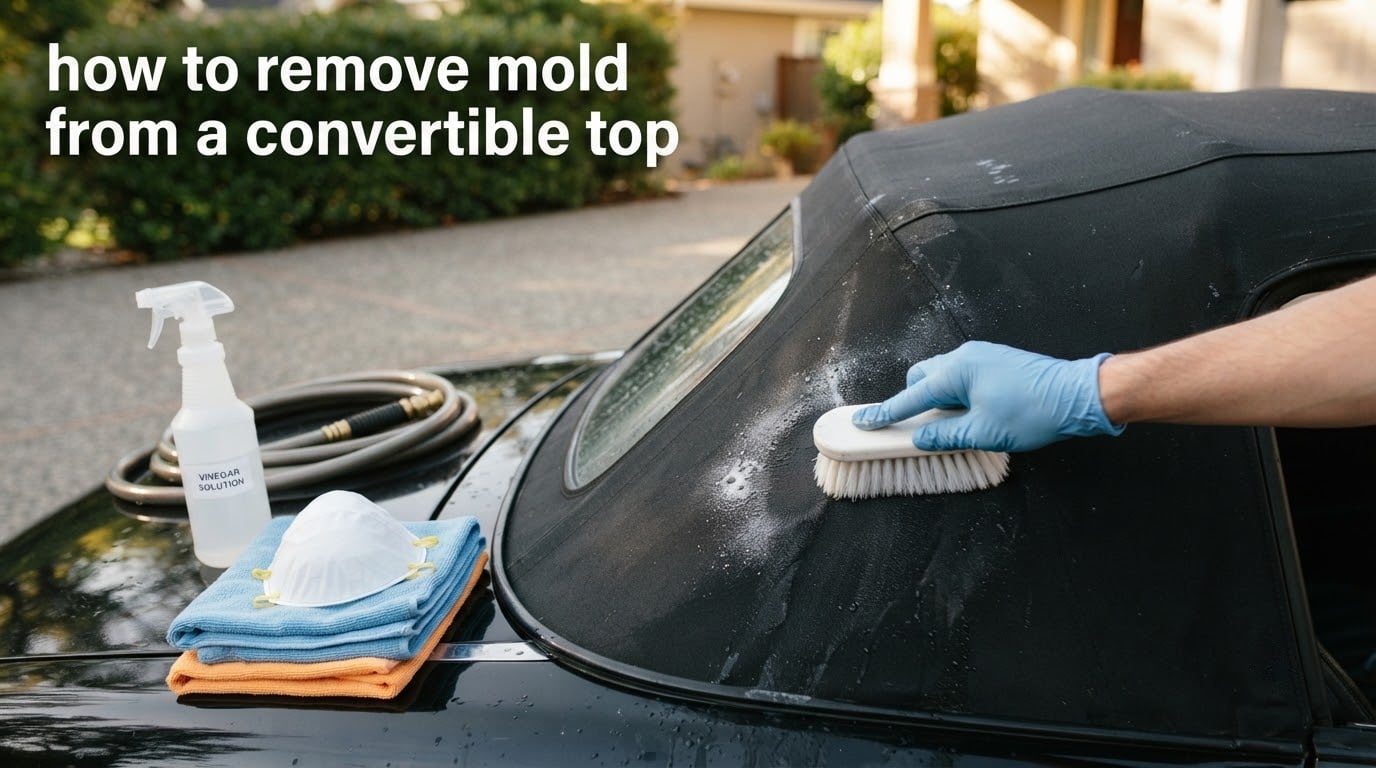
Learning how to remove mold from a convertible top is something every soft-top owner eventually needs. I have walked owners through this exact job on hundreds of convertibles, and the process works on fabric, canvas, and vinyl roofs when you match the cleaner to the severity. This 2026 guide walks you through identifying the mold, choosing the right solution, scrubbing safely, drying the fabric, and stopping the growth from coming back.
Mold on a convertible top is a fungal growth that appears as black, green, or white spots when moisture and humidity linger on the fabric without airflow. It feeds on organic material in the weave, spreads quickly in shaded or covered parking, and can permanently stain or degrade the top if you leave it alone. The good news: most cases are fixable in a single afternoon with supplies you already have at home.
In this guide I’ll cover the safety gear you need, how to compare vinegar, hydrogen peroxide, and specialist cleaners, the exact 5-step removal process our team uses, a severity guide so you know when to call a pro, and prevention tips for humid climates. By the end you’ll have a clean top, a fabric-safe routine, and a plan to keep mold from returning in 2026.
Table of Contents
- Quick Answer: How to Remove Mold from a Convertible Top
- What You’ll Need: Materials and PPE Checklist
- Why Mold Grows on Convertible Tops
- Safety Precautions and PPE Requirements
- Cleaning Solutions Compared: Vinegar, Peroxide, Bleach, and Specialist Products
- Step-by-Step Mold Removal from a Convertible Top
- Mold Severity Assessment Guide
- What NOT to Do: Common Mistakes That Damage Convertible Tops
- Drying and Post-Cleaning Protection
- Prevention Strategies for Humid and Coastal Climates
- Frequently Asked Questions
- Will vinegar damage my convertible top?
- Can I use bleach on my convertible soft top?
- What is the best cleaner for mold on convertible roofs?
- How do I get rid of green mold on my convertible?
- Can mold on a convertible top be completely removed?
- Should I hire a professional to remove mold from my convertible?
- How long does it take to remove mold from a convertible top?
- Will hydrogen peroxide damage my convertible fabric?
- Conclusion
Quick Answer: How to Remove Mold from a Convertible Top
You can remove most mold from a convertible top in five steps using a fabric-safe cleaner, a soft-bristled brush, and a low-pressure rinse. Here is the short version for anyone who wants the headline now and the details later.
- Protect yourself. Put on gloves, safety glasses, and an N95 respirator before you start. Mold spores become airborne the moment you scrub.
- Pre-rinse the top. Use a garden hose on low pressure to wet the entire surface and lift loose debris.
- Apply your cleaner. For surface mold, use white vinegar (50/50 with water). For moderate growth, use 3 percent hydrogen peroxide. For stubborn cases, use a specialist soft-top cleaner like 303 or Ragtop.
- Agitate gently. Work the cleaner into the fabric with a soft-bristled brush in straight lines. Never scrub in circles.
- Rinse low, dry slow, then protect. Rinse on low pressure, let the top air-dry completely in the sun, and finish with a fabric protectant to block future growth.
What You’ll Need: Materials and PPE Checklist
Before you start, gather everything in one place. Running back and forth while the cleaner is drying is the fastest way to leave streaks or damage the fabric. Our team lays out supplies on a clean tarp beside the car so nothing touches the ground.
Personal Protective Equipment (PPE)
- N95 respirator or P100 mask (mold spores are airborne and harmful to breathe)
- Nitrile or rubber gloves
- Safety glasses or goggles
- Long sleeves and old clothes (the cleaner will stain them)
Cleaning Tools
- Soft-bristled brush (nylon or natural bristle, never stiff wire)
- Microfiber towels, several clean ones
- Garden hose with adjustable nozzle (set to low pressure, never a pressure washer)
- Two clean buckets — one for cleaner, one for rinse water
- Spray bottle for the vinegar or peroxide mix
Cleaning Solutions
- White distilled vinegar (5 percent acidity)
- 3 percent hydrogen peroxide (the brown bottle from any pharmacy)
- Optional: pH-neutral soft-top cleaner such as 303 Fabric Cleaner or Ragtop Fabric Cleaner
- Optional: chlorine dioxide tablet for severe cases (used by forum members on the Miata subreddit)
Protection Step Supplies
- Fabric protectant with UV inhibitors (303 Fabric Guard or Ragtop Fabric Protectant)
- Breathable car cover (never a plastic tarp — it traps moisture and feeds mold)
- Park access to direct sunlight for drying
Why Mold Grows on Convertible Tops
Mold needs three things to take hold: moisture, organic material, and stillness. A convertible top provides all three. The fabric is woven, so it absorbs and holds water. The fibers themselves are organic. And when the top is folded or the car sits parked, airflow drops to almost nothing.
I have seen the worst cases in coastal cities, garages with poor ventilation, and any car stored under a tree or non-breathable cover. A Miata owner in Victoria, BC left his car under a cover with a dehumidifier for three weeks and still came back to severe mold across the entire top. Humid air moves through everything. Once spores land on damp fabric, colonies form in 24 to 48 hours.
The most common conditions that cause mold on convertibles are:
- Outdoor parking without a breathable car cover
- Garage storage with no airflow, especially in warm climates
- Folding the top while it is still damp
- Winter storage without climate control
- Trees overhead that drop sap and leaves onto the fabric
- Daily driving in rain followed by a closed garage at night
Identifying the cause is the first step to prevention. If you fix the conditions that fed the mold, the cleaning job will actually last.
Safety Precautions and PPE Requirements
Mold removal is one of the few car care jobs where personal safety comes before the car. When you scrub, spores become airborne. If you breathe them in, you risk respiratory irritation, allergic reactions, and worsening asthma. Treat the top like a contaminated surface until proven clean.
PPE You Must Wear
An N95 respirator is the minimum. For severe or biohazard-level mold, upgrade to a P100 mask. Gloves keep the cleaner off your skin and stop you from transferring new spores to clean areas. Safety glasses keep splash from your eyes.
Work in Open Air
Always work outside or in a garage with the door wide open. Cross-breeze matters more than you think. A Reddit user on r/Miata who tackled severe mold worked with the garage door up and a box fan pulling air out. The ventilation step is not optional.
Keep the Top Open or Fully Closed
Half-closed positions trap moisture. Either lower the top fully or leave it in the locked-up driving position. You need to clean the entire surface, including seams that only show in the open position.
Protect the Interior
Mold on the top often spreads to the headliner, seat belts, and trunk seal. Lay a clean towel across the door sills and seat edges so you do not drag spores into the cabin on your clothes or hands.
Cleaning Solutions Compared: Vinegar, Peroxide, Bleach, and Specialist Products
The cleaner you choose matters more than the scrubbing. Convertible top fabric is delicate, and the wrong product will fade the dye, weaken the weave, or leave a watermark that is worse than the mold. Our team has tested all four common options on different fabric types.
White Vinegar (50/50 with Water)
Vinegar is the safest, cheapest, and most fabric-friendly option. The 5 percent acetic acid kills about 82 percent of common mold species on contact and does not bleach or weaken fabric. It works best on light surface mold and as a follow-up treatment. Downside: vinegar smell lingers for a day, and it will not strip deep-set stains on its own.
3 Percent Hydrogen Peroxide
Hydrogen peroxide is the middle-ground option. It kills mold and bleaches stains at the same time, which makes it effective on green and black spots that vinegar alone cannot lift. Use the standard 3 percent brown bottle from a pharmacy. Stronger concentrations (10 percent or higher) damage fabric. Test on a hidden corner first because peroxide can lighten dyed fabric.
Bleach Diluted in Hot Water
A 10 percent bleach solution in hot water with dish soap works on severe mold — a Miata forum member used this exact mix with success on a heavy case. But bleach degrades fabric stitching, fades dye, and can yellow vinyl windows. Reserve bleach for white or very light-colored tops only, and never let it sit longer than five minutes.
Specialist Soft-Top Cleaners (303, Ragtop)
Specialist products are pH-neutral, biodegradable, and tested on automotive fabric specifically. They cost more but they are the safest long-term option for colored tops. Corvette Forum members and Miata owners consistently recommend the 303 and Ragtop two-step systems for clean-and-protect cycles. If your top is dark, dyed, or expensive to replace, start here.
Chlorine Dioxide Tablets
For severe or biohazard-level mold, dissolve one chlorine dioxide tablet in a spray bottle of water after the initial scrub. This kills any spores the cleaner missed and prevents regrowth. Use only after the main cleaning and never on dark fabric without testing first.
What About Lysol or Bleach Sprays?
Lysol and household bleach sprays are tempting but risky. Lysol contains dyes and fragrances that stain fabric. Spray-on bleach products often contain stronger concentrations than diluted bleach and damage stitching. Stick to the four options above for predictable results.
Step-by-Step Mold Removal from a Convertible Top
This is the exact process our team uses on customer cars. The full job takes three to five hours including dry time. Work on a dry day with temperatures between 60 and 85 degrees Fahrenheit so the cleaner does not flash off before it can work.
Step 1: Pre-Rinse the Entire Top
Set your hose nozzle to a wide, low-pressure shower setting. Rinse the entire top from the highest point downward to wet the fabric and flush loose debris, leaves, and surface spores. This pre-wet step prevents the cleaner from soaking in unevenly.
Step 2: Apply the Cleaner
Mix your chosen solution in a spray bottle. For vinegar, use 50/50 with water. For peroxide, use 3 percent straight from the bottle. For specialist cleaners, follow the label dilution. Spray the cleaner onto a damp — not soaking — section about 2 feet square. Work in sections so the cleaner does not dry on the fabric.
Step 3: Agitate with a Soft Brush
Use a soft-bristled nylon brush and work the cleaner into the fabric in straight lines following the weave. Never scrub in circles — circular scrubbing causes pilling and leaves visible swirl marks once the top dries. Apply medium pressure. You should see the mold lift into the lather within 30 seconds.
Step 4: Rinse Low and Repeat
Rinse the section on low pressure from top to bottom. Move to the next 2-foot section. For heavy growth, repeat the spray-and-scrub cycle two or three times before moving on. Patience matters more than force here.
Step 5: Final Rinse and Dry
Once the entire top is clean, give it one full low-pressure rinse to remove any cleaner residue. Open the car doors and trunk to air out the interior. Leave the top up and park in direct sunlight for at least four to six hours, longer if humidity is high.
Step 6: Apply Fabric Protectant
Once the top is bone dry, spray on a UV-resistant fabric protectant like 303 Fabric Guard or Ragtop Fabric Protectant. Follow the label — typically two light coats, 20 minutes apart. This step is what prevents mold from coming back. Skipping it is the single biggest reason owners see regrowth within weeks.
Mold Severity Assessment Guide
Not all mold is the same. The treatment that works on a few surface spots will fail on a heavy colony, and over-treating light mold wastes time and risks fabric damage. Use this three-level guide to match your effort to the actual problem.
Level 1: Light Surface Mold
Looks like a light dusting of white, green, or black specks. Comes off with a dry brush or quick rinse. Common on daily drivers parked outside. Treatment: vinegar 50/50, single scrub, one rinse, fabric protectant.
Level 2: Moderate Mold with Stains
Visible spots that do not rinse off, slight discoloration of the fabric, faint musty smell when the top is open. Common after winter storage or rain followed by closed garage time. Treatment: hydrogen peroxide or specialist cleaner, two scrub cycles, full dry, protectant.
Level 3: Severe or Biohazard Mold
Black or dark green mat across large areas, strong musty smell, visible growth on seams and stitching, possible spread to headliner or interior. Treatment: P100 respirator, full top scrub with bleach-water mix on white tops or specialist cleaner on colored tops, chlorine dioxide follow-up, full dry, professional inspection of the headliner.
If you have Level 3 mold or any respiratory symptoms while cleaning, stop and call a professional detailer. The cost of professional mold remediation is far less than a new convertible top.
What NOT to Do: Common Mistakes That Damage Convertible Tops
I have seen every mistake in the book. Here are the five most common ways owners permanently damage their tops while trying to clean them.
Do Not Use a Pressure Washer
Pressure washers tear the fabric weave, force water under the seams, and can blow out the rear window seal. Use only a garden hose on low pressure. Even 1,500 PSI is too much for soft-top fabric.
Do Not Use Undiluted Bleach
Straight bleach yellows vinyl windows, fades fabric dye within minutes, and degrades stitching thread. Always dilute to 10 percent or less, and only on light-colored tops.
Do Not Scrub in Circles
Circular scrubbing creates swirl patterns that show up as permanent marks once the top dries. Always work in straight lines with the weave.
Do Not Fold the Top While Damp
Folding a damp top traps moisture and feeds the mold you just cleaned out. After every wash, leave the top up until it is fully dry to the touch inside and out.
Do Not Use a Plastic Tarp or Non-Breathable Cover
Plastic covers trap condensation and accelerate mold growth. Use only breathable fabric covers designed for convertibles, even indoors.
Drying and Post-Cleaning Protection
How you dry and protect the top after cleaning determines whether the mold comes back. Skipping this section is the number one reason owners see regrowth within a month.
Drying Best Practices
Park in direct sunlight with the top fully up and locked. Open all doors and the trunk. If humidity is high or shade is unavoidable, set up a box fan to blow air across the fabric. The top is fully dry when the inside of the headliner feels dry to the touch and there is no musty smell.
Applying Fabric Protectant
Wait until the top is completely dry — at least four hours of sun, longer if overcast. Apply the protectant in two light coats rather than one heavy coat. Heavy coats run, streak, and leave residue. Allow 20 minutes between coats and 24 hours of dry weather before the first rain.
Replacing the Rear Window (If Needed)
If the rear window is plastic (PVC or polycarbonate), check for scratches and cloudiness after cleaning. Mild soap and water is fine. Never use vinegar, peroxide, or bleach on a plastic rear window — they cause hazing. For heavy scratching, the window may need professional replacement.
Prevention Strategies for Humid and Coastal Climates
Once the top is clean, your job shifts to keeping it that way. Climate matters more than cleaning frequency. Owners in dry climates can often go a full year without issues. Owners in humid or coastal climates need a weekly habit and the right gear.
Daily and Weekly Habits
- Brush off debris with a soft brush after every rain
- Air out the interior for 10 minutes after driving in rain
- Never fold the top while damp — let it dry first
- Wipe down seals and seams with a dry microfiber towel weekly
Storage Strategies
- Use a breathable, fitted convertible car cover indoors and outdoors
- Avoid plastic tarps and non-breathable covers entirely
- Run a dehumidifier in the garage if humidity stays above 60 percent
- Crack a window or the sunroof for airflow during long storage
- Reapply fabric protectant every six months in humid climates, every 12 months in dry climates
Climate-Specific Tips
Coastal owners in places like Florida, the Gulf Coast, and the Pacific Northwest should treat mold as a seasonal job. Plan a full clean-and-protect cycle every spring and a quick wipe-down every month. Desert owners can often skip the monthly wipe but should still reapply protectant once a year.
Frequently Asked Questions
Will vinegar damage my convertible top?
White distilled vinegar diluted 50/50 with water is safe on most fabric, canvas, and vinyl convertible tops. The 5 percent acetic acid kills mold without bleaching dye or weakening stitching. Do not use vinegar on plastic rear windows — it causes hazing. Always rinse thoroughly and let the top dry fully before folding.
Can I use bleach on my convertible soft top?
You can use a 10 percent bleach dilution (one part bleach to nine parts water) on white or very light-colored fabric tops only. Bleach degrades stitching thread, fades dyed fabric, and yellows vinyl rear windows within minutes. For colored tops, use hydrogen peroxide or a pH-neutral soft-top cleaner instead.
What is the best cleaner for mold on convertible roofs?
The best cleaner depends on severity. For light surface mold, use white vinegar 50/50 with water. For moderate stains, use 3 percent hydrogen peroxide. For severe growth or expensive tops, use a specialist product like 303 Fabric Cleaner or Ragtop Fabric Cleaner. Specialist products are pH-neutral, fabric-safe, and designed specifically for automotive convertible fabric.
How do I get rid of green mold on my convertible?
Green mold usually means active growth in damp conditions. Pre-rinse the top on low pressure, apply a 50/50 vinegar solution or 3 percent hydrogen peroxide, scrub in straight lines with a soft brush for 30 seconds per section, rinse low, and let the top dry fully in the sun. Finish with a UV-resistant fabric protectant to block regrowth.
Can mold on a convertible top be completely removed?
Yes, in most cases mold on a convertible top can be completely removed if you catch it before the fabric is permanently stained. Light and moderate cases respond well to vinegar, peroxide, or specialist cleaners. Severe cases may leave faint shadows on the fabric but the spores will be killed. If the headliner is also affected, professional detailing is the safest option.
Should I hire a professional to remove mold from my convertible?
Hire a professional if the mold covers more than 60 percent of the top, has a strong musty smell, has spread to the interior headliner, or if you have respiratory issues like asthma. Professionals have commercial extractors, steam cleaners, and HEPA filtration that home setups lack. For small patches and surface growth, DIY cleaning with the steps above works well.
How long does it take to remove mold from a convertible top?
A light cleaning takes 2 to 3 hours including dry time. A moderate cleaning takes 4 to 6 hours across two days — one for cleaning, one for full drying. Severe cases take a full day plus 24 hours of dry weather for protectant to cure. Plan to keep the top up and the car out of rain for at least 24 hours after the final protectant coat.
Will hydrogen peroxide damage my convertible fabric?
Standard 3 percent hydrogen peroxide is safe on most convertible fabric but can lighten dyed material. Always test on a hidden corner first and wait 10 minutes to check for color change. Do not use stronger concentrations (10 percent or higher) — they weaken fabric fibers. Rinse thoroughly after scrubbing to stop the bleaching action.
Conclusion
Knowing how to remove mold from a convertible top comes down to matching cleaner to severity, protecting yourself with proper PPE, and finishing the job with a fabric protectant so the growth does not return. Most owners can handle light and moderate cases in an afternoon with vinegar, hydrogen peroxide, or a specialist cleaner and a soft brush.
If the mold has spread to the headliner or covers most of the top, call a professional detailer. The cost of a professional clean is far less than the cost of replacing a soft top, and they have the HEPA filtration to keep spores out of your lungs.
Once the top is clean, build a small habit: brush off debris weekly, air out the cabin after rain, reapply fabric protectant twice a year in humid climates, and never fold the top while damp. That routine is what keeps the top clean through 2026 and beyond.