
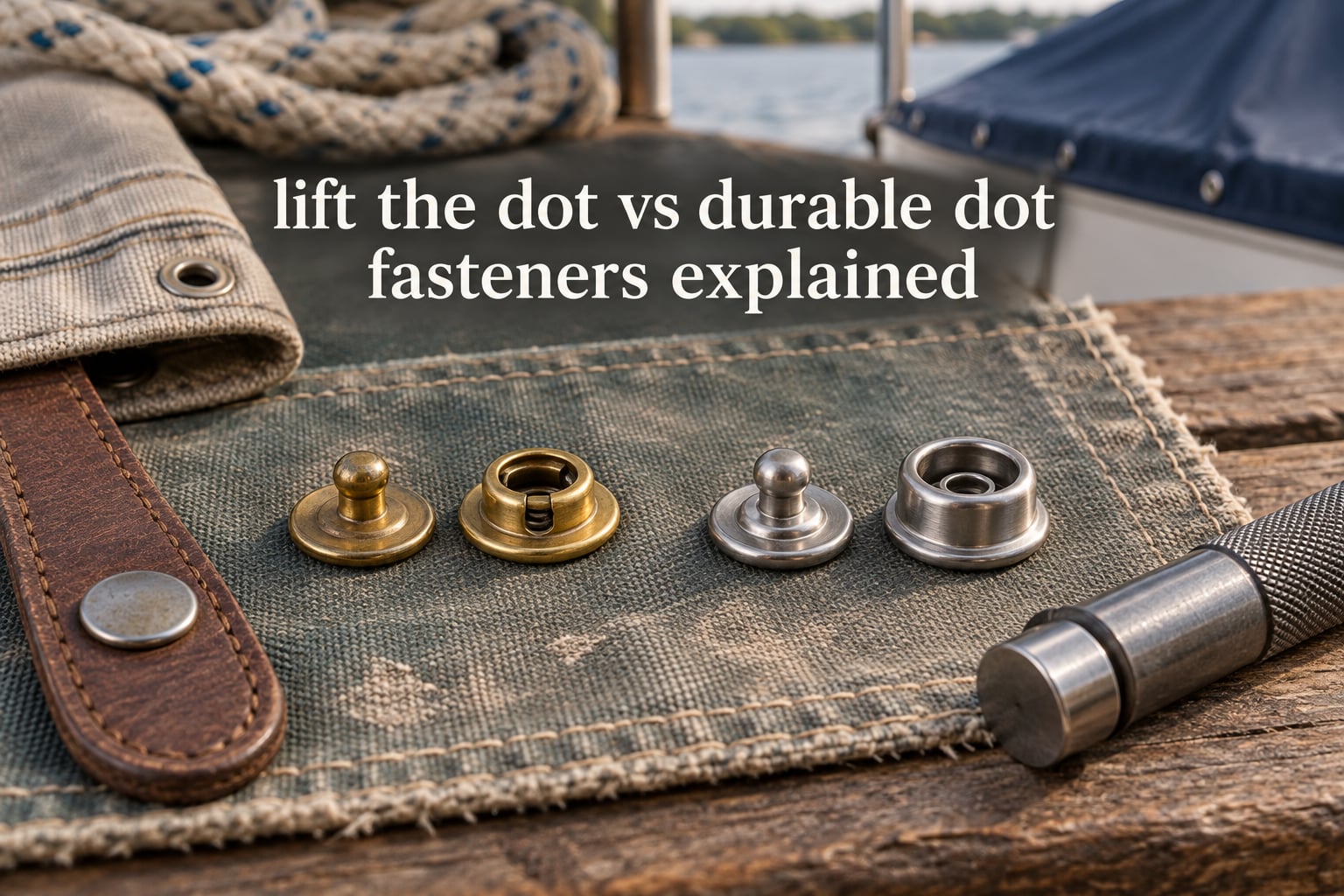
If you have ever wrestled with a snapped boat cover, a convertible top that pops loose, or a piece of military gear that refused to give, you were probably looking at either a Lift-the-DOT or a Durable DOT fastener. The two look almost identical at a glance, but they release in completely different ways, and picking the wrong one is the kind of mistake you only make once.
I have spent years working with snap fasteners on marine canvas, classic car interiors, and leather goods, and the question I hear most often is some version of “which one do I actually need?” This guide is my answer. I will walk you through how each fastener locks, where each one belongs, and how to choose between them without buying the wrong part number.
Table of Contents
- What Are DOT Fasteners and Why Do They Matter
- Lift-the-DOT Fasteners Explained
- Durable DOT Fasteners Explained
- Lift-the-DOT vs Durable DOT: Side-by-Side Comparison
- Applications and Use Cases for Each Fastener
- Installation Methods and Tools
- How to Choose Between Lift-the-DOT and Durable DOT
- Frequently Asked Questions
- What is the difference between Lift-the-DOT and Durable DOT fasteners?
- Which fastener is better for marine canvas and boat covers?
- Are Lift-the-DOT and Durable DOT fasteners interchangeable?
- What tools do I need to install these fasteners?
- What material grade should I choose for saltwater use?
- Can I install DOT fasteners without a Snapmaster tool?
- Final Verdict
What Are DOT Fasteners and Why Do They Matter
DOT fasteners are a family of heavy-duty snap fasteners originally developed to military specification. The name comes from the original patent holder, the DOT Corporation, and the trademark still appears on the highest-grade components. Within the DOT family, four cousins show up on almost every supplier shelf: Lift-the-DOT, Pull-the-DOT, Durable DOT (also called press studs), and Common Sense turn buttons.
All four share a stud-and-socket design. A circular stud on one half of the material mates with a circular socket on the mating half. When pressed together, the two halves lock. The difference between them is how they unlock. That release detail is what determines whether a fastener is right for your application.
You see DOT fasteners everywhere once you learn to recognize them. Boat covers, tonneau covers, and Bimini tops rely on them. Military packs, body armor carriers, and load-bearing harnesses use them. Convertible tops and classic car trim fasten with them. They are even common on leather goods, tents, awnings, and luggage. Reviewers in marine and military forums repeatedly point out that DOT fasteners outlast generic snap fasteners by years in harsh conditions.
Why does the spec matter? The military version, identified by NASM (National Aerospace Standard Mil-spec) part numbers, controls material grade, plating thickness, and dimensional tolerance. That is why a 316 stainless steel Lift-the-DOT stud survives saltwater that turns a cheap nickel-plated imitation orange in a single season.
Lift-the-DOT Fasteners Explained
Lift-the-DOT fasteners lock on three sides of the stud and release only when you deliberately lift a fourth side, the side stamped with a small dot. Lift that dotted flange and the socket pops free with a clean, mechanical release. There is no spring to weaken, no detent to wear out, and no accidental opening if something tugs on the cover.
The anatomy is simple. The stud side has a flat-headed post with a cross-shaped or bar-shaped foot that locks into the socket. The socket side is a brass or stainless ring with three inward-formed tabs that grip the stud on three sides and leave the fourth side, the dot side, slightly open. Push the two halves together and the tabs flex over the post and catch on the back. Lift the dot and the tabs swing outward, freeing the stud.
Several stud types are available, and choosing the right one matters more than most people realize. The screw stud threads through a pre-punched hole and locks with a nut on the back, ideal for hard substrates and marine grade work. The two-prong stud has two sharp prongs that pierce the fabric and bend outward on the back, eliminating the need to pre-punch. The self-piercing stud combines a piercing point with internal threads for thin sheet metal. There is also a clinch plate, a backing washer that prevents pull-through on soft materials.
Material grades cover most environments. Standard brass with a nickel or chrome finish handles indoor and light outdoor use. Solid brass without plating resists corrosion better than plated steel. For saltwater, 316 marine grade stainless steel is the only sensible choice. Reviewers on trawler forums and boating communities consistently report that 316 stainless Lift-the-DOT fasteners outlast every other option in saltwater conditions.
Durable DOT Fasteners Explained
Durable DOT fasteners are the press stud the world associates with the word snap. The stud has a rounded head with a slight neck. The socket is a spring ring, often four-leaf or six-leaf brass, that snaps over the neck with a satisfying click. To release, you pull the two sides apart with a steady tug; the spring ring flexes open and the stud pops free.
The press-stud action is fast and one-handed, which is why Durable DOT is the default on luggage, leather jackets, and tent flaps. You do not have to find a dot, lift a flange, or aim a finger. Just pull.
Anatomy is even simpler than Lift-the-DOT. The stud is a single piece, post and head formed together. The socket is a ring of springy leaves folded inward to grip the stud neck. There is no dot, no three-sided lock, no deliberate release step. The mechanical simplicity is also the durability story: fewer parts means fewer failure modes.
Durable DOT comes in three main sizes. Standard Durable is the everyday workhorse, common on clothing, leather goods, and light canvas. Baby Durable is the smaller cousin used where a low profile matters, on wallets, document folders, watch straps, and thin leatherwork. Heavy Durable (sometimes called DOT Snap) uses heavier gauge brass and a stronger spring ring for marine canvas, automotive trim, and industrial covers.
Material grades follow the same logic as Lift-the-DOT. Plated brass is fine indoors. Solid brass handles outdoor exposure. 316 stainless steel is the marine choice. The 316 stainless Heavy Durable version is widely used on boat covers and awnings where the press-stud action is preferred over the lift release.
Lift-the-DOT vs Durable DOT: Side-by-Side Comparison
The two fasteners look almost identical on a shelf, but they behave differently in almost every way that matters. Here is how they stack up against each other.
| Feature | Lift-the-DOT | Durable DOT (Press Stud) |
|---|---|---|
| Release method | Lift the marked dot flange to release | Pull straight apart; spring socket flexes open |
| One-handed release | Yes, but you must aim for the dot | Yes, any direction works |
| Accidental opening risk | Very low; locks on three sides | Moderate; any strong tug can release |
| Holding strength | High; mechanical lock, not spring tension | Moderate; depends on spring ring tension |
| Common stud types | Screw, two-prong, self-piercing, eyelet | Single stud with neck; rarely pronged |
| Typical installation | Snapmaster or M840 tool; some DIY options | Snapmaster, M840, hand press, or anvil sets |
| Best for tension | Convertible tops, tonneau covers, load-bearing straps | Boat covers, awnings, general fabric panels |
| Best for quick access | Moderate | Excellent |
| Material grades available | Brass, nickel-plated, 316 stainless | Brass, nickel-plated, 316 stainless |
| Typical applications | Military gear, marine tension panels, automotive trim | Luggage, leather goods, tents, awnings, clothing |
| Average cycle life | High; mechanical wear only on release | Moderate; spring ring fatigues over thousands of cycles |
The single biggest difference is the release. Lift-the-DOT is a deliberate, positive lock. You choose when it opens. Durable DOT is a tension-based snap. Anything that pulls hard enough opens it. For tension loads and safety, Lift-the-DOT wins. For convenience and quick access, Durable DOT wins.
Applications and Use Cases for Each Fastener
Marine canvas and boat covers are where most people encounter both fasteners. Bimini tops, side curtains, and tonneau covers that hold tension against wind usually use Lift-the-DOT because the three-sided lock resists the constant pull. Flat hatch covers and removable panels typically use Durable DOT for the fast on-and-off access sailors appreciate when they are working the boat alone.
Military gear leans heavily on Lift-the-DOT. Body armor carriers, load-bearing equipment, and modular packs all need fasteners that will not pop open under body movement or recoil. The NASM part numbers carried by military suppliers (such as NASM 1711 and related specs) are Lift-the-DOT. Reviewers on military collector sites specifically call out Lift-the-DOT as the standard for original pattern gear reproduction.
Automotive trim and convertible tops are split. Convertible top headers and tonneau rails use Lift-the-DOT for the tension load. Door panels, seat covers, and interior trim more often use Durable DOT because the press stud is faster to operate every day. Classic car restorers working on British and European marques typically source both types as original equipment demands.
Leather goods, tents, and awnings favor Durable DOT almost exclusively. The press stud is faster to operate, lower profile, and easier to install on leather and heavy canvas. A leatherworker posting on leatherworker.net noted that almost every commercial jacket, bag, and wallet uses Durable DOT or its smaller Baby Durable cousin because customers expect a quick pull-release.
Installation Methods and Tools
Both fasteners install by mechanically deforming the socket and stud into the fabric or substrate. The professional tool for the job is the Snapmaster system, often sold as the M840 kit, which uses interchangeable dies for each fastener type and size. With the correct die set, installation takes seconds per fastener and produces a consistent, factory-grade result.
Self-piercing installation works on lighter materials. Two-prong Lift-the-DOT studs push through fabric and bend outward against a clinch plate on the back, no pre-punched hole required. Self-piercing Durable DOT studs work on thin sheet metal up to about 1 mm thick, common on automotive panels and equipment enclosures. For thicker material, pre-drill a 5/32 inch pilot hole for a 3/8 inch stud, which is the standard marine canvas recommendation repeated on several boating forums.
Pre-punched installation is the most reliable method for marine canvas and heavy fabric. Mark the stud positions, cut a clean hole with a hole punch or rotary tool, insert the stud from the front, place the socket or clinch plate from the back, and crimp with the proper die in the Snapmaster tool. The result is a fastener that will not tear out under load.
DIY installation without the Snapmaster is possible for occasional or prototype work. Forum members on trforums and trawlerforum describe using a bench vise with machined sockets as a poor man’s press. Others use a hammer and a carefully shaped drift punch for one-off repairs. The results are inconsistent compared to a proper tool, but workable when a single replacement is needed. For any project larger than a handful of fasteners, the Snapmaster or M840 pays for itself in time saved and rejects avoided.
How to Choose Between Lift-the-DOT and Durable DOT
Start with the load. If the fastener holds tension, holds down a cover against wind, or secures anything safety-related, choose Lift-the-DOT. The three-sided mechanical lock will not pop open by accident, and that property alone justifies it for convertible tops, tonneau rails, body armor, and load straps.
Next, think about how often the fastener will be released. If it opens and closes dozens of times a day, Durable DOT is the more comfortable choice. The pull-release is faster and works from any angle, while Lift-the-DOT requires you to find the dot every time. Luggage, jacket closures, and tent flaps fall into this category.
Match the stud type to the substrate. Two-prong or self-piercing studs work on fabric and thin sheet metal without pre-punching. Screw studs work on hard substrates where you can drill and tap, or where a backing nut is accessible. Eyelet fixing works where a reinforced hole already exists in the substrate. Mixing stud types between Lift-the-DOT and Durable DOT on the same project is fine as long as each substrate gets the right stud.
One warning from the forums: the two systems are not interchangeable. A Lift-the-DOT stud will not lock into a Durable DOT socket, and vice versa. The stud and socket are matched pairs, even though they look similar at a glance. Always replace like-for-like, or replace the full stud-and-socket pair as a set.
Frequently Asked Questions
What is the difference between Lift-the-DOT and Durable DOT fasteners?
Lift-the-DOT fasteners lock on three sides of the stud and only release when you lift the marked dot flange. Durable DOT fasteners are press studs that lock with spring tension and release with a straight pull. The first is a deliberate, positive lock; the second is a faster, tension-based snap.
Which fastener is better for marine canvas and boat covers?
Lift-the-DOT is better for covers under constant tension, such as Bimini tops and tonneau covers, because the three-sided lock resists wind pull. Durable DOT is better for removable panels and flat covers where quick access matters. Most boat owners use both types on the same vessel for different panels.
Are Lift-the-DOT and Durable DOT fasteners interchangeable?
No. The stud and socket diameters and locking geometries are different. A Lift-the-DOT stud will not lock into a Durable DOT socket. Always replace like-for-like, or replace both halves of the pair together if you are switching systems.
What tools do I need to install these fasteners?
The professional choice is the Snapmaster M840 tool with the correct die set for your fastener type and size. For one-off repairs, a bench vise with a shaped socket or a hammer and drift punch will work but produces inconsistent results. Self-piercing two-prong studs eliminate the need for pre-punched holes on fabric.
What material grade should I choose for saltwater use?
Use 316 marine grade stainless steel for any fastener exposed to saltwater. Standard brass and nickel-plated fasteners corrode quickly in marine environments. Reviewers in boating forums report that 316 stainless parts outlast plated brass by several seasons in saltwater service.
Can I install DOT fasteners without a Snapmaster tool?
Yes, for small jobs and one-off repairs. Forum members report success using a bench vise, machined sockets, and careful hand pressure. For any project larger than a handful of fasteners, the Snapmaster tool produces more consistent results and pays for itself in time saved.
Final Verdict
Both Lift-the-DOT and Durable DOT fasteners are excellent when used in the right place. The choice comes down to what the fastener must do once it is installed. For tension loads, safety, and security, Lift-the-DOT is the stronger answer. For quick access, fast operation, and general fabric work, Durable DOT is the better fit.
If you are starting a project from scratch, identify the load case first. Marine canvas under tension, convertible tops, and military-grade gear all want Lift-the-DOT. Luggage, leather goods, tents, and awnings are better served by Durable DOT. Match the stud type to your substrate, choose 316 stainless for any saltwater exposure, and use the Snapmaster tool for consistent installations. With those rules in place, you will get years of service from either fastener.