
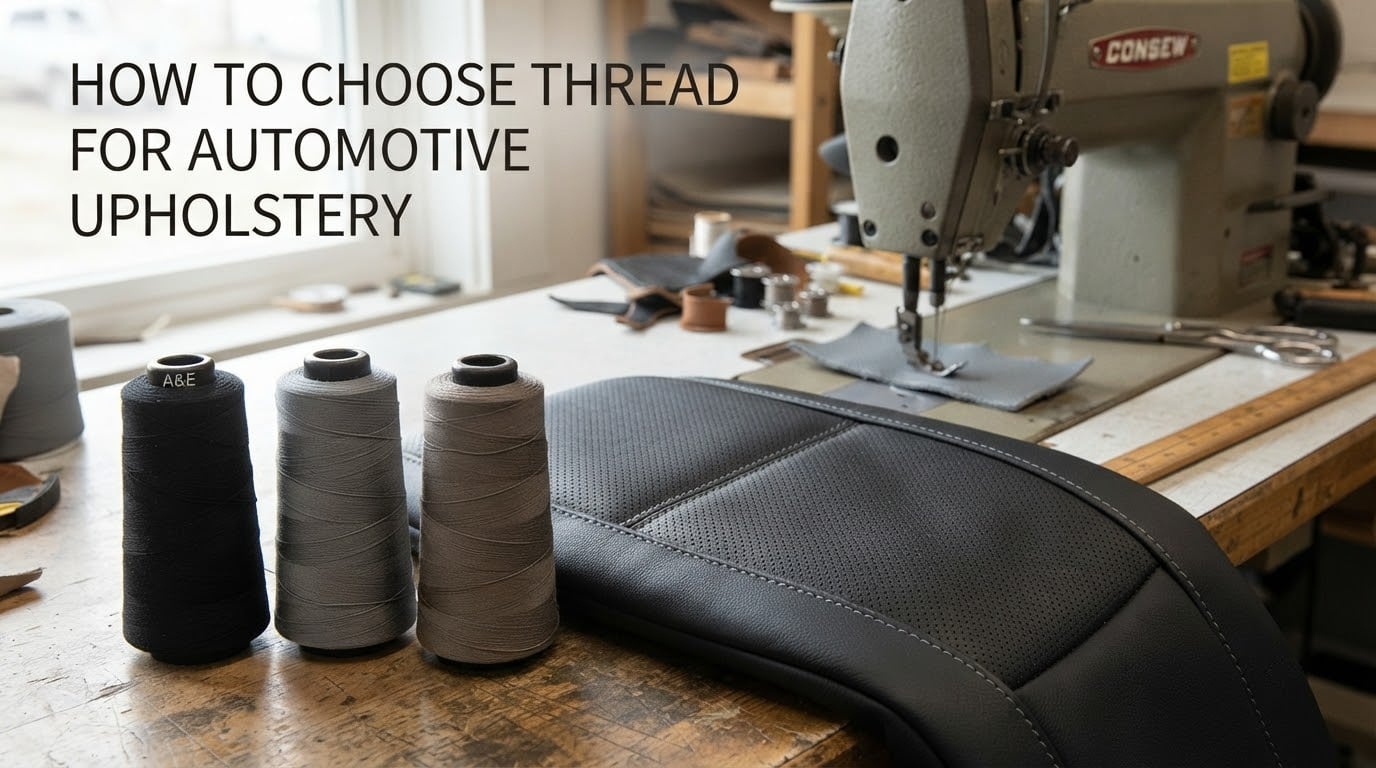
If you have ever pulled apart a car seat to find shredded thread hanging from the seams, you already know the answer to how to choose thread for automotive upholstery: not all thread is equal, and the wrong spool turns a weekend project into a do-over. After thirty years of cutting, sewing, and replacing automotive interiors at our shop, our team has watched the same pattern repeat itself. People buy what looks like strong thread at the local fabric store, run it through a home machine, and within a season the seams give up.
Automotive interiors are brutal on stitching. Heat cycles above 140 degrees Fahrenheit, constant UV exposure, sweat, abrasion from sliding in and out, and the flex of foam under your body all attack the thread first. Pick the wrong fiber, size, or finish and the seam fails long before the fabric wears out. Pick the right one and the work you do today will still look crisp years from now.
This guide walks through everything we use to make that call on real vehicles, daily drivers, classics, and customs. You will learn how to read thread sizing, why UV resistance matters more than most beginners think, and which pairing of needle and tension gives clean seams on vinyl, cloth, and leather. Whether you are sewing one seat or restoring a full interior, the same selection logic applies.
Table of Contents
- Understanding Automotive Upholstery Thread
- Bonded Nylon vs Bonded Polyester vs UV-Treated Polyester
- Thread Sizing Guide: Tex, Commercial, and Government Sizes
- Choosing Thread by Automotive Material
- UV Resistance: Why It Matters for Sun-Exposed Interiors
- Machine Setup: Needles, Tension, and Stitch Length
- Top-Stitching vs Structural Seaming
- Troubleshooting Thread Issues
- Brand Landscape and Buying Tips
- Frequently Asked Questions
- Conclusion
Understanding Automotive Upholstery Thread
Automotive upholstery thread is a heavy-duty, bonded synthetic thread, typically nylon or polyester, designed to withstand abrasion, UV exposure, and the constant flexing of car seats and interior trim. Standard household thread is engineered for cotton shirts and curtains, not for the punishment a car seat takes over a decade of use.
The word bonded matters. Bonding is a heat-and-adhesive process that fuses the individual filaments together and seals the thread surface with a protective coating. That coating does three things at once. It reduces friction as the thread passes through the needle eye and fabric. It prevents fraying when you cut a length and start sewing. It maintains a consistent diameter so tension stays even across long seams.
Beyond bonding, automotive thread is rated for tensile strength, which is the pounds of pull the thread can handle before snapping, and for abrasion cycles, sometimes called double-rub count. Higher numbers on both ratings mean the thread survives more stress before failing. The thread you choose should match the stress of the seam, not just the color of the fabric.
Finally, look for UV inhibitors. Standard polyester and nylon break down under sustained sunlight. UV-treated thread is built for convertibles, sunroofs, and any car that lives outdoors. Skipping this step is the number one reason custom interiors look tired after a few summers.
Bonded Nylon vs Bonded Polyester vs UV-Treated Polyester
The three most common automotive thread families each have a clear personality. Picking the right one depends on what you are sewing and where the car lives.
Bonded Nylon Thread
Bonded nylon, especially the Nylon 6,6 grade, is the traditional favorite for upholstery. It is soft, pliable, and offers excellent tensile strength with very high abrasion resistance. Nylon flexes with the foam and fabric, which makes it forgiving on seams that move a lot, like seat bolsters and door panel pulls.
The trade-off is UV sensitivity. Plain nylon thread fades and weakens faster than polyester when exposed to direct sun. For interiors that are mostly shaded, or for projects where the thread sits hidden under a flap, bonded nylon is hard to beat. For convertibles, sunroofs, or cars in Arizona, Texas, or Florida, you want to upgrade.
Bonded Polyester Thread
Bonded polyester brings the abrasion resistance and tensile strength of nylon, plus much better UV stability. The color holds longer, and the thread keeps more of its strength after thousands of hours of sunlight. Polyester is also slightly less elastic than nylon, which can be a benefit on seams that need to hold a precise shape rather than stretch with the foam.
Most modern automotive shops we work with reach for bonded polyester as the everyday default. It performs on vinyl, leather, and cloth, and it tolerates the heat inside a parked car on a summer afternoon. If you only want to buy one type of thread for general automotive work, this is the one.
UV-Treated Polyester Thread
UV-treated polyester is polyester with extra inhibitors built into the fiber or applied as a finish. The result is the strongest sunlight resistance available in a bonded sewing thread. Reviewers on r/Autoupholstery consistently recommend UV bonded polyester size 92 for top-stitching on cars that see real sun.
For most daily-driver interiors, regular bonded polyester is enough. For convertibles, classic cars without tinted glass, work trucks with bench seats, and any car parked outside year-round, the small upgrade to UV-treated polyester pays off in seams that still hold color five years later.
Thread Sizing Guide: Tex, Commercial, and Government Sizes
Thread sizing is where most beginners get lost. The same spool can carry three different numbers depending on the system the manufacturer uses. Once you understand the three systems, you can shop across brands without guessing.
Tex is the most straightforward. Tex is the weight in grams of 1000 meters of thread. Higher Tex means thicker, stronger thread. Tex 70 is a mid-weight upholstery thread, Tex 90 is heavier, and Tex 135 is for very thick leather and heavy industrial work.
Commercial sizes (sometimes called ticket numbers) are the traditional sizes you see on upholstery cones. Size 69 is the everyday workhorse, used for most automotive seams on home and prosumer machines. Size 92 is the heavier option for top-stitching, vinyl, and structural seams that need to look bold. Size 138 sits at the heavy end for true leather and saddle work.
Government size (size A, B, or similar) is the older U.S. military sizing. Most modern retail thread uses Tex or commercial numbers, but government sizes still appear on some industrial spools.
For automotive upholstery work, the practical shortlist is small. Size 69 covers most seams on cloth and lighter vinyl. Size 92 is the right choice for vinyl seats, leather bolsters, and visible top-stitching. Size 138 is reserved for very thick leather, convertible top binding, and similar heavy-duty applications. Going heavier than you need crowds the seam and adds bulk that punches through foam, so match size to material rather than defaulting to the biggest spool.
Choosing Thread by Automotive Material
The best thread for one material can be the wrong choice for another. Here is how we match thread to the three most common automotive surfaces.
Thread for Vinyl Upholstery
Vinyl is unforgiving. Needles punch through it instead of sliding between fibers, which means the thread has to handle repeated penetration without fraying. Bonded nylon or bonded polyester in size 69 works well for hidden seams. For top-stitching on vinyl seats and door panels, size 92 in bonded polyester gives the visual weight that matches the material thickness.
Avoid cotton-wrapped polyester core thread on vinyl. The cotton sleeve absorbs moisture and breaks down faster than the vinyl around it. Stick to all-synthetic bonded thread for any vinyl project.
Thread for Leather Car Seats
Leather stretches, breathes, and demands a thread that moves with it. Bonded nylon in size 69 is a traditional choice for structural seams, where the slight elasticity reduces stress at the stitch holes. For visible top-stitching, bonded polyester size 92 holds a sharper line and resists the UV that fades leather and thread together.
When sewing leather, your needle matters as much as your thread. Use a wedge-point or leather needle, paired with thread that has a bonded or lubricated finish, so each stitch slides cleanly through the material without skipping.
Thread for Cloth Interiors
Cloth is the most forgiving automotive material. Woven and knit fabrics grip the thread, so seam strength depends less on a heavy thread and more on stitch density. Size 69 bonded polyester handles almost every cloth application, from seat inserts to headliner panels. For decorative top-stitching on cloth door pulls or shift boots, size 92 in a contrasting color gives you the visible stitch line without overwhelming the material.
UV Resistance: Why It Matters for Sun-Exposed Interiors
UV is the silent killer of automotive thread. A car parked in the sun reaches surface temperatures well above 130 degrees Fahrenheit on the seats and door panels, and UV light breaks down the molecular bonds in standard polyester and nylon over time. The first sign is fading, then brittleness, then sudden seam failure long before the fabric wears out.
This matters most in three situations. Convertibles, where the entire interior sees direct sun. Cars without windshields or with removed tops for show. And daily drivers parked outside in sunbelt states. For these builds, UV-treated polyester is not an upgrade, it is the baseline.
UV inhibitors work by absorbing or reflecting the damaging wavelengths before they reach the polymer chain. Treated thread keeps its color and strength through years of exposure where untreated thread would have failed. Reviewers on theupholsteryforum.com confirm this: vehicles reupholstered with UV bonded polyester still hold their seams after years in convertibles, while untreated thread fails within two to three seasons.
One practical tip. If you cannot source UV-treated thread for a quick repair, at minimum choose bonded polyester over bonded nylon for sun-exposed seams. Polyester has inherently better UV stability, and the bonded coating adds another layer of protection.
Machine Setup: Needles, Tension, and Stitch Length
The best thread in the world fails on a poorly set up machine. Our team spends as much time dialing in the machine as choosing the thread, because the two work together. Here is the setup sequence we use on every automotive project.
Needle Selection
Match the needle to the thread, not the other way around. Size 69 thread pairs with a 100/16 needle for most automotive work. Size 92 thread pairs with a 110/18 needle. Size 138 thread needs a 125/20 or larger leather needle. Going too small crowds the thread in the eye and causes shredding. Going too large leaves visible holes in cloth and lighter vinyl.
For leather and heavy vinyl, use a wedge-point or cutting point needle designed to slice between fibers. For cloth and woven materials, use a sharp or microtex needle that penetrates cleanly. Replace the needle at the start of every project, and again after eight to ten hours of sewing, because a dull needle frays thread and tears fabric.
Tension Adjustment
Set the top tension by pulling the upper thread with the presser foot lifted. Movement should feel even and smooth, neither tight nor loose. Then sew a 4-inch test seam on scrap material that matches your project fabric. Look at both sides of the seam. Balanced tension shows the same small loop pattern on the top and bottom. If loops appear on the bottom, the top tension is too loose. If the top thread pulls flat or puckers the fabric, the top tension is too tight.
For size 92 thread on vinyl or leather, expect to reduce your usual top tension by a quarter to a half turn compared to all-purpose sewing. Heavy thread needs more room to move through the tension discs without binding.
Stitch Length
For most automotive seams, a stitch length of 8 to 10 stitches per inch (SPI), which is roughly 2.5 to 3 mm per stitch, gives the right balance of strength and flexibility. For top-stitching on vinyl or leather, drop to 6 to 8 SPI (3 to 4 mm per stitch) for a visible, decorative line. For very thin headliner material or cloth, stay at 10 to 12 SPI for a clean, low-profile seam.
Forum members on theupholsteryforum.com often cite 1/8 inch (about 3 mm) as the go-to stitch length for size 92 top-stitching on automotive vinyl. That figure lines up with our shop practice. The exact length is less important than testing on scrap first and checking that the seam looks balanced and lies flat without gathering.
Top-Stitching vs Structural Seaming
Not every seam has the same job, and choosing thread weight by the role of the seam prevents both weak construction and overbuilt, bulky stitching.
Structural Seams
Structural seams carry the load. The seam that holds a seat cover to the foam, the seam that anchors a headliner to the board, and the seam that attaches a door panel to the underlying frame all need strength first and visibility second. For these, size 69 bonded polyester or bonded nylon in a color matched to the back of the fabric is the right choice. You can run the same thread in the bobbin and the top, which simplifies setup and ensures balanced tension.
Top-Stitching
Top-stitching is decorative and structural at the same time. It carries some load, but its main job is visual: it defines the seat shape, highlights the panel breaks, and signals quality. For top-stitching on automotive vinyl and leather, size 92 in a contrasting or matching color is the industry standard. The thicker thread reads as a deliberate design choice and stands up to the abrasion of sliding in and out of the seat.
When choosing top-stitching thread, the rule is simple. Match the thread weight to the visual weight of the design. Heavy diamond pleats call for size 92 or larger. Subtle single rows on cloth door panels can carry size 69 without looking thin.
Troubleshooting Thread Issues
Even with the right thread on paper, real automotive materials throw curveballs. Here is how our team solves the most common problems.
Thread Breakage
If the thread keeps snapping, work through this list in order. First, check the needle. A dull or wrong-sized needle shreds thread faster than anything else, and replacement is the cheapest fix. Second, check the thread path. Look for burrs on the needle plate, the bobbin case, or any thread guide that the thread rubs against on the way to the needle. Third, recheck tension. Too tight a top tension snaps thread on every stitch. Fourth, confirm the thread is actually bonded and rated for automotive use. Regular all-purpose thread will break under automotive loads no matter how perfectly the machine is set up.
Fraying or Shedding
Fraying usually means the bonded coating has worn off or the thread is the wrong fiber. Bonded thread can lose its coating if it sits on a shelf too long or near heat. Test by pulling a length sharply between your hands. A properly bonded thread resists fraying. A coating failure shows loose fibers immediately. Replace the spool and clean the thread path to remove any residue left behind.
Skipped Stitches
Skipped stitches almost always come down to needle and timing. The needle may be too small for the thread, too dull for the material, or the wrong type for what you are sewing. Replace the needle first. If skips continue, check the needle orientation and hook timing on a heavier machine. For home machines, staying within the manufacturer recommended thread weight range prevents most timing issues before they start.
Bobbin Thread Showing on Top
If the bobbin thread is pulling up to the top of the seam, the top tension is too loose or the bobbin tension is too tight. Start by increasing the top tension in small increments and retesting. If the problem persists, check the bobbin case for lint and wear, and confirm the bobbin is wound evenly and inserted the right way for your machine.
Brand Landscape and Buying Tips
The brand matters less than the specifications, but reputation does tell you something about consistency. Look for thread that lists Tex, size, bonded status, and UV treatment clearly on the label. Suppliers who specialize in marine and automotive textiles tend to stock thread matched to the same durability standards you find in those industries, which is a step up from generic all-purpose thread.
When you find a brand and color that works, buy in bulk. Thread is one of the cheaper line items on any upholstery project, and running out mid-seam is a productivity killer. Most bonded automotive thread is sold on cones of 1500 to 6000 yards, which covers multiple full interiors at a much lower cost per yard than small spools.
One more buying tip from experience. Color matching varies more than you would expect between brands. Order a sample or color card before committing to a large cone, especially for visible top-stitching on a custom interior. The thread that looks “ivory” on one card can read “cream” on another, and that difference becomes obvious on a finished seat.
Frequently Asked Questions
What type of thread is best for upholstery?
Bonded nylon and bonded polyester are the two best thread types for automotive upholstery. Bonded nylon offers excellent flexibility and tensile strength, while bonded polyester adds superior UV resistance and color hold. For most automotive work, bonded polyester is the everyday default. For convertibles and sun-exposed interiors, choose UV-treated bonded polyester for the longest service life.
Can you use upholstery thread in a regular sewing machine?
Yes, but with limits. Home sewing machines can run size 69 bonded upholstery thread with a 100/16 needle for lighter projects like cloth door panels and headliners. Size 92 thread usually requires a heavy-duty home machine or a small industrial machine. Always sew a test seam on scrap material first, replace the needle for the project, and reduce top tension slightly to give the heavier thread room to move through the tension discs.
What kind of thread do you use for boat upholstery?
For boat upholstery, use UV-treated bonded polyester in size 69 for structural seams and size 92 for top-stitching. Marine environments add constant sun, salt, and moisture exposure that breaks down standard thread quickly. UV-treated polyester with a bonded coating resists all three and matches the marine-grade vinyl and fabric used on most boat interiors.
What size needle for automotive upholstery thread?
Match the needle to the thread size. Size 69 thread pairs with a 100/16 needle. Size 92 thread pairs with a 110/18 needle. Size 138 thread needs a 125/20 or larger wedge-point needle for leather and heavy vinyl. Replace the needle at the start of every project and after every eight to ten hours of sewing to prevent fraying and skipped stitches.
Do I need UV resistant thread for my car interior?
You need UV resistant thread if your car is parked outside regularly, has a convertible top or sunroof, or lives in a hot, sunny climate. UV inhibitors prevent the fading and brittleness that cause seam failure after a few summers. For garage-kept classics and shaded interiors, regular bonded polyester provides enough protection for most projects.
Conclusion
Choosing the right thread for automotive upholstery comes down to four decisions: bonded or not bonded, nylon or polyester, the right size for the material, and UV treatment when the car lives in the sun. Match those four to the seams you are sewing and the project will outlast the fabric around it.
Before you cut a single piece of material, order thread samples, sew test seams on scrap, and confirm tension, stitch length, and needle choice on the actual fabric. That twenty-minute investment saves hours of rework later. Our team has watched countless DIY projects succeed or fail on that one step alone.
Pick up bonded polyester in size 69 and size 92, add a 100/16 and 110/18 needle to your kit, and you are equipped for almost every automotive interior you will face this 2026. For convertibles and outdoor builds, upgrade to UV-treated polyester. The seams you sew today should still look sharp the next time you open the door.