
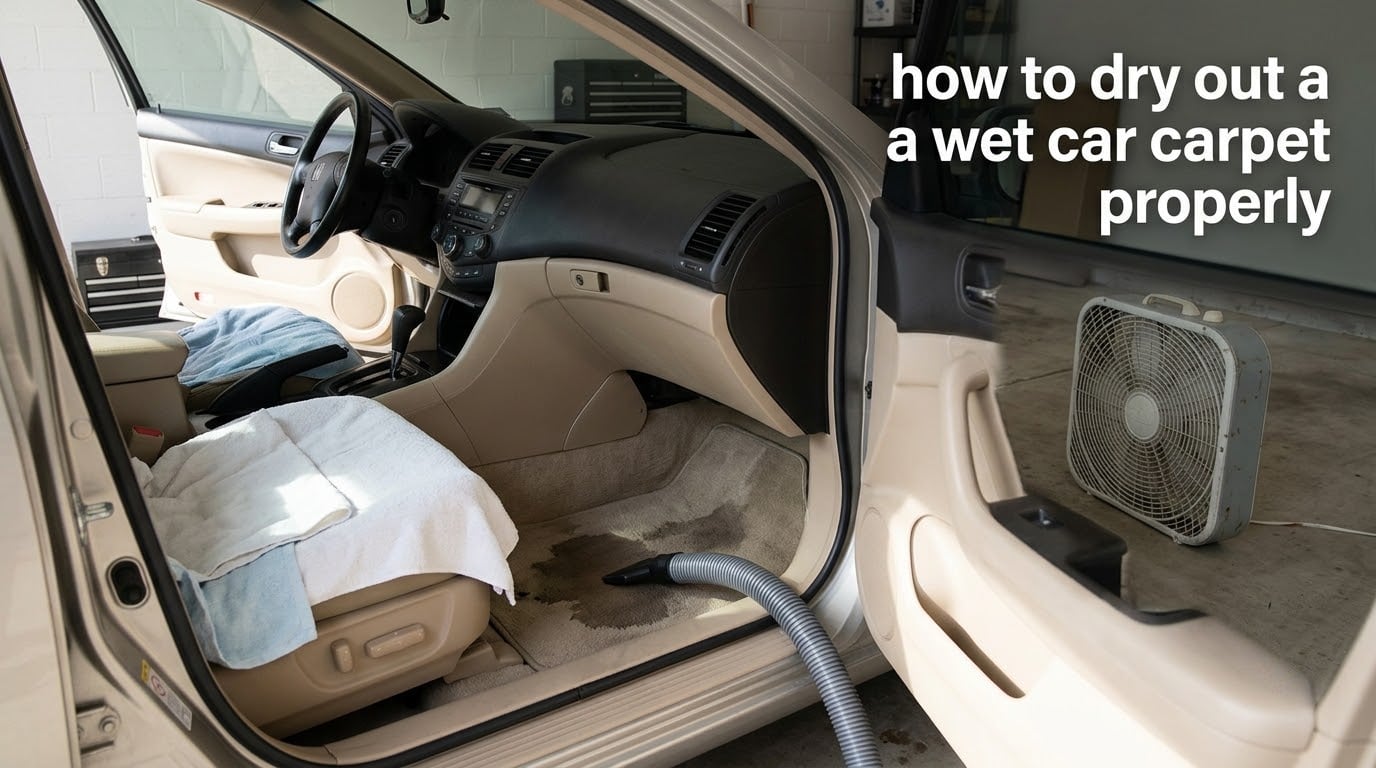
If your car carpet is soaked after a spill, a flooded street, or a slow leak you just noticed, you are on the clock. Moisture that lingers under the carpet turns into mildew, a sour smell, and sometimes electrical gremlins that cost far more than a wet vac ever would. Knowing how to dry out a wet car carpet properly — and doing it within the first 24 hours — is the difference between a fresh-smelling interior and a costly restoration bill.
I have helped friends pull soggy padding out of three different cars over the years, and the pattern is always the same: extract water fast, get air moving, and never let the foam backing stay damp for more than a day. This guide walks through the exact sequence I use, the tools that actually move the needle, and the safety pitfalls most forum posts skip.
Table of Contents
- Why Wet Car Carpet Needs Immediate Attention
- What Causes a Wet Car Carpet
- Safety First: Cars and Water Don’t Mix
- Quick-Start Checklist (First 30 Minutes)
- Step-by-Step: How to Dry Out a Wet Car Carpet Properly
- Tools and Supplies You Will Need
- Drying Methods Compared: Air, Sun, Heat, and Dehumidifier
- How to Reach the Padding Under the Carpet
- Mold and Mildew Prevention After Drying
- When to Call a Professional Detailer or Restoration Service
- Preventive Tips to Keep Your Car Carpet Dry
- Frequently Asked Questions
- Final Thoughts on Drying a Wet Car Carpet
Why Wet Car Carpet Needs Immediate Attention
A wet car carpet is more than a soaked floor mat. The carpet you see on top usually sits over a foam-backed pad and a thin sheet of sound deadening. Together those layers can hold several liters of water, even when the top fabric feels only damp to the touch. Trapped moisture becomes a breeding ground for mold spores within 24 to 48 hours, and once that musty smell sets in, it is famously hard to remove.
Wet carpet also accelerates rust on the floor pan, fouls the cabin air filter, and can short out wiring for seat heaters, airbag sensors, and the ECU if water pools beneath the carpet long enough. That is why car trim specialists in places like rainy climates treat any wet carpet as a same-day job, not a weekend project.
The good news: if you act within the first few hours, drying a wet car carpet is a job you can finish at home with tools you probably already own. This guide shows you exactly how.
What Causes a Wet Car Carpet
Before you start drying, it helps to identify how the water got in. The source changes your cleanup plan, especially when deciding whether to remove seats or trace a recurring leak.
Spills and accidents. A tipped drink, an umbrella left open, a leaking grocery bag — these are the most common causes of a wet car carpet. The spill usually sits on top of the carpet and the floor mat, so it is the easiest case to dry.
Flooded street or parking spot. Driving through standing water can push water past the door seals and into the cabin. Mechanics on forum threads like PriusChat report water creeping in around door sills and pooling under the carpet like a waterbed. The volume here is large and the water often reaches the padding.
Clogged AC drain. A blocked evaporator drain is a quiet culprit. Water backs up under the passenger side carpet, and the only symptom most drivers notice is dampness or a sweet smell coming from the vents. This is one of the most common wet carpet causes in humid climates, and a 5-minute fix once you find the drain.
Failed door or trunk seals. Worn weatherstripping lets rain seep in along the rocker panels and accumulate in the rear footwell. If your carpet is always wet behind the seat after rain, the door or trunk seal is the first place to inspect.
Heater core leak. A leaking heater core produces damp carpet on the front passenger side and a sweet coolant smell. This one demands a mechanic, but you still need to dry the carpet after the repair.
Safety First: Cars and Water Don’t Mix
Before you touch a single towel, treat the car as a hybrid of an electrical box and a chemistry set. Water in the wrong place can quietly trigger airbag warning lights, corrode the ECU, or rust a brake line from the inside out.
Disconnect the battery if water reached the carpet deeply. If water seeped under the carpet near the driver or passenger footwell, the seat position sensor, seat heater, and airbag wiring are sitting in liquid. Pop the hood and remove the negative battery terminal before you start working. You will lose radio presets, but you will not short a control module.
Never crank a wet car seat through full movement. Power seats have motors under the carpet. Moving them through full travel while wet can pull water into the motor. Disconnect the seat connector under the seat if you plan to run the seat motor while drying.
Skip the household hair dryer on large areas. A hair dryer can hit temperatures that warp plastic trim and singe carpet fibers, especially when held in one spot for too long. Save it only for small touch-ups on a low setting, and keep it moving.
Skip open flames and engine-on heaters. Any combustion heater in an enclosed garage adds carbon monoxide. If you want heat, use a space heater or run the car outside with a garage door wide open.
Mind the airbag sensors. Many cars have crash sensors under the front seats. If your carpet is wet enough that you suspect the sensors have been submerged, mention it to a body shop before reconnecting the battery.
Quick-Start Checklist (First 30 Minutes)
If your car carpet is wet and you only have half an hour, work through these steps in order. Each one removes water or buys you time before the mold clock starts ticking.
- Pull floor mats out and stand them on edge outside to drain.
- Soak up standing water with old towels, pressing firmly for 10 seconds per pass.
- Vacuum with a wet/dry shop vac on wet mode if you have one.
- Crack two opposite windows about an inch to create airflow.
- Point one box fan across the footwell from outside the open door.
- Sprinkle baking soda lightly over the damp area to start soaking up odor.
- Set a dehumidifier in the cabin if you have one, with doors open.
- Return in 4 hours to swap towels and check for the musty smell.
This checklist alone solves most small spills. For deeper water under the padding, keep going.
Step-by-Step: How to Dry Out a Wet Car Carpet Properly
The full drying process breaks into four clean phases. Done in order, they cover everything from a coffee spill to a flood-soaked footwell.
Extract Standing Water
Start by removing every drop you can physically lift, because evaporation alone will take days if you let standing water sit under the carpet. Press clean towels into the wet area and weight them down for 30 seconds; lift, move the towel, repeat.
If you own a wet/dry shop vac, run it now. Switch the filter to a foam or washable cartridge — a paper filter will clog on the first pass and may even shed into the carpet. Move the nozzle slowly across the surface, overlapping strokes the way you would vacuum dry carpet, and dwell on the edges where water migrates first.
For deep water under the carpet, a carpet extractor is the single most useful tool. Detailers use them because they spray clean water into the carpet and immediately vacuum it back out, dragging embedded moisture with it. A homeowner can rent a small extractor from most equipment rental shops for a day.
Remove Floor Mats and Seats
Floor mats hold water against the carpet and slow drying by an order of magnitude. Pull them out, drape them over a railing, and let them drain and air dry separately.
If the water reached the padding, the next move is the front seats. Most seats are held by four bolts at the corners. Disconnect the battery first, then unbolt, slide the seat back, and unplug the seat connectors. You can usually leave the seat base in place for minor spills, but for a true flood, getting both front seats out gives you clean access to the carpet underneath.
Rear seats usually release from one of two points: a pair of emergency pull latches at the bottom of the seat cushion, or a pair of hand-release straps on the rear of the seatback. Your owner’s manual lists the exact locations. Lay the seats on a tarp in the garage so you don’t soak the floor.
Lift the Carpet Edges
Once seats are out, you can finally lift the carpet corners and see what you are dealing with. Start at the door sill, where the carpet tucks under a plastic trim piece. Pull the sill trim up gently with a plastic trim tool — a flathead screwdriver works in a pinch but can scuff the sill.
Roll the carpet back toward the center of the cabin. This exposes the foam padding and the floor pan. You will often see water pooled directly on the metal; that is the water you could not feel from above. Sponge it up with towels, then run the wet vac across the metal floor.
CorvetteForum members dealing with the same problem found that propping the carpet up with small blocks of wood keeps the foam away from the wet metal, which lets both sides dry at the same time. A few 1-inch cubes of scrap wood under each lifted edge work fine.
Speed Up Evaporation
With extraction done and the carpet lifted, evaporation is the only step left. You are not just drying the surface — you are drying the foam backing, the sound deadening, and the floor pan.
Open every door and at least one window on the opposite side of the cabin. Stagger airflow is dramatically faster than airflow from one direction. A single box fan placed on the ground pointing into the wet footwell will move serious volume.
Sunlight is free heat that you should not waste. If you have a driveway that catches morning sun, open the doors and let the car bake for a few hours. Combine sunlight with a fan and you can shave drying time by half compared to a closed garage.
A dehumidifier pulls moisture out of the air and out of the wet carpet simultaneously. The community-tested benchmark from forum owners is roughly a 90 percent improvement after one overnight run with a mid-size dehumidifier inside the car with doors cracked. Empty the reservoir or run a drain hose to a bucket so it does not shut off.
Allow at least 24 to 48 hours of active airflow before closing everything up. If you reassemble the interior while the padding is still cold and clammy to the touch, you will trap mold and the smell will come back within a week.
Tools and Supplies You Will Need
Here is a focused kit that covers every step above. Most of it is stuff you already own; the rest can be borrowed or rented for less than the cost of a single detail shop visit.
- Wet/dry shop vac with foam filter (or rent a carpet extractor)
- Box fan or two, plus an outdoor-rated extension cord
- Dehumidifier, mid-size or larger, with a drain hose
- Microfiber towels and old bath towels
- Baking soda (army-sized box) and white vinegar in a spray bottle
- Plastic trim removal tools or a wide flathead screwdriver
- Socket wrench set for the seat bolts
- Rubber gloves and a dust mask for the dirty water phase
A useful upgrade is a moisture meter. The cheap pin-style meters sold at hardware stores read moisture in wood and fabric. They remove all guesswork about whether the padding is actually dry before you reassemble.
Drying Methods Compared: Air, Sun, Heat, and Dehumidifier
Not all drying methods are equal. The table below summarizes speed, effort, and the situations where each one shines. Pick the method that matches how wet the carpet actually is, not how wet it feels.
| Method | Best For | Drying Time | Effort Level |
|---|---|---|---|
| Towels + wet/dry vac | Surface spills and small floods | 1 to 4 hours for surface | Low |
| Open doors + sunlight | Mild dampness on a sunny day | 6 to 12 hours | Low |
| Box fan + open windows | Moderate water, no sun | 12 to 24 hours | Low |
| Dehumidifier inside cabin | Water in padding, slow leaks | 24 to 48 hours | Medium |
| Carpet extractor (rented) | Deep water under padding | Cut drying time by half | Medium |
| Professional flood drying | Standing water for days, sour smell | 2 to 5 days | Paid service |
For most home jobs, the right answer is a wet/dry vac for extraction, followed by a fan plus dehumidifier for finishing. Sunlight is a free bonus on top.
How to Reach the Padding Under the Carpet
The part you cannot see is the part that causes the most problems. Foam-backed padding sops up water like a sponge and holds it for days; rubber-backed padding sheds water faster but traps it between the rubber and the floor pan.
Foam-Backed Carpet
Foam padding is the most common type in modern cars. It feels soft underfoot, but it soaks up water quickly and slowly releases it. Once the top carpet looks dry, the foam underneath may still be saturated. This is the exact issue raised on the r/CarsIndia thread where the owner had pulled the carpet out but the foam padding could not be removed.
To dry foam-backed padding without removing it, focus on two things: aggressive airflow across the entire surface, and a dehumidifier running for 24 hours. If the carpet is still cool and clammy to the touch the next morning, give it another 24 hours before reassembly.
If the foam padding is removable — usually on older cars where it is glued at the edges rather than fully bonded — pull it out, hang it over a railing in the sun, and let it dry like laundry. A wet piece of foam in the sun on a breezy day can dry in 4 to 6 hours.
Rubber-Backed Carpet
Rubber-backed carpet, more common on economy and fleet vehicles, is easier to dry in one sense: the rubber does not absorb water. The water sits on top of the rubber and runs off when you lift the carpet. The catch is that the trapped water between the rubber and the floor pan has nowhere to go. Wipe the floor pan dry, lift the carpet edges with wood props, and run a fan underneath until the metal is no longer cold to the touch.
Mold and Mildew Prevention After Drying
Even a fully dry carpet can grow mildew later if a small pocket of moisture stays trapped. Prevention is mostly about neutralizing spores before they have a head start.
After the carpet is dry to the touch, do a vinegar pass. Mix equal parts white vinegar and water in a spray bottle and mist the damp-prone areas lightly. Vinegar is acidic enough to knock down surface mold spores and neutralize musty smells without leaving a residue. Let it air dry.
For lingering odors, baking soda is the go-to. Sprinkle it generously over the carpet, work it in gently with a brush, and leave it overnight. Vacuum it up the next morning. Repeat for any spot where the smell persists. Forum owners have reported that a Nutra Air aerosol spray is a useful follow-up after baking soda for stubborn cases.
If a black or green spot shows up on the carpet backing or the floor pan after drying, do not paint over it. Treat the area with a dedicated automotive mold remover, dry again, and check the surrounding foam for moisture before reinstalling.
When to Call a Professional Detailer or Restoration Service
Drying at home is great for the first 24 to 48 hours. After that, professional tools start to make more sense. Pull in a pro if any of these situations match yours.
- Standing water sat under the carpet for more than 48 hours
- The sour or mushy smell is still strong after one round of drying
- The airbag, seat heater, or check-engine light comes on after the water event
- The carpet padding is bonded to the floor pan and cannot be lifted
- You see any sign of rust forming on the floor pan
- The car was submerged past the door sills, not just damp inside
A flood restoration shop has truck-mounted extractors, heated air movers, and commercial dehumidifiers that pull moisture out of foam and padding in hours, not days. They also know how to inspect airbag sensors and seat modules for water damage. If you smell something sweet and see steam from the vents, that is a heater core issue, not a drying job — call a mechanic.
Preventive Tips to Keep Your Car Carpet Dry
Once the carpet is dry and back in, a few small habits keep it that way and prevent the next emergency.
Clean the AC evaporator drain once a year. The drain hole is usually under the passenger side of the firewall, on the outside of the car, and a flexible wire or pipe cleaner clears it in seconds. A clear drain keeps AC condensation from pooling under the passenger carpet.
Inspect door and trunk weatherstripping every spring. Worn seals are easy to spot — pinching a weatherstrip with your fingernail should leave a visible impression. Replace any seal that feels hard, cracked, or permanently compressed.
Vacuum the carpet thoroughly every month. A clean carpet absorbs less water because there is no loose dirt holding moisture against the fibers.
Carry a small microfiber towel and a trash bag. Spills are mostly survivable when you can blot them in the first 60 seconds.
Park on higher ground in heavy rain. If your street floods, even a few inches of elevation can keep water out of the cabin.
Frequently Asked Questions
What to do if your car carpet is wet?
Pull the floor mats out, soak up standing water with towels, then vacuum with a wet/dry shop vac. After extraction, crack the windows, point a box fan into the footwell, and run a dehumidifier in the cabin for 24 to 48 hours.
What absorbs water from car carpet?
Microfiber towels, old bath towels, and thick paper shop towels pull standing water out of carpet fast. For the moisture trapped in the foam padding underneath, baking soda absorbs and deodorizes while a dehumidifier pulls moisture out of the air.
How to draw moisture out of car carpet?
After towel-blotting and wet-vacuuming the surface, lift the carpet edges at the door sills to expose the foam padding. Run a box fan across the wet area and place a dehumidifier in the cabin with the doors cracked so moist air can escape.
How to dry out a wet carpet fast?
Vacuum up as much water as you can with a wet/dry shop vac first, then combine three things at once: open two opposite windows for cross-ventilation, point a box fan directly at the wet spot, and run a dehumidifier on the highest setting. Sunlight through open doors speeds things up even more.
How long does it take to dry a wet car carpet?
A surface spill dries in 4 to 12 hours with a fan. Water that reaches the foam padding takes 24 to 48 hours of active airflow and dehumidifier use. A truly flooded footwell can take 2 to 5 days to dry completely, even with professional equipment.
How do you get the smell out of wet car carpet?
After the carpet is dry, mist the area lightly with a 50/50 mix of white vinegar and water, let it air dry, then sprinkle baking soda generously over the carpet, leave it overnight, and vacuum it up. Repeat for any spot where the musty smell persists.
Final Thoughts on Drying a Wet Car Carpet
Learning how to dry out a wet car carpet properly comes down to three habits: extract first, ventilate second, and never reassemble the interior while the padding still feels cool to the touch. Surface spills are a single afternoon. Flooded padding is a weekend. Either way, you will end up with a fresh-smelling car and zero mold bill.
If you take one thing from this guide, take the order of operations. Towels and a wet/dry vac remove the easy water. Lifting the carpet at the door sills exposes the foam padding that holds the rest. A box fan plus a dehumidifier finishes the job that no towel can reach. Run that sequence the next time your carpet gets soaked, and you will not have to call a restoration shop.