
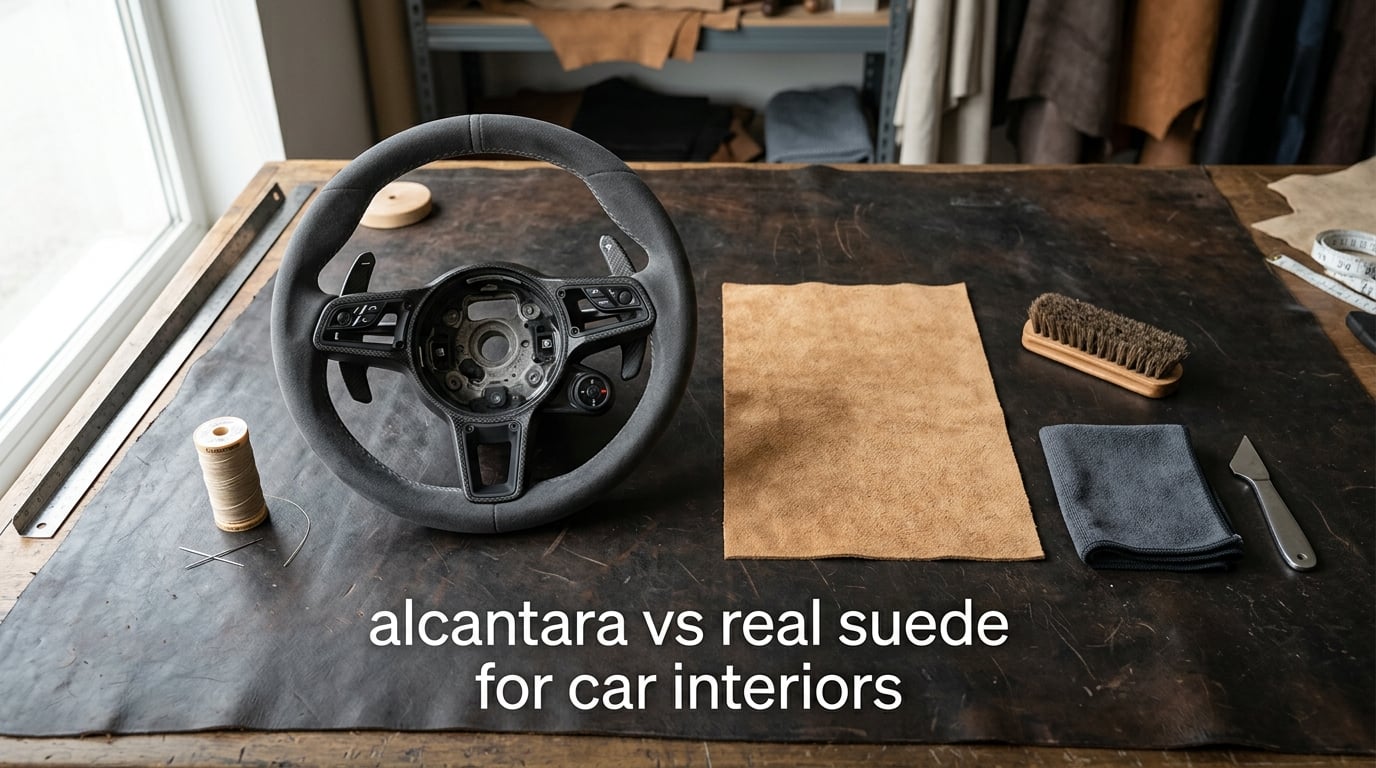
I have been trimming car interiors since 1998, and the alcantara vs real suede for car interiors question comes up almost every week in our shop. Customers want the soft, premium look of high-end performance cabins, but they are not sure which material will actually last five years of daily driving, sweaty hands, and coffee spills. After cutting, sewing, and replacing both materials in hundreds of projects, our team has strong opinions. This guide shares what we have learned so you can pick the right surface for your car.
You will get clear definitions, a side-by-side comparison, real-world durability data, cleaning protocols, and a decision framework you can use today. Whether you are upgrading a steering wheel, recovering seat inserts, or building a full custom interior, the answer usually comes down to one question: how do you actually drive?
Table of Contents
- What is Alcantara?
- What is Real Suede?
- Head-to-Head Comparison: Alcantara vs Real Suede
- Durability and Long-Term Wear
- Cleaning and Maintenance for Each Material
- Best Use Cases by Interior Surface
- Cost, Resale Value, and Environmental Impact
- How to Choose Between Alcantara and Real Suede
- Frequently Asked Questions
- What’s better, suede or Alcantara?
- Which is more expensive, Alcantara or suede?
- What are the downsides of Alcantara?
- Which is better for a headliner, suede or Alcantara?
- Is Alcantara fake suede?
- Is Alcantara more expensive than suede?
- How long does Alcantara last on a steering wheel?
- Can you clean Alcantara with water?
- Final Verdict: Which Material Should You Pick?
What is Alcantara?
Alcantara is a proprietary synthetic material made from an interlocking blend of roughly 68% polyester and 32% polyurethane microfibers. It is needle-punched and dyed using a patented process developed in Italy, and it is manufactured only at the Alcantara S.p.A. facility. Every square inch of authentic Alcantara carries the brand’s signature touch and a registered identification stamp.
The key advantage is micro-structure. Each fiber is split so finely that the final fabric has a dense, velvety nap with millions of tiny pores per square inch. These pores trap air, which gives Alcantara its soft tactile feel and acoustic dampening quality, while also providing the grip drivers love on performance steering wheels. The same structure makes it hydrophobic (water-resistant rather than absorbent) and inherently flame retardant without chemical coatings.
Alcantara is not generic microsuede. Cheap microsuedes often use a polyester base with a brushed surface treatment, and they tend to pill, flatten, and shine within a year on steering wheels. Genuine Alcantara has been the chosen headliner, dash, and steering-wheel material for BMW M, Porsche, Audi RS, Lamborghini, and Ferrari interiors for decades. It has also been carbon neutral certified since 2009, which matters to a growing segment of our restoration customers.
What is Real Suede?
Real suede is the natural flesh side of animal hide, most often lambskin, goatskin, or calfskin. The outer leather layer is removed, and the inner fibrous surface is buffed to create that signature soft nap. Higher-grade suede uses finer animal hides and tighter fiber structure, which is why luxury brands can charge a premium for it.
Natural suede is breathable and warm to the touch, with an organic feel that synthetic fibers struggle to fully imitate. It has been used in classic European luxury cars for decades and remains popular in vintage restorations and bespoke coachbuilt builds.
The trade-offs are physical. Suede is porous, so it absorbs water, sweat, body oils, and odors almost instantly. It also breaks down faster under UV exposure than synthetic alternatives, which is one reason automakers moved away from it for steering wheels and dashboards in the 1970s and have largely stuck with synthetic alternatives ever since.
Head-to-Head Comparison: Alcantara vs Real Suede
The table below summarizes how the two materials stack up on the attributes our customers ask about most. Read it as a quick scan, then dive into the detailed sections that follow for context.
| Attribute | Alcantara | Real Suede |
|---|---|---|
| Origin | Synthetic (polyester + polyurethane), Italian-made | Natural animal hide (lamb, goat, calf) |
| Water resistance | Hydrophobic; resists moisture and stains | Highly absorbent; water marks instantly |
| UV tolerance | High; resists fading and brittleness | Low; fades and stiffens within 2 years in direct sun |
| Grip (steering wheel) | Excellent, slight tackiness when dry | Soft but can feel slippery with sweaty hands |
| Cleaning difficulty | Moderate; specific products required | High; often requires professional cleaning |
| Durability (daily use) | 5+ years typical, longer with care | 2-4 years before visible wear on touchpoints |
| Odor absorption | Low | High; can harbor bacteria and smells |
| Vegan/ethical profile | Vegan and cruelty-free | Animal-derived |
| Eco certification | Carbon neutral since 2009 | Depends on tanning process |
| Typical surface use | Steering wheel, dash, headliner, seats | Decorative inserts, door pulls, vintage-style trim |
Durability and Long-Term Wear
When our shop tests durability, we look at three things: pilling, color shift, and grip retention. Both materials degrade differently over time.
Alcantara on steering wheels begins to show a slightly polished look on the 10-and-2 grip zone after roughly two to three years of daily use. We have seen BMW M wheels and Porsche wheels in the shop with that exact pattern. The fibers compress but rarely pill, because the micro-structure is so dense. A gentle brush with a soft-bristle brush restores the nap in most cases.
Cheap microsuede tells the same story but worse. Owners across Corvette and Toyota 4Runner forums report non-Alcantara suede inserts that looked terrible within six months: shiny, greasy, and starting to pill along seam lines. Real Alcantara simply does not behave that way under the same use conditions.
Real suede breaks down more dramatically under UV exposure. Natural fibers oxidize and lose tensile strength, which means the surface becomes brittle and the nap flattens within two to three years in a sun-exposed cabriolet or open sunroof car. We have replaced original suede headliners in classic Mercedes and Jaguar restorations where the material crumbled at the touch.
For sweat and body oils, the two behave opposite to what most customers expect. Alcantara resists absorption, so oils sit on the surface until wiped away. Real suede absorbs them, which is why older luxury car owners often notice a smell in their headliner or steering wheel after five to ten years of daily driving.
Cleaning and Maintenance for Each Material
Cleaning is where most owners get both materials wrong. Treat them the same as leather and you will damage one or both.
Alcantara Cleaning Protocol
- Vacuum the surface with a soft brush attachment on low suction.
- Dampen a microfiber cloth with warm water only. Never soak the fabric.
- Wipe gently in one direction, following the nap of the material.
- For stains, use a dedicated Alcantara cleaner per the manufacturer. Avoid all-purpose interior cleaners, leather conditioners, and anything containing silicone.
- Allow to air-dry fully, then brush the nap back up with a soft suede brush.
Real Suede Cleaning Protocol
- Allow any wet spills to dry fully before touching them; rubbing wet suede spreads the stain.
- Brush gently with a dedicated suede brush to lift dirt and restore the nap.
- For oil stains, sprinkle cornstarch or talcum powder, let it sit overnight, then brush it out.
- For serious stains, plan on a professional suede cleaning service. DIY washing almost always damages the nap.
- Apply a suede protector spray every six months for added water and stain resistance.
The takeaway: Alcantara is easier to maintain at home, but you must use the right product. Real suede tolerates less intervention, and the cost of mistakes is higher because the nap cannot be repaired once crushed.
Best Use Cases by Interior Surface
Choosing between Alcantara and real suede often comes down to where the material will live in your car. Here is the breakdown by surface.
Steering Wheel
Alcantara wins decisively here. The grip when your hands are cool is excellent, it does not become slippery with sweat the way leather sometimes does, and it absorbs less body oil. Driving gloves extend the life of any Alcantara wheel by years, which is the standard recommendation from owners on the BMW and Porsche forums. Real suede steering wheels are rare in modern cars for good reason: they wear quickly and become slick.
Headliner
For headliners, both materials work, but the choice depends on climate and how often the sun hits the roof. In convertibles or cars without tint, real suede will fade within two summers. Alcantara holds its dye and structure even under direct UV, which is why almost every modern supercar uses it for headliners. In a sealed coupe with good tint, either material can last; Alcantara still wins on resistance to spills and odors.
Seat Inserts and Bolsters
Seat inserts benefit from Alcantara’s grip. Whether you are driving a BMW M3 or a daily Civic Type R, the bolsters hold you in place during cornering. Real suede seat inserts show wear patterns within a year and absorb sweat on hot days, which is why most owners we work with eventually replace them with Alcantara.
Dashboard and Door Panels
Alcantara is the safer pick for dash pads and upper door panels, because it tolerates windshield reflection better than real suede. Real suede dashboards show UV cracks along the curve closest to the windshield within three to five years, which is a recurring complaint on enthusiast forums.
Shift Boot, Center Console, and Trim Accents
Both materials work well here because these are low-touch, low-UV surfaces. Real suede adds a vintage or coachbuilt aesthetic that synthetic cannot fully replicate. Alcantara is more consistent and easier to source.
Cost, Resale Value, and Environmental Impact
We never quote prices on website copy because they move around. What matters more for this decision is the relative cost positioning and what each material does for resale value.
Authentic Alcantara costs more per square meter than real suede at the raw-material level, but installation is similar in labor. The total custom-trim cost, including our shop labor, depends on the surface area, pattern complexity, and whether you choose a factory-matched OEM Alcantara or an aftermarket reproduction. Real suede can be cheaper at the raw level, but the cost of a sealed, color-matched, automotive-grade hide rises sharply when you specify a specific shade.
For resale value, original Alcantara holds up better because it ages more gracefully. A ten-year-old car with worn suede headliner reads as neglected; the same car with worn but intact Alcantara reads as performance-spec. We have seen this play out repeatedly in trade-in appraisals at our shop.
From an environmental angle, real Alcantara has been carbon neutral certified since 2009, and the manufacturing facility recovers and reuses solvents from the polyurethane process. Real suede is a byproduct of the meat industry, which gives it a low-waste profile for the hide itself, but the tanning process can involve heavy metals and high water use depending on the tannery. Vegan buyers and buyers with strict ESG requirements usually default to Alcantara on these grounds alone.
How to Choose Between Alcantara and Real Suede
Here is the simple framework our team uses during consultations.
- Pick Alcantara if: You drive daily, want the highest grip, sweat into the wheel on hot days, park in the sun, or plan to keep the car past five years.
- Pick real suede if: You are restoring a vintage vehicle, want an authentic natural feel, the surface is low-touch and out of direct sun, and you are willing to commit to professional cleaning when needed.
- Mix them: Many builds use Alcantara on steering wheel, shift boot, and seat inserts (high-touch, high-sun), and real suede on door pulls, headrest pillows, or decorative panels (low-touch, low-sun). This is what we recommend most often for a balance of feel, durability, and aesthetics.
If you are unsure, ask yourself three questions. Will your hands touch this surface every day? Will direct sunlight hit it? Will you be the one cleaning it? If the answer is yes to one or more, Alcantara is almost always the safer long-term pick.
Frequently Asked Questions
What’s better, suede or Alcantara?
For most daily-driven cars, Alcantara is the better choice. It grips better, resists water and stains, holds its color under UV, and tolerates sweat and body oils far better than real suede. Real suede is better suited to low-touch, low-sun surfaces in classic or vintage builds where authenticity matters more than maintenance cost.
Which is more expensive, Alcantara or suede?
At the raw-material level, real suede can cost less per square meter, while authentic Alcantara tends to be priced higher because of the patented Italian manufacturing process. Total installed cost depends on surface area, pattern, and labor. Shop estimates vary widely, so ask your trim shop for a written quote on your specific project.
What are the downsides of Alcantara?
Alcantara can shine or flatten on steering wheels after two to three years of daily use. It requires specific cleaning products; general interior cleaners and leather conditioners damage it. Heat can crush the nap on door armrests if the car sits in direct sun. Cheap microsuede knockoffs pill and look greasy within months, which often gets blamed on real Alcantara.
Which is better for a headliner, suede or Alcantara?
Alcantara is better for almost every modern headliner because it resists UV, holds dye, and does not absorb odors. Real suede works on enclosed headliners in classics with good tint, but it will fade and embrittle within two to three years in a convertible or sun-exposed coupe.
Is Alcantara fake suede?
Alcantara is not fake suede in the sense of a knockoff. It is a patented, Italian-manufactured synthetic material with its own unique micro-structure, performance properties, and environmental certifications. Cheap microsuede products are sometimes marketed as Alcantara-style, but genuine Alcantara is only made by Alcantara S.p.A. in Italy and carries a brand identification stamp.
Is Alcantara more expensive than suede?
Yes, in most retail channels authentic Alcantara carries a higher material cost than commodity real suede. The price gap narrows once you specify a high-grade, color-matched, automotive-rated suede hide, because those premium hides cost more than standard suede. Installation labor is similar for both materials.
How long does Alcantara last on a steering wheel?
On a daily-driven car, an Alcantara steering wheel typically lasts five years or more before the nap compresses noticeably on the 10-and-2 grip zone. Sim racers and BMW M owners report two to three years before the polished look appears. Driving gloves extend the lifespan significantly, and a soft brush refreshes the nap after cleaning.
Can you clean Alcantara with water?
Yes, you can clean Alcantara with water in small amounts. Use a damp microfiber cloth (never soak the fabric), wipe gently along the nap, and let it air-dry before brushing. For stains, use a dedicated Alcantara cleaner rather than all-purpose interior products or household soaps.
Final Verdict: Which Material Should You Pick?
For most owners comparing alcantara vs real suede for car interiors, Alcantara is the practical winner. It grips better, resists UV and moisture, holds its color, and tolerates the sweat, oils, and sun that come with real daily driving. Real suede still has a place in restorations and coachbuilt builds where the authentic natural look matters more than long-term maintenance, but it is a luxury reserved for low-touch, low-sun surfaces.
If you want the best of both worlds, pair them. Use Alcantara on the steering wheel, shift boot, and seat inserts, and reserve real suede for headrest pillows, door pulls, or decorative accents. You will get the natural warmth of suede without losing the grip and durability that modern driving demands. Our shop has been recommending that exact combination for nearly a decade, and our customers keep coming back with interiors that still look great at the five-year mark.