
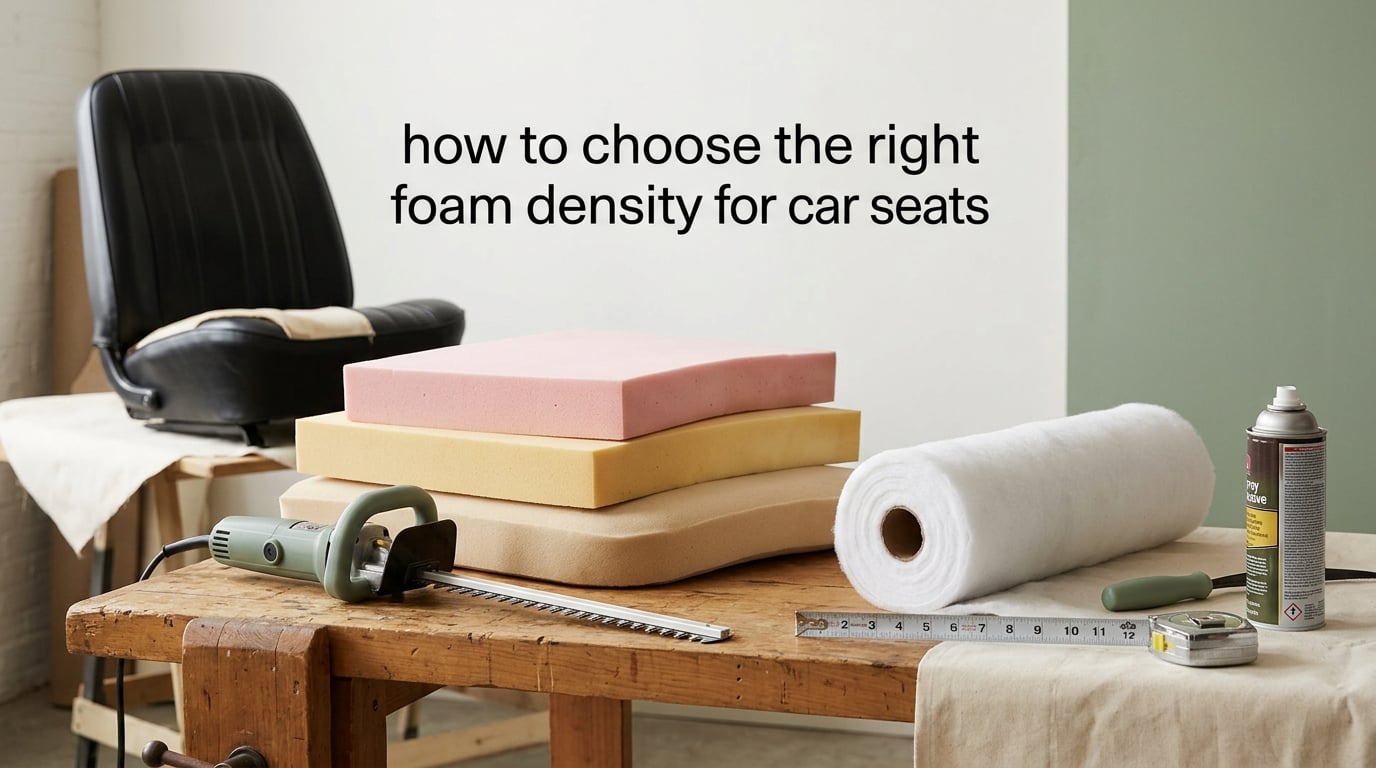
Choosing the right foam density for car seats means matching the foam’s PCF rating (typically 1.8 to 2.5 for daily drivers) and ILD firmness to your seat type, driving habits, and climate. Higher density foam lasts longer, resists sagging, and supports your body through temperature extremes that destroy furniture-grade foam within a few years.
I have been helping classic car owners and daily drivers pick seat foam for over a decade at our shop, and the most common mistake I see is people grabbing furniture foam because it is cheaper or easier to find. Automotive interiors punish foam in ways a living room sofa never does. A car’s cabin can swing from subzero mornings to 150+ degree afternoons, all while your full body weight presses into the same cushion every commute. This guide walks you through the actual numbers, foam types, and seat-specific recommendations so you buy the right material the first time.
Table of Contents
- What Is Foam Density and ILD? Core Definitions for Car Owners
- Common Foam Types for Automotive Upholstery
- Density Recommendations by Car Seat Type
- How to Measure and Choose Thickness for Car Seat Foam
- Car-Specific Factors: Temperature, UV, and Moisture
- Signs Your Car Seat Foam Needs Replacing
- DIY Replacement: Cutting, Wrapping, and Installing Car Seat Foam
- Where to Buy Automotive Foam and What to Look For
- Frequently Asked Questions
- The Bottom Line on Foam Density for Car Seats
What Is Foam Density and ILD? Core Definitions for Car Owners
Foam density is the weight of one cubic foot of foam, measured in pounds per cubic foot (PCF) or kilograms per cubic meter (kg/m3). Higher PCF numbers mean more material packed into every cubic inch, which translates directly to longer lifespan and better support. A 1.5 PCF foam feels fine on day one, but a 2.4 PCF foam will still feel supportive years later.
ILD stands for Indentation Load Deflection. It measures how much pressure it takes to compress a foam sample by 25 percent of its thickness. A low ILD (around 15 to 25) feels soft and plush. A high ILD (over 50) feels firm and supportive. Some manufacturers call this measurement IFD (Indentation Force Deflection), but it is the same test, just expressed in different units.
What Is Foam Density (PCF)
PCF tells you how heavy a cubic foot of foam is. A 1.8 PCF foam weighs 1.8 pounds per cubic foot. A 2.5 PCF foam weighs 2.5 pounds per cubic foot in the same volume. Since the volume is identical, the heavier foam contains more solid polyurethane and less air. More solid material means the cells resist breaking down longer under repeated compression.
For car seats specifically, I recommend a minimum of 1.8 PCF for daily drivers and at least 2.2 PCF for any seat that sees heavy use, such as a work truck or family hauler. Foam below 1.5 PCF is suitable for occasional furniture use but will sag in a car within the first summer.
What Is ILD and Why It Matters
ILD tells you how the foam feels when you sit on it. Two foams can both be 2.0 PCF, but one can feel like a marshmallow and the other feel like a wooden bench. The ILD rating captures that difference. For car seats, ILD between 30 and 45 tends to hit the sweet spot for most drivers.
If you want a softer, sink-in feel, look at ILD 25 to 32. If you want firmer support for long drives or back issues, look at ILD 38 to 50. Racing seats often use firmer foam in the 45 to 60 range because lateral support matters more than plush comfort.
Density vs Firmness: The Confusion Cleared
Density is quality. Firmness is feel. You can have high-density soft foam (2.5 PCF at ILD 28) and low-density firm foam (1.2 PCF at ILD 50). The high-density soft foam will outlast the low-density firm foam by years even though both feel different.
I always tell customers to pick density first based on how long they want the foam to last, then pick ILD based on how they want the seat to feel. Reversing that order leads to buying foam that feels great on day one and feels like a flat board by year three.
Common Foam Types for Automotive Upholstery
Not all foam is created equal, and the four main types you will encounter behave very differently inside a car. The material you choose affects comfort, longevity, heat behavior, and even how your upholstery fabric drapes.
Polyurethane Foam
Polyurethane foam is the most common and affordable option for car seat work. It comes in a wide range of densities and firmnesses, which makes it versatile for everything from a 1965 Mustang bench seat to a modern truck bucket. Standard polyurethane is open-cell, which means it breathes well but absorbs moisture.
Quality varies enormously in polyurethane. The cheap stuff at big box stores is often 1.2 to 1.5 PCF and will sag fast. Higher-grade polyurethane from upholstery suppliers typically runs 1.8 to 2.5 PCF and is what I use most often for automotive work.
High-Resiliency (HR) Foam
HR foam is a higher grade of polyurethane with an irregular cell structure that bounces back faster and resists compression set. HR foam typically has a PCF of 2.4 or higher and is the industry standard for quality automotive seating. It costs more than standard polyurethane, but it lasts roughly twice as long under daily use.
If you are restoring a daily driver or any car you plan to keep more than five years, HR foam is worth the upgrade. The recovery is noticeably better, and you will not see the body impressions that cheaper foam develops after a couple of years.
Latex Foam
Latex foam, whether natural or synthetic, has excellent resilience and a lifespan measured in decades rather than years. It also handles temperature extremes better than polyurethane, which makes it appealing for convertibles or cars parked outside. Latex foam is heavier and more expensive than polyurethane, and most upholstery shops do not work with it regularly.
The downside for car seats is weight. Latex adds noticeable pounds, which can matter in racing or classic car applications where every pound counts. For comfort-focused daily drivers, latex is a premium choice.
Memory Foam
Memory foam softens with body heat and conforms to your shape. It feels amazing for short stints but tends to sleep hot, which is a problem in a car that already builds up summer heat. Memory foam also rebounds slowly, so it does not provide the same supportive feel across multiple drivers.
I generally do not recommend pure memory foam for car seats. If you want the feel, layer a thin memory foam topper over a high-density HR foam base. You get the contour without the heat retention or slow recovery.
Which Type Works Best for Cars
For most automotive applications, high-density HR foam at 2.0 to 2.5 PCF hits the right balance of comfort, durability, heat tolerance, and cost. Standard polyurethane at 1.8+ PCF is a solid budget choice. Latex is the premium option if you want decades of service. Memory foam should be a thin layer at most.
Density Recommendations by Car Seat Type
Different seats in different vehicles put different demands on foam. A bench seat in a classic sedan has different needs than a deeply bolstered bucket seat in a sports car. Matching density and firmness to the seat style keeps you comfortable and makes the foam last.
Bucket Seats
Bucket seats in most daily drivers and SUVs see a single occupant and need foam that supports the full body without bottoming out. I recommend 2.0 to 2.4 PCF with ILD 32 to 40 for most bucket seats. This range gives you enough cushion to absorb road vibration while still keeping you positioned during cornering.
For deeply contoured sport seats with aggressive side bolsters, you can use slightly firmer foam (ILD 40 to 50) to maintain the shape of the bolsters. Softer foam will round off the bolsters and reduce lateral support.
Bench Seats
Bench seats, especially front benches in classic cars, see multiple occupants and tend to wear in the middle first. A higher density foam (2.2 to 2.5 PCF) handles the concentrated wear better. ILD around 35 to 42 gives a balance of comfort for long drives and support for shorter commutes.
If you are restoring a classic car with a rear bench, you can go slightly softer (ILD 28 to 35) since rear seats see less weight and shorter sitting times. Density still matters for longevity, but firmness can be more forgiving.
Racing Seats
Racing seats prioritize lateral support and feedback over plush comfort. Firm foam (ILD 45 to 60) at 2.4+ PCF keeps the seat shape consistent under hard cornering. The firmer foam also transmits more road feel through the seat, which helps drivers sense chassis behavior.
Many racing seats use a multi-density approach, with very firm foam in the bolsters and slightly softer foam in the base. This construction keeps drivers locked in during aggressive driving while still being livable on the drive to the track.
Classic Car Seats
Classic car seats vary wildly depending on the era and manufacturer. A 1960s Cadillac bench wants a softer ride, while a 1970s Porsche bucket wants firmer support. As a starting point, match the original feel. If the original foam was plush, go 1.9 to 2.2 PCF at ILD 30 to 38. If the original foam was firm, go 2.2+ PCF at ILD 40 to 50.
Restorers often try to use modern foam in classic seats, and that usually works, but make sure the foam thickness matches the original padding. Too thick and the cover will not fit correctly. Too thin and you lose the original silhouette.
Daily Driver vs Weekend Cars
Daily drivers see hundreds of hours of sitting per year, so density pays off in longevity. I always recommend at least 2.0 PCF for any daily driver, regardless of seat type. Weekend cars and show cars can get away with slightly lower density since they see less use, but going below 1.8 PCF is rarely worth the savings.
How to Measure and Choose Thickness for Car Seat Foam
Thickness matters as much as density. Too thick and the seat cover will not close, the headrest will not adjust, and you will feel like you are sitting on a stack of pancakes. Too thin and you will bottom out on the seat pan, which is uncomfortable and accelerates foam breakdown.
Measuring the Cushion Cavity
Step 1: Remove the seat cover carefully. Note how the original foam attaches (usually glued, sometimes clipped or velcroed).
Step 2: Measure the length and width of the cavity in the cover. Measure at the widest points, including any curves.
Step 3: Measure the depth of the cavity with the cover laid flat. This is your maximum foam thickness. Subtract 1/4 inch to allow for fabric and batting compression.
Step 4: If the original foam is still usable as a template, lay it on the new foam and trace around it. Old foam is the easiest pattern.
Standard Thickness Guidelines
Most car seat cushions are 2 to 4 inches thick. Bucket seats tend to run 2.5 to 3.5 inches. Bench seats often use 3 to 4 inches for the front and 2 to 3 inches for the rear. Headrests typically use 1 to 1.5 inches.
For lumbar support, a firmer foam (ILD 40+) at 1 to 1.5 inches can be added on top of the base cushion. Many upholstery shops build up the bolsters with firmer foam and leave the center softer for comfort.
How Foam Compresses Over Time
Even high-quality foam loses some thickness under use. Expect roughly 10 to 15 percent compression over the first year as the foam settles, then slower decline afterward. This is normal. If you measure your cavity and the old foam is already compressed, you may need to add 1/4 to 1/2 inch to restore the original seat height.
Car-Specific Factors: Temperature, UV, and Moisture
Car interiors are one of the harshest environments for foam. Temperatures inside a closed car can hit 150+ degrees in direct sun, then drop below freezing overnight. UV rays cook through the windows. Moisture from sweat and condensation works into the foam cells. None of these factors matter for a couch in a climate-controlled living room, and they are why automotive foam needs to be chosen with care.
Heat and Cold Cycles
Foam expands in heat and contracts in cold. Over hundreds of cycles, this expansion and contraction breaks down the cell walls, leading to sagging and loss of resilience. Higher density foam has thicker cell walls, which hold up better to these cycles.
If you live in a hot climate like Arizona or Texas, lean toward the higher end of density recommendations (2.4+ PCF). Cold climates are less harsh on foam, but cars in the north still see large temperature swings between seasons.
UV Exposure
UV rays break down polyurethane foam over time, making it brittle and crumbly. Foam itself is usually hidden under upholstery, but the seat cover fabric and any exposed foam edges need UV protection. Dacron batting wrapped around the foam adds a layer of protection and also gives the seat a smoother, more rounded appearance.
If your car has sunroofs or you frequently park outside, consider seat covers with UV-resistant fabric. This protects both the foam and the upholstery from premature aging.
Moisture and Sweat
Open-cell foam absorbs moisture like a sponge. Sweat, spilled drinks, and condensation all work into the foam and stay there, leading to mildew, odor, and accelerated breakdown. Closed-cell foam resists moisture better, but it does not breathe and feels less comfortable.
The practical solution is open-cell foam paired with a moisture barrier. Many upholstery suppliers sell breathable moisture barriers that go between the foam and the cover. These barriers keep liquid out while letting the foam breathe.
Heated Seat Compatibility
Heated seats add another wrinkle. The heating element sits between the foam and the cover, and foam with poor thermal conductivity can feel uneven or take forever to warm up. HR foam and latex handle heating elements well. Memory foam can feel slow to respond to the heater because it insulates so well.
If you have factory or aftermarket heated seats, make sure the foam thickness allows the heating element to sit close to the surface. Adding too much foam padding pushes the heating element away from your body and reduces its effectiveness.
Signs Your Car Seat Foam Needs Replacing
Foam rarely fails all at once. It usually sags gradually, and by the time you notice, the damage is months or years old. Knowing what to look for helps you catch the problem before it ruins your upholstery or your back.
Visible Sagging
The most obvious sign is a visible sag or depression where the driver or passenger normally sits. If your foam holds an impression when you stand up and slowly bounces back, it is aging. If it stays compressed and looks flat, it is failing.
Run your hand across the seat after you get out. If you can feel a clear low spot in the center, the foam has lost its resilience and needs replacement.
Comfort Loss
Foam that feels fine on short trips but uncomfortable on long drives is past its prime. The support structure breaks down slowly, and you only notice it when you spend more than 30 minutes in the seat. Reviewers on automotive forums regularly report this slow loss of comfort as the trigger for replacement.
Back Pain After Driving
Your seat foam plays a major role in supporting your spine. When foam compresses unevenly, your pelvis tilts and your lower back compensates, which leads to pain after driving. If you find yourself stretching or icing your back after long drives, your foam may be the culprit.
A new layer of high-density foam often resolves back pain that developed over years of driving on worn cushions.
Old Age Indicators
Foam over 10 years old is living on borrowed time in most climates. If your car is more than a decade old and still has the original foam, replacing it during any upholstery refresh is a smart move. The labor to swap foam is the same whether the foam is fresh or ancient, but the comfort improvement is significant.
DIY Replacement: Cutting, Wrapping, and Installing Car Seat Foam
Replacing car seat foam is a manageable DIY project if you are comfortable with basic tools. The job takes a few hours per seat and saves significant labor costs compared to a shop. The most important step is taking your time with measurements and cuts.
Tools You Will Need
You will need a sharp electric carving knife or foam saw, a marker, measuring tape, scissors, spray adhesive (3M 77 or similar), Dacron batting, and the foam itself. A cardboard template helps for complex shapes. A staple gun may be needed if your seat cover attaches to a foam-wrapped board.
Cutting Foam to Shape
Step 1: Lay the new foam flat and place the old foam (or template) on top.
Step 2: Trace the outline with a marker.
Step 3: Cut along the line with long, smooth strokes. Let the knife do the work. Pushing too hard tears the foam.
Step 4: For contoured areas like bolsters, cut small amounts at a time and test fit often. You can always trim more, but you cannot add material back.
Wrapping with Dacron Batting
Dacron batting is a thin polyester wrap that goes over the foam before the cover goes on. It smooths out small imperfections in your cuts, adds a soft layer, and reduces wear on the cover fabric from foam edges.
Wrap the foam with a single layer of Dacron, smoothing as you go. Spray adhesive holds the batting in place. Trim excess batting with scissors. The result should look like a smooth, slightly rounded cushion, not a hard-edged block of foam.
Installing in the Seat Cover
Step 1: Insert the wrapped foam into the cover, making sure it seats fully into all corners.
Step 2: If the cover has a zipper, close it slowly and watch for bunching. Adjust the foam inside if needed.
Step 3: For covers without zippers, work the foam in from one end and smooth toward the other end, similar to putting a pillow in a pillowcase.
Step 4: Reinstall the seat in the car and test the fit. The cover should lie smooth with no wrinkles or stress points.
Where to Buy Automotive Foam and What to Look For
Quality foam is not always easy to find at local fabric stores. Most upholstery shops source from specialty suppliers, and DIYers can do the same with a quick search for upholstery foam suppliers online.
Specialty Suppliers
Look for suppliers that cater to automotive and upholstery work specifically. They carry the right density ranges, can custom-cut to your specifications, and often offer foam with the right cell structure for car seat use. Many suppliers will cut to your template if you mail or upload the shape.
CertiPUR-US Certification
CertiPUR-US certification means the foam has been tested for content, emissions, and durability. Certified foams are made without ozone depleters, mercury, lead, or formaldehyde, and they meet VOC emission standards. For a closed car cabin where you breathe the air around the foam, this certification matters more than it does for a living room couch.
Custom Cut vs Sheet Foam
Custom cut foam costs more but saves time and ensures a perfect fit, especially for complex bucket seat shapes. Sheet foam is cheaper and works well for simple bench seats or when you are comfortable cutting your own shapes. For first-time DIYers, custom cut is usually worth the extra cost.
Frequently Asked Questions
What is the best foam density for a car seat?
The best foam density for most car seats is between 1.8 and 2.5 PCF. Daily drivers do well at 2.0 to 2.4 PCF, while heavy-use seats like work trucks or family haulers benefit from 2.4+ PCF. Pair the density with an ILD rating between 30 and 45 for balanced comfort and support.
How long will 1.8 density foam last?
In automotive use, 1.8 PCF foam typically lasts 5 to 8 years with daily driving before noticeable sagging develops. The exact lifespan depends on climate, weight load, and sun exposure. In hot climates with high UV exposure, expect closer to 5 years. In moderate climates with garage-kept cars, 1.8 PCF can stretch to 8 or more years.
Is 28 density foam good?
A density rating of 28 kg/m3 converts to roughly 1.75 PCF, which is on the lower end for daily-driver car seats. It will work for occasional-use vehicles and rear bench seats, but front seats in daily drivers will likely sag within a few years. For front seats, 32 kg/m3 (about 2.0 PCF) or higher is a better choice.
Is 1.5 density foam good?
Foam at 1.5 PCF is below the recommended range for automotive use. It is acceptable for occasional furniture applications but will compress and sag quickly in a car seat that sees daily use. Spending a little more for 1.8 PCF or higher dramatically extends the useful life of your seat foam.
What density foam for car seats?
Choose foam density based on use case. Daily driver bucket seats: 2.0 to 2.4 PCF. Work trucks and heavy-use vehicles: 2.4 to 2.8 PCF. Bench seats in classic cars: 1.9 to 2.3 PCF. Rear seats and occasional use: 1.8 to 2.0 PCF. Racing seats: 2.4+ PCF with higher ILD for lateral support.
What is the density of seat foam?
Seat foam density is the weight of one cubic foot of foam, expressed in pounds per cubic foot (PCF) or kilograms per cubic meter (kg/m3). Higher numbers mean more material and longer life. Most automotive seat foam falls between 1.5 and 2.8 PCF, with quality daily-driver foam at 2.0 to 2.4 PCF.
How thick should car seat foam be?
Most car seat cushions are 2 to 4 inches thick. Front bucket seats typically use 2.5 to 3.5 inches. Front bench seats run 3 to 4 inches. Rear bench seats use 2 to 3 inches. Headrests usually need 1 to 1.5 inches. Always measure the cover cavity and subtract a quarter inch to allow for fabric compression.
The Bottom Line on Foam Density for Car Seats
Choosing the right foam density for car seats comes down to matching PCF and ILD to your seat type, driving habits, and climate. Start with at least 1.8 PCF for any automotive use, lean toward 2.0 to 2.4 PCF for daily drivers, and pair your density with ILD 30 to 45 for balanced comfort. Skip furniture-grade foam, choose HR or high-density polyurethane from an upholstery supplier, and your seats will feel supportive long after cheaper foam has sagged.
Our team has guided hundreds of customers through foam selection over the years, and the projects that turn out best are the ones where the buyer spent a few extra minutes matching the foam to the seat before ordering. Measure twice, order once, and your car seats will thank you every mile of the drive.