
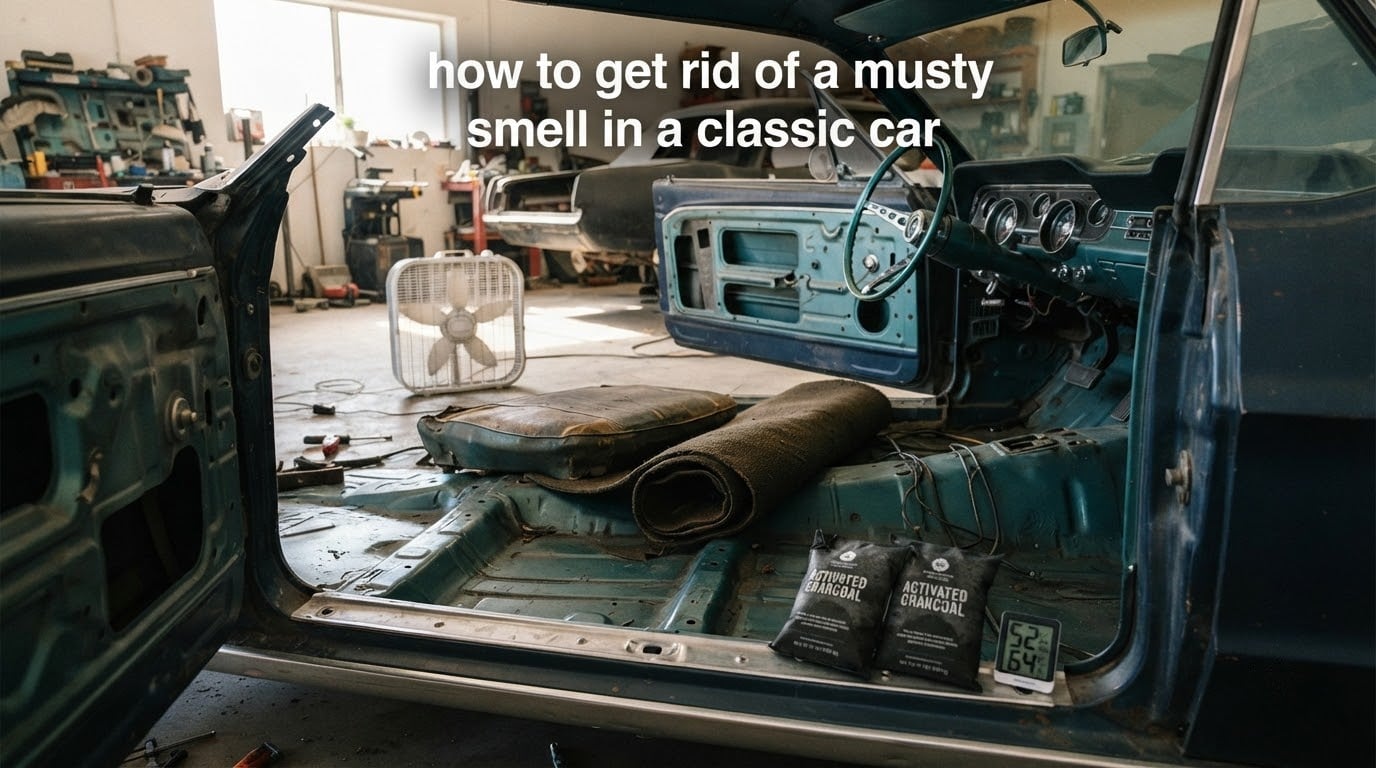
Getting rid of a musty smell in a classic car comes down to one rule: find the source before you clean anything. In most cars the odor is not on the surface at all. It is trapped in damp carpet padding, wet seat foam, a mouldy evaporator core, or the tar-like body seam sealer under the carpet, and it spreads through the cabin every time the fan runs.
That is why a detailer can wipe down every vinyl surface, spray an air freshener, and have the smell back within a week. The freshness spray covers the symptom while the moisture keeps producing spores.
Below is the process I walk owners through, from a ten-minute diagnosis to a full carpet and padding removal, plus the classic-specific sources that general car odour guides never mention.
Table of Contents
- What Actually Causes a Musty Smell in a Classic Car
- Diagnose First: Where Is the Smell Coming From?
- How to Get Rid of a Musty Smell in a Classic Car: The 5-Step Process
- The HVAC System: Cabin Filter, Evaporator, and the A/C Drain
- Natural and Chemical Deodorizing Methods Compared
- Ozone Treatment: Does It Work in a Classic Car and Is It Safe?
- What Not to Do: Air Fresheners, Bleach, and Soaking the Carpet
- Health and Safety: What Mold in an Old Cabin Actually Does
- Keeping the Authentic Old-Car Smell: A Purist’s Alternative
- Prevention Checklist for Storage and Daily-Driven Classics
- When to Call a Professional and What to Ask For
- Frequently Asked Questions
- How to get musty smell out of car interior?
- What are the common causes of bad smells inside an old car?
- What neutralizes musty smell?
- How do dealerships make old cars smell new?
- What is the old car’s smell?
- How do I get the old smell out of my car?
- Does an ozone generator work in a classic car, and is it safe?
- Can baking soda remove car odor?
- Conclusion
What Actually Causes a Musty Smell in a Classic Car
A musty smell is a stale, earthy, damp-basement odour. It is distinct from smoke, which is sharp and clings to vinyl, and distinct from the pleasant “old car smell” some owners deliberately keep. Musty specifically signals living mould and mildew colonising damp material.
Water gets in through failed window seals, a blocked sunroof drain, a soaked rubber mat, a leak behind a trim panel, or condensation off a cold evaporator. That water settles into padding, felt, or insulation where airflow cannot reach it. Mould colonises the material, spores release the odour, and the HVAC system circulates it through the whole cabin.
The four sources in almost every classic
- Carpet and seat foam padding. The single most common source, and the one enthusiasts name most often. Foam that has been wet cannot be fully dried or fully cleaned.
- The HVAC system. The evaporator core, the cabin air filter, and the A/C drain pan are permanently damp and permanently dark.
- The trunk and spare tyre well. Water pools there unnoticed for months, and the odour travels forward through the cabin pressure.
- Seam sealer and sound deadener. 1940s to 1970s cars were sealed with tar-like products and often had felt or mastic sound deadener laid under the carpet. Those materials hold odour permanently and cannot be washed out.
Source, cause and fix at a glance
| Odor source | Likely cause | Fix |
|---|---|---|
| Carpet and underlay | Water trapped in foam padding, often years old | Remove carpet and padding, dry or replace |
| Seat foam | Saturated foam, spill or leak into the cushion | Remove the cushion and dry or replace the foam |
| Floor mats | Rubber mats holding water against the carpet | Remove, wash and dry fully, use a mat tray |
| Evaporator core | Condensation feeding mould on a cold coil | Clean evaporator, unblock the drain, run the fan |
| Cabin air filter | Clogged filter loaded with debris and spores | Replace the filter |
| A/C drain | Blocked drain, water standing in the pan | Clear the drain tube outside the body |
| Trunk and spare well | Leak or condensation pooling in a hidden well | Find the leak, dry and deodorize the well |
| Body seam sealer and deadener | Aged tar and mastic holding odour under trim | Remove or cover with fresh material |
| Headliner and trim | Damp cloth, water stain, or a roof leak | Locate the leak, dry gently, clean with a cloth-safe product |
Diagnose First: Where Is the Smell Coming From?
Spend ten minutes on this before you buy a single product. A systematic check beats guesswork, and it takes less time than the clean you will do afterwards anyway.
Work from low and hidden to high and obvious
- Rubber mats. Lift them out and smell the carpet underneath. If the mat smells strongly and the carpet below does not, the mat is your source.
- Trunk and spare tyre well. Open the boot and lean in. This is where water collects without anyone noticing it.
- Under the front seats and along the rocker panels. Look for dampness, staining, or a cold damp patch on the carpet edge.
- HVAC. Run the fan on high with the doors open and put your nose at each vent. A smell that gets stronger at the vents points at the evaporator or the filter.
- Headliner and sunroof drain holes. Check the headliner for brown water stains and trace the sunroof drain tubes with a flexible wire.
A hygrometer or a cheap moisture meter turns guessing into a measurement. Anything reading damp in a car that should be dry is where the mould is living.
Then work out when the smell is worst. Stronger on a humid day or during rain means an outside water path, a window seal, or a blocked drain. Stronger with the fan running means the HVAC. Stronger always means something holding moisture permanently, and that is usually padding.
How to Get Rid of a Musty Smell in a Classic Car: The 5-Step Process
Here is the order that works. Finding the source, removing the material that cannot be saved, cleaning what stays, drying it properly, then preventing the return. Skipping step one is the single reason the smell comes back.
Step 1: Find and stop the source of the water
Every other step is wasted until the water stops coming in. Check window seals, weatherstripping along the roof rails, the sunroof drain tubes, and the body seams under the carpet edge.
For a car that has been stored, look for signs of a slow leak: tide marks on the carpet, dampness in the trunk, or a musty patch that appears after rain. A parked car still collects condensation every night, so a car that smells worse after a wet week has an entry point, not just dirty materials.
Step 2: Remove the carpet and padding without damaging your car
On a CorvetteForum thread about a C3, the owner consensus was blunt: replace the carpet and the padding rather than try to clean them. That advice applies to most classics, because a foam pad that has been wet holds water in its core for years.
Removing carpet in a fifty-year-old car is careful work. The risks are wiring, brittle trim clips, and old sound deadener that crumbles the moment you touch it.
- Disconnect the battery first. Older cars run wiring under the carpet along the sills, sometimes for seat heaters, dome lights or convertible-top wiring. Mark and unplug anything you find.
- Work from the front edge at the door sill, not from the centre. Start at a corner seam and peel back slowly, keeping tension even so the old adhesive does not tear the fibre pad underneath.
- Save every clip and fastener. Trim clips in old cars are usually the only ones of their kind left. Bag them by location.
- Expect the deadener to be a mess. Tar, rope, or felt deadener is not recoverable. Scrape what you can, bag it, and cover the bare pan with fresh butyl deadener or closed-cell foam before the new carpet goes down.
- Check the seat frame and springs while the seats are out. Old springs are often rusted and a common source of rattles later.
- Patch the factory holes before fitting the new carpet, or you will get wind and road noise straight through the floor.
If the carpet is dry, smells clean when held up to light, and has no stiffness from dried foam, you can often clean and reuse it. If the padding beneath is black, crumbling, or smells musty at arm’s length, replace it. Foam is cheap. Fighting saturated padding is not.
Step 3: Clean the original upholstery, vinyl and leather safely
Original interior materials in a classic are often not reproducible. Work gently, test an inconspicuous area first, and use the mildest product that does the job.
- Vinyl and plastic. A mild all-purpose cleaner diluted generously, applied with a soft microfibre cloth. Follow with a vinyl conditioner to keep the material supple and to give the surface less grip for future dust.
- Leather. Leather-safe cleaner only, no saddle soap, no degreaser. Wipe with barely damp cloth, then condition. Old leather often splits at the stitching if you over-wet it.
- Headliner cloth. Never saturate. This is a cotton or vinyl-covered board over bow and wire, and water will stain it and sag it. Work in small sections with a barely damp cloth, testing a hidden area behind a trim piece first.
- Hard interior surfaces. Detailers on r/Detailing report that wiping down every interior surface with an interior cleaner or mild APC has worked well for them, and it does remove surface film that traps smells.
Steam is the one method people ask about that I would use with real caution. A steam cleaner pushes hot moisture into the foam and into the seams. On a modern car you extract it straight out with a wet-dry vacuum. On a classic with no extraction, you have simply moved the problem deeper and given mould a warmer environment.
Step 4: Dry it properly, the step most people skip
Mould regrows on damp material. Cleaning a car and closing the doors on it puts you back at step one within a day.
- Heat the interior. Put the car in full sun with every door, hatch and boot lid open until the carpet is warm to the touch. On a CorvetteForum thread this was the paired recommendation after replacing the carpet: sun the interior to drive moisture out.
- Move air across it. A box fan in the cabin and one at the boot opening, running for several hours, moves moisture out of foam that no spray will reach.
- Use a desiccant. A passive dehumidifier or a rechargeable moisture absorber set in the cabin pulls residual moisture out over several days. Repeat it after rain and after every wash.
- Watch relative humidity. A small hygrometer in the cabin tells you when the interior is dry enough to close up. A dry car in a dry cabin is the goal.
- Do not reassemble until it is dry. Fitting carpet over damp foam traps the moisture and starts the cycle again.
Drying a fully stripped interior in a closed workshop takes days, not hours. If you are on a deadline, keep the fans running and leave the car open as long as you can.
Step 5: Prevent it from coming back
Once the source is gone and the interior is dry, deodorize the remaining materials and keep water out. That is covered in detail below, in the prevention checklist and in the method comparison.
The HVAC System: Cabin Filter, Evaporator, and the A/C Drain
The HVAC is the reason a localized problem becomes a whole-car problem. The fan pulls air through the evaporator, the plenum, and the vents, then pushes it back into the cabin, so a mouldy evaporator smells up the entire interior in minutes.
- Replace the cabin air filter. On many classics of this era the filter sits inside the plenum behind the glovebox. A clogged filter holds debris and spores right where the air enters.
- Clean the evaporator core. A foaming coil cleaner or an aerosol evaporator treatment, run with the fan on high and the recirculation button pushed in, carries the product across the core.
- Unblock the A/C drain. The drain tube exits low on the body side. Push a flexible wire through it while the system is off, and check that the pan under the evaporator is dry.
- Run the fan to dry the coil. After the A/C cycles off, leave the fan on medium with the doors open so the coil dries instead of sitting wet.
- Clean the vents and plenum. A soft detailing brush and a vacuum lift dust from the louvres, and a cloth with cleaner on both sides of the vent removes film the vacuum cannot reach.
BMW owners on ZPost make the same point about leaving the vents running inside the car. Moving air through the system while it dries is what clears the last of the damp.
Natural and Chemical Deodorizing Methods Compared
What neutralizes musty smell? It depends on whether the source is still wet. If water is still present, no deodorizer works for long. These methods are for a dry, clean interior that still carries an odour.
| Method | How it works | Material safety | Dwell time |
|---|---|---|---|
| Baking soda | Absorbs odours loosely; very cheap | Safe, but must be vacuumed out fully | 12 to 24 hours |
| Activated charcoal | Traps molecules on a large surface area | Safe; place in a breathable bag | 1 to 2 weeks |
| Vinegar solution | Neutralizes alkaline odours by contact | Test first; can dull gloss trim | Use diluted, then dry |
| Enzyme cleaner | Breaks down organic matter, not just odour | Use sparingly on headliner and foam | Follow with drying |
| Mild APC or interior cleaner | Removes the oily film mould grows on | Dilute; never on leather or cloth | Wipe off immediately |
| Steam | Loosens embedded dirt | Risk of soaking foam and staining | Immediate, with extraction |
| Ozone | Oxidizes odour molecules in the air | Safe when the car is vacated | 1 to 3 days sealed up |
Detailers on r/AutoDetailing stack three things for a general old-car odour: a deep clean, activated charcoal, and simply airing the car out. That combination works well once the moisture problem is solved.
Ozone Treatment: Does It Work in a Classic Car and Is It Safe?
Yes, and it is the most highly rated technique in the enthusiast forums. In a long thread on r/cars about the “old car smell”, the most-upvoted suggestion was to leave an ozone generator in the car for a couple of days, air it out afterwards, and put a cup of freshly ground coffee inside to absorb what remains.
Here is how to do it properly.
- Clean and dry first. Ozone oxidizes what is in the air. It does nothing about wet foam, so run the full five-step process before you start.
- Close the car up. Windows, doors and the boot all shut. Ozone works on the air volume inside the cabin and trunk.
- Set the generator low. Run a small unit rather than a large one, and place it where the fan can move air across it.
- Run the HVAC fan on medium with recirculation on so ozone reaches the evaporator core and the plenum, not just the front seat.
- Leave it for one to three days, then air the car out thoroughly with all doors open before anyone sits in it.
- Follow with charcoal or baking soda to absorb the residual smell as the car dries.
Safety: ozone is a respiratory irritant and is a poor idea for anyone with asthma. Never run a generator in a garage attached to a house, never run it in a closed workshop with people in it, and never stay in the car while it runs. Leave the car, ventilate the space, and air the interior out before driving.
What Not to Do: Air Fresheners, Bleach, and Soaking the Carpet
Most wasted effort on a musty classic falls into these three categories.
- Do not use air fresheners or odour beads as a fix. They mask the odour for minutes and add a layer of chemicals onto the surface where the problem lives. They also make it harder to diagnose, because everything smells the same afterwards.
- Do not bleach the carpet or padding. Bleach damages wool, jute and old synthetic fibres, and it does not reliably reach mould buried in foam. It can leave a residue that makes the odour worse later.
- Do not soak the interior. A hose, a pressure washer or an over-wet extractor can saturate sound deadener, cause rust on the floor pan, and get water into the body seams where it never dries.
- Do not steam original vinyl or headliner cloth. Both can shrink, stain or delaminate, and neither can be replaced with modern material on many cars.
- Do not run the A/C first and assume that is the fix. Owners frequently report the A/C making the smell worse, because the fan spreads spores it was already circulating.
Health and Safety: What Mold in an Old Cabin Actually Does
Mould in a closed car cabin is a real exposure, not just an aesthetic problem. Spores become airborne every time the fan runs, the doors open, or the seats get warm in the sun. People with asthma, allergies, sinus problems, or a weakened immune system can react to that.
Symptoms people report after a long session in a mouldy car include irritation of the eyes, nose and throat, coughing, and headaches. For anyone in the family with asthma, treat the mould removal as the priority rather than the odour.
While you work, open the doors and run a fan to move air out of the workspace. Wear a dust mask when you are pulling wet padding out of a car that has been closed up, and keep children out of the cabin until it is dry and aired out. If the car has been damp and closed for a long time, cleaning it in a poorly ventilated space is the worst option available.
Keeping the Authentic Old-Car Smell: A Purist’s Alternative
What is the old car smell? Owners on r/classiccars describe it as a mix of old vinyl, a hint of dust and must, and cigarettes, and a large share of them say they want to keep it. That is a legitimate choice, not a failure.
The scent usually comes from the materials themselves. In a Volkswagen Beetle, Shop Owner Magazine traced it to the seat padding, pads nicknamed “horse hair” though not made from actual horse hair, but from coconut husk fibre. The fibrous material holds and slowly releases its own scent. Replace it with modern foam and the smell goes with it, which is why reproduction horse hair pads exist for purists who want it back.
So there is a real choice here: remove the odour, or remove the character. If the smell is only mild vinyl and dust and you like it, deodorizing with charcoal and airing the car out will keep the character without stripping the interior. If there is genuine damp or mould under the carpet, that is not nostalgia, and it should go regardless of how much you like the rest of the interior.
Prevention Checklist for Storage and Daily-Driven Classics
Most classics spend more time parked than driven, and storage is where musty smells start. A short routine prevents the whole process.
For a car in storage
- Park on a hard, level surface rather than on carpet or dirt, and use a breathable car cover rather than a plastic tarp, which traps condensation.
- Open the doors, boot and bonnet briefly every month to exchange the air.
- Run the HVAC fan on high for twenty minutes with the doors open to dry the evaporator.
- Keep a rechargeable moisture absorber or a small dehumidifier in the cabin.
- Clear the sunroof and body drain holes at the start of every season.
- Add activated charcoal bags under the seats and in the boot.
- Check the cabin with a hygrometer after heavy rain or a cold night.
For a car driven regularly
- Wipe wet rubber mats and dry them flat rather than rolling them up damp.
- Shampoo the carpet and extract it fully rather than scrubbing the surface.
- Wash the car in a way that keeps water out of the door seals and the sill drains.
- Vacuum under the seats and inside the seat frame rails where damp gets trapped.
- Replace the cabin air filter on schedule, not when it looks dirty.
- Leave the fan running for a few minutes after the air conditioning cycles off.
When to Call a Professional and What to Ask For
Get a professional involved when the smell is in the HVAC and you cannot access the evaporator, when there is a leak you cannot find, when the carpet is glued down and brittle, or when you are dealing with heavy mould and asthma in the family. A deep clean with proper extraction and drying equipment is worth it when you do not have a wet-dry vacuum or a covered workspace.
On the question of how dealerships make old cars smell new: a reputable dealer does a proper detail with an ozone treatment, not a fragrance blast. That means a deep clean, a dry-out period, cabin filter replacement, and an ozone generator left in the car for a day or two before handover. If a dealer finishes in an hour with a scent product, the smell will be back within a month.
Frequently Asked Questions
How to get musty smell out of car interior?
Work in this order: find the water source, remove any saturated carpet and padding, clean what remains with the mildest product that works, dry the interior completely with heat, airflow and a desiccant, then prevent the return with regular airing and charcoal. Skipping the diagnosis is why most attempts fail within a week.
What are the common causes of bad smells inside an old car?
Four sources account for almost every case: damp carpet and seat foam padding, a mouldy HVAC evaporator with a clogged cabin filter or blocked A/C drain, water pooling in the trunk or spare tyre well, and aged body seam sealer and sound deadener under the carpet and headliner.
What neutralizes musty smell?
On a clean, dry interior, activated charcoal and baking soda absorb odours, vinegar neutralizes them, an enzyme cleaner breaks down the organic matter, and ozone oxidizes molecules in the air. None of them work for long if the source is still damp, so fix the moisture first.
How do dealerships make old cars smell new?
A good dealer runs a full detail with extraction, replaces the cabin filter, cleans the evaporator and drain, dries the interior properly, then runs an ozone generator in the sealed car for a day or two. A quick fragrance spray covers the smell for a few days and does nothing about the cause.
What is the old car’s smell?
It is usually a mix of aged vinyl, plastic, dust and, in a lot of cars, decades of cigarette smoke, with the seat padding as the main source. In a Volkswagen Beetle it is often the coconut husk fibre pads nicknamed horse hair, which hold and slowly release their own scent.
How do I get the old smell out of my car?
Start by removing the carpet and the seat padding, which is the fix most owners on classic car forums settle on because saturated foam cannot be fully dried or cleaned. Clean the remaining surfaces, dry the cabin for days with heat and fans, treat the HVAC, then deodorize with charcoal or ozone.
Does an ozone generator work in a classic car, and is it safe?
It works well on odour in the air, which is why it is the most-upvoted suggestion in classic car forums. It is safe only if you clean and dry first, run the car sealed and unoccupied, ventilate the surrounding space, and air the interior out thoroughly before anyone drives it.
Can baking soda remove car odor?
Baking soda absorbs odours loosely and works as a cheap deodorizer, but it does not kill mould or remove the source. Spread it over dry carpet and leave it overnight, then vacuum it out completely, and treat it as a finishing step after the real cleaning and drying.
Conclusion
To get rid of a musty smell in a classic car, treat it as a water problem rather than an air freshener problem. Four sources cause nearly every case: carpet and seat padding, the HVAC, the trunk and spare tyre well, and the seam sealer and sound deadener hidden under the trim.
Find the source first, remove material that cannot be saved, clean what stays with the mildest products that work, dry the interior for days rather than hours, and then keep water out. That process takes more effort than a scent spray and it is the only one that holds.
If the smell is part of what you love about the car, keep the vinyl and dust character and use charcoal and regular airing instead of a full strip. If there is genuine damp or mould underneath, remove it regardless, because it does not stay put and it is not good for anyone breathing in the cabin.