
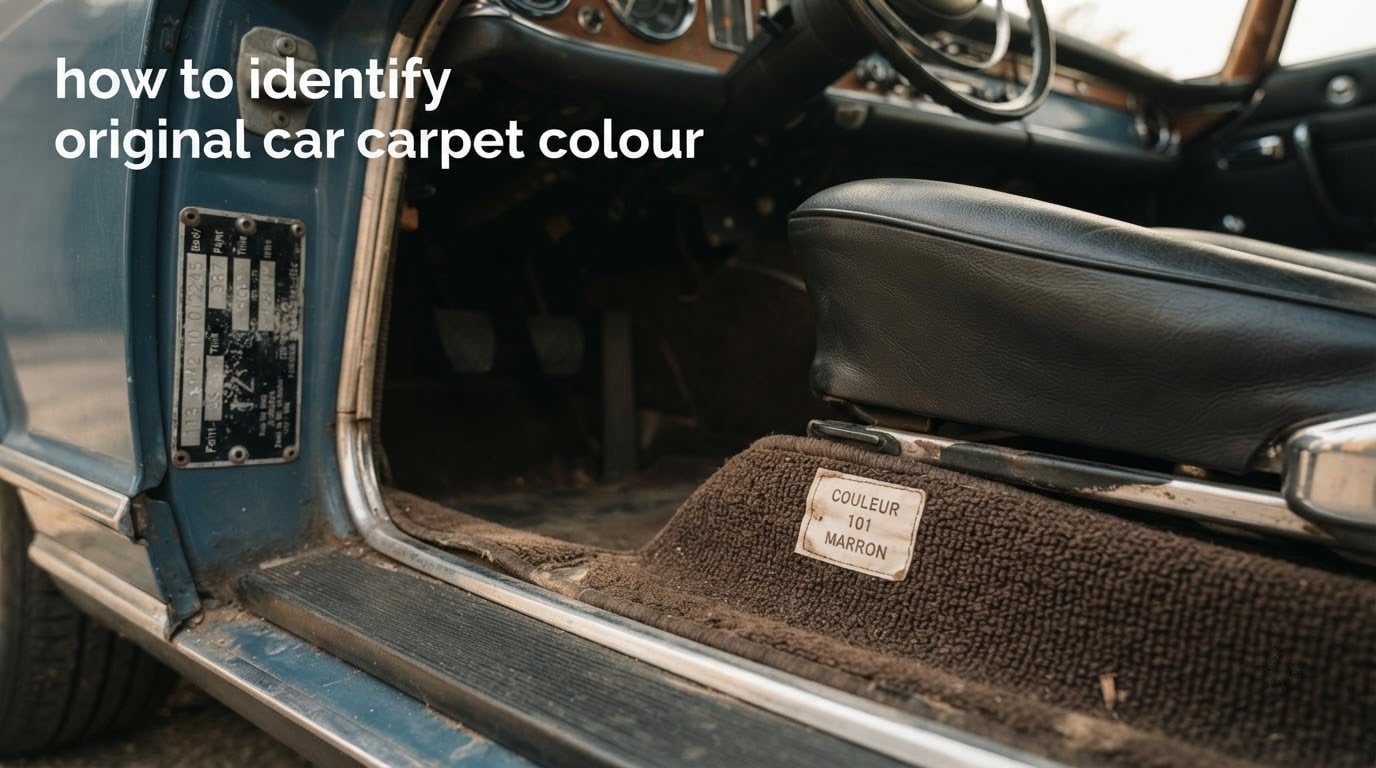
If you have ever pulled up a sun-faded floor mat and wondered what shade the carpet should actually be, you already know why this matters. The original car carpet colour is recorded by the manufacturer in a handful of places that most owners never think to check. I have walked countless customers through this exact process over the years, and the answer is almost always hiding in plain sight.
This guide explains how to identify original car carpet colour using three reliable methods, plus brand-specific tips for Ford, GM, and Mopar vehicles. We will start with the fastest approach and finish with the inspection techniques that catch what the codes miss.
Table of Contents
- Why Identifying Your Original Carpet Colour Matters
- How to Identify Original Car Carpet Colour Using the VIN Plate and Trim Code
- How to Read the Carpet Tag and Build Sheet for Colour Confirmation
- How to Inspect Under the Carpet for Original Colour
- Brand-Specific Code Locations for Ford, GM, and Mopar
- Common Pitfalls and Mistakes When Matching Original Carpet Colour
- Frequently Asked Questions
- Final Thoughts on Identifying Original Car Carpet Colour
Why Identifying Your Original Carpet Colour Matters
Factory carpet colour affects restoration accuracy, replacement ordering, and resale value. A reproduction set in the wrong shade sticks out immediately, and most buyers notice the interior before the paint. Knowing the original specification also saves you from trusting a worn, sun-bleached sample as the truth.
Owners come to us with three common situations. They are restoring a classic and want factory-correct trim. They are replacing worn carpet and need an exact match. Or they are checking whether the carpet currently in the car is original at all. Each of those questions leads back to the same starting point: the manufacturer’s recorded code.
Manufacturers do not write “blue” or “tan” on the carpet itself. They assign a code, stamp it on a plate, sew it into a tag, or print it on a build sheet. Your job is to find that code, decode it, and confirm it against a physical sample that has not been damaged by sunlight or wear.
How to Identify Original Car Carpet Colour Using the VIN Plate and Trim Code
The fastest path to the original carpet colour runs through the VIN plate and the trim or option code printed on it. The VIN identifies the vehicle, but the trim code tells you what the factory installed inside it. Together, they pin down the exact interior specification for your build date.
What the VIN Plate Tells You About Interior Colour
The VIN itself does not carry colour data. It identifies the vehicle’s make, model, year, engine, and assembly plant. The carpet colour sits in a separate piece of information that lives on the same plate or on a paired data plate.
On most cars, the data plate lists paint codes, trim codes, and option codes. The trim code is the one that maps to your interior colour and carpet. Decode that code using the manufacturer’s reference chart and you have your answer.
Two cars with identical VINs from the same model year can still have different interior colours if the original buyer ordered options. Always trust the trim code over the model year alone.
Where to Find the Trim Code on Your Vehicle
The trim code location varies by brand, but the door jamb is the most common spot. Look at the driver’s side door pillar, either on a sticker on the door itself or on a metal plate riveted to the B-pillar. The driver’s door jamb plate typically lists paint, trim, and build date in a small grid.
Some manufacturers hide it elsewhere. Ford often prints trim codes on the door jamb label. GM uses RPO codes that appear on a service parts identification sticker, usually in the glove box or under the spare tire cover. Mopar puts the colour information on the fender tag for older models or on a build sheet tucked into the car.
Once you spot the trim code, write it down exactly as printed. Two-letter codes are common, but some manufacturers use three or four characters. Do not guess or round. The wrong character leads to the wrong shade.
After you have the code, decode it using the manufacturer’s reference chart. Most charts are free from the manufacturer or from enthusiast sites dedicated to your marque. Match the code to the colour name, and you have identified the original carpet specification.
How to Read the Carpet Tag and Build Sheet for Colour Confirmation
The trim code gives you the specification, but the carpet tag and build sheet confirm what the factory actually installed. These physical records catch the rare cases where a car was changed at the assembly plant or swapped before delivery.
Reading the Carpet Tag Stitched Into the Carpet
Most original carpets carry a small fabric tag stitched into an out-of-the-way seam. Common spots include under the front passenger seat, along the rear bulkhead, or along the edge near the B-pillar. You may need to lift the carpet slightly to find it.
The tag usually shows the part number, manufacturer code, and sometimes a colour abbreviation. On Ford products, the tag often reads the dye lot number. GM carpets typically show the part number with a suffix that identifies the colour group. Mopar tags frequently use names like “Chestnut” or “Dark Blue” printed directly.
If the abbreviation does not match the trim code, that is a clue. It could mean the carpet was replaced with an aftermarket or reproduction set, or it could simply mean the factory used a slightly different naming convention. Cross-reference both numbers before assuming a mismatch.
Locating the Build Sheet or Broadcast Sheet
The build sheet is a printout the factory generated when your car was ordered. It lists every option the original buyer selected, including interior trim. If you can find it, you have the original specification in writing.
Build sheets often hide under the carpet, behind the glove box liner, under the rear seat, or folded inside the door panel. On classic Mopar cars, the broadcast sheet frequently lives under the rear seat or tucked against the wheel well. Ford and GM cars from the 1970s through 1990s sometimes carry a build sheet under the carpet on the driver’s side.
Build sheets fade and crumble with age. Handle them carefully and photograph the contents before they disintegrate further. The trim line on a build sheet usually reads in plain language, so decoding is rarely necessary.
When the carpet tag and build sheet both agree, you have a strong confirmation of the original specification. When they disagree with the trim code, treat the build sheet as the most authoritative source since it came straight from the order.
How to Inspect Under the Carpet for Original Colour
Codes and tags tell you what should be there. Physical inspection tells you what is actually there. After decades of sunlight, the visible carpet often looks nothing like the original shade. The colour hiding under the mats and along the edges is your best clue.
Hidden Inspection Points That Reveal Original Shade
The carpet under the front seats rarely sees direct sun. Pull back the seat and check the carpet colour there. The edges along the centre console or transmission tunnel also stay shaded. Compare those spots against a sun-exposed area near the door or rear hatch.
If the difference is dramatic, the carpet has faded and the visible colour is no longer trustworthy. A piece of original carpet tucked under a console for forty years will look almost new. A piece exposed to a windshield for the same period will look tan even if it was originally black.
UV fade does not change all colours equally. Reds and blues tend to shift the most. Browns and greys hold their shade better. Knowing this helps you estimate the original colour from a faded sample.
What to Look for Underneath the Carpet
The underside of the carpet often shows the original dye batch. Flip a corner near the door jamb or under a seat and look at the backing. The colour on the back frequently matches the original specification even when the face has faded badly.
Also check the padding. Many original carpets use jute or foam padding that itself shows age differently than the carpet face. The carpet manufacturer’s logo or part number may be stamped into the padding, giving you another cross-reference.
Look for clues that the carpet has been replaced. Newer adhesives, fresh stitching, or a different texture all suggest a replacement. A carpet that is original usually shows consistent wear across all hidden and exposed areas.
Brand-Specific Code Locations for Ford, GM, and Mopar
Each manufacturer puts interior codes in a slightly different spot. Knowing the common location for your brand saves you from tearing the car apart unnecessarily. Here is where to look for the three most common American marques.
Ford Interior Trim Code Locations
Ford prints the trim code on the driver’s door jamb label, usually in the lower corner of the certification sticker. The code is typically a two-letter combination like “BF” for blue or “CR” for red. Cross-reference it against Ford’s trim code chart to identify the original carpet colour.
On older Fox-body Mustangs and classic Fords, the carpet tag itself is often the easiest source. Look along the front edge of the carpet under the dashboard or near the parking brake. Ford frequently prints the colour name directly on the tag, which removes the need to decode anything.
Ford Blue and Light Blue are not interchangeable, even though both are blue. The factory ACC carpet for a 1966 Mustang in Ford Blue is a noticeably different shade than the Light Blue option. Always match by exact name, not by description.
GM RPO Code Locations for Interior Colour
GM uses RPO (Regular Production Option) codes for nearly every factory option, including interior colour. The RPO codes appear on a service parts identification sticker, which usually lives in the glove box, on the trunk lid, or under the spare tire cover.
Interior trim codes on GM vehicles are typically three-character codes. Look for a code that begins with a letter followed by two numbers, or a combination of letters that identifies the interior colour group. Decode using GM’s RPO reference chart to find the colour name.
On Camaros and Firebirds, the trim code is also stamped on the driver’s door VIN plate. Look for a small metal tag riveted to the door pillar. The trim code sits next to the paint code, and the two together give you the complete factory interior specification.
Mopar Fender Tag and Broadcast Sheet Codes
Mopar vehicles from the classic era carry a fender tag riveted to the driver’s side inner fender. Pop the hood and look at the upper left corner of the engine bay. The fender tag lists paint code, trim code, and major options in a two-row format.
The trim code on a Mopar fender tag is typically a two-letter code that maps directly to a colour name. “CR” means red interior, “BV” means blue, and so on. The broadcast sheet or build sheet gives the same information in plainer language and sometimes includes the carpet colour specifically.
If the fender tag and broadcast sheet disagree, trust the broadcast sheet. The fender tag reflects what was available at the time of stamping, but the broadcast sheet reflects the actual order as the car was built.
Common Pitfalls and Mistakes When Matching Original Carpet Colour
Even with the right code and the right inspection, a few common mistakes can send you down the wrong path. Here are the issues that come up most often, and how to avoid each one.
Why Your Carpet Looks Different From the Code
UV fade is the most common reason. A carpet the factory made in a deep red can look pink after decades of sun exposure. Blues shift toward grey. Browns lighten toward tan. The trim code never changes, but the visible colour does.
Wear and staining also distort the visible colour. Heel marks, spilled coffee, and dye transfer from mats all change how the carpet looks. None of those changes affect the original specification.
If the carpet has been replaced at some point, the visible colour may not match the original code at all. Check the carpet tag and build sheet to confirm the carpet is original before trusting what you see.
Avoiding Mismatched Replacement Carpet
Order replacement carpet by code, not by colour name. Two shades of blue that look identical on a supplier’s website can be noticeably different in person. The trim code removes the guesswork.
Request a swatch before ordering a full set. Most suppliers will send a small fabric sample so you can compare against a hidden area of the original carpet. This step catches nearly every mismatch before you commit.
Reproduction carpet for classic cars is generally accurate to factory specifications, but dye batches vary between production runs. If you are matching an existing original carpet, always request a swatch from the current batch rather than trusting a catalogue photo.
Frequently Asked Questions
Can a VIN tell you the interior color?
A VIN alone does not record the interior colour directly. It identifies the vehicle, but the trim code or RPO code printed on the door jamb plate or data plate is what maps to the original interior. Use the VIN to locate the data plate, then decode the trim code on that plate to identify the carpet colour.
How to find color code using VIN?
Start at the driver’s door jamb and read the certification sticker or data plate riveted there. The trim code is usually a two or three character code printed alongside the paint code. Write it down exactly, then look it up in the manufacturer’s trim code reference chart to identify the original carpet colour.
How to find car interior color code?
The interior colour code is most often on the driver’s door jamb sticker or on a service parts identification label in the glove box or trunk. On classic Mopar cars it appears on the fender tag. On GM cars it is listed as an RPO code on the parts identification sticker.
How do I find my car color code online?
Once you have the trim code from the door jamb or data plate, search the manufacturer’s reference chart by code. Most brands publish free decoding charts on their owner resource pages, and marque-specific enthusiast sites also maintain comprehensive code databases that map codes directly to colour names.
How to know what color carpet to get?
Match replacement carpet by the trim code rather than by visible colour. Order a swatch first and compare it against a hidden area of the original carpet such as under the front seat. This confirms the dye batch and avoids the common pitfall of trusting a faded or sun-bleached sample.
Where can I find the interior color code on my Chevy?
On a Chevy the interior colour code appears on the service parts identification sticker, usually in the glove box, on the trunk lid, or under the spare tire cover. The RPO code for interior trim is a three character code. Cross-reference it in the GM RPO chart to identify the original carpet shade.
Final Thoughts on Identifying Original Car Carpet Colour
Learning how to identify original car carpet colour comes down to three reliable sources: the trim or RPO code on the data plate, the carpet tag and build sheet, and the hidden inspection areas under seats and along edges. When all three agree, you can order replacement carpet with confidence.
Start with the door jamb, write down the trim code exactly as printed, and cross-reference it against a manufacturer’s chart. Then confirm with the carpet tag and a quick inspection of a hidden area. If anything looks off, the build sheet is your tiebreaker.