
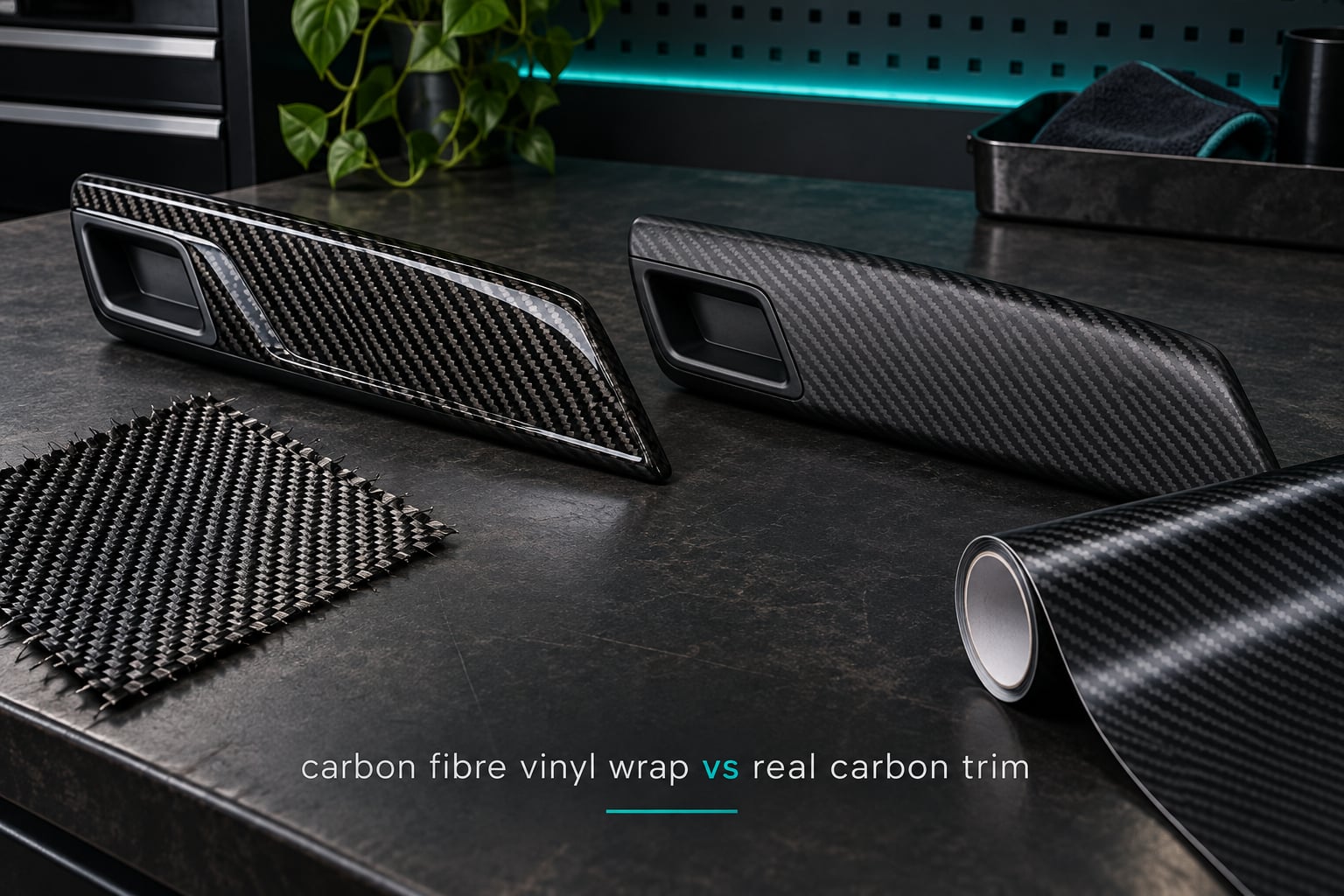
If you have ever run your fingers across a dashboard inlay and wondered whether you are touching woven carbon or a printed film, you are not alone. The carbon fiber vinyl wrap vs real carbon trim question comes up constantly in our workshop, usually from owners who want the motorsport look without the motorsport invoice. Here is the honest version.
Real carbon trim is a structural composite. Fibres are woven into a 2×2 twill or plain weave, laid into a mould, flooded with epoxy resin, cured under heat and pressure, trimmed, sanded and clear-coated. It is the same material family as a race car floor panel or an airframe spar, and it costs what that process costs.
Carbon fiber vinyl wrap is a flexible cast film printed with a carbon pattern, laminated for gloss, and bonded with a pressure-sensitive adhesive. It buys the appearance of carbon in about a day of labour and can be removed again. Neither is better than the other. They answer different questions, and most interior trim never needs the second answer.
This guide covers what each material is, how to tell them apart in the hand, where a third option fits, and which one to choose for the specific part in front of you.
Table of Contents
- What Is the Difference Between Carbon Fiber Vinyl Wrap and Real Carbon Trim?
- What Carbon Fiber Vinyl Wrap Actually Is
- What Real Carbon Fiber Trim Is
- Carbon Fiber Vinyl Wrap vs Real Carbon Trim: Head-to-Head
- How to Tell Real Carbon From Carbon Vinyl
- Understanding Wrap Generations: 3D, 4D, 5D and 6D
- The Third Option: Hydro Dipping
- What Each Option Really Costs
- Weight and Performance: Does Vinyl Give You Anything?
- Where Each Option Works Best
- Installation Difficulty and DIY Feasibility
- Durability, UV and Climate Performance
- Verdict by Use Case and Budget
- Frequently Asked Questions
- How can I tell the difference between real carbon fiber and fake carbon fiber?
- Is carbon fiber wrap worth it?
- Can a wrapped car go through a carwash?
- Which carbon fiber wrap is the most realistic?
- What is the most realistic looking carbon fiber wrap?
- Is hydro dipping better than wrapping?
- What are the downsides of hydro dipping?
- Is it better to paint or wrap carbon fiber?
- Does carbon fiber vinyl wrap add weight or performance?
- Conclusion
What Is the Difference Between Carbon Fiber Vinyl Wrap and Real Carbon Trim?
Carbon fiber vinyl wrap is a printed PVC or polyurethane film that reproduces the woven pattern of real carbon fiber, while real carbon trim is a genuine carbon fiber reinforced polymer panel woven from carbon strands and cured in epoxy resin.
That single sentence is the whole comparison. The wrap copies the picture. The composite is the thing itself. Everything else on this page – cost, weight, strength, repair, resale – is a downstream consequence of that difference.
What Carbon Fiber Vinyl Wrap Actually Is
Understanding the construction tells you almost everything about how the wrap behaves. It is a four-stage laminate, and each stage explains one of its strengths and one of its weaknesses.
Base film. Cast vinyl, or polyurethane in higher-end films, gives the wrap its stretch. Calendered film is cheaper and stiffer, which is why cheap carbon wrap fights you around a compound curve. Cast film from 3M Di-Noc, VViViD, Avery Dennison, Hexis, Suntek or XPEL is what you want on a centre console or a mirror cap.
Printed pattern. The weave is a high-resolution print. No fibres are involved, and there is no depth below the surface – the pattern is pigment sitting in the film.
Protective laminate. A clear or satin top layer produces the gloss. It is what gives 4D and 5D film its depth illusion and what makes edge lifting visible when it happens.
Adhesive. A micro air channel adhesive releases trapped air during squeegee work and conforms to compound curves. Quality varies more by brand and batch than enthusiasts expect, and forum posts about edge lift trace back to adhesive far more often than to film quality.
Some films add an embossed texture so the weave can be felt with a fingertip. It helps at arm’s length in a dark cabin and does nothing under direct sunlight, where the eye reads gloss and reflection rather than touch.
What Real Carbon Fiber Trim Is
Three genuine processes get sold as carbon, and knowing which one you are looking at explains its finish better than any description of gloss level.
Dry carbon. Fibres are laid in a mould and cured with minimal resin, often in pre-preg form. The weave stays sharp and visible because the resin is thin. This is the most obviously carbon-looking finish and the most common on visible trim.
Wet carbon. More resin is used, so the fibre sits deeper beneath a thick, high-gloss clear coat. The weave is muted and softened by depth rather than printed on. Wet carbon is what OEM carbon bonnet and roof panels use.
Forged carbon. Compressed fibre fragments rather than an ordered weave, giving a marbled, random pattern. It is a genuine composite with a distinctive look, not a cheap substitute, but it will never read as a twill weave.
The realism argument on forums usually collapses into this distinction. One long-running Bimmerforums thread from 2010 claimed a 3M Di-Noc carbon fibre fabric wrap has “a closer look and feel to real carbon fiber than actual polished carbon fiber does” – and the nuance is the point. A high-gloss wrap can flatter a matte dry carbon part under cabin light.
Carbon Fiber Vinyl Wrap vs Real Carbon Trim: Head-to-Head
Almost every comparison of these two materials online skips the specification detail, so here is the complete one.
| Factor | Carbon fiber vinyl wrap | Real carbon trim |
|---|---|---|
| Material | Printed cast PVC or PU film with laminate | Carbon fiber reinforced polymer, epoxy cured |
| Cost driver | Film per part plus trimming labour | Pre-preg or labour-intensive wet lay-up and clear coat |
| Weight versus original trim | Negligible addition | Genuine saving, meaningful only on large panels |
| Structural strength | None, cosmetic skin only | Very high, load bearing in real applications |
| Visual realism | High at 1-2 metres, flat under direct sun | Genuine depth, weave visible or resin-muted per process |
| Tactile feel | Firm, optionally embossed, no weave depth | Woven texture, cooler to the touch, resin hard |
| Durability | UV fading, yellowing, edge lift, expected to age out | Resin degrades, fibres unaffected, UV resistance tied to clear coat |
| Damage repair | Re-wrap the part or panel section | Specialist resin repair, or replace the part |
| Reversible | Yes, with heat, residue and substrate risk | No, it is the part |
| Pattern and colour choice | Wide, including forged, twill, gloss and matte | Weave fixed by tooling, colour fixed by resin |
| Typical lead time | Days | Weeks, tooling for new patterns |
The row most owners under-read is structural strength. A wrapped dashboard inlay protects nothing and carries nothing. If a part exists to hold a load, absorb a crash, or take heat, wrap is the wrong tool entirely.
How to Tell Real Carbon From Carbon Vinyl
This is the question owners ask most often, and it is the one most wrap vendors answer badly. Six checks, in order of reliability.
1. Look at an unpainted edge or cut face. Real carbon shows fibre ends, resin thickness and a layered cross-section. A wrap shows film layers, printed pigment and adhesive, with a uniform thin edge. This is the only genuinely conclusive check.
2. Read the weave under raking light. Move a light source across the surface. A real composite shows depth, with fibres at different distances from you, and a subtle waviness that no print reproduces. Wrap shows a flat image whose brightness changes but whose structure does not move.
3. Check whether the weave survives the clear coat. Sharp, defined weave means dry carbon. A softened, slightly blurred weave under deep gloss means wet carbon. A perfectly sharp weave under a mirror finish is a wrap, because no printed laminate behaves that way.
4. Compare gloss uniformity. Hand-laid or wet-lay real carbon varies slightly panel to panel. Factory-printed film from a single roll is very consistent, sometimes suspiciously so across a set of parts that came from different cars.
5. Flex an edge or tap the part. Vinyl has a slight give and a muted tap. Real carbon rings and does not flex. Be careful with an installed part, and never test by forcing a bonded trim edge.
6. Feel the temperature. A composite part sits noticeably cooler in a cold cabin because the fibre conducts heat away from the surface. Film sits closer to the plastic temperature beneath it.
The common thread: wrap wins at a distance, real carbon wins the moment anyone leans in. Enthusiasts on Bimmerforums and ClubLexus have argued this for well over a decade, which tells you the two are genuinely close rather than one being an obvious fake.
Understanding Wrap Generations: 3D, 4D, 5D and 6D
These numbers describe a marketing ladder, not a physical dimension. Nothing about 5D film is five-dimensional or five millimetres deep. What changes is weave definition, how strongly it is embossed, and how wet the gloss looks.
| Tier | Look | Real carbon analogue | Best trim application |
|---|---|---|---|
| 3D | Coarse weave, matte or satin, tactile | Dry carbon, matt clear | Flat panels, discreet interior accents |
| 4D | Rounded weave with semi-gloss depth | Dry carbon, satin clear | Dash, door cards, console pieces |
| 5D | Deep gloss, weave softened by the laminate | Wet carbon | Large flat panels, bonnet and roof |
| 6D | Hyper-gloss, high apparent depth | Varnished supercar carbon | Show builds and gloss-heavy schemes |
There is a practical trade-off vendors rarely mention. The higher tiers that look most realistic are also the least forgiving films on compound curves. Mirror caps and tight console radiuses are better served by 4D, and using 5D or 6D there is where installers create their own problems.
The Third Option: Hydro Dipping
Hydro dipping, or hydrographics, is not vinyl and it is not composite. The part is filmed, floated on a printed water-soluble film, and the pattern transfers through surface tension. It deserves its own column because it solves a problem wrap solves badly.
Where hydro dip wins. Complex three-dimensional shapes – mirror housings, intake surrounds, multi-branch trim – get a continuous pattern with no seam and no relief cuts. One forum user described hydro-dipped parts on a z4 as still looking as good years after application as the day they were done.
Where hydro dip loses. The pattern is ink, not structure, so there is no depth and no real texture. Enthusiasts on hdforums routinely call it out as a film with ink on it rather than carbon. Repair is effectively impossible, edges can lift, and removal tends to take the top coat with it.
Forums genuinely disagree on which looks better, and one Mustang forum comment that hydro dipping “looks ok under the hood, but everywhere else just looks cheap” captures the real dividing line. Hydro dip is a good solution for hidden or highly compound geometry and a poor one for a visible cabin surface you will be looking at daily.
What Each Option Really Costs
Cost is the most important practical variable and the one most sensitive to describe honestly, so here is the structure of it rather than a figure that changes weekly.
Wrap cost is mostly labour. The film itself is a small share of a trim job. A centre console or pair of door inlays requires partial disassembly, panel preparation, template or freehand cutting, heat work on curves, and edge finishing. On tight radiuses the labour can exceed the film several times over. This is also why a wrap is a poor DIY job on a part you would otherwise have to strip to reach.
Real carbon cost is driven by the process. Dry carbon in small parts is manageable in a well-equipped shop. Wet carbon with a deep clear coat is slower, and anything needing new tooling for a pattern adds weeks. Genuine carbon is also usually bought as an OEM or aftermarket replacement part, which brings a second cost many owners forget: a real carbon part is frequently not interchangeable with the original trim without modification, whereas a wrapped original part is.
Hidden costs on both sides. Wrap jobs can be marred by a poor adhesive batch, and rework means a second strip-out. Real carbon parts can be damaged in handling before they are ever fitted, and a cracked clear coat is not a cosmetic issue.
The honest frame. Wrap is priced as a labour line. Real carbon is priced as a part. Comparing them directly is comparing a service to a component, which is why the gap feels larger than the materials justify.
Weight and Performance: Does Vinyl Give You Anything?
No. On trim, vinyl wrap gives you no measurable performance benefit of any kind.
This is the most settled question in the enthusiast forums, and the answer has been consistent for years. An Evox discussion concluded that interior trims are light enough that carbon parts “wouldn’t give you any noticeable performance gains.” A Reddit carbon fiber thread put it more simply: if the goal is a pure aesthetic change, just wrap it.
The reason is geometric. A door inlay or console bezel weighs a few hundred grams in either form, and the difference between cast film and a few millimetres of composite is small enough to sit inside the error of any sensible measurement. Real carbon earns its place on bonnets, roofs, spoilers and diffusers, where the panel is large and the saving is measurable. It earns nothing on a trim bezel.
So the question is never performance. It is purely whether you want the material or the look.
Where Each Option Works Best
Mapping the decision to the part removes most of the argument.
| Part | Recommended | Reason |
|---|---|---|
| Centre console and dash inlays | Wrap, 4D | Flat to gently curved, high visual contact, no load |
| Door card inlays and piano black refresh | Wrap, 3D or 4D | Large visual area, compound curves reward cast film |
| Wing mirror caps | Wrap, 4D | Tight radius, no stiffness requirement |
| Spoilers and diffusers | Real carbon, or wrap for budget builds | Visible, aerodynamic, genuine saving and stiffness |
| Bonnet and roof panels | Real carbon | Heat, load and weight all argue for composite |
| Motorcycle fairings | Either | Wrap for appearance, real carbon where weight is contested |
| Complex 3D intake or surround | Hydro dip | Seamless pattern on compound geometry |
| OEM trim restoration | Real carbon | The point is authenticity, not looks |
| Show car build | Real carbon or 6D wrap | Judged close up, and consistency matters |
Installation Difficulty and DIY Feasibility
A wrap job on a visible interior part is a real skill, not a weekend afternoon. The film is the easy part; the trimming, the relief cuts around compound curves and the edge finishing are what separate a good result from a bad one.
The sequence is consistent: remove the trim, clean and degrease the plastic, dry-fit or template the film, cut with a relief cut at every direction change, heat and stretch, squeegee from the centre outwards, then fold and burnish the edges. Overstretching is the classic failure, and it leaves stress whitening along tight radii that never fully disappears.
On piano black plastic the paint is already the weak point. Adhesion to a stressed gloss surface is unpredictable, and forum reports of adhesive residue and lifted edges cluster around exactly those parts.
That also settles a question people ask in three different forms. Is it better to paint or wrap carbon fiber? If you mean painting the epoxy resin of a real carbon part, no: paint adds weight, hides the weave and introduces a repair problem. If you mean painting a plastic trim part to imitate carbon, it is a real option and it is more durable than wrap, but it is a permanent change with no pattern choice and no reversal. If you mean wrapping, it is reversible and it is the only one of the three you can take off.
Durability, UV and Climate Performance
Wrap ages. Expect UV fading, yellowing in the laminate, and lifting at seams and edges first. Enthusiasts on r/SVRiders quote roughly five years of good outdoor appearance for a quality gloss carbon film, and reports of three to five year fade, lift and yellow are routine rather than exceptional. Hot, high-UV climates shorten that. A car that lives in a garage lasts considerably longer than the same film outdoors in summer sun.
Car washes are not the enemy people think they are. Touchless and automatic washes are fine. The risk is brush and roller washes driving grit into an edge that has already started to lift, and that is a condition to repair, not a reason to avoid washing.
Care is straightforward: pH-neutral shampoo, no harsh solvents, no stiff brushes, no pressure washer aimed at a seam.
Removal is where regret lives. Heat and patience will lift most wrap, but adhesive residue on piano black is common and can only be removed aggressively at the cost of the substrate. Paint damage on removal is a real risk, not a scare story. The finish you had before wrapping determines what you have after.
Resale is a genuine consideration. A professionally wrapped car generally presents better than one with lifting edges or failed trim. Real carbon trim, correctly fitted, can support a higher-value claim if the buyer knows what it is, and can just as easily read as a modification if the part numbers do not match.
Verdict by Use Case and Budget
Pull the whole thing into a decision rule.
Choose wrap if the goal is appearance on non-structural trim, the part is plastic you want to keep reversible, or you are covering a large area on a sensible budget. Wrap is the correct default for interior trim, and most of the time the question of real carbon never needs to be asked.
Choose real carbon if the panel is large, hot, load-bearing, aerodynamic, or if the car is being restored to standard. Also choose it if you want the material itself, because a wrap is not a substitute for it in any physical sense.
Choose hydro dip if the geometry is too complex for clean seaming and the part is not a surface you will inspect daily.
Choose none of the three if a good clean, a polish and a piano black refresh will get you most of the way. That is the option owners most often skip, and it is frequently the right one.
Frequently Asked Questions
How can I tell the difference between real carbon fiber and fake carbon fiber?
Look at an unpainted edge first, since a real composite shows fibre ends, resin thickness and a layered cross-section while a wrap shows printed pigment and a uniform thin film edge. Then read the weave under raking light: real carbon shows depth and slight waviness, while a print stays flat. Check whether the weave softens under a deep gloss, which indicates wet carbon. Flex and temperature give a fifth and sixth signal, since vinyl gives slightly and sits warmer than composite.
Is carbon fiber wrap worth it?
For interior and exterior trim where the goal is purely cosmetic, yes. It delivers the carbon look on a sensible budget, it is fully reversible, and trim parts are far too light for weight or strength to matter. It is not worth it if the goal is lightness, stiffness or a structural repair, because a printed film provides none of those. Judge it on labour as much as film, since trimming and edge finishing set the price.
Can a wrapped car go through a carwash?
Yes. Touchless and automatic car washes are safe for a wrapped trim area, and there is no reason to avoid them. The genuine risk is brush and roller washes forcing grit into a seam that has already begun to lift, which accelerates an existing problem rather than creating one. Wash with pH-neutral shampoo, keep pressure washers away from edges, and repair any lifting early.
Which carbon fiber wrap is the most realistic?
For maximum realism on large flat panels, 6D hyper-gloss film. For interior trim and compound curves, 4D is the better choice, because the deeper tiers are stiffer and fight you around tight radii. The 3D, 4D, 5D and 6D names are a marketing ladder rather than a physical dimension, and what actually changes is weave definition, embossing depth and gloss. A 5D gloss film under cabin light also flatters matte dry carbon remarkably well.
What is the most realistic looking carbon fiber wrap?
It depends on the panel and the viewing distance rather than on a tier number. Large flat surfaces carry 5D and 6D well because there is no distortion to hide. Small compound trim pieces suit 4D, which is more forgiving to install and still reads convincingly. Branded films from 3M Di-Noc, VViViD, Avery Dennison, Hexis, Suntek and XPEL are consistently a tier or two ahead of unbranded stock in print definition and laminate depth.
Is hydro dipping better than wrapping?
Hydro dipping is better on one specific point: complex three-dimensional shapes. A floated pattern transfers without seams or relief cuts, which wrap cannot do cleanly on tight compound geometry. For a visible cabin surface you look at daily, wrap is generally the better result, because hydro dip has no weave depth and enthusiasts regularly describe the ink layer as reading as fake up close. Treat hydro dip as the geometric solution and vinyl as the finish solution.
What are the downsides of hydro dipping?
The pattern is ink sitting on the surface rather than structure, so there is no depth or real texture. It is effectively impossible to repair, edges can lift, and removal can take the top coat with it. Quality varies with the pre-treatment step, and a poorly prepared part will show flow lines and uneven coverage. It is also hard to change your mind later.
Is it better to paint or wrap carbon fiber?
The question has three readings. Painting the epoxy resin of a real carbon part is not advisable, because paint adds weight, hides the weave and creates a repair problem. Painting a plastic trim part to imitate carbon is a legitimate permanent option and outlasts wrap, but it allows no pattern choice and cannot be reversed. Wrapping is the only one of the three you can remove, which is why it suits most trim.
Does carbon fiber vinyl wrap add weight or performance?
No, not on trim. A wrap adds a negligible amount of weight to a part that already weighs very little, and it provides no structural strength whatsoever. Forum consensus has been consistent for years that carbon parts on interior trim give no noticeable performance gain, because the saving is too small to measure. Real carbon earns its place on bonnets, roofs and spoilers, where the panel is large enough for the weight difference to register.
Conclusion
The carbon fiber vinyl wrap vs real carbon fiber trim question has a short answer. Wrap copies the appearance of carbon; real carbon is carbon. On interior trim, where weight and strength are irrelevant, that distinction usually does not justify spending on the composite, and a quality 4D or 5D film looks convincing to almost everyone who is not deliberately looking for it.
Real carbon earns its cost on bonnets, roofs, spoilers and restoration work. If you are still unsure which side of the line your part falls on, bring it in and we will tell you honestly which one is the sensible purchase.