
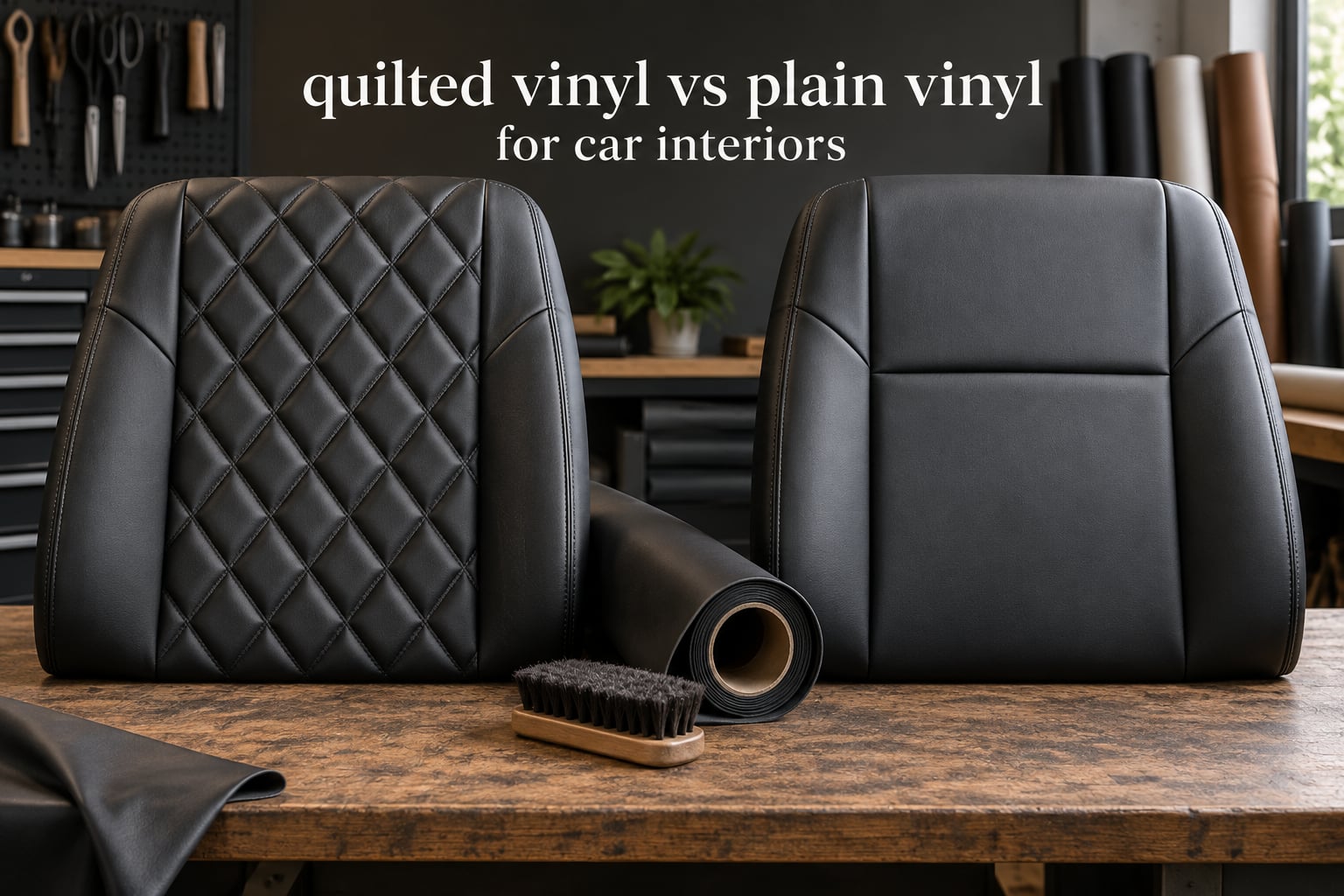
Choosing between quilted vinyl and plain vinyl comes down to one question: do you want the interior built from stitched, padded panels or from flat, wipe-clean skins. In our trim shop we cut both, on classics being returned to factory specification and on daily drivers that carry kids, dogs and 40-degree summers. The base material is often identical. The construction never is.
Quilted vinyl is upholstery vinyl cut and sewn into padded, stitched panels, usually over foam, to build a diamond, button-tuck or channel pattern. Plain vinyl, often called smooth or flat vinyl, is the same coated face stretched as one piece over the cushion with light pleating or perimeter stitching only.
Short answer: plain vinyl suits factory-accurate restorations, budget refreshes and anyone who wants the fastest possible clean. Quilted vinyl suits custom builds, comfort-first interiors and hot rod work where pattern and padding are the whole point. A third option, embossed faux-quilt vinyl, delivers the quilted look with no foam and no stitching.
The rest of this guide breaks both approaches down the way we assess them at the bench: what the material is, how it feels over years, how it behaves in heat and UV, where dirt collects, what the job costs per seat, and what happens when something tears. Our guidance is built from shop practice plus what owners report back to us after a few summers in the sun.
Table of Contents
- Quilted Vinyl vs Plain Vinyl: A Side-by-Side Comparison
- What Quilted and Plain Vinyl Actually Are
- Comfort and Feel Over Time
- Durability, Cracking and UV Behaviour
- Which Finish Ages Better by Climate
- Cleaning, Stains and Everyday Maintenance
- Cost: Material, Labour and Cost per Seat
- What Actually Happens During Each Install
- Repair and Re-stitch Economics
- Identifying What Your Car Already Has
- Choosing the Right Vinyl for Your Build
- Frequently Asked Questions
- What type of fabric is best for car interior upholstery?
- How long do vinyl seats last?
- Which is better for car seats, leather or vinyl?
- Is it cheaper to reupholster or buy new car seats?
- What are the different types of vinyl fabric?
- How do I tell if my seats are leather or vinyl?
- Does quilted vinyl crack in hot weather?
- Can you wash quilted vinyl car seats?
- Conclusion
Quilted Vinyl vs Plain Vinyl: A Side-by-Side Comparison
Here is the short version in table form. The third column is included because embossed faux-quilt vinyl solves a real problem: people who want the diamond pattern of quilting without the labour, the foam bulk or the crevices that trap grit.
| Attribute | Quilted Vinyl | Plain Vinyl | Embossed Faux-Quilt Vinyl |
|---|---|---|---|
| Construction | Cut panels sewn over foam, stitched seams | One stretched piece, pleats optional | Flat panel with pressed pattern |
| Padding depth | Full, visibly cushioned | Whatever the original foam gives | None beyond the seat foam |
| Comfort over long drives | Highest, foam spreads pressure | Firm, foam pressure shows through | Middle, pattern is visual only |
| Cracking risk in heat | Seams hide early cracks, valleys stress first | Flat, so UV hits the whole face evenly | Same as plain, no seam stress |
| Cleaning | Brush valleys, wipe the face | Single wipe, fastest of the three | Wipe, pattern holds dirt visually |
| Grit and dust trap | High, in every channel | Low, only at pleats | Moderate, in the pressed valleys |
| Install labour | Longest, pattern matching per panel | Shortest, pull, stretch, tack | Close to plain, no stitch pass |
| Material yield per seat | Lower, offcuts from every panel | Best, panels nest on the roll | Good, but pattern repeat is fixed |
| Factory-accurate match | Only if the car came that way | Best chance of an OEM look | Wrong for factory work |
| Repair after a tear | Seam can blow, foam may survive | Panel is replaceable and cheap | Replace the panel, same as plain |
| Sound dampening | Adds the most | Minimal | Minimal |
| Best for | Custom, hot rod, show and comfort builds | Restorations, daily drivers, tight budgets | The look without the upkeep |
What Quilted and Plain Vinyl Actually Are
Both are coated fabrics, and the vocabulary matters more than the marketing. Almost all automotive vinyl is a PVC or polyurethane face bonded to a polyester backing. Marine-grade vinyl is the same idea specified for salt water and UV, sold in wider colour ranges, and the same rolls end up in car work when the colour matches.
You will see two specification families. One is measured in double rubs, an abrasion count where a Wyzenbeek or Martindale figure of 100,000 means the sample survived 100,000 back-and-forth cycles under a defined pressure. Vendors quote it because it is the closest thing to an objective number. Cleaning codes matter just as much in a car: a W or WS code allows water-based cleaner, an S code allows solvent, and anything stronger will slowly attack the coating.
What changes between the two finishes is what happens after the roll arrives at the shop. Plain vinyl gets pulled over the cushion, tensioned, and tacked or stapled at the perimeter. Quilted vinyl gets cut into multiple panels, each panel laid over a foam layer, and the whole assembly sewn with a stitch gauge chosen to match the pattern scale.
That foam layer is where most of the comfort difference comes from. It is not the coating. A quilted seat with thin foam and tight stitch spacing can feel harder than a plain seat over a full factory foam pad, because a tight stitch pulls the cover taut and removes the give.
Embossed faux-quilt vinyl sits in the middle. The pattern is pressed into the surface during manufacturing, so there is no foam, no seam and no second pass with a sewing machine. We see a lot of Boston Black style material quoted at 100,000 double rubs on a 54-inch roll with a W cleaning code, which makes it an easy match for anyone who wants diamond panels that still wipe clean like plain vinyl.
Comfort and Feel Over Time
Quilted panels feel softer in the first ten minutes, mostly because the foam and the pattern break up the hard edges of the seat pan. Owners of quilted diamond-pattern synthetic seats in a Bimmerpost thread on the BMW X5 describe the material as softer than the real leather option in the same car, with comfort on par with merino. That is the most common reaction we hear too.
Plain vinyl is more honest about what the foam underneath is doing. On a worn car with a collapsed cushion, the cover shows every edge of the foam beneath it. That is a genuine argument for re-foaming before you re-cover, and it is an argument that applies whether you pick quilted or plain.
Over time the gap narrows in an interesting way. Quilted upholstery hides the first signs of age, because the seams and valleys interrupt a crease. Plain vinyl shows wear honestly and evenly, which some owners prefer and some read as looking tired sooner.
One thing quilted does not do is insulate much on its own. The foam stops a small amount of heat transfer and the vinyl face reflects some radiant heat, but a parked car in summer will still be extremely hot on any surface. Parking shade and a sunshield matter far more than the choice of finish.
Durability, Cracking and UV Behaviour
Heat and UV do the real damage, and the pattern of that damage differs between the two finishes. Reports from owners are worth reading carefully because they disagree. In the same Bimmerpost discussion, one person describes cracking on the driver seat within six months, while another reports cracking starting around ten years in California sun and heat on the driver seat, with less-used seats simply hardening instead. A third reports 25,000 miles with the quilted seats looking as they did on day one.
The consensus across that discussion is more useful than any single timeline: maintenance discipline matters more than material. Conditioned and cared for, both leather and synthetic last. Neglected, both crack. That is the honest version of the answer, and it holds for the leather-versus-vinyl argument far more than it does for pattern-versus-plain.
Where the finishes part ways is mechanical. A plain panel is one continuous membrane under tension, so the whole face ages together and UV exposure is even across it. A quilted panel concentrates stress in the seam lines and in the valleys where two stitched edges meet, and those are the first places to fail when the coating loses plasticizer.
The other durability factor is abrasion rating, and it is measurable. A material quoted at 100,000 double rubs is a reasonable specification for a seat that sees daily use. A material quoted at 30,000 is better suited to a door panel or an occasional car.
A word on dye transfer, because it comes up constantly and is usually misunderstood. Vinyl does not bleed onto paint or cloth the way some soft synthetics do. What you may see is a faint surface bloom or haze in high-heat conditions, which wipes off and is a cosmetic effect rather than damage.
Which Finish Ages Better by Climate
Climate changes the answer more than most buyers expect. A finish that looks superb in a mild coastal region can look tired in three years under desert sun, and a panel that seemed slightly plain in a freezing garage can be the reason a car looks cared for.
| Environment | Quilted Vinyl | Plain Vinyl |
|---|---|---|
| Hot and humid, coastal | Seams slow water entry, valleys need drying | Wipes clean fastest, no crevices |
| Freezing winters | Stiff foam and stiff vinyl both take more abuse cold | Cold-flexible surface, no seam failure risk |
| High UV, desert | Seam valleys crack first, visible early | Even fade across the face, easier to spot |
| Daily driver, family use | Soft feel wins, cleaning is the trade | Spill and wipe wins, less comfort |
| Show car, weekend use | Pattern is the entire reason to build it | Understated and correct for restorations |
| Semi, RV, work vehicle | Dampening helps on long haul runs | Toughest and cheapest to repair in the field |
The practical rule we give customers: high UV pushes you toward a heavier gauge with a UV-stabilised coating and a light colour, and away from tight, deep quilting. Cold climates push you toward thicker foam, because stiff vinyl on cold foam is uncomfortable long before either material fails.
Cleaning, Stains and Everyday Maintenance
Plain vinyl is the easier surface to live with. It is non-porous, it has no seam lines to trap anything, and a damp cloth with a mild cleaner handles almost everything a car interior sees. That is the single strongest reason families and pet owners end up choosing it.
Quilted panels are not difficult to clean, but they are a two-job clean. The face wipes in seconds. The valleys need a soft brush, and if you skip that step the grit stays there and starts wearing a groove into the coating under the driver bolster.
Check the cleaning code before you use anything. A W or WS material takes soap and water. Solvents and silicone dressings belong to S-coded materials, and putting the wrong product on a W-coded vinyl leaves a film that traps dust and makes the surface look worse than not cleaning it at all.
One maintenance mistake we see constantly is using leather saddle soap on vinyl. It works, and it slowly strips the plasticizer out of the coating. A dedicated vinyl conditioner once or twice a year is the right product for a PVC or PU face.
Cost: Material, Labour and Cost per Seat
Quilted costs more per seat than plain, and almost all of that gap is labour rather than material. The vinyl itself is often the same roll. What you pay extra for is the cutting, the foam, the layout, the stitch pass, and the extra hours of fitting.
Material yield tells the same story. Vinyl typically comes on a 54-inch roll, and a plain seat cover nests efficiently on that width. A quilted seat needs a main panel, a side panel and a bolster, and the offcuts from each are wasted unless the layout is planned across the whole set of seats at once. A full interior cut as one job wastes far less than two seats cut separately, which is why shops quote interiors and single seats so differently.
As a rough trade guide, a plain seat cover is a pull, stretch, pleat and tack job measured in a few hours. A foam-backed, stitched quilted seat is a much longer build because every panel has to be cut on the pattern, laid, pinned and sewn before it goes on the frame. In a truck or RV where the panels get button-tucked, the labour scales with the number of tufts, not the square footage.
On the reupholster-or-replace question, the honest answer is that reupholstering almost always wins on a car whose seats are structurally fine. Seats fail from foam collapse, frame rust or failed electric mechanisms far more often than from the covering. Replacing seats to avoid recovering vinyl is spending the labour budget twice.
Replacing a whole set of covers from an off-the-shelf supplier is the middle path, and it works well when the seat is a simple shape. It stops the moment the car has unusual bolsters, a factory diamond pattern or anything the supplier did not catalogue.
What Actually Happens During Each Install
Knowing the process explains most of the trade-offs, and it helps you judge a quote.
Plain vinyl, step by step. The old cover comes off and the foam is inspected or replaced. The new panel is cut, warmed slightly so it relaxes, pulled over the cushion, tensioned with a tool, pleated if you want the factory look, and tacked or stapled around the perimeter. No sewing machine is involved unless there is a decorative seam.
Quilted vinyl, step by step. The panel set is cut first, which is where accuracy matters most. Each panel is laid over its foam, stretched to the pattern, and sewn with a consistent stitch gauge. The sewn assembly is then fitted to the frame, and the seams have to land where the pattern lines belong. A stretched panel cannot be pulled back once it is sewn, so a mistake in the first pass is a full redo.
Embossed faux-quilt. Cut and fit, much like plain vinyl. The pattern is already in the material, so the only decision is how the fixed pattern repeat lines up across panels.
Repair and Re-stitch Economics
This is the question almost nobody asks and everybody eventually faces. A blown quilt seam is a different repair from a torn plain panel, and the difference is worth planning for.
When a quilt seam fails, the thread has usually broken from abrasion or UV, not from a puncture. If the foam underneath is still sound, the panel can usually be re-stitched by removing the old thread, re-seating the seam allowances and running a new line. If the vinyl in the valley has stretched or gone brittle, the seam will not lie flat again, and the panel is scrap.
A plain panel is a simpler repair. Small splits can be patched from behind, and a whole panel can be replaced without re-machining anything, which keeps the cost of damage low. That recoverability is a quiet argument in plain vinyl’s favour for a work vehicle or a family car.
Identifying What Your Car Already Has
Before you order anything, work out what came from the factory. It narrows your options immediately, because a car built with flat panels will not accept a diamond pattern without new foam on every seat.
Look at the pattern. A repeating diamond, channel or square grid means it was built quilted. A single continuous surface with straight pleats running front to back means plain.
Press the surface. A quilted panel is soft and springy, and the seams feel like slight ridges under your palm. A plain panel feels taut, and any softness you feel is the seat foam showing through.
Check the seams. Machine stitching along pattern lines means quilting. A single line around the outer edge means a plain panel with a perimeter seam.
Look at the door cards and rear quarters. Match whether they are pleated, flat or patterned, and note the colour in daylight rather than in a shaded garage, where dark vinyl looks black and light vinyl looks grey.
Then look for factory data. A build sheet, an upholstery code on a trim tag, or the original material code under the carpet or seat rail can name the exact vinyl and colour. On a restomod, that code is the difference between an interior that looks factory and one that looks close.
Choosing the Right Vinyl for Your Build
Most decisions come down to four choices, and getting them in this order saves money.
Start with the pattern. Factory restoration means matching the original flat or pleated style in the original colour. Custom work is where quilting earns its cost. If you are undecided, embossed faux-quilt gives you the look at plain-vinyl handling.
Next, pick the coating. PVC is the tougher, cheaper face and handles UV and abrasion well. Polyurethane feels softer and more leather-like but is more sensitive to heat and solvent cleaners. Marine-grade stock is the safest pick for a car that lives outside or near salt water.
Then check the specification. A double rub figure of 100,000 is a sensible floor for a daily-driven seat, and a W or WS cleaning code is what you want if you will use household cleaners.
Finally, confirm the pattern repeat and roll width before cutting. Embossed material has a fixed repeat you cannot stretch, and a repeat that does not line up across a door card is obvious from ten feet away.
One last point. Owners mixing quilted and plain panels in the same car can absolutely pull it off, and a plain door card with quilted seats is a common restomod combination. What does not work is two different colours of the same vinyl, because vinyl from different dye lots will not match side by side.
Frequently Asked Questions
What type of fabric is best for car interior upholstery?
For most cars, automotive-grade vinyl with a polyester backing is the best balance of durability, cleanability and cost. Look for a 100,000 double rub rating and a W or WS cleaning code. Marine-grade vinyl is worth the extra for coastal or outdoor use, and polyurethane-faced material feels softer but tolerates heat and solvents less well.
How long do vinyl seats last?
It depends far more on climate and maintenance than on the pattern. Owners report quilted synthetic seats holding up at 25,000 miles unchanged, and others reporting cracking around ten years on a driver seat in California sun. Conditioned regularly and kept out of standing heat, good vinyl can easily outlast the car. Neglected vinyl hardens and cracks far sooner.
Which is better for car seats, leather or vinyl?
Vinyl wins on cleanability, cost and resistance to spills, which is why owners with kids and pets choose it. Leather wins on feel and on how it ages visually, since leather creases softly while vinyl can crack. In the Bimmerpost thread on the BMW X5, owners of the quilted synthetic seats rated them softer than the real leather in the same car. Neither is a clear winner for everyone.
Is it cheaper to reupholster or buy new car seats?
Reupholstering is almost always cheaper, because seats fail from collapsed foam, frame rust or failed mechanisms far more often than from the covering. Replacing seats to avoid recovering vinyl spends the labour budget twice. The one exception is a seat with an unusual shape or a factory diamond pattern that no off-the-shelf supplier catalogues, where a full replacement can cost less than a custom build.
What are the different types of vinyl fabric?
The main families are PVC-faced and polyurethane-faced vinyl, each with a polyester or foam backing. Marine-grade vinyl is the UV and salt-resistant specification sold for boats. Within those, material may be flat and plain, foam-backed and stitched into a quilted pattern, or embossed with a quilted look and no stitching. A double rub rating such as 100,000 measures abrasion resistance.
How do I tell if my seats are leather or vinyl?
Check the pattern and the surface. Vinyl usually shows a fine leather grain, a repeatable surface texture and a plastic feel that leather does not have. Look at a hidden edge or a seam allowance: a split edge on a coated material shows fabric or foam beneath, while leather shows a suede-like underside. Vinyl also creases in a stiff ridge when bent, while leather folds into a soft, rounded crease.
Does quilted vinyl crack in hot weather?
It can, and the seams and valleys go first because they carry the most stress, but the finish matters more than the pattern. Reports range from cracking within months to ten years in California sun, and from 25,000 miles with no visible change. A UV-stabilised coating, a lighter colour, regular conditioning and shade parking all push the timeline out.
Can you wash quilted vinyl car seats?
Yes, but check the cleaning code first. A W or WS material takes mild soap and water, and you should brush the valleys with a soft brush so grit does not stay and wear a groove. An S-coded material can take solvent cleaner. Avoid leather saddle soap and silicone dressings on vinyl, because they strip plasticizer and leave a film that traps dust.
Conclusion
Quilted vinyl vs plain vinyl is not a quality contest. Quilted buys pattern, padding and dampening with extra labour and a cleaning routine that includes the valleys. Plain buys speed, low cost, a factory-correct look and the easiest wipe-down in the business. Match your car for a restoration, choose quilting when the pattern is the point, and reach for embossed faux-quilt when you want the look without the upkeep.
Whichever way you go, buy on specification rather than on looks alone: double rub rating, cleaning code, coating type and the pattern repeat. Bring the samples to the trimmer, not just photos, and check your figures against what the car originally had before you order.
Last reviewed for October 2026.