
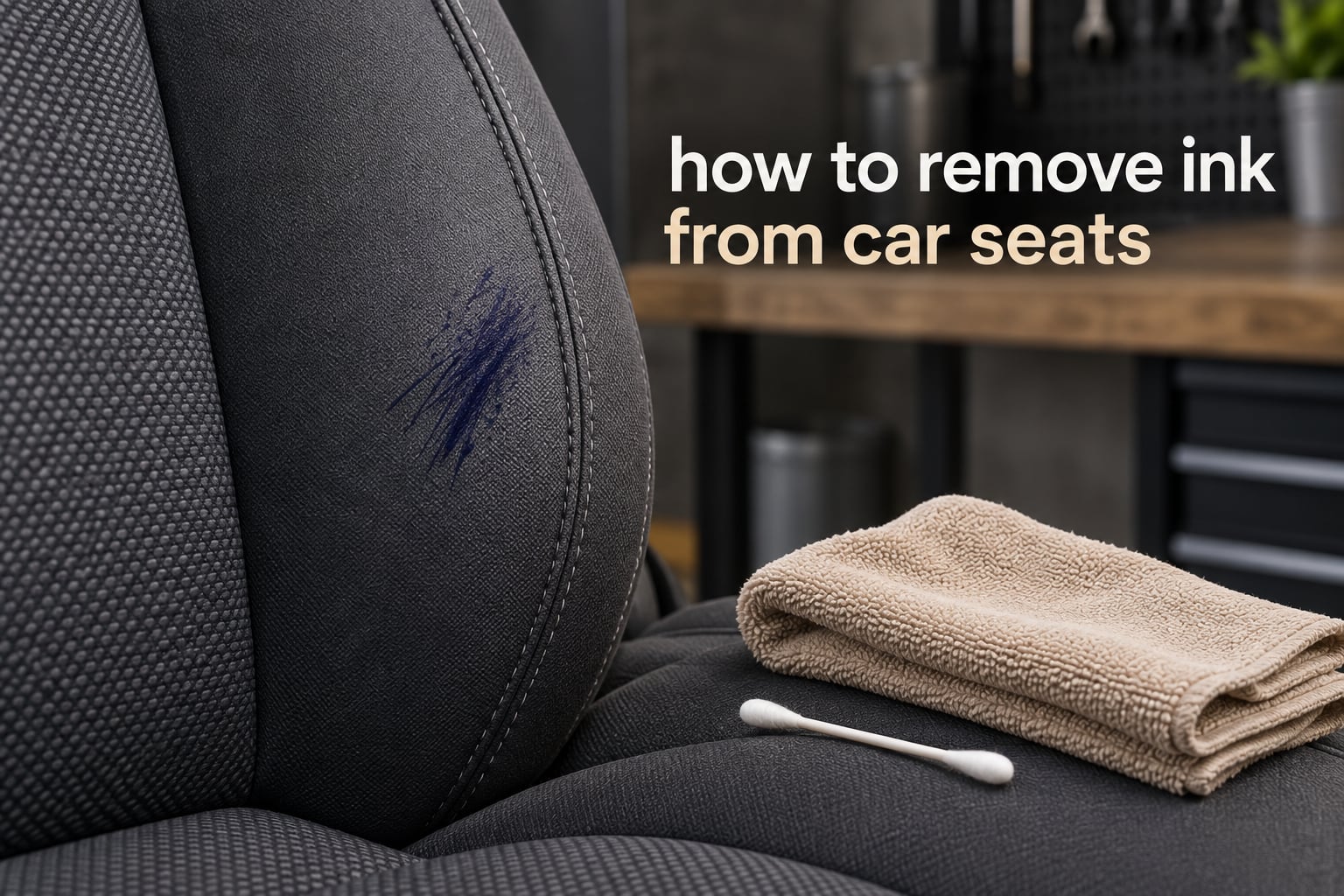
If you are wondering how to remove ink from car seats, the answer is simpler than it looks: you dissolve the carrier liquid and lift the pigment onto a clean towel. Blot the mark, work 70% isopropyl alcohol into it with a cotton swab in short straight passes, and never scrub. Which method you use depends on whether your seats are leather, vinyl or fabric, and on how old the ink is.
We work on seats with ink out of them every week, and the biggest factor in whether a mark comes out is not the product. It is how long the ink sat there. Everything below is the order we would run on the bench.
By the fitting and trimming team at Segal Motor Trimmings | Published and reviewed in October 2026
- Test a hidden spot first. Put a few drops of your solvent on a seam or under the seat lip, wait 60 seconds, then look for colour change or stiffness.
- Blot fresh ink immediately. Press a clean microfiber towel straight down, lift, and repeat with a fresh section. Do not wipe side to side.
- Load a cotton swab with 70% isopropyl alcohol and dab from the outside of the mark toward the centre.
- Change the swab every pass. A dirty swab re-deposits the pigment you just lifted.
- Stop and reassess in daylight. If the mark is only lighter, not gone, repeat with a dedicated leather cleaner.
- Condition leather or vinyl afterwards so the finish does not dry out and crack.
- On fabric, pre-treat, agitate and extract rather than blotting alone. Cloth behaves nothing like leather.
Table of Contents
- The 48-Hour Window: Why Fresh Ink Is Far Easier to Remove
- Step 1: Identify Your Seat Material Before You Open a Bottle
- Ballpoint vs Gel Pen vs Permanent Marker: What You Are Actually Dealing With
- How to Remove Ink from Leather Car Seats
- How to Remove Ink from Vinyl Seats
- How to Remove Ink from Fabric and Cloth Car Seats
- Perforated and Ventilated Seats: How to Keep Cleaner Out of the Holes
- What NOT to Use on Car Seats
- If You Already Made It Worse: Shiny Halo vs Faded Shadow
- When Ink Removal Fails: Re-Dye, Recondition, or Replace the Panel
- How to Stop Ink Stains From Happening
- Frequently Asked Questions
- Can pen ink be removed from leather car seats?
- How do you get ballpoint pen ink out of leather car seats?
- What removes an ink pen from vinyl seats?
- How to get pen ink out of car seat fabric?
- What takes ink out of upholstery fabric?
- Does Dawn dish soap remove ink?
- Will rubbing alcohol damage leather car seats?
- Can you use a magic eraser on car upholstery?
- Will WD-40 remove ink from leather?
- How long does ink take to set in leather, and is an old stain still removable?
- Is baking soda safe for leather car seats?
- Can I re-dye a leather car seat myself?
The 48-Hour Window: Why Fresh Ink Is Far Easier to Remove
Ink is pigment suspended in a carrier liquid. While the carrier is still there, a solvent can dissolve it and the pigment transfers to whatever you touch it with. Once the carrier has evaporated, the pigment has had days or weeks to migrate down into the grain, under the urethane topcoat, or deep into a fabric fibre.
That is why commercial ink removers are built around a freshness window. As one detailing source put it, an ink remover for protected leathers is designed for recent contamination, and marks older than three to five days may not respond or will only be lightened. The same limit applies to every household method on this page.
So the honest priority order is speed first, material knowledge second, solvent choice third. A ballpoint mark caught in ten minutes comes out with a damp towel. The identical mark found three weeks later is a refinishing job. If a fresh spill is happening right now, get to the material section and come back to the rest later.
Step 1: Identify Your Seat Material Before You Open a Bottle
Most failed ink removals start with the right solvent on the wrong surface. Thirty seconds of checking saves an hour of damage.
| What you see | What it is | Safe approach |
|---|---|---|
| Visible grain, water beads on the surface then slowly absorbs | Coated or semi-aniline leather with a urethane topcoat | 70% isopropyl alcohol or a pH-balanced leather cleaner |
| Water disappears instantly, colour changes when wet | Full aniline leather, nubuck or suede | Dry methods only, very light pressure, expect limits |
| Uniform plastic grain, stitched seams, fabric weave at the edge | Vinyl or leatherette | Isopropyl alcohol works, but check for dye transfer first |
| Woven or knitted surface, absorbs water, no grain | Cloth or fabric upholstery | Pre-treat, agitate, extract. Skip alcohol on light colours |
| Fine holes in clusters, sport-seat pattern | Perforated or ventilated leather | Apply to the towel, never the seat |
The water-bead test is the fastest read you can do. Put a drop of water on an inconspicuous part of the seat. If it sits on top for a few seconds, there is a topcoat protecting that leather and alcohol is safe. If it darkens immediately and spreads, the leather is aniline, and alcohol will take colour with the ink.
Ballpoint vs Gel Pen vs Permanent Marker: What You Are Actually Dealing With
Matching the pen to the solvent saves you from escalating to something harsher than you need.
| Ink type | How it behaves | What lifts it |
|---|---|---|
| Ballpoint | Oil-based, sits on the surface, transfers to a towel almost immediately | 70% isopropyl alcohol, then a leather cleaner for the shadow |
| Gel pen | Pigment-heavy, leaves a coloured ghost after the dark line lifts | Alcohol first, then a dedicated ink remover. A faint tint usually remains |
| Permanent marker such as a Sharpie | Dense dye resin, bonds fast, alcohol barely touches it | Dedicated permanent ink remover with repeated dwells. Re-dye is often the honest answer |
| Transfer from clothing | Often denim dye rather than ink, and it keeps coming back | Fresh alcohol lifts it, but it only stops returning if you stop wearing the source |
A toddler drawing in permanent marker on the back seat is the scenario we are asked about most, and it is the least forgiving. Set expectations early. You can often fade such a mark from heavily visible to faintly visible, which on light leather still reads as a stain.
How to Remove Ink from Leather Car Seats
- Spot test. Put a few drops of 70% isopropyl alcohol on a hidden seam and wait 60 seconds. Any whitening, colour shift or stiffening means stop and use a pH-balanced leather cleaner instead.
- Blot the surface ink. Press a clean microfiber towel down, hold 10 seconds, lift. Repeat with a fresh section until the towel comes away clean. This alone handles most fresh ballpoint.
- Load a cotton swab with 70% isopropyl alcohol. Roll it along the outside edge of the mark, working inward in short straight lines. Never use circles. Pigment pushed around under friction ends up deeper in the grain.
- Swap swabs constantly. Each swab carries ink off the seat. A dirty one just spreads the mark into a wider, lighter halo.
- Lift and check in daylight. Stop every 30 seconds. A dark line fading to a soft shadow is progress. No change after four or five passes means the ink is set.
- Move to a dedicated leather cleaner for set-in ink. Apply it to the towel rather than the seat, let it dwell 60 seconds, then blot. Higher-strength alcohol strips the topcoat, so this is where you stop escalating.
- Condition the leather. Work in a conditioner and let it dry fully before sitting down. Alcohol leaves the surface dry and pale, and on ivory, beige or cream seats this step is the difference between a fix and a complaint.
On nubuck and suede, stop after step 2. There is no topcoat to preserve and any liquid takes dye with it, so a dry suede brush is the honest limit of what you can do yourself.
How to Remove Ink from Vinyl Seats
Vinyl responds to the same solvents as coated leather because it is a coated surface, but it behaves differently in two ways. Vinyl is more heat sensitive, so never leave a freshly treated seat in direct sun to dry, and vinyl dyes layer in a way that can transfer onto your towel and your hands.
- Check for dye transfer first. Press a damp white cloth on a hidden area. Colour on the cloth means the vinyl is surface-dyed and alcohol will take colour with the ink.
- Blot fresh ink with a dry microfiber towel, working outside-in under light pressure.
- Dab with 70% isopropyl alcohol on a soft detailing swab, in short straight passes.
- Watch the swab. If ink stops transferring but the mark persists, the pigment is inside the vinyl. A dedicated plastic and vinyl cleaner with a longer dwell works better than more alcohol.
- Clean the surrounding panel. Door cards and armrests get marked at the same time, and a half-cleaned panel reads as damage.
- Finish with a vinyl protectant to restore sheen evenly across the panel.
How to Remove Ink from Fabric and Cloth Car Seats
Cloth is the most common version of this question and the worst served by advice written for leather. The workflow is pre-treat, agitate, extract. Blotting alone lifts the surface and leaves the line.
- Vacuum or brush the seat first so you are not grinding loose grit into wet fabric.
- Pre-treat with dish soap. Mix a couple of tablespoons of Dawn into a cup of warm water, dampen the area, work it in gently, and leave it 10 to 15 minutes.
- For light-coloured cloth, go gentler. Use a dilute Woolite solution, roughly 6 parts hot water to 1 part Woolite, sprayed on and left about 30 seconds before you work it in.
- Agitate with a soft-bristle brush in short strokes following the weave. A powered brush attachment on a carpet extractor works well if you have one.
- Use a baking soda paste for stubborn spots. Mix it with just enough water to spread, apply, and leave 15 minutes before scrubbing lightly.
- Extract. Use a wet vacuum or upholstery extractor with a diluted white vinegar solution to pull the loosened pigment out of the pad rather than push it deeper.
- Dry with airflow. A fan on high for several hours prevents musty smell and re-setting. A damp cloth seat in a warm car will smell within days.
| Method | Dwell time | Works on | Risk |
|---|---|---|---|
| 70% isopropyl alcohol | Work while wet | Ballpoint and gel on darker cloth | Low on dark, can bleach light or patterned cloth |
| Dawn dish soap pre-treat | 10 to 15 minutes | All ink types on cloth | Very low, rinse thoroughly |
| Woolite 6 to 1 in hot water | 30 seconds | Set-in ballpoint on cloth | Low |
| Hydrogen peroxide stain remover | As labelled, then extract | Ballpoint and gel on pale cloth | Medium, test first, can bleach |
| White vinegar solution | 5 minutes | Ballpoint residue and odour | Low, but never leave it to dry on leather |
| Baking soda paste | 15 minutes | Surface marks and general grime | Low, mild abrasion if scrubbed |
Order matters. Do not stack every method in that table on one seat. Run the gentlest first, look at the result in daylight, and only then move down the list.
Perforated and Ventilated Seats: How to Keep Cleaner Out of the Holes
Perforated leather is where solvent work turns into a permanent dark halo. Liquid that enters a perforation carrying pigment with it deposits the stain inside the hole, where no surface cleaning will reach it.
- Never spray or pour directly onto a perforated seat. Apply to the towel or swab instead.
- Fold a microfiber towel into a narrow edge so you can load solvent on one face and press it into the leather rather than flooding the surface.
- Work cotton swabs around each hole, one hole at a time, light pressure, no pooling.
- After the ink lifts, run a damp cloth over the panel to rinse, then press a dry towel firmly into the perforation pattern to pull the moisture back out.
What NOT to Use on Car Seats
Every method below has a forum thread behind it saying it worked. The mechanism is what matters.
| Product | What it does to a seat | Verdict |
|---|---|---|
| Acetone and nail polish remover | Dissolves the urethane topcoat permanently, leaving matte cracked leather | Never on leather or vinyl |
| Magic eraser (melamine foam) | A mild abrasive that scrapes off the topcoat and surface pigment, leaving a white or shiny halo worse than the ink | Never on leather. Caution on fabric, dab only |
| Bleach and chlorine cleaners | Strips dye and oxidises fabric fibre | Never inside the cabin |
| WD-40 | Will lift ink, being a petroleum solvent, but softens the topcoat and leaves a greasy patch that traps dirt | Caution. Works, then costs you a re-condition or refinish |
| Degreaser or oven cleaner | Made for metal and grease, not coated upholstery | Never |
| Hairspray | Alcohol-based, so it does dissolve ink, but a long soak floods the topcoat and leaves a stiff pale patch | Caution, short spray and immediate blot only |
The hairspray argument is worth settling, because plenty of owners swear by it. It is not a myth. Its useful window is just tiny. A light spray blotted within seconds behaves like diluted alcohol. A soak left to dry is what strips and bleaches the finish, and the popular advice to follow it with a magic eraser is the exact sequence that produces a halo. If you use it, keep it brief and always follow with conditioner.
On the magic eraser, the mechanism matters more than the warning. Melamine foam is a mild abrasive. On fabric it can be useful, dabbed gently. On leather it sands off the topcoat and the pigmentation underneath, so the mark does not fade, it gets deleted along with the colour around it. That is why the stain looks lighter than the seat afterwards. It is not progress.
If You Already Made It Worse: Shiny Halo vs Faded Shadow
Two very different things can happen after you work on an ink stain, and telling them apart decides what you do next.
- A faded shadow is still darker than the leather around it but has lost its crisp edge. You are still winning. Keep working gently and move to a dedicated cleaner.
- A white or lighter halo is lighter than the surrounding leather. You have removed pigment, not ink, because the surface colour came off with the solvent or an abrasive took the topcoat with it.
A white halo is the point of no return for do-it-yourself work. Conditioning will not bring the original colour back, because that colour lived in the finish that came off. Re-dyeing is the only real repair, and it is where a trimming shop earns its keep. A shiny, stiff or differently reflective patch is a softer version of the same problem, and re-conditioning with a protectant often blends it enough to live with.
When Ink Removal Fails: Re-Dye, Recondition, or Replace the Panel
Some stains are not a cleaning problem. Escalate in this order instead of buying another solvent.
- Try once more, gently. A dedicated ink remover with a proper dwell time is a different chemistry from alcohol, not a stronger version of it.
- Recondition thoroughly. If the seat is dry, pale or stiff, several conditioning sessions over a few days often make a mark far less visible than it was mid-treatment.
- Re-dye the panel. This is the correct fix for a permanent marker stain, a white halo, or set-in ink that has faded but not lifted.
- Replace the panel. If the foam underneath is saturated or the bolster is torn, a clean and re-dye will not save it.
Before anyone sprays anything, find your interior colour code. It is stamped on the driver’s door jamb, usually on a sticker or plate alongside the VIN. That code gives you the factory colour, which is the difference between a spot blend that matches and a panel that is slightly wrong forever. Our rule is that any colour gets test-matched on a piece of spare vinyl first, off the car, in daylight. A match on a screen is meaningless. A match in a car park at 4pm is worth something.
How to Stop Ink Stains From Happening
The cheapest ink removal is the one you avoid. A protectant on the driver’s bolster, the inner armrests and the door pulls buys you a window in an accident, because the liquid sits on the barrier instead of soaking in.
- Apply a leather or vinyl protectant to high-contact surfaces and refresh it a few times a year.
- Wipe the bolster and armrests with a quick detailer weekly. Fresh ink lifts far more easily than ink that has had a week to set in a warm car.
- Stow pens in a door pocket or console tray, not a back pocket. A leaking ballpoint in a back pocket is the most common way ink reaches a seat.
- Keep pen caps on. A loose cap in a glovebox is how Sharpie reaches upholstery in the first place.
- For a back seat with kids in it, a fitted cover or wipe-clean mat buys more time than any cleaning method recovers later.
Frequently Asked Questions
Can pen ink be removed from leather car seats?
Yes, if you act inside roughly 48 hours. Blot with a clean microfiber towel, then dab 70% isopropyl alcohol on with a cotton swab in short straight passes, changing the swab each time. Ink that has set in past a few days will fade rather than disappear, so finish with a leather conditioner.
How do you get ballpoint pen ink out of leather car seats?
Spot test a hidden seam, then press a dry microfiber towel down on the mark and lift. Most fresh ballpoint transfers straight to the towel. For the rest, work 70% isopropyl alcohol in with a cotton swab, outside edge toward the centre, never in circles. Swap the swab each pass and condition the leather when you finish.
What removes an ink pen from vinyl seats?
Isopropyl alcohol and a dedicated plastic and vinyl cleaner both work, because vinyl is a coated surface like leather. Check for dye transfer on a hidden area first, since surface-dyed vinyl can lose colour with the ink. Blot, dab in short straight passes, and finish with a vinyl protectant. Never use acetone.
How to get pen ink out of car seat fabric?
Use the pre-treat, agitate and extract workflow. Work Dawn dish soap in and leave it 10 to 15 minutes, agitate with a soft brush following the weave, then pull the pigment out with a wet vacuum or upholstery extractor. Air dry with a fan afterwards. Dabbing alone lifts the surface and leaves a line behind.
What takes ink out of upholstery fabric?
The reliable options are 70% isopropyl alcohol for fresh ballpoint, a Dawn dish soap pre-treat for all ink types on cloth, and dilute Woolite, roughly 6 parts hot water to 1 part, for set-in marks. Test alcohol on light or patterned fabric first. Whatever you pick, extraction is the step people skip and the one that matters.
Does Dawn dish soap remove ink?
Yes, on fabric. It is a surfactant, so it gets between the fibres and lifts the ink off the surface for an extractor to pull away. It does almost nothing on leather or vinyl, where there is no fabric structure to penetrate. Pair it with a hydrogen peroxide stain remover for set-in ballpoint on cloth seats.
Will rubbing alcohol damage leather car seats?
On coated leather, 70% isopropyl alcohol used sparingly with a cotton swab and followed by a conditioner is safe, and it is our standard first step. The damage comes from three habits: scrubbing, soaking the panel, and leaving high-concentration alcohol to dry. Alcohol strips oils and dulls colour, which is why conditioning is not optional.
Can you use a magic eraser on car upholstery?
On leather, no. Melamine foam is an abrasive, and on leather it sands the topcoat off along with the ink, leaving a white or shiny halo that is harder to fix than the stain. On fabric it can help, used gently and dabbed rather than scrubbed. Once a halo appears, no cleaner returns that colour and refinishing is the repair.
Will WD-40 remove ink from leather?
It can, because WD-40 is a petroleum solvent and ink dissolves in it. The problem is what it leaves behind: the topcoat goes soft and dull and a greasy patch stays in the surface, holding dirt. If you use it, expect to recondition the panel properly afterwards. You have traded a stain for a refinishing decision.
How long does ink take to set in leather, and is an old stain still removable?
Treat the first 48 hours as your real window. Marks older than three to five days tend to lighten rather than disappear, because the pigment has migrated into the grain or under the topcoat. You can still fade an old mark far better than leaving it, but plan on refinishing the panel if the seat is a light colour.
Is baking soda safe for leather car seats?
As a dry paste, yes, and it is useful for surface marks and general grime. Leave it about 15 minutes and scrub very lightly. Do not leave a wet paste on leather, and do not use it on nubuck or suede, where the paste takes dye with it. On cloth it pairs well with a dish soap pre-treat.
Can I re-dye a leather car seat myself?
Technically yes, with spray dye matched to the factory interior colour code, but colour match is the whole difficulty. Find the code on the driver’s door jamb and test the colour on spare vinyl, in daylight, before it goes near the seat. A mismatched panel is visible forever. Set-in permanent marker also needs the surface abraded back first, which is bench work.
Learning how to remove ink from car seats comes down to four habits. Act inside 48 hours, know whether you are holding leather, vinyl or cloth, blot with a solvent and never scrub, and condition the surface when you are done. Those four cover the large majority of the pens and markers that end up in cars.
When a mark will not lift, the useful next step is not a stronger chemical. It is a decision between re-conditioning, re-dyeing and replacing the panel, and the interior colour code on the driver’s door jamb tells you which is realistic before you spend an afternoon on it.