
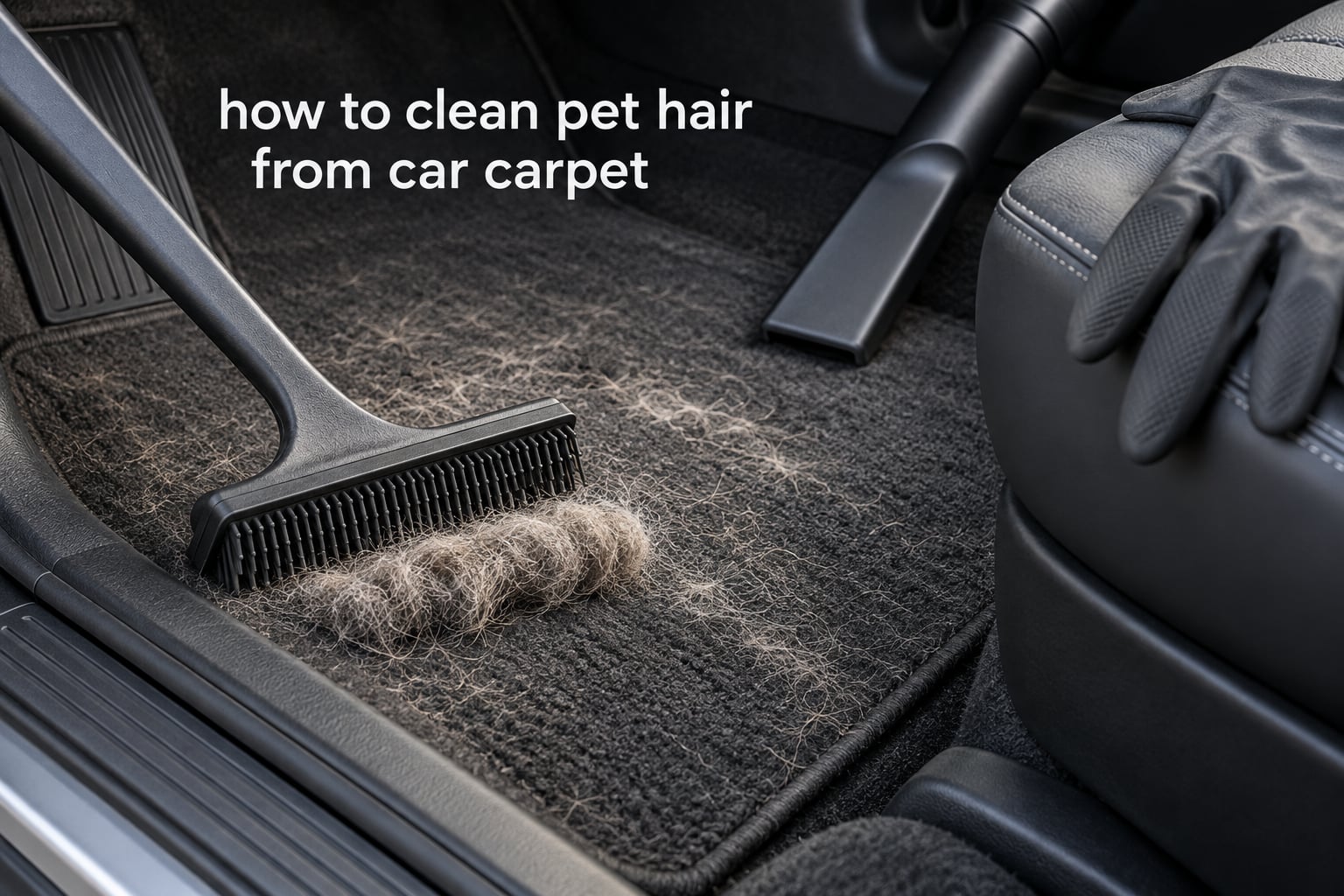
Pet hair in a car is not a dirt problem, it is an anchoring problem. Once a strand of fur works down between the carpet fibers and wraps around the pile, a vacuum rides straight over it. The reliable method is to loosen the hair first with a rubber pet hair brush or a slightly damp rubber glove, rake it in one direction only, and vacuum immediately while you brush.
That single sequence is what detailers actually do, and it is why a rubber-bristle brush is the most-recommended tool across nearly every detailing forum we read. Most people who struggle with this problem own a perfectly good vacuum and use it in slow back-and-forth passes, which pushes hair deeper instead of pulling it out. Learning how to clean pet hair from car carpet well is mostly a matter of changing the order of those two jobs and the direction you move in.
Pro tip: work in small sections, roughly the size of a door panel, and keep the vacuum nozzle moving while the brush is on the carpet. Brushing and vacuuming at the same time is dramatically more effective than doing them in sequence, and one user on a detailing forum reported a full car cleared in about 15 minutes that way.
Table of Contents
- Why Vacuuming Alone Fails on Car Carpet
- What You Need Before You Start
- How to Clean Pet Hair From Car Carpet: Step by Step
- Match the Tool to the Hair Type
- Floor Mats, Factory Carpet and the Trunk Are Three Different Jobs
- No Tools? DIY Alternatives That Actually Work
- How Long It Takes and How Often You Should Do It
- Deep Clean the Carpet After the Hair Is Gone
- Mistakes That Damage Car Carpet
- How to Stop Pet Hair Coming Back
- Frequently Asked Questions
- What do detailers use to remove pet hair?
- What to spray on car carpet before vacuuming?
- What is the best dog hair remover for vehicles?
- What gets rid of dog hair in a car?
- How do professional detailers get dog hair out of carpet?
- What kind of brush can I use to remove pet hair from my car carpet?
- What is the best way to get dog hair out of the carpet in my car?
- Why does my vacuum barely pick up dog hair from car carpet?
- Wrapping Up
Why Vacuuming Alone Fails on Car Carpet
Embedded pet hair is hair that has been worked down into the carpet pile by weight, body movement and vibration until it is held in place by friction and a static charge between the fiber and the hair itself. At that depth it is below the reach of most household vacuum nozzles, so the machine passes over a carpet that looks unchanged.
Back-and-forth vacuuming makes it worse. Each stroke drags the pile over the anchored strand, which presses the hair deeper and re-tamps the fibers around it. The right goal is not to lift the hair off the surface, it is to pull it out of the pile, which is why the best tool for the job is a rubber bristle brush or a damp glove rather than a stronger vacuum setting.
Rubber works because it creates friction without generating the fine abrasions a stiff nylon brush leaves in the fibers. Drag it across the carpet and loose hair rolls up into a wad instead of scattering. Dampen the glove very slightly and the effect increases, because a thin moisture film makes the rubber grip the pile a little harder.
This is also why owners who use mats put the job off for months. Hair mats into the mat fibers and the pile beneath them at the same time, so the problem grows in two places at once until it feels unfixable.
What You Need Before You Start
Detailers reach for a small, repeatable kit rather than a large one. If you want the professional method, this is the list.
- Rubber pet hair brush. The core tool. A rubber squeegee works as a close substitute on flat carpet.
- Shop vac or a vacuum with a crevice attachment. Suction matters less than airflow, and a narrow nozzle lets you work a seam at a time.
- Damp rubber or latex gloves. Cheap, and the only tool you need for a light shedding coat.
- Sticky parcel tape. A secondary pickup for hair the vacuum will not catch. Single-sided, not duct tape.
- Small detail brush. For the carpet edges, the seat rails, the trunk hinge recesses and the door pockets.
- Old towels or a microfiber cloth. If you plan to shampoo the carpet afterwards.
For hair specifically, most people do not need a spray. Pre-treatments matter for stains and odour, not for fur. See the deep clean section for what to use once the hair is lifted.
How to Clean Pet Hair From Car Carpet: Step by Step
Follow these six steps in order. Skipping straight to the vacuum is the single most common reason a car still looks hairy after twenty minutes of work.
1. Clear the area and dry vacuum
Take out every floor mat, move anything stored in the trunk, and clear the footwells. Vacuum the carpet dry first, on the highest suction setting, to remove grit. Sand and dried mud under a pile of hair will grind into the fibers during brushing and dull the carpet permanently.
2. Loosen the hair with the brush or glove
Put on the damp rubber glove or pick up the rubber brush. Make short, light strokes over the carpet to break the static hold and start the hair rolling. At this stage the goal is to see wads forming on the surface, not to clear the carpet completely.
3. Scrape in one direction only
Now rake the brush steadily in a single direction, taking about 30 cm strokes, and let the hair gather ahead of the tool. This is the step people get wrong. Raking the pile over a strand of hair re-anchors it, so reversing direction undoes the work you just did. Lift the brush, move it back to the start, and rake again the same way.
4. Pick up or vacuum immediately
Vacuum the wads before they settle back down. Best results come from vacuuming while you brush, moving the nozzle in the same direction as the brush, so loosened hair goes straight into the hose instead of drifting across the carpet. Most household vacuums do fine here because the hair is now on top of the pile rather than inside it.
5. Repeat until the passes come up clean
Change the brush angle on the second round. A different approach to the pile reaches fibers the first pass flattened. Two or three passes in the same area is normal for a heavy coat, and you will feel the brush start to glide once the hair is gone.
6. Treat what is left in the fibers
Anything still visible after two passes is either a single long strand wrapped around a fiber bundle or hair sitting in a seam. Pull strands out by hand or use sticky parcel tape pressed on and lifted straight up. For seams and corners, drop to the crevice tool and use the rubber brush rather than more suction.
Match the Tool to the Hair Type
Short-haired and long-haired pets need different tools, and the AI-generated answers on this topic keep asking readers to clarify which one they have. This breakdown answers it directly.
- Short, fine coat shedding year round (Labrador, Beagle, most cats). Use a damp rubber or latex glove, then a vacuum. Move in slow glove strokes toward you, roll the hair into a wad and vacuum it immediately. Expect 10 to 20 minutes for one car.
- Long undercoat blowout (Husky, German Shepherd, Golden Retriever). Use a rubber pet hair brush or a rubber squeegee. Rake in one direction only with 30 cm strokes and vacuum on the pass directly behind the brush. Expect 45 to 90 minutes.
- Double-coated breed in shed season. Use a rubber brush plus a shop vac with a crevice attachment. Work section by section, brushing and vacuuming at the same time, three passes per area. Expect 90 minutes to 2 hours.
- Cat hair on carpet. Use a rubber squeegee or a damp glove. Take short sharp strokes, keep the pile moving and do not press down. Expect 15 to 25 minutes.
- Rubber or textile floor mats. Use a rubber brush, or a stiff brush on rubber-backed mats. Brush the mat face down off the edge of a table or into a bin, then wash it. About 5 minutes per mat.
- Trunk and cargo carpet. Use a rubber brush, then a vacuum with a wide nozzle. Work from the hatch forward so hair moves toward the opening. Expect 20 to 40 minutes.
Long undercoat hair is the hardest case because it wraps around fiber bundles instead of sitting on top of them. If a brush pass leaves the carpet looking clean but hair reappears a day later, the strands were pulled off the surface and not out of the pile. Go back over that area with a slower, firmer rake.
Floor Mats, Factory Carpet and the Trunk Are Three Different Jobs
A mat and factory carpet respond to different things. A rubber-backed mat has a flat, hard surface, so a stiff brush or even a hand broom works well and the mat can come out of the car and be beaten outside. Factory carpet has a pile, and a stiff brush on carpet fluffs the fibers so badly that the carpet then needs shaving with a razor to look level again.
So treat mats with the aggressive setting and the factory carpet with the rubber brush. Tap the loose hair out of the mat fibers first, then vacuum both sides. Most owners who feel they have a mat problem are actually looking at hair trapped in the pile beneath the mat, which is why moving the mat reveals a second, worse layer.
The trunk carpet is the most neglected area in the whole car. It gets wet, it holds moisture, and hair packed into it is usually the source of any damp smell that appears later. Give it its own pass rather than treating it as an extension of the back seat.
No Tools? DIY Alternatives That Actually Work
If you have nothing in the glovebox, several household items do a surprising amount of the job.
- Damp rubber gloves. The most-recommended item on every detailing forum we checked. Slightly damp, not dripping.
- Sticky parcel tape. Press it down on the pile and peel it straight up. One user on a Jeep forum reported this working after duct tape, a household vacuum, a shop vac and a wire brush had all failed.
- A nail brush from a craft store. Cheap and stiff enough to loosen embedded hair without cutting the pile.
- A damp microfiber cloth. Better than nothing on light shedding, though it smears rather than collects.
- A dryer on cool. Moving air lifts hair off the surface so you can collect it, but keep it cool and keep it moving. Heat and a parked nozzle can damage carpet fibers.
Two popular options deserve a warning. Duct tape leaves adhesive residue and grabs nothing useful, and a wire brush is the fastest way to make a car carpet look permanently fuzzy. A disposable razor is used by some owners on flat areas and doubles as a bobble remover, but skip it on patterned or stitched carpet where the blade can cut yarn.
How Long It Takes and How Often You Should Do It
Time depends almost entirely on the coat. A short-haired pet in a small car is a 15-minute job. A German Shepherd in shed season across a large SUV is a two-hour job, and that is a realistic number rather than a complaint.
When you are in a hurry, here is the 20-minute express routine: take the mats out and hit them outside, vacuum the footwells and seat edges, then do a fast damp-glove pass from the seat line forward with the vacuum following directly behind. That gets about 80 percent of the visible hair and leaves the deep pile for a full session later.
For cadence, weekly is enough for most owners with a weekly vacuum. Do a full pass before and after each shedding season, which is when the pile is deepest. Anyone with a double-coated breed should treat shedding season as a monthly task rather than a seasonal one, because the undercoat builds faster than it sheds.
Deep Clean the Carpet After the Hair Is Gone
Once the pile is clear, a light shampoo treatment is worth it, because hair removal often leaves the carpet smelling of trapped dander even when it looks clean. Work an automotive carpet shampoo or an enzyme cleaner into the carpet with a handheld brush, keeping the product damp rather than wet, and blot with clean towels rather than scrubbing.
Drying is the part people rush. Run the heater and fan on high with the doors open until the carpet is completely dry to the touch, including under the mats. Carpet that stays damp inside a closed car develops a wet-dog smell within days, and that smell is very hard to remove later. One detailer warned in a forum thread that over-wetting a car carpet is what creates an overpowering smell, and that advice matches what we have seen in practice.
For odour without shampoo, baking soda scattered over the dry carpet, left for several hours and vacuumed up works as a deodorizer. It does not remove hair, so use it after the brush work, not instead of it.
Mistakes That Damage Car Carpet
Carpet in a car has limited recovery. It cannot be replaced section by section, and factory carpet is thinner than carpet in a house, so damage shows faster.
- Back-and-forth scrubbing. The most common habit and the least effective one. Rake in one direction only.
- Stiff or wire brushes on factory carpet. They fluff the pile, and the carpet then needs shaving to look level again.
- Over-soaking. Saturation pushes water into the floor pan and under the trim, where it stays and smells.
- Bleach and ammonia-based cleaners. They can bleach the dye and, at concentration, attack the foam backing that holds the pile.
- Duct tape. It leaves adhesive on the fibers and picks up almost no hair.
- High heat from a dryer parked on one spot. Carpet fibers melt and flatten permanently.
How to Stop Pet Hair Coming Back
Cleaning is the response. Lining is the fix, and for a car that takes a shedding pet every day, lining turns a two-hour job into a fifteen-minute one.
Rubber all-weather mats are the cheapest option. They are waterproof, they come up with a simple hose-down, and the hair sits on top of a hard surface where a stiff brush works well. The trade-off is fit: a flat mat that does not cover the footwell and trunk edge leaves carpet exposed, and the exposed strip is where hair reappears first.
Custom-fit trunk and cargo liners solve the trunk problem specifically, because the cargo area is where fur collects fastest and where water gets trapped. Since we work on automotive trimmings, this is the part of the car we get asked about most, and the fit difference between a universal mat and a custom liner is the difference between covering the carpet and merely covering most of it.
Two habits do the rest. Brush your dog or cat outside before it gets in, and use seat covers on the rear bench so the hair lands on a washable fabric instead of into a seat seam. A seat cover that comes off and gets laundered weekly removes more hair than any tool used on the seat itself.
Frequently Asked Questions
What do detailers use to remove pet hair?
Detailers use a rubber pet hair brush or a slightly damp rubber glove to break the static hold, then a vacuum with a crevice or wide nozzle to collect what the brush lifts. Many work the two tools simultaneously, brushing with one hand while vacuuming with the other, in small sections. A shop vac is preferred for long undercoat hair because sustained airflow keeps the wad from drifting back onto the carpet. Sticky parcel tape is the usual backup for strands the vacuum will not catch.
What to spray on car carpet before vacuuming?
For pet hair, usually nothing. Hair is held in place by friction and static, not by a stain, so a spray adds nothing to the removal step. Pre-treatment matters for stains and odour, where an enzyme cleaner helps break down organic residue. The one exception is a lightly dampened carpet, which can be misted before brushing so a rubber glove grips the pile harder. Avoid soaking, since water pushed into the floor pan causes a damp smell that outlasts the hair problem.
What is the best dog hair remover for vehicles?
For short-haired pets, a damp rubber or latex glove is enough. For long undercoat hair and double-coated breeds, a rubber pet hair brush or rubber squeegee is the better tool, paired with a shop vac. Match the tool to the coat rather than buying the strongest brush: a stiff bristle brush fluffs factory carpet and then needs shaving to look level. Sticky parcel tape works as a cheap secondary pickup for whatever the vacuum leaves behind.
What gets rid of dog hair in a car?
Loosen the hair with a rubber pet hair brush or slightly damp rubber glove, rake it in one direction only so the pile lays over and releases the strands, then vacuum immediately while the brush is still on the carpet. The order matters more than the equipment. Vacuuming first, or vacuuming back and forth, presses hair deeper into the pile and leaves the carpet looking unchanged. Two or three passes per area is normal for a heavy coat.
How do professional detailers get dog hair out of carpet?
The professional method is a fixed sequence: clear mats and clutter, dry vacuum to remove grit, agitate the pile with a rubber brush or glove, rake in a single direction, and vacuum simultaneously with a crevice or shop-vac attachment. They work in small sections rather than whole surfaces, because a section that is brushed and vacuumed in one pass stays clear. Several sections are repeated at a different brush angle, then seams and corners get a crevice tool and a rubber brush rather than extra suction.
What kind of brush can I use to remove pet hair from my car carpet?
Use a rubber-bristle brush, or a rubber squeegee on flat carpet. Rubber creates friction that rolls loose hair into a wad without abrading the fibers. A stiff nylon or wire brush is the wrong choice on factory carpet because it fluffs the pile, and the carpet then requires shaving to look level again. A small nail brush is a cheap stiff option that loosens embedded hair without cutting yarn. Whatever you use, rake in one direction only, never back and forth.
What is the best way to get dog hair out of the carpet in my car?
Treat the hair as anchored rather than loose. Start by removing floor mats and vacuuming the carpet dry to lift grit, since brushing sand into the fibers dulls them permanently. Next, loosen the hair with a damp rubber glove or rubber pet hair brush, rake in one direction, and vacuum right behind the brush. Repeat each area two or three times at a different angle, then pull out remaining strands by hand or with sticky parcel tape. The trunk carpet needs its own pass, not an extension of the back seat.
Why does my vacuum barely pick up dog hair from car carpet?
Because the hair is embedded in the carpet pile rather than sitting on top of it. Friction and a static charge hold strands against and around the fibers, often below the reach of a household nozzle, so the machine passes over an apparently clean surface. Back-and-forth strokes make it worse by pressing the hair deeper. The fix is to change the order: loosen the hair with a rubber brush or damp glove first, rake it in one direction so the fibers lay over and release it, then vacuum it while it is still on top of the pile.
Wrapping Up
To clean pet hair from car carpet, change the order of the work rather than the strength of the vacuum. Clear the mats, dry vacuum, loosen the pile with a rubber brush or damp glove, rake in one direction, and vacuum immediately behind the brush. Two or three passes per section, then pull out the stragglers by hand or with sticky parcel tape.
Match the tool to the coat, keep the stiff brush off factory carpet, and let a shampooed carpet dry fully before you close the doors. If the job keeps coming back, a rubber mat and a custom-fit cargo liner turn a two-hour reset into a fifteen-minute one, which is the only fix that actually lasts through shedding season in 2026.