
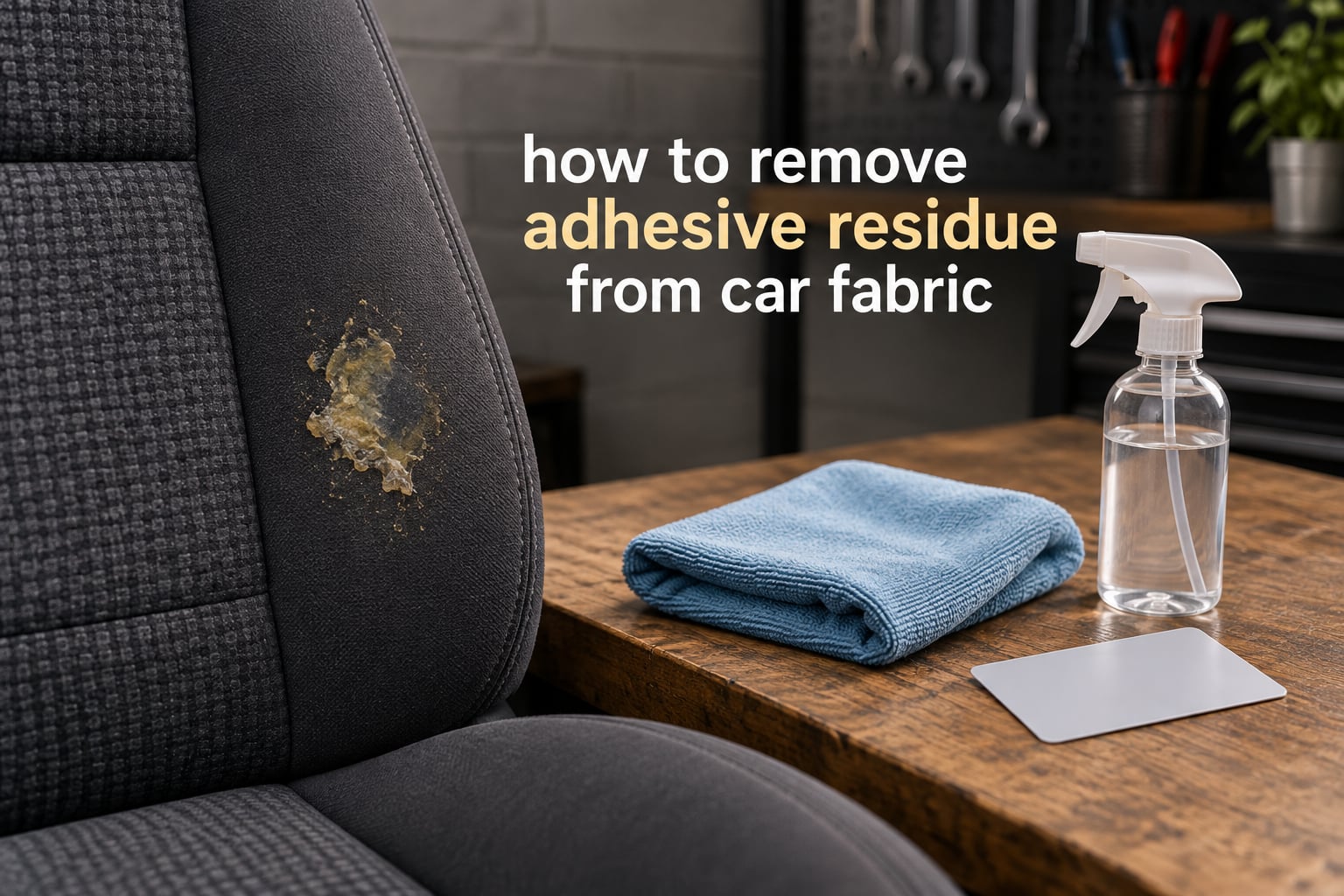
Sticker glue, tape, decal backing, badge adhesive and trim cement all leave the same thing behind: a tacky film bonded into the fibers of your cloth seat, headliner, carpet or door panel. Getting it off car fabric is less about scrubbing harder and much more about picking the right solvent, giving it time to work, and blotting instead of rubbing. This guide walks through the four methods detailers actually reach for, in the order you should try them, plus what never to touch your upholstery with.
I’m not going to pretend this is a glamorous job. I have spent more weekends on this than I’d like to admit, mostly on cars that came with someone else’s bad parking permits, sun-baked dealer decals and tape somebody used as a scratch pad. The good news is that the difference between a clean seat and a torn one comes down to about ten minutes of preparation.
Before you touch anything, work out what the sticky stuff actually is. Adhesive residue on car fabric is leftover pressure-sensitive glue — the same chemistry that makes a vinyl sticker stick to glass in winter — and it can sit there for years after the sticker itself is long gone. Untreated residue attracts dust, darkens the fabric, and slowly works into the foam padding underneath. Learning how to remove adhesive residue from car fabric properly protects the trim you spent real money on.
Table of Contents
- How to Remove Adhesive Residue From Car Fabric: The 3-Step Shortcut
- How to Remove Adhesive Residue From Car Fabric Step by Step
- Which Method Should You Use? A Decision Guide
- Surface-Specific Guidance for Every Fabric Area
- What Not to Use on Car Fabric
- The Kit You Need and the Aftercare Nobody Mentions
- Professional Detailer Tips and When to Call One
- How to Prevent Adhesive Residue on Car Fabric
- Frequently Asked Questions
- Will WD-40 remove adhesive from car fabric?
- Can I use Goo Gone on my car seats?
- Does rubbing alcohol damage car fabric?
- Will Dawn dish soap remove sticker residue?
- What dissolves automotive glue?
- Will hydrogen peroxide remove sticker residue?
- How long should I let adhesive remover sit before scrubbing?
- How do I get super glue off car seat fabric?
- Final Thoughts on Removing Adhesive Residue From Car Fabric
How to Remove Adhesive Residue From Car Fabric: The 3-Step Shortcut
If you want the short version before the detail, here are the three steps that resolve most cases. If you only remember one thing, remember step two.
- Identify the surface and spot-test it. Find the upholstery care label before you start. Dab your solvent into a hidden seam or under the seat rail and wait a few minutes, then check for color transfer on a white cloth.
- Soak the residue with 70% isopropyl alcohol and wait. Saturate the sticky area with a microfiber towel, leave it in place for 10 to 15 minutes, and repeat the soak if the adhesive is thick. The dwell time does the dissolving — not your arm.
- Blot, don’t rub. Press a clean dry microfiber cloth over the spot and lift. Rubbing spreads the dissolved resin into a wider ring and pushes it deeper between the fibers.
Then clean the area with warm soapy water to remove any oily film the solvent left behind. That last step is what stops a clean seat from looking dirty again a week later.
How to Remove Adhesive Residue From Car Fabric Step by Step
Work through these methods in order. Each one is stronger than the last, so stopping early is the single most effective way to protect premium fabric.
Method 1: Start With Warm Soapy Water
Warm soapy water clears fresh residue and gives you a read on the fabric. It dissolves surface dirt and any adhesive that has not fully crosslinked into the fibers, which is usually anything applied in the last few months.
- Mix the solution. Use warm water with a small amount of clear dish soap, roughly a tablespoon per cup. Avoid fabric softener and anything scented — softener leaves a film that traps dirt.
- Work it in gently. Dip a soft brush or old toothbrush into the mix and lightly agitate the residue. A stiff brush on a pressure-sensitive adhesive is how you pull threads out of the bolster.
- Wipe and rinse. Wipe with a clean damp cloth, then blot dry with a microfiber towel. Work outdoors or with the doors open so the foam underneath can dry.
Tip: Dish soap on its own is weak against cured adhesive, and several people searching for a fix have reported disappointment with Dawn-style products on baked-on residue. It is a first pass, not a final one.
Method 2: Use 70% Isopropyl Alcohol
Rubbing alcohol at 70% concentration is the safest effective solvent for most car fabric, and it is what most detailers reach for first. Isopropyl alcohol penetrates the synthetic resin in the adhesive and breaks the bonds holding it to the fiber, then evaporates completely without leaving a film behind. Detailers confirm this method repeatedly for cloth and microsuede seats, always with a spot test first.
- Confirm colorfastness. Dampen a white cloth with 70% isopropyl alcohol and rub it into a hidden seam. If dye comes off, dilute with distilled water or stop and go gentler.
- Soak, do not scrub. Fold a microfiber towel, soak it in alcohol, and lay it flat over the residue. Leave it for 10 to 15 minutes. For adhesive that has baked on in the sun for months, extend to 20 minutes and re-wet rather than scrubbing dry.
- Blot from the outside in. Press a clean dry microfiber cloth down and lift straight up. The residue will transfer onto the cloth as a dark, greasy transfer.
- Lift stubborn film with a plastic edge. For anything still clinging, lay another soaked towel on top and gently draw a plastic card or a putty knife across it. Pressure-sensitive adhesive comes off in a single film this way, a technique documented on the Rennlist Porsche forum.
- Repeat until gone, then wash. Two or three cycles are normal on old residue. Finish by cleaning the area with the soapy water from Method 1 and let it dry fully.
Careful: 91% isopropyl works faster on cured glue, but the higher concentration dries quicker and gives you less working time. It is worth trying on 70% first and only stepping up if the residue resists.
Method 3: Use an Automotive Adhesive Remover
Specialized automotive adhesive removers are the strongest option for residue that has hardened for a year or more. Products sold for automotive trim — the orange-pad spray category, 3M’s adhesive remover line, and citrus-based d-limonene formulas — are formulated for oil and rubber polymer adhesives and cut through them faster than alcohol.
- Read the label for upholstery. Some formulas are approved for paint, glass and plastic only. Check specifically for fabric, vinyl and headliner compatibility.
- Apply to a microfiber towel, not the seat. Spraying directly risks saturating the foam padding beneath and pushes adhesive deeper. Dampen the towel instead.
- Give it a 10 to 15 minute dwell. On the Rennlist forum, users pairing a plastic putty knife with an automotive adhesive remover report a clean single-piece lift after that soak. Users of a 3M specialty adhesive remover describe similar results on interior plastic and vinyl.
- Peel rather than smear. Loosen the edge with the plastic card and peel the film back on itself. Smearing turns a solid layer into a thin film over a wider area.
- Wash immediately. Every one of these products leaves an oily film if you skip the wash. That film attracts dust and makes the seat look worse than before you started, the most common complaint seen about them on forums.
Careful: Citrus-based and heavy-solvent formulas are noticeably more aggressive than alcohol. Work in small sections with ventilation, and never move from a tested spot to an untested one.
Method 4: Try a White Vinegar Solution
White vinegar is the low-risk household option and it works on light, recent residue. Acetic acid softens the adhesive and lifts it from the fiber without stripping dye. Commenters on TorqueNews have reported success with white vinegar combined with hot water and dish soap for lighter residue on fabric surfaces.
- Dilute it. One part white vinegar to two or three parts warm water. Straight vinegar on upholstery is acidic enough to dull a dye over repeated applications.
- Apply and dwell for 5 to 10 minutes. Spray into a cloth rather than the seat, and keep the area damp during the wait.
- Blot and re-treat. Blot with a clean cloth, then reapply if residue remains. Two or three passes are typical.
Tip: Follow vinegar with the soapy water wash, because the sugar and acid can leave a dull film that only shows up once the seats are warm.
Which Method Should You Use? A Decision Guide
Pick your starting point by adhesive age and how firmly it is holding. This is the shortcut most guides skip, and it saves an hour of trial and error.
- Residue applied in the last few months, still slightly tacky: warm soapy water. It is already loosening, and a solvent is overkill.
- Tape, decal or sticker glue a year or two old: 70% isopropyl alcohol with a 15 minute dwell.
- Sun-baked adhesive that has gone hard and dark: automotive adhesive remover with a plastic card, after an alcohol soak has softened it.
- Fresh super glue or a hot glue blob: dab with alcohol, do not soak, and work the edges inward from the outside.
- Permanent construction adhesive: alcohol and vinegar both struggle. Soak, cover with a plastic-wrapped towel for 30 minutes, then lift the film. If it will not move, call a detailer.
- Unknown residue near a headliner or seatback foam: alcohol only, in the smallest amount that works, so the foam does not stay saturated.
Surface-Specific Guidance for Every Fabric Area
Car fabric is not one material, and a method that is perfect on a seat bolster can ruin a headliner. Here is how the same four methods change by surface.
Cloth Seats
Standard woven cloth takes alcohol well. Blot rather than rub, and expect the dye to be the limiting factor rather than the fiber — spot test on a seam that is not under a seam protector.
Alcantara and Suede
Microsuede and Alcantara are the surfaces people worry about most, and the worry is not unfounded. They trap residue deep in the nap, so cleaning takes several passes rather than one. Use 70% isopropyl with the shortest dwell that works, and always brush the nap dry in one direction afterward to avoid a visible mat.
Headliner
The headliner is foam-backed, does not dry quickly, and shows every mark. Use the minimum solvent that works, blot from the centre outward, and keep windows open until the area is completely dry. Dried-in moisture under a headliner is how you get a mildew smell on a car that was clean last month.
Carpet and Floor Mats
Carpet and rubber mats give you more freedom because nothing is visible when the mat is out. Rubber mats can soak in soapy water, scrub with a brush, and rinsed thoroughly. Carpet needs the same blotting discipline as seats, with an extra pass to pull the slurry back out of the pile.
Door Panels
Door cards are mostly vinyl or soft-touch plastic with fabric inserts, so treat the two parts separately. A damp cloth with soapy water on the plastic, and alcohol on the fabric insert only where the colorfastness test passes. Soft-touch coatings cloud permanently under solvents, so keep the towel damp rather than wet.
What Not to Use on Car Fabric
Most damaged upholstery we see was damaged by a well-intentioned owner, not by the adhesive. These are the ones to leave in the cabinet.
- Acetone and nail polish remover. Acetone dissolves a wide range of synthetic fibers outright and will bleach a print or a colored thread permanently. Forum warning against it on interior surfaces is near-universal. This includes the acetone-based removers sold for plastic work.
- Heat from a hair dryer or heat gun. Heat softens pressure-sensitive adhesive and drives it further into the weave, and it can set the bond harder. Skip it on fabric completely; it is a technique for decals on paint.
- Hydrogen peroxide. It bleaches rather than dissolving, so the residue goes but so does the color around it. Not worth the risk on anything other than white cloth you have already tested.
- WD-40 on fabric. It does soften some adhesives, which is why the idea spreads, but it is designed to leave an oil film. On fabric that film soaks into the foam, attracts dirt, and is very hard to fully remove afterward. It works on vinyl trim and paint. Keep it off upholstery.
- Razors, steel wool and stiff brushes. Any metal edge cuts fabric. Use a plastic card or putty knife, which is what the Rennlist users do.
- Paper towels and shop towels. They shred and leave lint. Microfiber only.
- Hard pressure while scrubbing. The most common self-inflicted wound. Adhesive under a scrubber becomes a set of fiber shreds instead of a removable film.
The Kit You Need and the Aftercare Nobody Mentions
Most of the kit is already in your kitchen. Gather everything first, because interrupting a dwell time to find a towel is how residue gets spread.
- 70% isopropyl alcohol in a spray bottle and a plain cup for dipping
- Microfiber towels — at least four clean ones
- White microfiber cloth for the colorfastness test
- A soft-bristled brush or old toothbrush
- A plastic card, an old gift card, or a putty knife
- Warm water and clear dish soap
- Small spray bottle for vinegar solution
- Paper towels to protect painted or plastic trim nearby
- Masking tape to mark off a test patch while it dries
Aftercare matters more than people expect. Wipe the finished area with warm soapy water to lift the solvent’s oily trail, rinse with a barely damp cloth, then blot dry and let it air out with the doors open. Once fully dry, a fabric-safe protectant leaves a barrier so the next spill sits on top of the surface instead of bonding into the pile.
Professional Detailer Tips and When to Call One
Detailers carry one habit up front: they test in a hidden area, and they change the cloth constantly. A fresh section of microfiber picks up resin, and once a dirty towel goes back over the spot you are reapplying the contamination. They also let the product do the work, which is the opposite of what most people do with a stubborn spot.
Professionals also work small. A two-inch square of adhesive gets treated first, and only when that square comes away clean do they move on. Working a whole seat back at once is how an area you fixed ends up needing a second pass, because the wet edge carries adhesive into the clean section beside it.
Call a detailer when the adhesive is in the foam, not the fabric — you will feel the spot stay soft and tacky after the surface residue lifts. The same applies to construction-grade adhesive, to a residue that has spread over more than a seat panel, or to any headliner job on a car worth protecting. A detailer has steam, controlled heat and extraction equipment you will not, and the labour is the expensive part in all three cases.
How to Prevent Adhesive Residue on Car Fabric
Most of this work disappears if you take five seconds beforehand. Apply any tape or sticker to a hard surface, vinyl or glass, never to cloth. If a parking permit has to go on a window, use the adhesive tab rather than a full-coverage decal, and peel it slowly at a low angle so the glue releases instead of tearing off in a sheet. Wipe a new adhesive area with a damp cloth right after removal to lift the last of it while it is still soft. And keep a microfiber towel and a bottle of alcohol in the car — a fresh spill is a two-minute fix, while a year-old one is an afternoon.
Frequently Asked Questions
Will WD-40 remove adhesive from car fabric?
WD-40 softens some adhesives, but it leaves an oily film that soaks into seat foam and carpet and attracts dirt. It is designed for vinyl trim, hinges and paint, not upholstery. Use 70% isopropyl alcohol or an automotive adhesive remover on fabric, and keep WD-40 for hard surfaces.
Can I use Goo Gone on my car seats?
Yes, the automotive version is widely used on car seats, provided you spot-test first and wash the area afterwards. Check the label for fabric and vinyl approval, apply it to a microfiber towel rather than spraying the seat, and give it a 10 to 15 minute dwell. Wash with soapy water afterwards or the oily film it leaves will make the seat look dirtier than before.
Does rubbing alcohol damage car fabric?
At 70% concentration, isopropyl alcohol is safe for most automotive cloth, microsuede and Alcantara when you spot-test a hidden seam first and blot rather than rub. The risk is the dye rather than the fiber. Avoid acetone and nail polish remover, which can dissolve synthetic fibers outright.
Will Dawn dish soap remove sticker residue?
Dish soap in warm water clears light, recent residue and lifts surface dirt so you can see what you are dealing with. It is too weak on adhesive that has cured for months or baked on in the sun. Use it as step one, then follow with isopropyl alcohol if residue remains.
What dissolves automotive glue?
Three things do: isopropyl alcohol, automotive adhesive removers built around oil or citrus solvents, and heat — which is the one to avoid on fabric. On upholstery, alcohol is the safest of the three because it evaporates clean. Heavy solvents work faster but need a longer wash afterwards to remove the oily film they leave.
Will hydrogen peroxide remove sticker residue?
Hydrogen peroxide bleaches rather than dissolving, so it will lighten the dye around the residue as well as lifting it. On white cloth it can work as a last resort after a spot test. On any colored or patterned upholstery the color damage is permanent, so use alcohol instead.
How long should I let adhesive remover sit before scrubbing?
Ten to fifteen minutes is the standard dwell time on car fabric. Re-wet the towel rather than rubbing the area if it dries out first. Thirty minutes with the towel sealed under cling film helps with construction-grade adhesive. Scrubbing before the dwell time is up is the most common way people damage their seats.
How do I get super glue off car seat fabric?
Dab isopropyl alcohol around the edge of the glue and work inward with a plastic card — super glue cures from the outside, so the perimeter releases first. Do not soak the area, since liquid super glue travels into the fibers and spreads as it soaks. Blot with a clean cloth and wash with soapy water when you are done.
Final Thoughts on Removing Adhesive Residue From Car Fabric
Learning how to remove adhesive residue from car fabric is less about finding a magic product and much more about sequence. Soapy water first, 70% isopropyl alcohol second, an automotive adhesive remover only when alcohol has done its best, and a vinegar soak for light residue on sensitive trim. The dwell time does the work, blotting keeps the damage down, and the soapy water wash afterwards decides whether the seat still looks clean in a month.
Nothing on that list requires heat, metal tools or a hard scrub, and that is the whole point. If you have dealt with a parking permit, a dealer decal or tape somebody left behind, start at step one, give it a fair fifteen minutes, and check the result before moving to anything stronger. We refreshed this guide for 2026 and will keep updating it as the method list changes.