
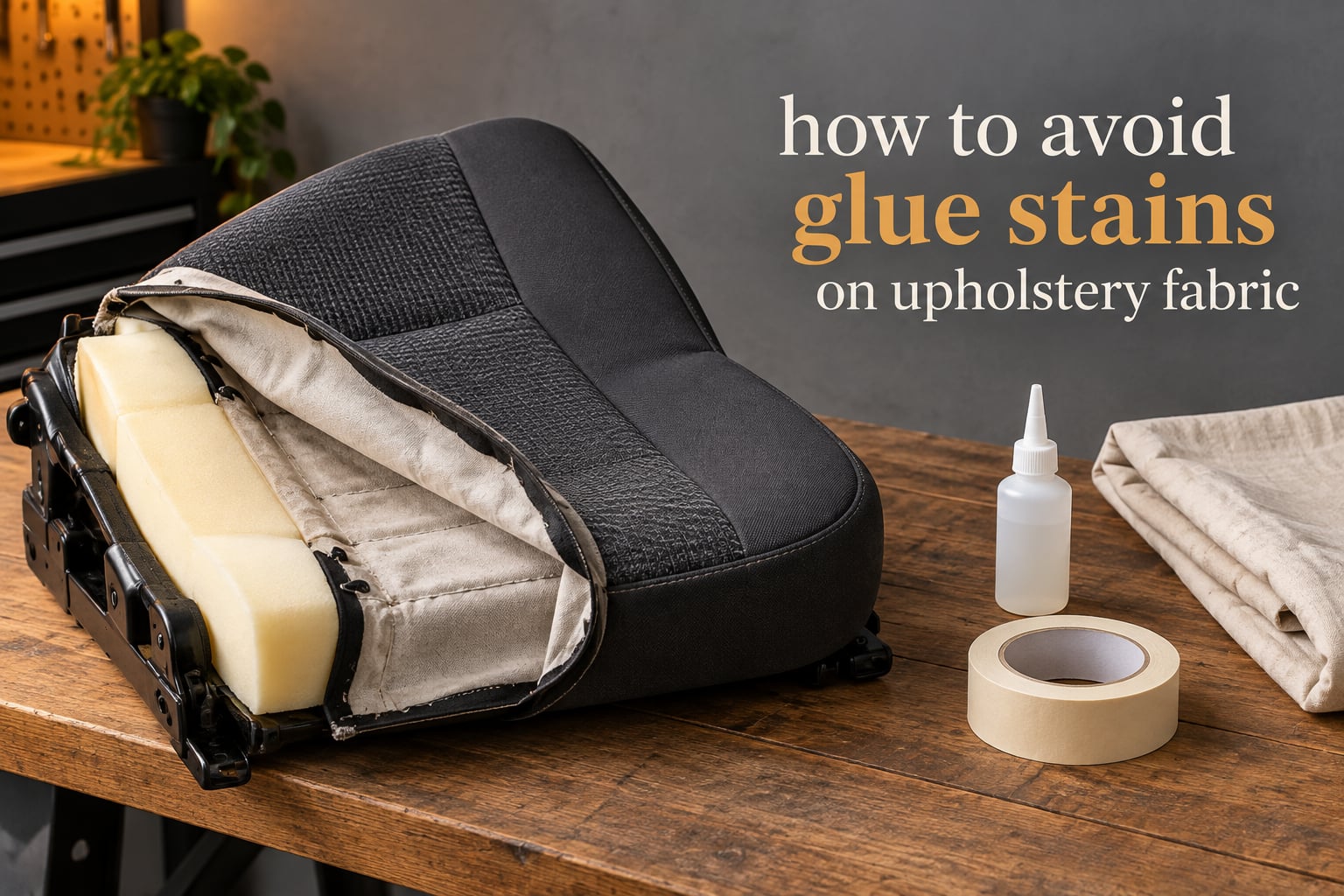
Glue reaches upholstery fabric in three ways: direct contact during a repair, overspray from an aerosol or squeeze bottle, and adhesive squeezing through a seam from the other side. All three are avoidable, and every one of them is easier to prevent than to undo. This guide covers how to avoid glue stains on upholstery fabric, from cleaning-code checks through work-area setup, adhesive selection and precise application, plus a bounded removal section for the case where glue has already landed.
Most glue accidents on a seat or a sofa are not caused by a careless person. They are caused by a job where nobody set up a barrier first, then a repair that needed more adhesive than the seam could absorb, then a cloth used to wipe a bead that should have been left to set. Change any one of those three things and the stain never happens.
We work with bonded trim panels, headliners and seat covers in 2026, and the single most common call we get is not about glue that spilled. It is about glue that was wiped. The distinction matters, because glue that sets on the surface can usually be lifted, while glue that has been smeared into a pile is part of the fabric permanently.
Table of Contents
- How to Avoid Glue Stains on Upholstery Fabric: Why It Happens
- Check the Cleaning Code Before You Do Anything
- Set Up a Work Area That Cannot Get Glue on the Fabric
- Choose an Adhesive Matched to the Fabric and the Job
- Apply Glue So It Never Reaches the Upholstery
- What to Do If Glue Already Touched the Fabric
- Mistakes That Permanently Set a Glue Stain
- When a Glue Stain Means Re-Trimming or Replacing
- Frequently Asked Questions
- What removes glue from fabric upholstery?
- How to prevent upholstery from getting stains?
- What can I put on fabric to make it stain resistant?
- What can I spray on my couch to make it stain resistant?
- How do I remove glue stains from a couch?
- Will vinegar remove glue from fabric?
- What can dissolve fabric glue?
- Does fabric spray protect against glue stains?
- Why does upholstery look worse after cleaning glue off it?
- What stains cannot be removed from a sofa?
- Conclusion
How to Avoid Glue Stains on Upholstery Fabric: Why It Happens
Upholstery is a bonded assembly, not a single layer of cloth. A typical seat panel stacks face fabric, a backing or scrim, foam padding, and an adhesive layer that holds them together; a headliner adds a foam pad and a woven cloth. Because those layers are laminated, an adhesive that reaches the fibre has two surfaces to grip instead of one, and no amount of careful scrubbing gets it back out cleanly.
Glue stains because of capillary action and cure. Most fabric adhesives are water-based polymers or solvent-based compounds that wet the fibre, wick along it, and then harden into a solid film once the water or solvent flashes off. At that point the bond is mechanical, not chemical, and the glue is locked into the weave at the same scale as the yarn itself.
There is a second path people rarely consider: adhesive backing. Many panels are manufactured with a pre-applied adhesive layer on the back. A detailer on r/AutoDetailing pointed out that glued-on upholstery should be treated carefully with aggressive cleaning methods, because the cleaning can compromise the adhesive and cause the bond to fail later, even when the surface still looks acceptable. That is the trap: the fabric survives, the bond does not.
So prevention is not about being tidy. It is about controlling where the adhesive physically goes, and about never putting a solvent on a laminate you did not intend to dissolve.
Two glue paths most people forget: overspray and squeeze-through
Overspray is the mist from an aerosol can or a fine squeeze bottle that lands as a fine mist well outside the intended area. On a dark or pile fabric it is nearly invisible until the adhesive cures, by which point it is a field of tiny hard spots rather than one manageable blob.
Squeeze-through is the same accident on the other side of the panel. Glue applied to a seam or a backing saturates the substrate and exudes through the face fabric as a line or a set of spots. This is common on foam-backed panels where the seam allowance is loaded more heavily than the foam can absorb.
Both are controlled by the same three things: lower flow, slower application, and a barrier on the face side.
Check the Cleaning Code Before You Do Anything
Read the cleaning code tag before you plan the job, not after the stain appears. The tag tells you which cleaning family is safe on that fabric, and it also tells you which remedies are off-limits for the rest of the item’s life.
| Code | What it means | What is safe | What destroys it | Glue relevance |
|---|---|---|---|---|
| W | Water-based cleaner only | Water, water-based shampoo, gentle detergent | Any solvent, including alcohol and acetone | Solvent attempts can strip the adhesive backing and de-laminate the panel |
| S | Solvent-based cleaner only | Hydrocarbon solvent, dry-cleaning fluid | Water of any kind | Water leaves rings and can bleed dye; a glue spot here needs a solvent, not a wet cloth |
| W/S | Either method | Water-based or solvent-based cleaner | Over-wetting and aggressive agitation | Most forgiving code, but blot rather than scrub regardless |
| X | Professional cleaning only | Nothing at home | All home treatment attempts | Do not test solvents on X-coded fabric; masking is the only safe option |
Two warnings belong here. First, on a W-coded bonded panel, an alcohol or acetone attempt to lift glue residue can attack the backing adhesive even when the face fabric looks unaffected, so the item can be clean and structurally compromised at the same time. Second, on S-coded natural fibres, water can cause bleed, shrink, pucker and a brown watermark, which is a different problem from the glue and often harder to fix.
Whichever code you find, patch test in a hidden area first. Test for colourfastness and for pile distortion, not just for stain lift. A white cloth test that shows no colour transfer is still not proof that the fibre will not distort under solvent.
Set Up a Work Area That Cannot Get Glue on the Fabric
This is the section that stops glue stains before they start, and it is the one most repair guides leave out. Treat the work area as the primary control, not as tidiness.
Before opening any adhesive, run this pre-flight checklist:
- Remove the cushions, loose pads and any detachable trim from the frame. Glue damage on a removable cushion is a re-cover; glue damage on a fixed bonded panel is a re-trim.
- Lay a drop cloth or plastic sheeting over everything underneath and around the piece, extending further than you think you need. Glue overspray travels.
- Mask the face fabric with low-tack masking tape, leaving a narrow margin of about 5 mm beside the seam so overspray has nowhere to land on the visible pile.
- Set up a glue board: a flat sacrificial surface you can squeeze and spread glue on, rather than balancing the panel on your knee.
- Open ventilation. Solvent adhesives give off fumes, and a closed garage is the reason many people rush the cure and ruin the bond.
- Keep a clean white cloth, a pipette or fine-tip applicator, and a scrap of masking tape within reach before the job starts.
- Check the sewing or repair plan so you know the total glue volume needed. Most glue accidents are over-application, not spill.
For car and boat interiors, add one more step: where the panel can be safely unbolted and the trim re-glued off-fabric, do it off-fabric. Working flat on a bench with the face fabric masked is close to zero risk. Working upright inside a car with a panel that has to be held in place is where overspray happens.
Headliner cloth is effectively a single-attempt surface. A headliner is stitched, tensioned and bonded around the roof bows, so there is no realistic way to remove it, clean it and re-tension it without distorting it. Treat the roof lining as a no-glue zone, tape the bows, and use mechanical fixings wherever the design allows.
Choose an Adhesive Matched to the Fabric and the Job
Not all glues are equally bad on fabric, and the differences are predictable. The ones that stain hardest are the fast-curing, high-solvent and high-flow types; the safest are thin, water-based and applied in a controlled line.
| Adhesive | Fabric compatibility | Overspray and squeeze-through risk | Cure time | Stain reversibility | Typical use |
|---|---|---|---|---|---|
| Water-based polymer (PVA, craft and fabric glue) | Good on most woven and non-pile fabrics | Low, but saturates and can bleed through | Slow to touch-dry, fully cured after 24 hours | Fair, if lifted before cure; poor once set | Seams, hems, appliqué, light repair |
| Solvent-based contact cement | Good on leather, vinyl and heavy cloth; risky on natural fibres | High, it is designed to spray and to soak | Tacky almost immediately, bonds on contact | Very poor; it soaks into the pile | Seat covers, headliner cloth, leather trim |
| Cyanoacrylate (super glue) | Permanent, ignores most fibre types | Very high, it wicks into weave and foam | Seconds | Effectively none | Small trim fixings only, never near upholstery |
| Hot melt adhesive | Needs a controlled substrate, damages foam if overheated | Low, but a hot bead melts and sinks | Seconds to handle | Poor, leaves a hard plastic-looking spot | Fabric-to-plastic and trim tacking |
| Wheat paste or starch paste | Natural fibres, cotton | Low | Slow, needs ventilation to dry fully | Good, it washes out with water | Traditional repairs and temporary holding |
Three rules come out of that table. Super glue does not belong anywhere near upholstery fabric or foam. Contact cement should be sprayed onto a board and rolled or brushed onto the substrate, never sprayed at the panel. And a water-based polymer glue applied in a thick bead will push straight through a thin face fabric, so thin coats win every time.
Apply Glue So It Never Reaches the Upholstery
Precision application is the second real control after masking, and it comes down to a few habits that trim technicians use daily.
- Use a pipette, a fine-tip applicator bottle or a fine nozzle. Never free-pour from the cap, and never squeeze directly over the fabric.
- Build a tape dam along the seam, a ridge of low-tack tape that catches squeeze-through before it travels into the pile.
- Apply glue to the backing or the underside only, keeping the seam allowance narrower than the panel thickness so the excess has nowhere to go.
- Lay a thin, even coat. A second thin coat after the first flashes off beats one heavy coat, because heavy coats migrate.
- Respect the dwell time the adhesive needs before you bring the two surfaces together, and do not press them together early to compensate.
- Wait the full cure time before stressing the bond. Surface-dry means safe to handle; cure means fully solvent-resistant, and only the second one matters if glue will be nearby later.
Over-application is the failure that causes stiffness and cloudy residue, particularly on dark and sheer fabrics. Excess polymer forms a film on top of the fibre rather than inside it, and that film shows up as a stiff, lighter patch once it dries. The fix is always less glue, more time.
Apply a stain protector before the first glue job
What can I put on fabric to make it stain resistant? A spray-on fabric protector that leaves an invisible barrier. It slows water, oil and everyday spills, and it makes a glue spot sit on the surface for longer, which gives you a much bigger window to lift it. That is the honest limit of the claim.
| Protector type | What it blocks | What it does not block | Reapplication interval | Cure before use |
|---|---|---|---|---|
| Water-based fluorochemical-free repellent | Water, coffee, juice, everyday spills | Solvent-based glues and contact cement | Every 12 to 18 months | Several hours, fully cured overnight |
| Fluorochemical solvent-based protector | Water, oil and grease-based stains | Cyanoacrylate and most contact cements | Every 12 to 24 months | Several hours, fully cured overnight |
| Fabric sealant for porous cloth | Absorption, dye bleed in headliner cloth | Anything that is not water-based | Once per repair cycle | Per label, often 24 hours |
So will a protector stop a glue stain? Usually not. Protectors repel liquid far better than they resist adhesive, and users looking for glue protection on forums consistently find that a spray gives more confidence than it gives coverage. Treat a protector as one layer of a defence that still includes masking and precision application, not as the defence itself. Apply it before the first glue job, not after the stain, and always patch test because a coating can change the hand and colour of the fabric.
What to Do If Glue Already Touched the Fabric
What removes glue from fabric upholstery? It depends on the adhesive, and for most water-based glues a small amount of warm water and blotting works, while cured contact cement and super glue need a solvent. The technique matters more than the product: blot, work from the outside in, and never scrub. Rubbing drives adhesive deeper into the pile and is the single most common reason a small spot becomes a permanent patch.
Start with the least aggressive method that could work and stop at the first one that does the job:
- Water-based glue, still soft: lift the bulk gently with a white cloth, then blot with barely damp water and a clean white cloth, working from the outside of the spot toward the centre.
- Dried water-based glue: warm water and a little gentle detergent, allowed to dwell for a few minutes, then blot. Do not use hot water on natural fibres, it can set protein-based stains.
- Sticky residue and film: isopropyl alcohol or rubbing alcohol on a white cloth, applied to the cloth rather than the fabric, dabbed and lifted. Users report this clears many adhesive residues quickly.
- Cured contact cement: a fabric-safe adhesive remover or degreaser, following the same blot-and-lift pattern, with several short passes instead of one long one.
- Dried blob or hardened bead: let it fully harden, then lift mechanically with a card or a scraper held perpendicular, the way a blade is used to lift sealant from a flat surface. Never drag it along the surface, and never press it into the pile.
Most adhesives dissolve best in ethanol or isopropyl alcohol rather than acetone, because acetone tends to bleach or melt what is under the glue. Work up the aggression in order and test each step in a hidden spot. On a bonded panel, stop at the first solvent that works, because every extra pass is another pass at the adhesive backing.
For cured glue on vinyl or leatherette seats, a steam cleaner is reported to lift flexible universal glue safely, though we would still patch test and keep the steam off a W-coded face fabric. You can also see sticky residue clearing with a paste-style adhesive remover on a paper towel after a decal or sticker is peeled off.
If the fabric feels stiff, the colour has shifted, the pile is crushed, or a ring has appeared where the cleaner was applied, stop. Continued treatment turns a repairable spot into a panel that needs re-covering.
Mistakes That Permanently Set a Glue Stain
Some failures cannot be walked back. These are the ones we see most often, and knowing which is which saves a lot of time.
| What happened | Why it is permanent | What to do now | What not to do |
|---|---|---|---|
| Wet glue wiped or smeared | The adhesive is driven along and into the fibre rather than sitting on the pile | Stop, let it set fully, then lift mechanically from the edge | Rub, scrub or smear it further |
| Overspray left to cure | Many small hardened spots bond individually to the fibres | Steam or solvent pass, then blot | Pick each spot off with a blade |
| Solvent used on a W-coded panel | The backing adhesive is attacked, so the panel de-bonds later | Accept the clean surface, plan a re-trim | Keep going because the surface still looks fine |
| Over-cleaned and over-wetted | Dye bleeds and watermarks set as the area dries | Let it dry fully, then reassess | Add more product to fix the ring |
| Mixed products in one clean | Two chemicals react, foam, and deposit a new film | Rinse or blot with plain water, wait, reassess | Layer solvents until it looks better |
On the vinegar question that comes up constantly: vinegar is weak acid and water. It can lift a fresh water-based glue film and it is useful on a hard water ring, but it does nothing to contact cement or super glue, and it can set protein-based or dye-based stains. It is a safe first test, not a solution.
When a Glue Stain Means Re-Trimming or Replacing
What stains cannot be removed from a sofa? Anything that has bonded into the pile rather than sitting on it, anything that has bleached or distorted the colour, and anything on an X-coded fabric you have already treated. A stiff, lighter patch is a resin film, and no solvent removes it without taking fibre with it.
What stains cannot be removed from a sofa? The ones that have become structural: a solvent attack on the backing, a bleach mark, a scorch from a heat gun held too close, or a colour shift from an over-wet clean. What can I do instead is re-cover the cushion, re-trim the panel or re-upholster the piece, and in a bonded assembly that is often cheaper than trying to rescue the original face fabric.
That is where a trimming workshop earns its place. A glued seat panel with a cured overspray field across the centre is not a cleaning job, it is a replacement job, and the earlier you accept that, the less damage you do trying to avoid it. If the same glue landed on a car seat, a headliner or a boat cushion, the trim can often be released and re-bonded off-fabric.
Frequently Asked Questions
What removes glue from fabric upholstery?
It depends on the adhesive. Fresh water-based glue lifts with a white cloth and barely damp water blotted from the outside in. Sticky film and contact cement residue usually need isopropyl or rubbing alcohol applied to the cloth and lifted, and hardened beads are best left to cure fully and raised mechanically with a card held perpendicular. Solvents dissolve adhesive but can attack the backing of bonded upholstery, so patch test and use the least aggressive method that works.
How to prevent upholstery from getting stains?
Mask the face fabric with low-tack tape, lay a drop cloth generously larger than the work area, remove detachable cushions, work on a flat glue board instead of holding the panel in place, and apply adhesive with a pipette or fine tip rather than pouring. Keep the coat thin, build a tape dam along the seam to catch squeeze-through, and open ventilation so you can respect the full cure time instead of rushing the bond.
What can I put on fabric to make it stain resistant?
A spray-on fabric protector that dries to an invisible barrier. It slows water, oil and everyday spills and buys you more time to lift a glue spot off the surface. It does not reliably block solvent-based adhesives, so it is one layer of protection rather than a substitute for masking. Patch test first, because a coating can change the colour and hand of the fabric.
What can I spray on my couch to make it stain resistant?
Any water-based upholstery fabric protector sprayed evenly, allowed to cure fully, and applied in two light coats rather than one heavy one. Expect it to handle drinks, food and oil far better than glue or solvent. Reapply roughly every 12 to 18 months, check the cleaning code first, and always test a hidden area because coatings can leave a visible film on dark or pile fabrics.
How do I remove glue stains from a couch?
Check the cleaning code, patch test, then work up from water to alcohol-based solvent to a fabric-safe degreaser, stopping at the first method that works. Blot with a white cloth rather than scrubbing, always from the outside of the spot toward the centre, and let the area dry fully between attempts. For a hardened blob, let it cure completely and lift it mechanically with a card held perpendicular instead of dragging it along the pile.
Will vinegar remove glue from fabric?
Vinegar is diluted weak acid, so it can lift a fresh water-based glue film and shift a hard water ring, but it does nothing to contact cement, hot melt or super glue. It can also set protein-based or dye-based stains, so it is worth using only after a patch test. For most cured adhesives, alcohol-based solvent works far better.
What can dissolve fabric glue?
Warm water with a little detergent dissolves most water-based polymer glues while they are still soft. Isopropyl or rubbing alcohol dissolves most dried adhesive films and contact cement residue, and a fabric-safe adhesive remover handles the toughest cured films. Acetone works but tends to bleach or melt the fabric underneath, so it is the last resort rather than the first, especially on anything that is not leather or vinyl.
Does fabric spray protect against glue stains?
Only partly. Protectors are designed to repel water and oil-based spills, not adhesives, and forum users consistently report that a spray gives more confidence than real coverage against glue. The better preventive controls are masking tape, a tape dam along the seam, low flow from a fine applicator and keeping the adhesive off the face fabric entirely.
Why does upholstery look worse after cleaning glue off it?
Usually one of three things: solvent stripped the adhesive backing so the panel now reads as clean but is de-bonding, water-based cleaning left rings and a stiff residue film, or the spot was scrubbed and the pile is crushed. A stiff, lighter patch after cleaning is a cured polymer film rather than a remaining stain, and it will not come out without taking fibre with it. At that point re-covering is the practical answer.
What stains cannot be removed from a sofa?
Bonded adhesive driven into the pile, bleach marks, scorch damage, dye bleed and colour shift from an over-wet clean, and anything you have already treated on an X-coded fabric. A cured resin film reads as a stiff, lighter patch because it sits on top of the fibre, and solvents only remove it by taking the fibre with them. Re-covering the cushion or re-trimming the panel is the reliable option.
Conclusion
Knowing how to avoid glue stains on upholstery fabric comes down to three controls, in order: mask the fabric, control the flow of adhesive, and keep the glue on a sacrificial surface instead of on the panel. Everything else in this guide is detail on those three.
Read the cleaning code before you start, work off-fabric wherever the panel allows it, apply thin coats through a fine tip, and respect the full cure time. If glue has already landed, work up from water to alcohol-based solvent, blot rather than scrub, and stop the moment the fabric stiffens or shifts colour.
And if the spot has become a resin film rather than a stain, stop cleaning. Re-covering a cushion or re-trimming a bonded panel will get you a better result than any solvent will.