
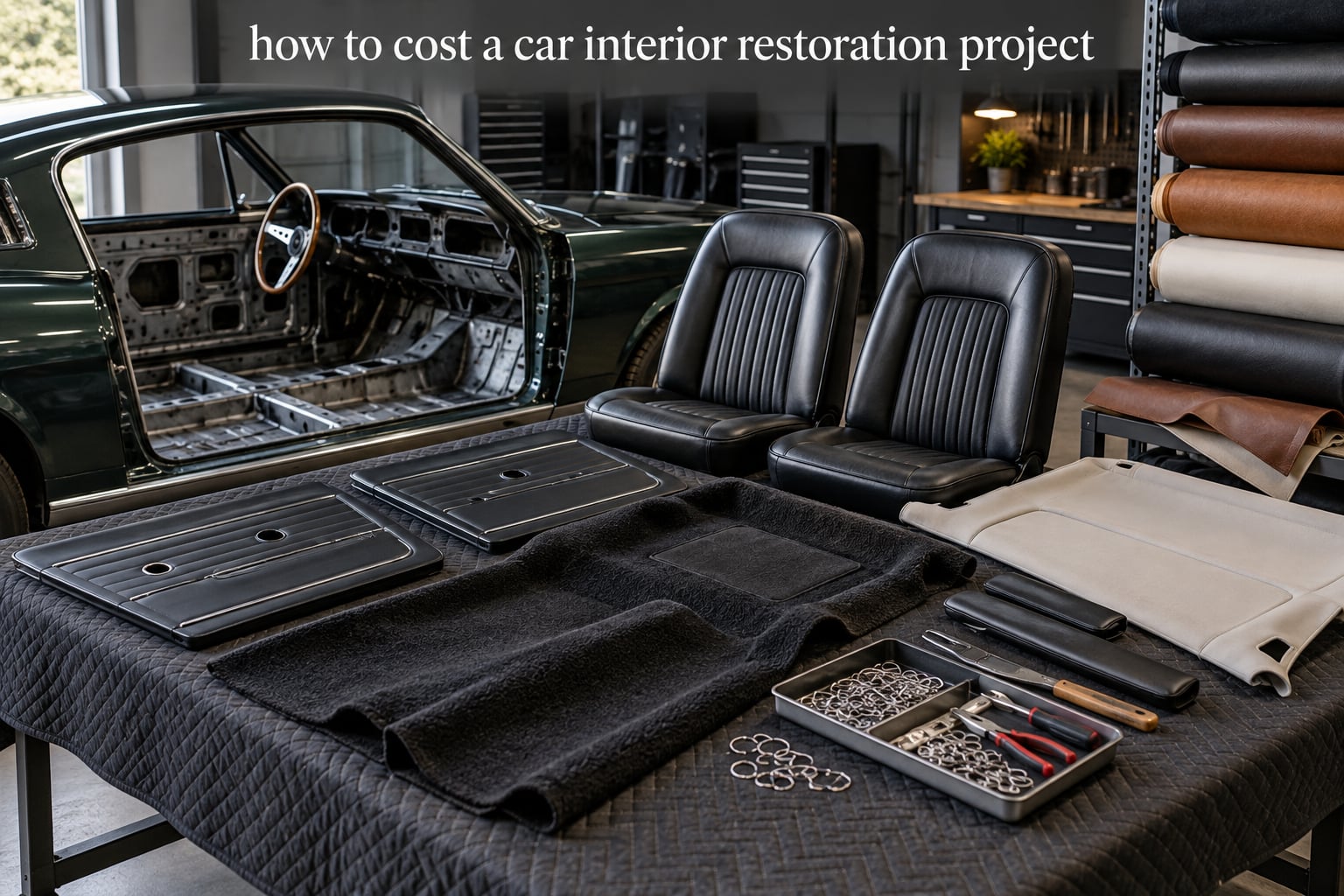
A car interior restoration costs exactly what your hours, your labor rate and your material choices add up to, and almost nobody ever shows you that arithmetic. Most quotes arrive as a single round number with no line items, which leaves you unable to tell whether you are being sold a driver-quality refresh or a concours build.
This guide is the method. It shows you how to cost a car interior restoration project component by component, starting from labor hours rather than from a total someone else picked for you. By the end you will have a per-component hour table, a seven-step costing sequence, a fill-in worksheet and a method for reading a competing quote without guessing.
We have updated the guidance for 2026. All rate and lead-time figures reflect 2026 specialist shop practice in the US, with regional variation flagged throughout.
Table of Contents
- What a car interior restoration actually covers
- How to cost a car interior restoration project: the seven-step method
- Step 1: Define the scope in writing
- Step 2: Choose a quality tier and commit to it
- Step 3: Count the labour hours per component
- Step 4: Set the labour rate from local evidence, not a national average
- Step 5: Price the materials separately
- Step 6: Add a contingency of 10 to 30 percent
- Step 7: Total it, then stress-test the total
- Per-component labour hours: the numbers to build your estimate from
- A worked example: pricing a two-door coupe at driver quality
- Choose your quality tier and material before you price anything
- Hidden costs that are missing from most quotes
- How to read and challenge a shop quote line by line
- The descope ladder when a quote comes in over budget
- DIY versus professional: the hours tell the story
- The costing worksheet: fill this in before you call a shop
- Timeline, documentation, and insurance
- Frequently Asked Questions
- How much does it cost to restore a car’s interior?
- How much does it cost to redo the entire interior of a car?
- How many hours does a full car interior restoration take?
- What labor rate per hour should I budget for interior work?
- Is it cheaper to reupholster car seats or buy new ones?
- Why does headliner replacement cost so much?
- How do I know if an upholstery quote is fair?
- Will insurance cover car interior restoration?
- Is a car interior restoration worth the money?
- How does interior cost compare with a frame-off restoration?
- Conclusion
What a car interior restoration actually covers
A car interior restoration is a comprehensive return-to-original-specification project that includes seats, headliner, door panels, carpet, dash pad, trim, and period-correct hardware. The word matters, because most people use restoration, reupholstery, replacement and repair interchangeably, and each word carries a very different number attached to it.
Here is the vocabulary worth holding on to before you price anything.
- Spot repair is a single torn panel, a cracked surface or a failed stitch. It is the smallest scope by far.
- Refresh means the interior comes back clean and functional using modern materials and modern shop rates, without any attempt at originality.
- Reupholstery is component-by-component cover replacement on the original frames and foam.
- Full restoration strips the interior to bare metal and foam, addresses any substrate or frame corrosion found, and rebuilds everything to a stated specification.
- Restomod adds modern systems such as ambient lighting, heated and ventilated seats, or hidden electronics into a classic shell.
- Survivor preservation is the opposite impulse: keep original material wherever it is genuinely serviceable, and stabilise rather than replace.
Where the money actually goes
Seats are almost always the largest single line item, because they are the most labour-intensive component and the one that most often needs new foam. Dash pad and trim work follows, then custom stitching and pattern matching, then carpet and headliner.
Material is usually the smaller share of the bill. Owners quote roughly 30 to 40 percent material and 60 to 70 percent labour on a typical build, which is the opposite of what most people assume when they imagine an upholstery job.
Daily driver or classic: these are two different budgets
A ten-year-old daily driver being refreshed is a labour-rate question, because the material is readily available and the shop is nearby. A sixty-year-old coupe is a sourcing question, because the material may need ordering from a specialist supplier and shipping to your shop may add weeks.
Mixing the two into one average produces a number that is wrong for both. Decide which car you are budgeting before you read a single range.
How to cost a car interior restoration project: the seven-step method
The method is arithmetic, not opinion. Follow it in order and you will produce a defensible number that you can put in front of a shop.
Step 1: Define the scope in writing
Write down every component you intend to address, by name, before you price anything. A driver-quality interior on a two-door coupe typically means two front seats, one rear seat, door panels, carpet, headliner and dash pad, plus the disassembly and reassembly of all of it.
Write what you are excluding as well. Exclusions are where arguments start, and a written exclusion list ends them before the invoice does.
Step 2: Choose a quality tier and commit to it
Decide whether you are buying driver quality, concours-correct work, a restomod or survivor preservation. The tier is the single largest multiplier in the whole estimate, and it multiplies both labour hours and material cost.
Do not leave this open. A shop cannot quote an undefined tier, and a quote that appears to cover all four tiers is really a quote for the cheapest one.
Step 3: Count the labour hours per component
Use the per-component hour table below as your starting point, then adjust for your vehicle. Seats run the longest, headliner and carpet run shortest, and the disassembly and reassembly line is a real job that is frequently missing from quotes.
Add your hours, component by component. Do not estimate a total in your head.
Step 4: Set the labour rate from local evidence, not a national average
Get the rate from shops that actually quote this work, in your own area. Independent trim and upholstery shops sit at the low end, marque or brand specialists sit in the middle, restomod and concours shops sit high, and dealer rates sit above all of them. Owners on r/upholstery have reported dealer rates several times what an independent shop charges for identical work.
Collect at least three rates, take the median, and hold the high one in reserve. Region moves this number more than any other variable in the entire estimate, and a published national average will mislead you precisely where it matters most.
Step 5: Price the materials separately
Price each material independently and demand a named supplier and, for leather, a named grade and dye lot. Ask whether the quoted price includes freight, because specialty material shipped out of state commonly adds 10 to 20 percent on top of the base price.
Ask whether foam is included and what density it is. Quotes that omit a foam specification are telling you something about the quote.
Step 6: Add a contingency of 10 to 30 percent
Teardown is where budgets die. Owners consistently report finding crumbled foam, frame rust or failed substrate once the interior is apart, and shops themselves expect 10 to 30 percent of surprises on a full teardown.
Use 10 percent for a partial job where the components are coming off intact, 20 percent for a full interior on a vehicle of unknown condition, and 30 percent for a survivor car where the original material is being assessed for the first time.
Step 7: Total it, then stress-test the total
The formula is simple: total equals (total hours multiplied by your rate) plus materials, all multiplied by 1 plus your contingency percentage. Write the arithmetic down in full.
Then run two stress tests. What happens to your total if the labour rate turns out to be 50 percent higher than the median you found? And what happens if teardown adds 30 percent? If either answer makes the project impossible, descope it now rather than after the deposit.
Per-component labour hours: the numbers to build your estimate from
No competitor in this space publishes a per-component hour table, and that is the reason most people cannot cost their own car. This is the table to work from. Hours include removal, preparation and reinstallation for that component.
| Component | Hours (low) | Hours (high) |
|---|---|---|
| Front seat, complete rebuild (each) | 8 | 14 |
| Rear seat or rear bench, complete rebuild | 5 | 9 |
| Headrest and armrest covers (set) | 1 | 2 |
| Door panel, per side | 2 | 4 |
| Carpet set, cut and installed | 3 | 5 |
| Headliner | 3 | 6 |
| Dash pad | 3 | 5 |
| Instrument cluster, remove and refit | 2 | 3 |
| Steering wheel, remove and refit | 1 | 2 |
| Console | 2 | 4 |
| Full interior teardown and reassembly | 4 | 8 |
| Sunroof or convertible top interior | 4 | 8 |
Four rules for adjusting the table to your car. Add roughly 30 to 50 percent for a vehicle with no prior interior work logged, because access fasteners are seized and nothing comes apart cleanly. Subtract nothing for a modern vehicle, but do note that a modern interior carries wiring and sensor costs that a classic one does not.
Add hours for a convertible top mechanism, sunroof, or a console with a shifter and harness to rebuild. And remember that hours and rate are separate line items, which is exactly how a fair quote presents them.
A worked example: pricing a two-door coupe at driver quality
Here is the whole method in one calculation, so you can see the shape of the answer. The car is a mid-1960s American two-door coupe being brought back to driver quality, using original-spec vinyl and cloth, with the headliner left in place because it is structurally sound.
Scope and hours:
- Two front seats, complete rebuild: 2 multiplied by 11 hours = 22 hours
- Rear seat, complete rebuild: 1 multiplied by 7 hours = 7 hours
- Door panels, two sides: 2 multiplied by 3 hours = 6 hours
- Carpet set: 4 hours
- Dash pad: 3 hours
- Full teardown and reassembly: 4 hours
That is 46 hours, which sits comfortably in the middle of the range the table implies for this scope. Now apply the method. Suppose your median local rate is R and your material total is M. Labour is 46 multiplied by R. The subtotal is 46R plus M. With a 20 percent contingency, the number you take to the shop is that subtotal multiplied by 1.20.
Now run the sensitivity check. If the shop that does the work charges 1.6 times your median rate, the labour line rises 60 percent while the material line barely moves. If teardown adds 30 percent instead of 20 percent, the total rises by a further 8.3 percent. Both of those are known in advance, and both are reasons to have the number in your hand before the phone rings.
Choose your quality tier and material before you price anything
Scope tiers
| Tier | What it covers | Typical hours | Best for |
|---|---|---|---|
| Spot repair | One panel or one surface | 1 to 4 | Torn seat, cracked armrest, failed seam |
| Refresh | Deep clean, repair, modern materials, no originality goal | 6 to 14 | Daily driver, sale preparation |
| Reupholstery | New covers on original frames and foam, all soft trim | 30 to 50 | Most daily driver rebuilds |
| Full restoration | Strip to bare, address substrate and frame, rebuild to spec | 45 to 75 | Classic car, concours entry |
| Restomod | Full rebuild plus modern systems and hidden electronics | 60 to 100 | Driver-quality build with modern comfort |
Every step up that ladder is a multiplier on both hours and material, and the steps are not evenly spaced. Concours work can run two to three times a driver-quality build on the same car, which is the number owners most often underestimate.
Material tiers
Material is a multiplier too, but a smaller one than people expect. The table below uses synthetic vinyl as the baseline of 1.0, so you can price the jump to any other material without relying on a published per-seat figure.
| Material | Relative material cost | Durability | Best use |
|---|---|---|---|
| Synthetic vinyl | 1.0 baseline | Excellent, wipes clean | Daily drivers, high-sun interiors |
| Woven cloth or polyester | 1.0 to 1.2 | Good, but stains | Original-spec cars where vinyl is wrong |
| Synthetic leatherette | 1.2 to 1.5 | Good, can peel at seams over time | Modern replacement, high-visibility panels |
| Top-grain leather | 1.8 to 2.4 | Very good, develops a patina | Premium driver and concours work |
| Full-grain or aniline leather | 2.4 to 3.0 | Good, shows wear honestly | Heritage builds where hide source is documented |
| Nappa leather | 2.8 to 3.5 | Good, softest touch | Restomod interiors with modern comfort goals |
| Alcantara or microfibre suede | Adds roughly 25 to 40 percent | Moderate, needs careful cleaning | Headliners and accents on concours cars |
Period-correct material carries its own premium, because the supplier sells to the restoration trade rather than to volume. Name the supplier and the grade in writing, and for leather, ask for the dye lot. A colour that is close but from a different dye lot is a problem you will find at final assembly, not before it.
Era and vehicle type adjustment factors
Pre-1960 European cars carry the highest adjustment of any category, because trim suppliers for those cars are thin and patterns are frequently hand-made. American coupes and muscle cars from the 1960s and 1970s are the easiest, with the widest supplier base.
Modern vehicles sit in a different place again, because airbag modules, seatbelt pretensioners, seat heater elements and occupancy sensors add electrical labour that a classic car simply does not have. Open-pillar cars, convertibles and hardtops add their own access time. Adjust from the base table, and state your adjustment in writing so a shop can agree or argue with a number rather than a feeling.
Hidden costs that are missing from most quotes
Almost every surprise on this list is documented by owners, and almost none of them appear on an upholstery quote. Check each one explicitly.
- Windshield removal for headliner work. A headliner install usually requires pulling the windshield, which adds 3 to 6 hours plus glass labour. The upholstery quote routinely omits this, and it is the single most common invoice surprise on the job.
- Airbag and seatbelt recalibration. Modules, pretensioners and seat heater elements are not free to put back. Budget 1 to 2 hours per affected seat.
- Freight. Specialty material shipped out of state commonly adds 10 to 20 percent to base material cost.
- Rush and restock fees. Ordering once and getting the dye lot wrong means paying twice, and rush handling is charged per order.
- Teardown discoveries. Crumbled foam, frame rust, failed substrate and seized fasteners. Budget 10 to 30 percent for this and hold it back deliberately.
- Consumables and originals. Clips, fasteners, welts, hog rings, thread, adhesive and stretch clips add up, and originals are cheaper than reproduction parts on a surviving car.
- Mould and water damage remediation. If the car has had a leak or a flooded history, remediation is a separate job with its own line item.
- Tax, shop supplies and disposal. Frequently omitted and occasionally larger than expected on a materials-heavy job.
Ask the shop for a written statement of what is not in the quote. Owners who do this report that the list of exclusions is often as long as the list of inclusions.
How to read and challenge a shop quote line by line
A fair quote is a document, not a number. Use this five-point triage before you compare anything.
- Count the line items. A quote with fewer than six lines is not itemised. A round total with no breakdown tells you the shop is either not costing properly or not trusting you with the breakdown.
- Separate hours from rate. You need to see the hour estimate and the rate as distinct numbers. Without that split you cannot apply your own rate sensitivity, and you cannot compare two shops at all.
- Check the components against your written scope. Every component you wrote in step one should appear. Missing headliner or console lines are the most common omission.
- Check the material specification. Named supplier, named grade, foam density stated, freight included or excluded, dye lot confirmed for leather.
- Read the exclusions and the deposit terms. You want to know what is not covered and how much of the total is due before work starts, before it is due.
Then run the red-flag check. A single round number with no line items is one. No mention of glass work on a quote that includes a headliner is two. Aftermarket covers offered with no foam specification is three, and this is the trap that costs owners the most, because cheap covers look acceptable in photos and then fade and pucker within two summers, forcing the same labour to be paid twice.
Red flag four is a quote with no disassembly and reassembly line at all. On a full interior, that labour is real and it belongs on the document. Red flag five is a price that lands on a suspiciously round number. Real costs are built from hours multiplied by a rate, and they rarely come out even.
Finally, corroborate. Look for photos of completed work in your own era and category from the same shop, and ask directly whether they have done your specific year and model before.
The descope ladder when a quote comes in over budget
When a quote lands 30 percent above your number, work down this list in order. Each rung costs less visual and driving quality than the one below it.
- Keep the headliner if it is structurally sound. This is the single biggest saving available and it costs almost nothing in appearance.
- Stay at driver quality. Drop concours expectations and the stitch pattern work with them.
- Reuse original trim and hardware where the original part is serviceable. Reproduction hardware is rarely the weak link.
- Keep original foam if it still holds shape. New foam is a large, easily deferred cost.
- Defer door panels to a second phase if the frames and mechanisms are sound.
- Drop restomod features such as ambient lighting and added heating. These add wiring labour and new failure points later.
- Phase the project across two budget cycles rather than cutting structure. Splitting the work keeps quality while easing the cash burden.
Never descope by using cheaper material as a shortcut. That is the rung that produces a failed job, because the labour still has to be paid again.
DIY versus professional: the hours tell the story
Professional work is not primarily about skill in the way people assume. It is about hours and about owning the tooling. A full interior job needs hog ring pliers and hog rings, a pneumatic stapler, upholstery shears, an industrial needle and thread, headliner adhesive with stretch clips, a heat gun, and a workspace where a stripped car can sit for weeks.
As a time estimate, assume the table above roughly doubles for a competent first-timer, and add another 25 percent for a car where nothing has been apart before. A 46-hour professional job becomes 90 to 115 hours across a weekend-watching owner, which is four to six months of evenings and weekends.
Where DIY works: carpet, door panels, headliner, armrests and headrests, and single-seat work. Where it rarely works: complete seat rebuilds with new foam, anything involving dash substrate repair, and anything with an airbag or pretensioner in it, which needs a technician and the correct diagnostic tool.
The costing worksheet: fill this in before you call a shop
Copy these six lines into a notes file and fill them in. Everything on this list is either a number you have looked up or a number you have asked a shop for. Nothing here is a guess unless you label it as one.
- Scope — list every component, and list every exclusion.
- Tier — driver quality, concours, restomod, or survivor. One word, written down.
- Hours — total from the per-component table, with your vehicle adjustment applied and the adjustment noted.
- Rate — median of at least three local quotes, with the high rate recorded alongside.
- Materials — itemised by component, with supplier, grade, and freight included or excluded.
- Contingency — 10, 20 or 30 percent, decided by the condition of the car, not by optimism.
Then the total: (hours multiplied by rate) plus materials, multiplied by 1 plus contingency. Print it, date it, and bring it to the first conversation. Shops respect a customer who arrives with a number, and that number becomes the benchmark for every competing quote you collect afterwards.
Timeline, documentation, and insurance
Timeline is a real budgeting variable and most cost guides ignore it. Period-correct material lead times run 4 to 16 weeks, which means shop time is sometimes booked before the material exists. Add shop scheduling and you should expect 3 weeks for a refresh and up to 9 months for a full concours or restomod build.
If you are on a deadline, ask what a rush order costs before you commit to the date, not after.
For insurance, standard market-value policies settle an interior claim at the depreciated value of the car, which is rarely the right basis. Agreed-value classic cover, where the declared value rather than the purchase price is the settlement basis, is the coverage worth having before the work starts rather than after.
Build the documentation file as you go. Photograph the car before teardown. Keep itemised invoices that separate hours and rate, name the material supplier and grade, and record the dye lot for leather. Get an appraisal if you are restoring a car worth more than a few tens of thousands. The r/E30 community regularly budgets a full leather redo on cars worth a fraction of the finished job, and the owners who regret it are the ones without a documentation trail when they sell.
For resale, a driver-quality interior typically returns a high proportion of its cost at sale, and a concours-correct interior can return more than it cost. The spend is easier to justify when you have photographs and receipts showing the work was done properly, because a documented car sells faster and holds its value longer.
Frequently Asked Questions
How much does it cost to restore a car’s interior?
The cost is your hours multiplied by your local rate, plus materials, plus 10 to 30 percent contingency. A full interior runs roughly 45 to 75 labour hours at driver quality and more at concours level, with seats alone taking 8 to 14 hours each. Material typically runs 30 to 40 percent of the bill, labour 60 to 70 percent. Price the car in front of you rather than trusting an average.
How much does it cost to redo the entire interior of a car?
Cost the job component by component: seats, rear seat, door panels, carpet, headliner, dash pad, teardown and reassembly. A driver-quality reupholstery of an entire interior lands around 30 to 50 hours, and a full restoration to original specification runs 45 to 75. Multiply your hours by a local rate you have collected from three shops, add named materials, then add contingency.
How many hours does a full car interior restoration take?
Budget 45 to 75 labour hours for a full interior restoration at driver quality, and 60 to 100 hours for a restomod with added wiring and electronics. Seats consume the most, at 8 to 14 hours each, while carpet takes 3 to 5 and the headliner 3 to 6. A competent owner working alone should expect roughly double these figures.
What labor rate per hour should I budget for interior work?
Take the median rate from at least three shops in your area that actually quote interior work, and hold the highest one in reserve. Independent trim shops sit at the low end, marque specialists in the middle, restomod and concours shops high, and dealer rates above all of them. Rate is the single largest multiplier in an interior estimate, so a national average will mislead you.
Is it cheaper to reupholster car seats or buy new ones?
Reupholstering almost always wins where the frame and mechanism are sound. Owners report single seat bottom quotes in the several hundred range where material makes up most of the bill, and remanufactured covers quoted well below aftermarket custom work. New seats only make sense when the frame, springs or mechanisms have failed, and owners should compare both against the 8 to 14 hours of labour each rebuild requires.
Why does headliner replacement cost so much?
A headliner is only 3 to 6 hours of sewing and fitting, but installing one usually requires removing the windshield, which adds several hours of glass labour and a calibration on some vehicles. Most upholstery quotes omit that glass work entirely, which is why the headliner line on an invoice is often the biggest surprise on the whole project. Ask for glass removal to be quoted separately before work starts.
How do I know if an upholstery quote is fair?
Check that the quote has at least six line items, that hours and rate appear as separate numbers, and that every component in your written scope appears on it. A single round total with no breakdown is the clearest warning sign. Confirm the material supplier, grade, foam density and whether freight is included, and confirm that glass work, recalibration, tax and teardown surprises are quoted or explicitly excluded.
Will insurance cover car interior restoration?
A standard market-value policy settles an interior claim at the depreciated value of the car, which is rarely the right basis for restoration work. Agreed-value classic cover, where the declared value rather than the purchase price is the settlement point, is the coverage worth arranging first. Restoration undertaken purely for enjoyment is not a covered loss, so it has to be self-funded.
Is a car interior restoration worth the money?
It is worth it when the car is mechanically sound underneath and the interior is the reason you cannot drive or enjoy it, since a driver-quality interior typically returns a high proportion of its cost at sale. It is not worth it when the car needs chassis, driveline or rust work first, because a new interior in a car that needs a frame-off rebuild will be redone soon anyway.
How does interior cost compare with a frame-off restoration?
An interior is a small fraction of a full frame-off restoration, because the teardown, body work, paint, mechanical rebuild, suspension and wiring all sit outside the interior budget. The one case where the two merge is a car coming out of a full rebuild, where the interior is priced as the final stage of a much larger number rather than as a standalone job.
Conclusion
To cost a car interior restoration project, work from hours outward rather than from a total inward. Count the hours per component, collect a real local rate from three shops, price the materials by name, add 10 to 30 percent contingency for what teardown will reveal, and then stress-test the result against a higher rate and a worse discovery.
Do all of that before you make a call, and the quote stops being a mystery. Fill in the worksheet, bring it with you, and you will know in the first five minutes whether the shop is costing the job or guessing at it.