
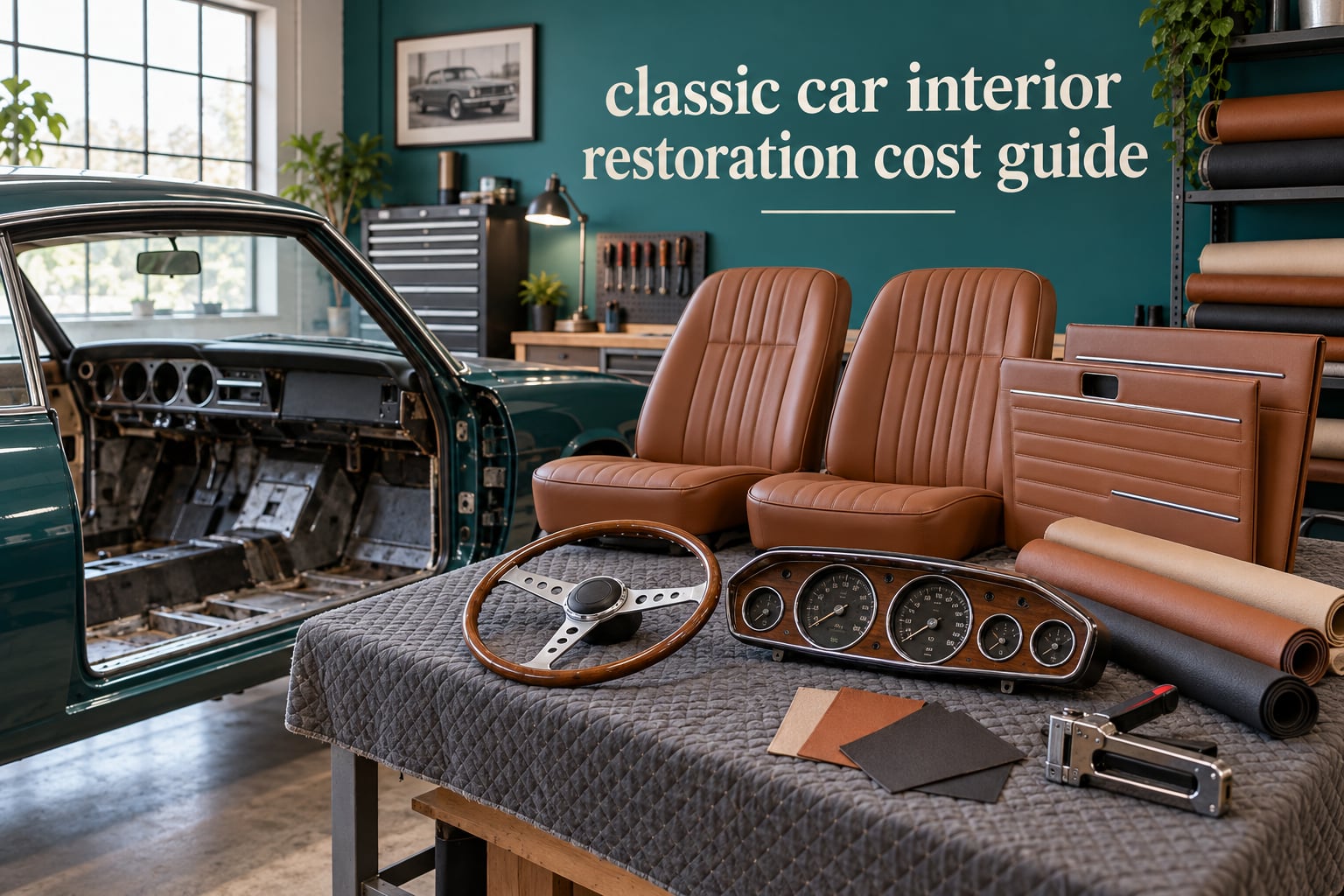
A full classic car interior restoration typically costs between USD 7,800 and USD 60,000 or more, with driver-quality work landing around USD 12,000 to USD 22,000, concours-grade interiors running USD 28,000 to USD 45,000, and restomod builds starting near USD 35,000. The number that matters most is not the range at all. It is the tier you pick, because the same car in a different tier is a different job entirely.
I have watched enough owner projects to know that the quotes which go wrong are the ones where the tier was never named out loud. You agree a price, the trimmer assumes driver-quality, you were picturing show car, and the conversation turns hostile at invoice time. Owners on enthusiast forums describe the same pattern repeatedly: an initial expectation that roughly doubles or triples, and the jumps always arrive at the invoice rather than the quote.
| Tier | What it means | Typical total (USD) | Shop time |
|---|---|---|---|
| Survivor preservation | Keep the original interior, stop the decay | 1,800-5,500 | 3-7 days |
| Driver-quality | Correct materials, correct colours, everyday durability | 12,000-22,000 | 4-8 weeks |
| Concours | Period-correct grain, stitch pattern, hardware, no visible deviation | 28,000-45,000 | 8-16 weeks |
| Restomod | Modern internals, hidden wiring, integration work | 35,000-60,000+ | 12-24 weeks |
This guide breaks those tiers down line by line, covers every major interior component, shows how era and region move the number, and gives you a seven-step method for reading a quote before you sign anything. Every figure is a range, because a range is the honest unit of currency for this work.
Table of Contents
- What Counts as a Classic Car Interior Restoration?
- The Four Cost Tiers Explained
- Component-by-Component Cost Breakdown
- What Moves the Price Up or Down
- Shop Labour Rates and Shop Types
- Costs by Vehicle Era
- Materials and Where to Source Them
- DIY vs Professional: What It Actually Saves
- How Long Does an Interior Restoration Take?
- How to Read a Shop Quote
- Hidden Costs Nobody Quotes
- Restomod and Modernization Costs
- Is It Worth It? Resale Value and Documentation
- Frequently Asked Questions
- How much does it cost to restore the interior of a classic car?
- How much does it cost to reupholster classic car seats?
- How much does it cost per hour to restore a classic car?
- What is the average cost to restore a classic car interior?
- What is the average cost for a frame-off restoration of a classic car?
- How to modernize an old car interior?
- Can old leather car seats be restored?
- Is it cheaper to reupholster car seats or buy new ones?
- Is classic car interior restoration worth it?
- How many hours does it take to fully restore a classic car?
- How long should a headliner replacement take?
- Conclusion
What Counts as a Classic Car Interior Restoration?
A classic car interior restoration is a whole-interior return to original specification: seats, carpet, headliner, door panels, dash, trim and hardware, built out in materials and stitch patterns that match what the factory specified. Anything narrower than that is a different job with a different budget.
The vocabulary is muddled in forum threads, so it helps to fix the terms before you start pricing anything.
| Term | What it covers | Typical cost (USD) |
|---|---|---|
| Preservation | Cleaning, conditioning, patching the worst wear, original parts kept | 1,800-5,500 |
| Refresh | Deep clean, polish, new carpet and mats, no structural work | 2,500-7,000 |
| Repair | One component: a torn seat, a sagging headliner, a cracked pad | 300-2,500 |
| Reupholstery | Seats only, existing foam and frames usually retained | 600-1,800 per seat |
| Partial retrim | Seats plus door panels, leaving headliner and carpet original | 4,000-11,000 |
| Full restoration | Every interior surface, hardware, correct stitch patterns, correct materials | 12,000-45,000 |
A full job means the whole cabin comes apart. Seats out, door cards off, dash pad released, headliner dropped, carpet lifted, console removed, hardware catalogued. That teardown is where the honest quote and the padded quote separate, and we will come back to it in the quote-reading section.
The Four Cost Tiers Explained
The four tiers differ in material grade, labour hours and how much of the original hardware is retained. A driver-quality job uses the correct pattern and colour in a slightly harder-wearing material. A concours job matches grain, perforation, seam and hardware exactly, and that difference is most of the price gap.
Survivor preservation
Survivor preservation is the cheapest way into the hobby and the most overlooked. If your interior is faded rather than torn, a good clean, a leather condition pass, new carpet and correct period mats can transform the car for a small fraction of a rebuild. The limitation is obvious: original upholstery fades. A preservation job on a car that has sat in sun for twenty years will look better, not new.
Preservation also suits originality-obsessed buyers. Replacing a faded but intact original seat because it looks tired reduces the car’s value in the eyes of exactly the people who pay the most for it.
Driver-quality
Driver-quality is the working default and the best value per pound spent for most owners. Correct colours, correct general pattern, modern backing materials that will not crack in five years, sound deadening under the carpet, and seams that hold up to daily use. This is the tier that makes sense on a car you intend to drive to shows and to the shops, not one that lives under a sheet in a museum.
Concours
Concours work reproduces the factory specification closely enough to pass judging. That means the right vinyl grain, the right perforation layout, the right seam pattern, the right fasteners, and hardware that has been replated rather than replaced with a modern equivalent. Concours interiors cost more because every hour is slower and the materials cost more. One Healey 3000 owner on a vintage sports car forum put a minimum of USD 55,000 on a full concours restoration, noting that concours-grade materials were the single biggest premium.
Concours is the wrong tier for most cars. It is the right tier for a car that is being built to be judged, and for a car whose value genuinely reflects that level of finish.
Restomod
A restomod interior keeps the original architecture and guts it with modern systems: hidden Bluetooth, heated seats, memory positions, USB, digital gauges behind original bezels, air conditioning that works. The cost premium is not in the parts. It is in the integration hours, the fabrication, the drilling decisions, and the wiring that has to be invisible when the door cards go back on.
Component-by-Component Cost Breakdown
Seats are the largest single line item in nearly every interior quote, followed by carpet and the dash pad. The table below gives installed costs per component across the tiers, which is what your invoice will actually reflect.
| Component | Driver-quality (USD) | Concours (USD) | Restomod (USD) |
|---|---|---|---|
| Front seats, per pair | 1,800-3,200 | 3,500-6,500 | 4,500-9,000 |
| Rear seat or benches | 1,400-2,800 | 3,000-5,500 | 3,500-6,500 |
| Moulded carpet, underlay and deadening | 900-2,000 | 1,600-3,200 | 1,800-3,500 |
| Headliner | 700-1,800 | 1,800-3,500 | 2,000-4,000 |
| Door panels, per pair | 900-1,900 | 2,000-3,800 | 2,200-4,200 |
| Dash pad reskin | 800-1,700 | 1,900-3,600 | 2,200-4,500 |
| Instrument cluster rebuild | 350-900 | 700-1,600 | 1,200-3,000 |
| Centre console | 400-1,200 | 1,000-2,400 | 1,400-3,200 |
| Steering wheel rewrap or replica | 350-900 | 800-1,800 | 1,000-2,400 |
| Seat belts, re-chromed pair with buckles | 250-600 | 600-1,300 | 800-1,800 |
| Full labour and reassembly | 3,000-6,000 | 6,000-12,000 | 9,000-18,000 |
Seats: why they dominate the invoice
Seats dominate because they are three surfaces of material, a frame, foam, springs or a plywood base, and hardware, all built twice for a car with a bench front. Reddit’s project car community puts labour around USD 150 to USD 250 per seat depending on location, with complete upholstery kits under USD 500 a pair for simpler cars. A 1968 Mercedes-Benz 450SL owner with low mileage and full garage history reported about USD 2,500 for a complete reupholstery job, with upwards of USD 350 for an individual seat.
Those numbers are consistent because seat work is labour-dense. Foam is cut and stitched to the original pattern, panels are stretched over hog rings and a pneumatic staple gun, and seams are built by hand. Seat frames from the era are often tired: rusted springs, perished webbing, collapsed foam. If the frame goes, the labour roughly doubles because the whole seat has to be stripped back to metal.
Bucket, bench and rear configurations all differ. A front bench is one large piece and the cheapest per seat. Separate buckets mean two full builds plus a centre console between them. A rear package often gets quoted as an afterthought and then becomes the line that surprises people.
Carpet and headliner
Moulded carpet is cut to the floor pan, so it is not a rectangle of material. A good carpet kit includes the underlay and often sound deadening, and the price difference between a flat kit and a properly deadened, correctly bordered carpet is significant. Budget an afternoon of drying time after fitting, because carpet that goes in wet will never lie flat.
Headliners look like a simple square until you meet one that is bagged from decades of heat and roof leaks. Stretch it back into shape with a steamer, or replace it. The replacement is not the expensive part; the expensive part is getting at it, which brings us to a hidden cost almost no quote mentions.
Dash pad, cluster and console
A dash pad is the most visible surface in the car after the seats and the most unforgiving under sunlight. Reskinning is a craft: the pad is stripped, the old vinyl removed, the foam and backing assessed, the new material stretched and heat-formed into the contours, and the grain aligned so it reads as one piece. A Porsche 912 owner on a vintage Porsche forum quoted USD 450 for the stitch and fit of a vinyl dash cover alone, having already completed the preparation work himself. That figure is a good illustration of how thin the margin on this component is.
Instrument clusters are usually cheaper than owners expect, since the work is mechanical: new internals, new lenses, new needles, a clean bezel, and sometimes modern movements behind original faces. A centre console is more expensive because reproduction units are not always available and the unit has to be finished to match the surrounding trim.
Seat belts and hardware
Restored and re-chromed belts are the line item that most often gets stripped out of a quote to make the number look better, then added back as an extra. Webbing degrades, chrome pits, buckles seize, and the anchor hardware on a fifty-year-old car can be structurally suspect. Budget for the pair with buckles, not per belt, and ask whether anchor points are included.
What Moves the Price Up or Down
Six factors account for almost all of the variation between quotes for the same car. Understand them and you can sanity-check any number you are handed.
- Era of the vehicle. Pre-1960 cars carry a premium of roughly 15 to 40 percent because patterns must be drawn from scratch, original hardware is harder to source, and construction used methods a modern shop no longer runs by default.
- The tier you name. This is the biggest single lever, and the one most often left unsaid. The spread between driver-quality and concours on the same car can exceed the cost of the driver-quality job itself.
- Where the material comes from. Period-correct and NOS material carries a premium over reproduction-grade. Modern coated and UV-stable material costs more up front and saves money later if the car is driven.
- Vehicle category. Coupe, four-door sedan and convertible differ substantially. A four-door has twice the door cards; a convertible adds collapsible or complex roof-lining work and convertible-specific panels. Expect a 20 to 40 percent spread across body styles.
- Scope. Full interior, partial retrim and single-component repair are different orders of magnitude. A baseline full-scope job in the tiers above starts at roughly USD 1,200 for a very small car, and the range from there is wide.
- Regional labour rate. The hourly rate in your market can swing the final invoice by thousands on an identical scope. Shops quote the same 60 hours very differently depending on what a shop hour costs locally.
Note what is not on this list. Colour changes, embroidery, custom badging and exotic materials all add cost, but they are choices, not variables. A quote that moves because you added features is a normal quote. A quote that moves because nobody defined the scope is a problem, and the next two sections are about catching that.
Shop Labour Rates and Shop Types
Specialist motor trim shops typically bill between USD 80 and USD 225 per hour, with the widest spread in the United States where labour is the dominant cost. A published Los Angeles rate range sits at USD 70 to USD 225 per hour, and a specialist shop national average is around USD 80 per hour. General-purpose auto upholstery shops sit lower, and dealer-adjacent and high-end restoration centres sit at the top of the range.
| Shop type | Indicative rate (USD/hr) | Best for |
|---|---|---|
| Owner-operated trim shop | 70-100 | Value driver-quality work, direct with the trimmer |
| Specialist motor trim shop | 90-140 | Full restorations, pattern matching, panel forming |
| Restoration centre | 140-225 | Concours and restomod work with in-house metal and paint |
Rates outside the United States are lower in local-currency terms and follow the same structure: independent operators at the bottom, specialist trims shops in the middle, restoration centres at the top. Quote in your own currency with a specialist shop, and compare like with like rather than against a converted number from another market.
One Australian trade source published a useful component reference in AUD, including a moulded carpet with underlay at AUD 700, a centre console at AUD 600, a dash crash pad at AUD 600, a steering wheel from AUD 500, seat belts and buckles re-chromed at AUD 1,300, an instrument facia at AUD 650, trim recolour at AUD 550 and a vinyl headliner at AUD 650. Those figures show how a specialist shop allocates cost across a full build, and the proportion of the total going to belts and the facia is worth remembering when a quote omits them.
Costs by Vehicle Era
Era is the clearest predictor of whether a job is straightforward. Later interiors use fewer one-off components and more generic shapes; earlier ones require pattern development and original hardware.
| Era | Driver-quality (USD) | Concours (USD) | Restomod (USD) | Notes |
|---|---|---|---|---|
| Pre-1960 | 16,000-28,000 | 35,000-55,000 | 40,000-60,000+ | Pattern drawing, hand-formed panels, scarce hardware |
| 1960s-1970s | 12,000-22,000 | 28,000-45,000 | 35,000-55,000 | The most common build; good reproduction support |
| 1980s-1990s | 7,800-16,500 | 18,000-30,000 | 25,000-45,000 | Simplest builds, often the best value |
Why pre-1960 costs more
Pre-1960 interiors were built with materials and methods that are harder to imitate. Panels were formed by hand, trim was often unique to a model year, hardware had small parts that were never reproduced, and a single missing trim clip can stop a reassembly. Shops that specialise in the era charge for the pattern thinking, not just the sewing.
That is not an argument against buying an early car. A pre-1960 car with a sound interior can be the cheapest way into the class, precisely because you are not funding a full rebuild. The premium only appears when the interior needs doing.
Materials and Where to Source Them
Material choice moves the invoice more than most owners expect, and it is the cheapest place to lose money. Grade your material honestly against how the car will be used.
| Material | Per yard (USD) | Per finished seat (USD) | Character |
|---|---|---|---|
| Original cloth | 25-60 | 200-600 | Correct for many 60s and 70s builds, fragile |
| Period-correct vinyl | 35-90 | 300-800 | Correct grain and colour, needs UV protection |
| Leatherette | 45-110 | 500-1,500 | Coated, easy care, closest modern stand-in for vinyl |
| Genuine leather | 90-220 | 1,000-3,000 | Soft, ages well, needs UV-stable hide |
| Alcantara or suede | 120-260 | 1,500-3,500 | Premium, restomod-leaning, not period |
Reproduction-grade vinyl from a specialist supplier is the sensible default for driver-quality work. It is dimensionally stable, available in the original grain, and holds colour under a roof. Period-correct and NOS material is the right call for concours work, and it is genuinely more expensive. A 1969 Imperial Coupe owner on a Mopar forum was quoted USD 5,500 by an interior vendor for floor pans and the interior, everything except the dash, which is a useful marker for a late-60s American car mid-range.
For sourcing, the names worth knowing are few and worth using by name: TMI for reproduction interior kits, Distinctive Industries for vinyl and cloth, Legendary Auto Interiors for kits and components, and SMS Auto Fabrics for a wide material range including correct cloth patterns. For hides, Bridge of Weir and Connolly are the recognised references in automotive leather. Your trimmer will normally handle all of this, and asking which supplier the material comes from is a reasonable question to put in writing.
Two material checks are worth knowing as an owner. First, vinyl has a bonded white cloth backing on the reverse; that is the quickest way to tell whether the material delivered is what was promised, and a mismatch here is the single most common vendor dispute trimmers report. Second, colour is matched by dye lot, and two dye lots of the same named colour are not the same colour. On a partial retrim, a retained original next to new material will show it, especially in sunlight.
DIY vs Professional: What It Actually Saves
Doing part of the work yourself does not remove the cost, it moves it from your invoice into your time. Some tasks genuinely suit a weekend; others will cost you more than a shop once mistakes are priced in.
| Task | DIY materials (USD) | Shop installed (USD) | Realistic DIY verdict |
|---|---|---|---|
| Carpet and underlay | 250-600 | 900-2,000 | Good first project, cutting is forgiving |
| Headliner | 120-300 | 700-1,800 | Doable, access is the hard part |
| Door panels | 80-200 each | 900-1,900 per pair | Heat-forming is a learning curve |
| Front seat rebuild | 400-1,200 | 1,800-3,200 per pair | Not a first upholstery job |
| Rear bench rebuild | 500-1,400 | 1,400-2,800 | Steering around a fixed backrest is awkward |
| Dash pad reskin | 200-600 | 800-1,700 | High risk of visible failure |
| Steering wheel rewrap | 30-80 | 350-900 | Popular first job, widely satisfied with results |
Look at the ratio rather than the absolute saving. A steering wheel rewrap saves 90 percent of a small number, which is a nice first project. A dash pad reskin saves a good deal on a large number and risks a visible failure, which is a bad trade. That is the whole DIY calculation in one line.
One owner on an enthusiast forum described doing all the paint in a single-car garage with no labour cost and sitting at roughly USD 5,000 in materials, which is a fair illustration of where the cost actually goes: not into the invoice, but into the hours. Budget the hours as carefully as the money.
There is also a middle path that suits a lot of owners: strip and clean everything yourself, remove the seats and door cards, and hand the shop a documented set of components. You keep the teardown savings and reduce the risk of damage, and the shop is not discovering rust in your footwells and billing you a surprise for it.
How Long Does an Interior Restoration Take?
Calendar time matters more than shop hours, because the car is off the road the whole time. One trimmer working full time needs two to three weeks on a single interior, and a full car restoration runs past 500 shop hours in total.
| Scope | Shop hours | Calendar (one trimmer) |
|---|---|---|
| Preservation or refresh | 20-40 | 3-7 days |
| Seats only | 30-60 | 1-2 weeks |
| Partial retrim | 60-110 | 2-4 weeks |
| Full driver-quality interior | 110-180 | 4-8 weeks |
| Full concours interior | 180-300 | 8-16 weeks |
| Restomod interior | 250-450 | 12-24 weeks |
Allow buffer time. Parts that are self-sourced can sit behind other work in the queue, and a trimmer who has promised three other cars will not reorder their schedule for your parcel. If time matters more than money, say so at the quoting stage, because that is a scheduling decision rather than a quality one.
How to Read a Shop Quote
A quote should be a written scope with component line items, not a single figure attached to a vehicle badge. If you get the second thing, the number is a guess and the first invoice will be a negotiation.
- Confirm the tier in writing. Ask for the sentence that says which tier the work is quoted at. This single line prevents most disputes.
- Check the line items. A credible quote separates seats, carpet, headliner, door panels, dash pad, cluster, console, wheel, belts and labour. Round numbers with no breakdown are the thing owners on forums consistently reject.
- Confirm teardown is included. Ask explicitly whether removal and refitting are in the price. Some quotes cover manufacture only, which is why they look lower.
- Confirm foam, frames and hardware. Foam, seat frames, rails, springs and fasteners are the classic extras, and they are usually discovered at teardown. Get them listed as included or excluded before you sign.
- Ask what happens if they find more. Agree a threshold and a process. A shop that will stop and call you, rather than bill and apologise later, is worth a great deal.
- Ask about material by supplier name. Which supplier, which grade, which colour, and will you see physical swatches before cutting.
- Confirm the warranty. Stitching and seam work is commonly warranted for 12 to 24 months. Ask for it in writing, and ask who stands behind it.
Red flags worth walking away from: a headliner quoted without any mention of windshield removal, which usually signals an unfinished job; a quote produced before the car has been inspected; a willingness to cut an uncut original dashboard for a modern stereo; a refusal to record what was removed; and no answer on who is responsible if a self-sourced part fails.
One more practical point. Get three quotes. Owners report quotes varying by USD 800 to USD 1,500 between shops in the same market, and without a second and third number there is no way to tell a fair price from a padded one. Quote-shopping is uncomfortable in a small trade, so ask two trusted owners which shop they would use again rather than cold-calling five.
Hidden Costs Nobody Quotes
These are the items that turn a fair quote into a shock invoice. None of them are dishonest; they are just scope that was never written down.
The cheap seat-cover trap
Budget aftermarket covers cost a fraction of concours-grade material and fail in predictable ways. They fit badly, pucker at the seams, and fade within a couple of summers, and then they are redone at full labour. Forum owners describe exactly this: pay for a cheap cover and a mediocre fit, then pay again to have it removed and replaced properly, having also paid the labour twice.
The arithmetic is brutal. A budget cover at USD 150 to USD 300 against a concours-grade cover at USD 400 to USD 800 looks like a saving until the second labour charge lands. On a pair of seats with 15 hours of work, doing the job twice adds more than the material saved on the first attempt. Buy the material once.
The headliner that is really a windshield job
A proper headliner replacement usually requires the windshield to come out so the header and the front edge of the roof can be reached and the material can be stretched without creasing. That glass work is commonly quoted separately, or quietly absorbed into a line item labelled something else. Budget roughly USD 300 to USD 600 for the removal and refit on a typical car, and ask about it directly.
If a shop quotes a headliner and does not mention the windshield, ask. It is not a trick, but it is an unfinished job if it is missed.
Foam, frames and hidden damage
Foam from the 1960s and 70s is often crumbly, and frames are frequently rusted at the springs and perished at the webbing. Rusted footwells under the carpet are the classic discovery, and they belong to the bodywork budget rather than the trim budget, but the interior job cannot finish until they are fixed.
Decide your policy before teardown starts. Either the shop stops and quotes the extra, or you authorise a capped contingency. Owners who skip this step report interior invoices jumping two to five times from their original expectation, and the jump almost always arrives at the end.
Colour matching and dye lots
New material never exactly matches a faded original, and the mismatch shows most in direct sun on horizontal surfaces like the parcel shelf and the rear seat back. There are two honest responses. Do the whole interior so the new material is internally consistent, or retain the originals and accept the contrast.
Patching a panel in small sections so the work can be done cheaply is the version owners criticise most, because the result reads as worse than doing nothing. If money is tight, do a complete component rather than a partial one.
Rush fees, freight and tax
Expediting a job roughly doubles the rate, and it is worth paying only if there is a real event. Freight on reproduction parts is a real line and a real cost, and a self-sourced part that arrives in two weeks versus a shop-supplied part that arrives with the job is a genuine difference in calendar time. Sales tax on the job is applied on labour as well as materials in most jurisdictions, which surprises people with a 20 percent jump on a labour-heavy quote.
Restomod and Modernization Costs
Modernizing a classic interior is a sequence with a predictable cost structure, and doing the steps in the right order saves rework. Here is how the money divides.
- Audio and speakers. Hidden speakers behind the grilles, a hidden amplifier, and a receiver that can be reached without pulling the dash. USD 600 to USD 2,500 depending on how invisible you want it.
- Bluetooth and connectivity. A receiver tucked under the seat or in the console, with the antenna routed out of sight. USD 150 to USD 600 plus integration labour.
- Heated seats. Heating elements under the original foam, with wiring run through the frame and a controller in the console. USD 500 to USD 1,500 per seat, and it is far cheaper if done during a full interior job than afterwards.
- Seat memory and electric adjustment. Switches, motors, rails and control module. USD 800 to USD 2,500 for the pair.
- Digital instrumentation. Modern movements behind original faces, or a discreet screen. USD 400 to USD 3,000. This is the item most likely to compromise an original interior, so decide your authenticity trade-off before ordering anything.
- Air conditioning. Vintage systems restored with modern refrigerant and a discreet evaporator, or a full modern system routed through the existing vents. USD 4,000 to USD 12,000, and the highest integration cost of any modernizing step.
- Lighting and final detail. LED replacements chosen to match the original colour temperature, plus hidden USB and a modern fuse arrangement. USD 200 to USD 1,200.
The rule that keeps restomod bills controlled: every one of these decisions belongs in the interior phase. Heated seats, speakers, wiring access and air conditioning routing all assume the seats, carpet, headliner and console are out of the car. Adding any of them afterwards means paying teardown and reassembly a second time.
Is It Worth It? Resale Value and Documentation
Whether the spend is recovered depends on the tier you chose and whether you can prove what was done. A driver-quality interior on a car that was already driver-quality rarely returns more than 70 to 90 percent of the cost. Concours work on a car that was not concours to begin with can return 100 to 130 percent, because the car moves up a class. Documented work adds a further 25 to 60 percent in some markets.
| Tier | Typical spend (USD) | Likely recovery | Verdict |
|---|---|---|---|
| Preservation | 1,800-5,500 | 60-100% | Strongest ratio of any spend |
| Driver-quality | 12,000-22,000 | 70-90% | Good value if it keeps the car usable |
| Concours | 28,000-45,000 | 100-130% | Only when the car is judged or sold at the top |
| Restomod | 35,000-60,000+ | Varies widely | Buys use, not value, in most cases |
Over-restoration is the most common financial error in this hobby. Building a concours interior in a driver-quality car is money the market will not hand back, and enthusiasts say so plainly in forum threads: at some point the cost of restoration exceeds what the finished car is worth.
Documentation is what converts a spend into value. Keep a full photographic record of the interior as found, including every blemish, because the before pictures are the evidence that the work happened. Build a written spec sheet listing materials, suppliers, colours and hardware. Retain the receipts. Take dated photos of the finished interior in daylight, not under flattering light, since the next buyer will photograph it the same way.
Then have the car appraised before the work starts and again after, and put both numbers in front of an agreed-value insurance specialist. Providers in that market include Hagerty, Grundy, American Modern and J.C. Taylor. Agreed-value cover responds to the documented state of the car, which is precisely why the photo record and spec sheet matter: they are the evidence the underwriter uses. A restoration without documentation is an expense; a documented restoration is an asset with a paper trail.
Sourcing and methods note
The ranges in this guide reflect published 2026 specialist trim shop rates and component pricing, worked examples shared by owners on enthusiast forums covering vehicles from the 1960s through the 1990s, and one dated component price list published by an Australian trim shop. Figures are stated in USD unless noted and reflect United States shop conditions for 2026, with non-US markets lower in local-currency terms and following the same structure of operator, specialist and restoration-centre rates.
Ranges are installed costs including materials, labour and shop overhead, and they exclude bodywork repairs discovered at teardown, paint, mechanical work, glass replacement and sales tax. Labour rate ranges carry the widest spread of any figure here, and a single shop hour priced at the top of the range against one priced at the bottom will change a final invoice by thousands on an identical scope. Every figure here is a planning range, not a quote, and no two cars are identical.
Frequently Asked Questions
How much does it cost to restore the interior of a classic car?
A full classic car interior restoration typically costs between USD 7,800 and USD 60,000 or more. A driver-quality interior in a 1960s or 1970s car runs USD 12,000 to USD 22,000. Concours-grade work runs USD 28,000 to USD 45,000 because materials and labour hours both rise. A restomod build with modern audio, heating, memory seats and air conditioning starts near USD 35,000.
How much does it cost to reupholster classic car seats?
Budget USD 600 to USD 1,800 per seat for a driver-quality rebuild that retains the original foam and frame. A concours seat with new foam, a refinished frame and period-correct material runs USD 1,200 to USD 3,000. A front pair usually lands between USD 1,800 and USD 3,200 driver-quality, rising to USD 3,500 to USD 6,500 for concours work.
How much does it cost per hour to restore a classic car?
Specialist motor trim shops typically bill USD 80 to USD 225 per hour depending on market and shop type. Owner-operated trim shops sit around USD 70 to USD 100, specialist shops around USD 90 to USD 140, and restoration centres at USD 140 to USD 225. A full driver-quality interior needs roughly 110 to 180 shop hours, so labour alone can account for half the invoice.
What is the average cost to restore a classic car interior?
Across mixed eras and finishes, a sensible planning figure is USD 12,000 to USD 25,000 for a complete driver-quality interior. Pre-1960 cars sit higher because patterns must be drawn and hardware is scarce, while 1980s and 1990s cars can be done for USD 7,800 to USD 16,500. Preservation-only work on a faded but intact interior is far lower, at USD 1,800 to USD 5,500.
What is the average cost for a frame-off restoration of a classic car?
A frame-off restoration of an entire classic car typically runs from tens of thousands of dollars to well over a hundred thousand, depending on tier and condition. The interior is one line among many: paint, mechanical work, suspension, brakes and trim all compete for the same budget. Forum owners of a 1969 Imperial Coupe expected 30,000 to 40,000 for a good driver restoration starting from a sound car, with a transmission rebuild alone at USD 1,500.
How to modernize an old car interior?
Work in this order so nothing has to come apart twice: hide speakers and Bluetooth receivers, add heated seats and memory controls while the seats are out, run all wiring, then install digital instruments, discreet air conditioning, LED lighting with matched colour temperature, and modern USB charging. Budget USD 5,000 to USD 20,000 on top of the trim work, with air conditioning alone running USD 4,000 to USD 12,000.
Can old leather car seats be restored?
Yes, if the leather is sound. Dried, cracked or thin leather usually needs replacing, but lightly worn leather can be cleaned, conditioned, re-dyed and re-stitched with good results. Frame rust and perished webbing are the real limits, and refinishing the frame often costs more than new foam. Get the seat inspected before deciding, because a leather restoration is not always cheaper than a vinyl reupholstery.
Is it cheaper to reupholster car seats or buy new ones?
For classic cars, reupholstering is almost always cheaper and almost always better, because original seats are built for the specific frame, rails and contours and reproduction seats rarely fit perfectly. Reproduction complete seats exist for some kits and typically cost more than the labour to rebuild the originals. Judge a kit on grain, pattern and backing material, since a poor fit will never sit flat on a period frame.
Is classic car interior restoration worth it?
Usually, as part of a larger plan, with the caveat that value recovery depends on tier. Driver-quality work on a driver car typically recovers 70 to 90 percent of the spend. Concours work on a car that will be judged or sold at the top can recover 100 to 130 percent. Restomod interiors mostly buy usability rather than value. Whatever the tier, dated photographs, a written spec sheet and receipts are what turn the spend into documented value.
How many hours does it take to fully restore a classic car?
A full car restoration runs past 500 shop hours in total, and the interior portion is commonly 110 to 180 hours for driver-quality work or 180 to 300 hours for concours. One trimmer working full time needs two to three weeks on a single interior, and calendar time runs four to eight weeks driver-quality and eight to sixteen weeks concours once parts, scheduling and drying time are counted.
How long should a headliner replacement take?
A headliner normally takes four to eight hours of shop time, but reaching it properly usually requires removing the windshield, which adds roughly USD 300 to USD 600 and another half day. A badly bagged or torn headliner can take much longer to stretch back into shape or to remove at all. If a quote does not mention windshield removal, ask, because that is where the surprise usually sits.
Conclusion
Classic car interior restoration cost is decided by one decision before any other: the tier. A driver-quality interior for a 1960s or 1970s car lands around USD 12,000 to USD 22,000, a concours interior runs USD 28,000 to USD 45,000, and a restomod build starts near USD 35,000 and can pass USD 60,000. Preservation of a faded but original interior at USD 1,800 to USD 5,500 is the cheapest and often the smartest place to start.
Take the tier into the room with a shop, ask for the scope in line items, and make sure teardown, foam, frames and hardware are written down as included or excluded before you sign. That single habit is the difference between the quote you agreed to and the invoice you actually pay, and it is the part of this process that costs nothing and protects everything.