
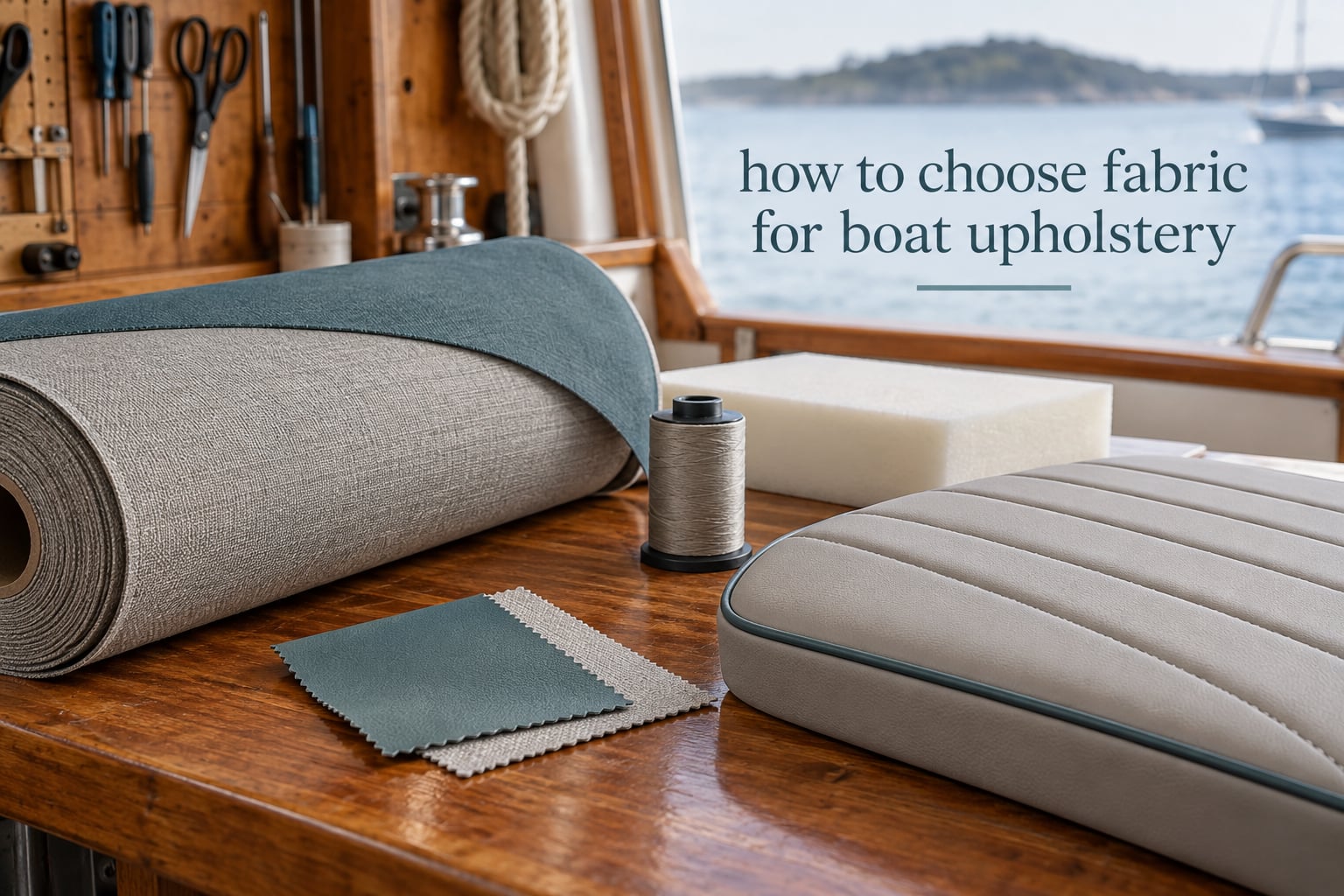
Choosing the right boat upholstery fabric comes down to one question: where does this cushion live? A helm seat in direct Florida sun, a V-berth in a shaded saloon and a transom bench in a saltwater wash line face completely different problems, and they should not wear the same cloth. Most guides answer this question with an opinion, and the forum threads that dominate the search results are full of them. This guide is built the other way around, from exposure outward.
Over years of trimming and re-trimming work on the bench, the same failures keep showing up in the same order. Fabric fades before it wears out, seams let go before the cloth does, and then water sits inside a cushion nobody can see until the mould smell starts. None of that is a fabric-quality problem on its own. It is a system problem, and it starts with the cloth you specify.
Below you will find a location-to-material decision matrix, the seven factors that should drive the decision, a spec sheet checklist with real minimum thresholds, and the foam, thread and drainage details that decide whether the cushion survives a season or ten. Updated for 2026.
Table of Contents
- What Is the Best Fabric for Boat Upholstery?
- The 7 Factors That Should Drive Your Fabric Decision
- Marine-Grade Vinyl vs Solution-Dyed Acrylic
- Why Cheap Vinyl Cracks and Goes Brittle in Full Sun
- Choosing Fabric by Cushion Location
- How to Read a Marine Fabric Spec Sheet
- Sunbrella Alternatives That Cost Less
- Colours, Heat and Hot Climates
- What Not to Buy for a Boat
- Don’t Ignore the Foam, Thread and Drainage
- Where to Buy Marine Fabric
- DIY or a Professional Marine Upholsterer?
- How Long Will the Upholstery Last?
- Frequently Asked Questions
- What is the best fabric for boat upholstery?
- What factors should I consider when choosing upholstery fabric?
- What are the downsides of vinyl fabric?
- What is the most durable upholstery fabric?
- What is the best fabric for boat cushions?
- What is the best material to use for covering boat seats?
- What is the best material for seat padding?
- What fabric is like Sunbrella but cheaper?
- Is Top Gun marine fabric better than Sunbrella marine fabric?
- Is marine vinyl breathable?
- Conclusion: Match the Fabric to the Cushion
What Is the Best Fabric for Boat Upholstery?
The best fabric for most boat cushions is a solution-dyed acrylic canvas for anything in sun, air or above deck, and a closed-cell foam core underneath a marine-grade vinyl skin for anything that takes a soaking. Solution-dyed acrylic locks pigment inside the fibre so UV cannot strip the surface colour. Marine vinyl forms a continuous waterproof, wipe-clean skin over a polyester backing. There is no single best fabric, only the right fabric for the location.
That answer changes across a boat. A sun pad facing open sky needs maximum fade and UV resistance. A cockpit cushion needs a waterproof skin and a drainage route. A berth needs breathability, and the cloth choice only matters once the location is settled.
The 7 Factors That Should Drive Your Fabric Decision
- UV exposure. Direct open sky is the harshest test. Solution-dyed acrylic is the benchmark here because the pigment sits in the fibre core rather than on the surface. Below deck and under a hardtop, exposure drops sharply and the requirements relax with it.
- Water and salt. Salt does more than stain. It works into stitching and into foam cores, and it dries to a residue that scuffs and abrades. A waterproof skin that can be hosed off is worth a great deal on a cockpit seat.
- Breathability. Somewhere in every boat sits a place where a person sleeps or rests for hours. Vinyl there traps sweat against the body, and a slick wet cushion at the helm is a safety problem as well as a comfort one. Use a breathable cloth in a V-berth or saloon.
- Abrasion. A helm seat, a companionway step and a cockpit bolster all see knees, bags and gear. Double rub and Martindale numbers are the only honest way to compare one cloth with another.
- Cushion location. This is the factor most guides skip. Exposure, moisture load and how the cushion is used are all set by where it sits, so location resolves most of the argument before it starts.
- Colour and heat. Dark colours absorb more heat, and a black cushion in a hot cockpit is noticeably hotter to sit on than a pale one. A light fabric also shows staining sooner, which changes how owners clean it.
- Cost and lifespan together. Cheap fabric that fades and cracks in three seasons is not cheaper, it is re-spent. Compare cost per yard against expected seasons of service in the sun, not against another roll of cloth on the same rack.
The three percent cotton rule. Professional upholsterers working on boats repeatedly advise fabric containing less than 3 percent cotton, a rule raised by owners on the YBW forum after advice from an upholstery company. Cotton absorbs water, holds it inside the seam and feeds mould from the inside out where nobody can see it. A small cotton content in a blend is tolerable. A cotton-linen upholstery cloth is not marine fabric, whatever the label says.
Marine-Grade Vinyl vs Solution-Dyed Acrylic
These are the two families that matter, and the honest answer is that they win different jobs. Acrylic wins on colour retention, breathability and how the cushion feels under a shirt. Vinyl wins on water, wipe-cleanability, grip and sheer toughness. Many working boats end up with both, matched to the panel.
| Material | UV and fade | Water | Breathability | Feel | Relative cost | Best used for |
|---|---|---|---|---|---|---|
| Solution-dyed acrylic | Excellent, colour to the core | Sheds water, not waterproof | Good | Woven, soft | Higher | Sun pads, T-tops, berths, bulkheads, covers |
| Marine-grade PVC vinyl | Good with quality topcoat and stabilisers | Waterproof, hoseable | Poor | Coated, cool-touch finishes vary | Mid to lower | Helm seats, cockpit cushions, engine covers, headlining |
| Solution-dyed polyester | Good, less stable than acrylic | Sheds water | Fair | Woven, crisp | Lower | Dodgers, biminis, covers, low-exposure panels |
| Coated marine canvas | Fair to good | Waterproof | None | Stiff | Lower | Spray hoods, engine covers, tarpaulins |
| Piece-dyed acrylic or poly blend | Poor, surface dye fades and weakens | Varies | Good | Woven | Lower | Avoid in direct sun |
| Cotton or linen blend | Poor | Absorbs | Good | Woven | Lower | Cabin throw covers only, never wet zones |
What Vinyl Does Not Do Well
Vinyl does not breathe, so heat builds under the cushion and against the body. It also fails in a specific way: the topcoat and the plasticisers inside it break down under ultraviolet light, the surface goes stiff, and then it cracks. It is a genuinely tough material that ages badly if the cloth was not built for sun. The downsides of vinyl fabric are really downsides of thin, cheap vinyl, and that distinction matters at the point of purchase.
Why Cheap Vinyl Cracks and Goes Brittle in Full Sun
Marine vinyl is a soft PVC compound with plasticisers that keep it supple. Ultraviolet light cooks those plasticisers out of the top layer over time, and the surface that was once flexible hardens into something closer to a stiff shell. Cracks follow the stress lines, and the cloth feels wrong long before it looks broken.
There is a second, less obvious culprit: sunscreen. Avobenzone, the active ingredient in most sunscreens, strips the protective topcoat from vinyl faster than sun alone. Owners who work on their boat in a swimsuit in a sunny cockpit are effectively accelerating the damage, and this is a recurring theme in owner discussions about vinyl seat condition.
Quality marine vinyl resists this for far longer, and the cool-touch and heavier-coated versions last longest of all. The comparison that matters is 5 to 10 years or more for good marine vinyl against roughly 3 to 5 years for standard upholstery vinyl in the same exposure.
Choosing Fabric by Cushion Location
This is the framework we work from. Read down the left column, then across, and the material decision takes about a minute.
| Cushion location | Best material | Why | Watch out for |
|---|---|---|---|
| Helm and captain chairs | Marine-grade vinyl or coated acrylic over closed-cell foam | Constant sun, spray and body contact | Wet vinyl is slick, so keep a non-slip surface or texture |
| Cockpit cushions | Marine-grade vinyl | Water sits on these for hours | Drain holes and closed-cell foam are mandatory |
| Berths and saloon | Solution-dyed acrylic, breathable | Long contact with skin, little sun | Foam still needs a water-resistant base layer |
| Sun pads and bow seating | Solution-dyed acrylic, heaviest grade | Full open-sky exposure, no shade | Fading, check colour hold before buying |
| Bulkhead and headlining panels | Solution-dyed acrylic or light marine vinyl | No water, moderate light | Stretch and seam allowance during fitting |
| T-top and tower upholstery | Solution-dyed acrylic | Constant full sun, little water | Highest UV demand on the boat |
| Engine covers and lazgers | Coated marine canvas | Wet, salty, stowed folded for long periods | Fold creases and mildew in damp storage |
| Dodgers, biminis and cockpit covers | Solution-dyed polyester or acrylic | Transient rain and spray, high sun | Seam tape and thread quality decide longevity |
One rule cuts across every row. Whatever the cloth, a cushion that lives under a cover for months in a damp shed still has to be a synthetic that tolerates storage, because fabric choice is not only about the day the boat is in use.
How to Read a Marine Fabric Spec Sheet
Most buyers cannot tell a genuinely marine cloth from a patio cloth with a nautical name, because both spec sheets list fibre content and colour. Four numbers on the label do the real work, and here are the minimums we would accept on a boat.
1. Fibre content and cotton percentage
Look for 100 percent acrylic or polyester, or a stated cotton content under 3 percent. Anything labelled as a cotton blend for a wet or sunny location is a household upholstery fabric, not a marine one.
2. Solution-dye versus piece-dye
The spec tag should say solution-dyed, or the brand should state that the colour goes to the core. Piece-dyed fabric has colour sitting on the fibre surface, so it fades unevenly and weakens as the sun works on it. This single phrase separates a cloth built for sun from one built for a covered patio.
3. Abrasion ratings
A double rub count describes how many cycles a fabric survives in a test rig. For a boat in full sun, look for 50,000 double rubs or more. Martindale is the European equivalent, and 25,000 Martindale is the common baseline, with higher figures on heavy-duty cloth. Marine-grade vinyl often carries its own abrasion figure, and anything under 30,000 should go on a low-traffic panel at most.
4. UV exposure hours
This is the single most useful number for a boat and the one most often missing. Solution-dyed acrylic in the top tier runs 2,000 hours or more of UV exposure. 1,500 hours is a workable minimum for a shaded or covered panel. If the spec sheet says nothing about UV hours, treat the cloth as an indoor-grade product until proven otherwise.
5. Additional terms worth checking
- Marine canvas weight in ounces per 36 inches. Heavier is more durable, and it matters for covers and dodgers.
- Water repellency and cleanability. A coated back or a bleach-cleanable rating tells you how it behaves after a spill.
- Mildew and anti-microbial treatment. Useful on foam, less decisive on fabric.
- Woven versus coated back. A coated back improves water resistance and slows the migration of moisture into the cushion.
Five checks to run on a swatch before you buy. Hose it and watch whether water beads or soaks. Rub it with sunscreen and look for a mark or a sticky patch. Bend it and smell it, because strong off-gassing is a sign of a heavy coating. Check the selvage or backing for a woven, closed structure. Then read the tag for the words solution-dyed, and check the rub count and UV hours. A cloth that fails two of those five is a patio cloth.
Telling marine-grade vinyl apart from standard upholstery vinyl is easier than most sellers admit. Marine vinyl is sold in 54 inch widths for boat work, carries a heavier coating, and lists a UV or outdoor rating. Automotive and furniture vinyl is usually narrower or sold by the metre, and its spec sheet is vague about ultraviolet exposure. Ask the supplier directly which vinyl it is; the answer is decisive.
Sunbrella Alternatives That Cost Less
Sunbrella is the name most owners arrive with, and it earns the reputation. As noted on CruisersForum, the Sunbrella furniture fabrics are great to work with and wear extremely well, but they are pricey. That price is real, and several alternatives deliver most of the performance for less.
- Outdura shares the solution-dyed acrylic construction and reads very close to the original, at a lower price point.
- Sattler offers a broad marine and awning range with good solution-dye performance in the mid tier.
- Contender and Shelter-Rite cover the heavy awning and cover end of the market, which suits dodgers and covers more than cushions.
- Crypton is worth a look where stain resistance matters more than raw UV performance, such as an interior saloon panel.
The saving is real when the cushion lives in shade, under a cover or inside the cabin. For a sun pad taking direct open-sky exposure all season, the price gap between the top acrylics is the smallest part of the decision, and the colour hold is what you are paying for.
Colours, Heat and Hot Climates
Light colours reflect more heat, and a pale cushion in a hot cockpit is cooler to sit on than a dark one. That is a comfort point, not a durability point, and it is worth weighing on a boat that sits in the sun for hours.
For colour longevity, the answer is in the dye rather than the pigment. Solution-dyed cloth holds its colour because the colour is the fibre. Ask for a colourfastness statement, and before committing to a colourway, look at a yardage sample that has already been in full sun if you can. Piece-dyed cloth tells you very quickly that it is the wrong choice.
What Not to Buy for a Boat
Most disappointing cushions are not badly made. They are made from the wrong cloth, and the list of wrong cloths is short and worth memorising.
- Interior home-decor fabrics. Indoor upholstery fabric has no UV rating, no abrasion rating and no water story at all.
- Standard automotive vinyl. It is built for a car interior with a laminated window, not for open sky. It bakes and cracks.
- Cotton and linen blends. These absorb water, hold salt and feed mould inside the cushion.
- Untreated or piece-dyed polyester. Cheap, and it fades and weakens in the first hard season of sun.
- Velvet and chenille. They crush, they stain permanently, and they shed in salt air.
- Outdoor patio cloth bought for the wrong job. It is a real outdoor fabric, but built for a covered chair rather than a wet, salty cockpit.
One more is worth naming: any fabric that arrives without a spec tag. If the supplier cannot tell you the rub count, the UV hours and the fibre content, you are buying on colour alone.
Don’t Ignore the Foam, Thread and Drainage
The most cited complaint in every owner forum is mould inside the cushion, and no fabric choice on its own prevents it. The fix is a system, and each part has to be specified.
On the Reddit r/upholstery thread on marine work, the recommendation that comes up again and again is to look for anti-microbial foam and give every cushion some sort of drain hole on the bottom. That matches what we see on the bench. Open-cell foam acts as a sponge, holds water and rots a cushion from the inside out where the cover still looks perfect. Closed-cell foam does not absorb water, which is why closed-cell foam with a waterproof cover is the standard cockpit configuration described in long-term liveaboard references.
| Foam type | Density range | Water behaviour | Use it for |
|---|---|---|---|
| Closed-cell marine foam | 1.8 to 2.5 lb/ft3 | Does not absorb water | Exposed cockpit and helm cushions |
| High-density closed-cell | 2.5 to 3.0 lb/ft3 and up | Does not absorb water | Helm seats, sun pads, seats that carry weight |
| Multi-layer and softer core | Layered, roughly 1.8 to 2.5 | Needs a sealed base | Berths and saloon, built like a mattress |
| Open-cell foam | Any | Absorbs water and holds it | Avoid in any wet zone |
Thread matters more than most owners expect. As put on the SailboatOwners forum, choose a synthetic and make sure a premium quality polyester thread is used to sew it together, because standard thread degrades quickly in sun and salt. UV-stabilised polyester thread, in the V-69 and V-92 grades, or a PTFE thread, is the correct pairing with acrylic and vinyl. A seam that is weaker than the cloth it joins is a seam you will be re-sewing in two seasons.
Finally, drainage. Drill drain holes through the bottom panel of every cushion, add side vents or grommets so trapped air and water can move, and use a mesh or coated base layer between foam and cover so water can escape instead of sitting. None of this is visible once the cushion is made, which is exactly why it gets skipped.
Where to Buy Marine Fabric
Three routes work. A large marine fabric supplier online gives the widest colour choice and ships cut lengths to anyone, which solves the colourway problem for buyers outside major ports. A local sailmaker or canvas shop can match an existing boat’s scheme, cut to pattern and often install the work. A marine upholsterer handles the foam, stitching and fitting as one job, which is the cheapest route if the cushions are complex.
Big-box craft stores do carry marine vinyl, but the selection is narrow. Owners on Reddit report Hobby Lobby marine vinyl as black, white and blue only, and finding tan or grey in a specific colourway is the most common sourcing complaint we hear. Specs are limited too, so check the roll rather than trusting the shelf tag.
DIY or a Professional Marine Upholsterer?
Make it yourself when the cushions are simple, flat and repetitive, when you already sew, and when you can source closed-cell foam and drainage hardware. A cockpit bench is a reasonable weekend project.
Hand it over when the shapes are compound or curved, when the cloth is a full yard of open-sky acrylic, when the foam specification matters more than the sewing, or when a safety issue such as a slick helm cushion has to be solved properly. Compounded corners, piped welts and matched colourways across a whole cockpit are where a shop earns its money.
How Long Will the Upholstery Last?
Roughly 5 to 10 years or more for quality marine vinyl in full sun, 10 years or more for solution-dyed acrylic in a comparable position, and around 3 to 5 years for standard upholstery vinyl in the same exposure. Piece-dyed cloth sits at the bottom of that range whether or not it is cheap.
Maintenance decides more of the outcome than the brand. A rinse with fresh water after every salt exposure, keeping cushions off wet decks and letting them dry in the sun rather than folded in a damp hold, and covering the boat when it is not being used will each add years. Cushions stored damp and folded will mould no matter what cloth you chose, and that is the truth most fabric marketing skips.
Frequently Asked Questions
What is the best fabric for boat upholstery?
Solution-dyed acrylic canvas is the best choice for anything in direct sun or above deck, because the dye sits inside the fibre and resists UV fading. For cushions that take a soaking, marine-grade vinyl over closed-cell foam is more practical. Match the fabric to the location rather than looking for one universal answer.
What factors should I consider when choosing upholstery fabric?
Seven factors matter: UV exposure, water and salt, breathability, abrasion, cushion location, colour and heat, and cost measured against expected service life. Location resolves most of the argument first, since it sets the exposure, the moisture load and how the cushion is used.
What are the downsides of vinyl fabric?
Vinyl does not breathe, so heat and moisture build against the body. It can feel slick when wet, which matters at the helm. Quality marine vinyl resists ultraviolet breakdown, but thin standard vinyl loses its plasticisers in full sun, goes stiff and eventually cracks.
What is the most durable upholstery fabric?
For resistance to abrasion and general toughness, marine-grade vinyl is the most durable. For colour retention under ultraviolet light, solution-dyed acrylic is the most durable, because the colour goes to the fibre core. In practice, the two are often used together on the same boat.
What is the best fabric for boat cushions?
Helm and cockpit cushions take marine-grade vinyl over closed-cell foam. Berths and saloon panels take solution-dyed acrylic because they need breathability. Sun pads and T-tops take the heaviest solution-dyed acrylic, since they face open sky with no shade.
What is the best material to use for covering boat seats?
Marine-grade vinyl is the best covering material for seats exposed to water, and solution-dyed acrylic is best for seats exposed to sun. Use acrylic anywhere a person rests against the fabric for hours, such as a V-berth sleeping surface, and vinyl anywhere water pools.
What is the best material for seat padding?
Closed-cell marine foam in the 1.8 to 2.5 lb/ft3 range suits most cushions, while 2.5 to 3.0 lb/ft3 and above suits helm seats and sun pads that carry weight. Open-cell foam absorbs water and holds it, so it is rejected in any wet zone.
What fabric is like Sunbrella but cheaper?
Outdura is the closest match, sharing the solution-dyed acrylic construction at a lower price point. Sattler covers the mid tier, while Contender and Shelter-Rite suit covers and awnings. Crypton is worth considering for interior panels where stain resistance matters more than ultraviolet performance.
Is Top Gun marine fabric better than Sunbrella marine fabric?
They serve different jobs. Top Gun is a heavier coated fabric aimed at covers and awnings, so it is tougher and waterproof but stiffer and less comfortable to sit on. Sunbrella acrylic is a woven solution-dyed cloth that breathes and holds colour, which is why it wins for cushions and interior panels.
Is marine vinyl breathable?
No. Marine vinyl is a continuous coated skin and does not breathe, which is its main drawback for sleeping surfaces and for hot helm seats. Use a solution-dyed acrylic instead wherever long skin contact and heat build-up are the concern.
Conclusion: Match the Fabric to the Cushion
How to choose fabric for boat upholstery comes down to location first and specification second. Solution-dyed acrylic for sun, air and anything a body rests against, marine-grade vinyl for anything that gets wet, and a spec sheet that shows a rub count, UV hours and a cotton content under 3 percent. Then specify closed-cell foam, UV-stable thread and drainage, because fabric alone will not stop mould.
Start by ordering swatches of two or three candidates and running the five checks in the store. Take the sample home, hold it against the existing trim, and decide with the cushion in front of you rather than on a screen.