
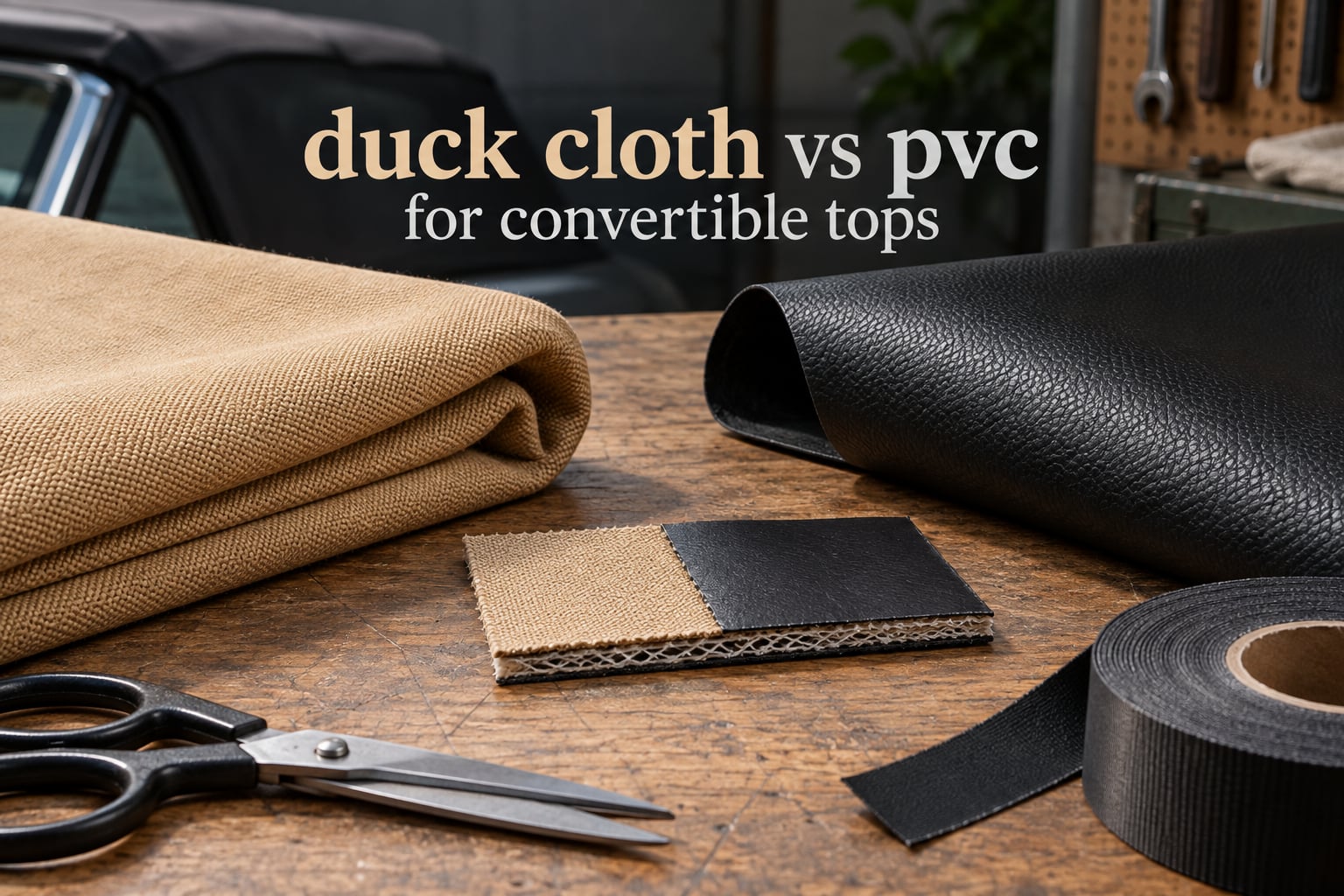
Choosing a convertible top material usually comes down to one comparison: duck cloth versus PVC vinyl. The two look and behave nothing alike, and the right pick depends on where the car lives, how often the roof goes down, and how much maintenance you actually enjoy.
I have spent October 2026 in the convertible top and trim business, and the same question walks through the door every week. Owners are not choosing between two fabrics in the abstract. They are choosing between two different failure modes, two different care routines, and two different experiences at 70 miles an hour with the roof down.
This guide breaks down what duck cloth actually is, what PVC vinyl actually is, and how the two compare on water, sunlight, lifespan, noise, cold-weather folding and cost. It also covers the naming trap that confuses most buyers, the coated-fabric hybrid that most modern convertibles ship with, and a two-minute test for identifying the material on the top you already own.
Table of Contents
- Duck Cloth vs PVC Vinyl for Convertible Tops: The Quick Answer
- What Is Duck Cloth?
- What Is PVC Vinyl for a Convertible Top?
- Duck Cloth vs PVC Vinyl: Head-to-Head Comparison
- How Each Material Fails
- Care and Maintenance: Duck Cloth vs Vinyl
- Climate and Use-Case Match
- Cost Comparison: What Actually Drives the Bill
- Naming Trap: Duck Cloth vs Canvas vs Stayfast, Twillfast and Sunfast
- Why Modern Convertibles Rarely Use True Duck Cloth
- How to Tell What Material Your Top Already Is
- Frequently Asked Questions
- Which is better for a convertible top, cloth or vinyl?
- What is the best material for a convertible top?
- How long do vinyl convertible tops last?
- What are the different types of convertible tops?
- What are the differences between Stayfast cloth and Twillfast cloth?
- What is the best fabric convertible top cleaner and protectant?
- Which is better, canvas or vinyl?
- Is duck cloth waterproof?
- Conclusion
Duck Cloth vs PVC Vinyl for Convertible Tops: The Quick Answer
Duck cloth is quieter, warmer, folds in cold weather and looks better for decades, but it fades, stains permanently and needs a fabric protectant. PVC vinyl sheds water completely, wipes clean and survives road salt, but it hardens, chalks and cracks as the plasticizer leaves. Choose cloth for a garage-kept or show car. Choose vinyl for a daily driver in snow, salt or desert heat.
What Is Duck Cloth?
Duck cloth is a plain-woven cotton canvas, heavy enough to hold a shape, tight enough to shed water, and dyed through the fibre rather than coated on the surface. It is the material most people picture when they think of a classic American convertible top.
The name comes from the fabric originally used for duffel bags, tents and workwear. Sailors and soldiers got duck cloth because it was tough, cheap and available. The same properties made it the standard soft top material on American convertibles for decades before vinyl took over.
Two construction details matter when comparing cloth tops:
- Plain weave versus twill weave. A plain weave has the over-one, under-one pattern that gives duck cloth its flat, matte surface. A twill weave has a diagonal rib running across the fabric, which is stronger, drapes more smoothly and resists abrasion better. Many of the best-known cloth top names are twill constructions.
- Weight in ounces per square yard. Heavier cloth resists tearing and holds its shape when folded, but adds weight to the top frame and costs more. Lighter cloth is easier on the mechanism but less durable.
Modern cloth tops also carry a water-repellent treatment, usually a fluorochemical or silicone-based finish sprayed onto the fibres. That finish is what makes water bead and roll off. It is not a waterproof membrane, and it wears down over the life of the top.
Owners ask constantly whether canvas is actually waterproof. The honest answer is that untreated duck cloth is not, and treated duck cloth resists rain for a while. In a hard downpour, water eventually finds its way through the weave and the seam tape. Owners on the my350z forum thread about going cloth or vinyl raise exactly this point, and the consensus is that cloth handles occasional rain fine but should not be relied on in sustained wet weather.
What Is PVC Vinyl for a Convertible Top?
PVC vinyl for a convertible top is a plasticized polyvinyl chloride film bonded to a backing fabric, most often polyester. The soft PVC skin gives the top its flexibility and its colour, while the backing carries the load and the stitching.
Two construction details matter here too:
- Pinpoint versus non-pinpoint embossing. A pinpoint vinyl has a fine, uniform texture across the surface that resembles fine leather grain. Non-pinpoint vinyl has a coarser, more random texture. Pinpoint is the modern default and hides scuffs better.
- Single-ply versus multi-ply. A single-ply top is one layer of vinyl over its backing. A multi-ply top layers a second coated fabric against the inside face, adding thickness, insulation and sound deadening at the cost of weight and folding stiffness.
One genuine advantage of vinyl is that it is not a fabric at all. There is no open weave for water to travel through, so rain sits on the surface until gravity takes it. The same property is its weakness in another sense: air cannot pass through, so the cabin gets hot faster in summer, and there is no natural fibre to soften sound.
Modern cars often use a coated fabric that is neither of the two classic options. This is a polyester or PET base fabric with a PVC coating facing, sometimes described as vinyl-faced or coated fabric. It behaves like vinyl on the outside but retains a woven core. A restorer will see one on a late-model car and immediately know it is not the cotton duck the factory fitted decades earlier.
Duck Cloth vs PVC Vinyl: Head-to-Head Comparison
This table is the short version of the entire argument. Every row below reflects how owners and installers describe the two materials in practice.
| Attribute | Duck Cloth | PVC Vinyl |
|---|---|---|
| Water behaviour | Beads and sheds, but eventually saturates in heavy rain | Fully blocks water, wipes dry |
| Sunlight behaviour | Dye fades gradually, irreversibly | Surface hardens, chalks and yellows |
| Primary failure mode | Colour loss, permanent staining, mildew in the weave | Plasticizer loss, hardening, cracking, tear at the bow |
| Typical lifespan | Long when stored dry and maintained; colour is the limit | Long when conditioned; cracking is the limit |
| Maintenance chemistry | Fabric cleaner plus fabric protectant and water repellent | Vinyl dressing or conditioner with UV blockers |
| Road noise | Noticeably quieter, absorbs high-frequency wind noise | Louder, more pattering sound at speed |
| Thermal comfort | Warmer in cool weather, breathes more | Hotter in sun, no breathability |
| Cold-weather folding | Folds down in freezing conditions | Stiffer; can crease or crack when folded very cold |
| Appearance over time | Weathers into a soft patina, looks richer | Fades and chalks to a flat grey along creases |
| Install sensitivity | Very sensitive to fit; wrinkles in the corners show badly | More forgiving, seams hide small misalignment |
| Best fit for | Garage-kept, weekend, show and restoration use | Daily driving, snow, salt and desert climates |
Read the noise and insulation rows together. Cloth is not dramatically warmer, but the difference at highway speed is dramatic enough that owners notice it immediately on a first drive. If road noise is the thing you hate most about a convertible, that row alone can settle the decision.
The last row is the one most buyers underestimate. Cloth is unforgiving of a poor installation. Owners repeatedly report on the my350z forum that excellent material fitted by a novice still looks bad, and that corner wrinkles give away a rushed install on cloth far more visibly than on vinyl.
How Each Material Fails
The single most useful thing to know about duck cloth versus PVC is that these materials fail in opposite directions. Cloth loses colour. Vinyl loses softness. Neither failure can be reversed by a protectant, and choosing the wrong chemistry makes both worse.
How duck cloth fails
Ultraviolet light attacks the dye molecules in the cotton fibre. The top does not crack or go stiff. It simply becomes paler, usually unevenly, and most visibly on the horizontal surfaces that see the most sky: the top’s crown, the rear deck seam and the bow.
Beyond fading, cloth has three secondary failure modes:
- Permanent staining. Oil, sap, bird droppings and fuel stains penetrate the weave. Once set, they do not come out with a fabric cleaner.
- Mildew. A damp cloth top that is folded and stored will smell within days. The weave holds moisture and organic matter against the fibre.
- Seam and stitch-line discolouration. The taped and stitched seams often go before the field panels do, because they trap water and take the abrasion.
How PVC vinyl fails
Heat and ultraviolet light attack the plasticizer inside the PVC. The plasticizer is what keeps the film supple, and as it migrates out, the top hardens. Once hard, the material loses the ability to move with the bows and the weather, and it cracks.
The classic progression owners describe on the SpyderChat vinyl versus cloth thread runs like this: the top feels fine for years, then one season it feels noticeably stiffer, chalky marks appear where it folds, and the surface takes on a dusty grey sheen. In a hot climate this can accelerate dramatically. The first visible cracks usually appear at the bow and along the rear deck seam, where the top flexes most.
The damage compounds. A vinyl top that is allowed to harden and then folded in freezing weather is the classic combination that produces a permanent crease or a split at the rear seam.
Lifespan expectations and what shortens each material’s life
For cloth, lifespan ends when the colour is gone beyond what the owner will accept. Fold storage, sun exposure and skipped cleanings are what shorten it. A cloth top driven every day in strong sun without a protectant will fade far faster than one that is cleaned and sealed twice a year.
For vinyl, lifespan ends when cracks appear and the top stops sealing. Missed conditioning, extreme heat and cold folding are the accelerators. A vinyl top that lives outdoors in a desert garage will age faster than the same top on a car in a temperate coastal climate, regardless of how well it was installed.
Neither material has a fixed number of years. The honest answer is that both can last indefinitely with the right care and neither survives neglect, and the failure arrives in a different season for each.
Comfort: noise, insulation and cold-weather folding
Cloth is quieter. The weave scatters wind noise, and owners consistently report that a cloth car feels calmer at 70 miles an hour than the same car with vinyl.
Cloth also folds down in cold weather without complaint, which matters in northern climates. Vinyl becomes stiff when cold, and folding a cold, stiff top is how you get a crease that never comes out. If your car lives outdoors in winter, this row deserves real weight.
The rear window is a separate decision
Glass versus plastic rear window has nothing to do with the top material, and it is worth deciding on its own terms. Plastic rear windows yellow, scratch, cannot be tinted and degrade faster than glass. Glass rear windows cost more, weigh more and constrain the top’s folding stack on cars with a low-profile folded roof.
On the Third Generation F-Body boards, this debate is one of the longest-running on the site, with owners split almost evenly between glass for scratch resistance and plastic for foldability. Pick the window that fits how the car is used.
Care and Maintenance: Duck Cloth vs Vinyl
Using the wrong protectant is the most common mistake on this topic, and it can permanently damage a top. A product designed for vinyl will not penetrate a woven cotton fabric. A product designed for fabric will not condition a PVC film. Keep them separate.
Five-step cloth top routine
- Wash monthly in the shade. Use a dedicated fabric convertible top cleaner, not a general car shampoo, which leaves residue in the weave.
- Work the seams by hand. The taped seams collect dirt faster than the panels and need a soft brush and a little extra attention.
- Let it dry completely. This is not optional. Any moisture left in a cloth weave before protection is how mildew starts.
- Apply a fabric protectant with water repellent. Owners commonly use Raggtopp-type products for this step, and the routine is reapplied rather than done once.
- Store folded only when bone dry. A damp cloth top folded into a car will smell within days.
Four-step vinyl top routine
- Clean with a soft cloth and mild soap. Vinyl holds dirt on the surface, so cleaning is faster and shallower than cloth cleaning.
- Dry fully in the shade. Direct sun while wet will print water spots into the film.
- Apply a vinyl conditioner or dressing. This is the step that slows plasticizer loss, and it is the step owners skip most often. A UV-blocking dressing is worth more on a car that lives outdoors.
- Condition before winter storage and after the first warm month. Two applications a year keeps the film supple through the seasons that stress it.
Warning: never fold a wet top. This is the single most repeated mistake in owner threads, and it causes permanent wrinkling and seam damage on both materials. Water trapped in a folded cloth top also invites mildew within days.
Between seasons, store the top dry, clean and lightly conditioned, in a breathable cover indoors. A car cover left on a folded top for months traps the same moisture you worked to remove.
Climate and Use-Case Match
There is no universally better material. There is only a better match for a specific car in a specific place. This matrix is how I would steer an owner at the counter.
| Scenario | Better choice | Why |
|---|---|---|
| Daily-driven car in snow and road salt | PVC vinyl | Wipes clean, tolerates salt, no absorbency to worry about |
| Daily driver in desert heat | PVC vinyl, conditioned regularly | Cloth fade rate in strong sun is the limiting factor |
| Coastal and salt-air climate | Either, leaning vinyl | Salt and constant damp punish cloth storage |
| Garage-kept weekend car | Duck cloth | Appearance and noise matter more than snow tolerance |
| Classic restoration to factory spec | Duck cloth or Haartz-grade canvas | Matches what the car left the factory with |
| Show car and concours preservation | Duck cloth | Looks correct, and colour holds when stored properly |
| Modern convertible with coated fabric | Match the OEM material | A cloth top on a coated-fabric car will not sit or seal the same |
Matching the material to the car
A restored classic deserves the material it was built with, because that is what the rest of the car is designed around: the top frame, the bows, the tensioning and the rear window all assume a specific thickness and flex. For modern cars, matching the coated fabric the factory specified is the safest route, since a mismatch shows up as poor sealing along the rear deck.
Preservation versus daily use
Decide honestly how the car will be used. Owners who describe a cloth top as the best decision they ever made usually garage it and drive it on fair days. Owners who drove a cloth top daily through a Midwestern winter usually came back to vinyl. Neither answer is wrong, but the second owner bought the wrong top for their habits.
Cost Comparison: What Actually Drives the Bill
Cloth carries a material premium over vinyl, and the difference is usually modest next to the rest of the job. This is the part of the comparison that surprises new buyers.
Installation labour routinely costs as much as or more than the top itself, and it is not negotiable in the way the material choice is. A top is a made-to-order part, and on the CorvetteForum and my350z threads owners describe the real cost of a mistake as the replacement top that follows a failed fit.
So the practical cost breakdown looks like this:
- Material premium for cloth over vinyl: the smaller part of the bill.
- Installation labour: the dominant line item in most jobs.
- Removable glass versus plastic rear window: an independent cost decision.
- Top hardware, bows and lining: worth inspecting before ordering, not replacing by default.
Because the material premium is the small number, choosing vinyl to save money rarely pays back. A vinyl top that needs replacing in a shorter period costs more across its life, and the cloth is what makes the car worth looking at. Buy the material your usage justifies, not the material the invoice is smallest for.
Naming Trap: Duck Cloth vs Canvas vs Stayfast, Twillfast and Sunfast
Most of the confusion in this topic comes from names. A buyer searching duck cloth versus PVC will encounter Stayfast, Twillfast, Sunfast, Haartz, canvas and plain duck, and assume those are competing products. They are largely not.
The direct answer: Stayfast, Twillfast and Sunfast are the same base material under different names. This is confirmed repeatedly on the Third Generation F-Body boards, where the consensus settled early in the thread that the three labels describe one material rather than three grades of it.
What actually distinguishes the options is construction, not branding:
- Duck cloth describes the weave family. Plain weave for the classic flat matte look, twill for a diagonal rib and better abrasion resistance.
- Canvas is a broader word that any tight plain-weave cotton fabric can fall under. On its own it means nothing about quality.
- Haartz is the manufacturer name that carries real weight. Owners on the CorvetteForum threads note that cheap aftermarket cloth is routinely sold as canvas but is not Haartz-grade, and it looks it.
- Stayfast, Twillfast and Sunfast are trade names for coated or treated cloth constructions from the same basic cotton duck platform.
When a seller writes canvas without a weave, a weight or a manufacturer, that is not a quality signal. Ask for the weave type and the weight in ounces. Those two answers tell you far more than the product name.
Why Modern Convertibles Rarely Use True Duck Cloth
Ask a car dealer what the top is made of and you will usually get a vague answer involving coated fabric. That is because most modern convertibles do not use true cotton duck. They use a multi-ply laminate: a synthetic base fabric with a PVC coating facing, sometimes paired with an elastomer layer for flexibility.
The reasons are practical. A synthetic coated top is lighter, cheaper to produce, more consistent across a production run, and easier to service. It also does not need to be re-stretched, and it resists mildew because it does not absorb. Every one of those is a genuine advantage that explains the shift.
What the trade costs is character. The material has a plastic feel, it sounds harder under wind, and it cannot be repaired with fabric products. For a classic car, a modern coated top is a visible anachronism. For a modern car, duck cloth is the anachronism, and fitting one creates sealing and tension problems at the rear deck.
This hybrid is genuinely a third option, and it explains why an owner who pulls the fabric from a late-model car and holds it to the light sees no cotton weave at all.
How to Tell What Material Your Top Already Is
Most owners can identify their material in under two minutes. Run these three checks in order and stop when one gives a clear answer.
- Read the label first. Check the driver’s side bow, the window header or the underside of the rear deck trim for a material stamp. Haartz, Stayfast or Twillfast means cloth. A model number or the word vinyl or coated means PVC.
- Pinch and look at the grain. Pull the material between finger and thumb. Pinpoint vinyl has a fine, even pebble texture you can see in daylight. Cloth shows a visible woven grid, and a twill shows a diagonal line.
- Test the weave from underneath. Open the top and look at the inside face. Vinyl is a continuous sheet with a backing; cloth shows an open weave and stitching, and often a taped seam.
Add a water test if you still are not sure. Put a few drops on the surface. Vinyl beads hard and rolls off. Treated cloth beads at first but absorbs over a few minutes.
If the answer is coated fabric, the top is a hybrid and neither care routine in this guide applies exactly. Use a vinyl-safe dressing and skip the fabric sealants, which will sit on the surface and go chalky.
Frequently Asked Questions
Which is better for a convertible top, cloth or vinyl?
It depends on climate and use. Duck cloth is quieter, warmer, folds in cold weather and looks better over time, but it fades, stains permanently and needs fabric protectant. PVC vinyl blocks water completely, wipes clean and handles snow and road salt, but it hardens, chalks and cracks as the plasticizer leaves. Choose cloth for a garage-kept or show car, and vinyl for a daily driver in winter, salt or desert heat.
What is the best material for a convertible top?
There is no universal winner, only a better match for the car. A classic restoration wants duck cloth or a Haartz-grade canvas to match the factory. A daily-driven car in snow, salt or desert heat is better served by PVC vinyl. A modern convertible with coated fabric should stay with the coated fabric the manufacturer specified, because a mismatch causes sealing problems at the rear deck.
How long do vinyl convertible tops last?
There is no fixed year count, because lifespan ends when cracks appear and the top stops sealing rather than at a set date. A conditioned vinyl top on a temperate car can run a very long time with no issues. A top stored in a hot desert garage without regular conditioning ages far faster. The accelerators are heat, ultraviolet light, skipped vinyl dressing and folding the top while it is cold and stiff.
What are the different types of convertible tops?
The main types are cotton duck cloth, which is a woven and dyed cotton canvas, and PVC vinyl, which is a plasticized PVC skin bonded to a backing fabric. Vinyl comes in pinpoint or non-pinpoint embossing and in single-ply or multi-ply construction. A third and very common type on modern cars is coated fabric, a synthetic base with a PVC facing that behaves like vinyl on the outside. The rear window is a separate choice between glass and plastic.
What are the differences between Stayfast cloth and Twillfast cloth?
The difference is the trade name, not the material. Stayfast, Twillfast and Sunfast are different names for the same basic cotton duck platform, and owners confirm this repeatedly on enthusiast forums. What genuinely varies is construction: plain weave gives a flat matte face, while twill weave gives a diagonal rib, better abrasion resistance and smoother draping. Ask a seller for the weave type and the weight in ounces rather than relying on the product name.
What is the best fabric convertible top cleaner and protectant?
Use a dedicated convertible top fabric cleaner for the wash step, and a fabric protectant that contains a water repellent for the sealing step. Owners commonly use Raggtopp-type products for this routine. Apply the protectant in the shade, only after the top is completely dry, and never on a wet top. Do not use a vinyl dressing on cloth, and do not use a fabric sealant on vinyl, because the wrong chemistry leaves residue that ages badly.
Which is better, canvas or vinyl?
Canvas, meaning a good-quality cotton duck weave, is better if the car is garage-kept, driven on fair days or kept as a show car, because it is quieter, warmer and holds its appearance longer. Vinyl is better if the car is driven daily through snow, road salt or desert heat, because it blocks water, wipes clean and does not absorb moisture. Installation quality matters more to the finished result than the material brand, so budget for a good fit rather than saving on the material.
Is duck cloth waterproof?
No, and neither is any other convertible top. Treated duck cloth beads water and sheds light rain, because the water-repellent finish makes droplets roll off the fibre. Sustained heavy rain eventually finds its way through the weave and the seam tape. This is why owners of cloth tops store them dry and folded, and why a car caught in a downpour should be aired and dried before the top is closed or folded.
Conclusion
The duck cloth versus PVC vinyl decision is not a quality contest. Cloth trades water resistance and low maintenance for quieter drives, better appearance and cold-weather flexibility, and it fails by fading rather than cracking. Vinyl trades comfort and looks for total water blocking and easy cleaning, and it fails by hardening rather than fading.
Match the material to where the car sleeps and how often the roof goes down, and buy the weave and weight you actually want rather than the cheapest label. Then care for it correctly, because a fabric protectant on a woven top and a vinyl dressing on a PVC top are not interchangeable and the top you already own can be identified in two minutes.