
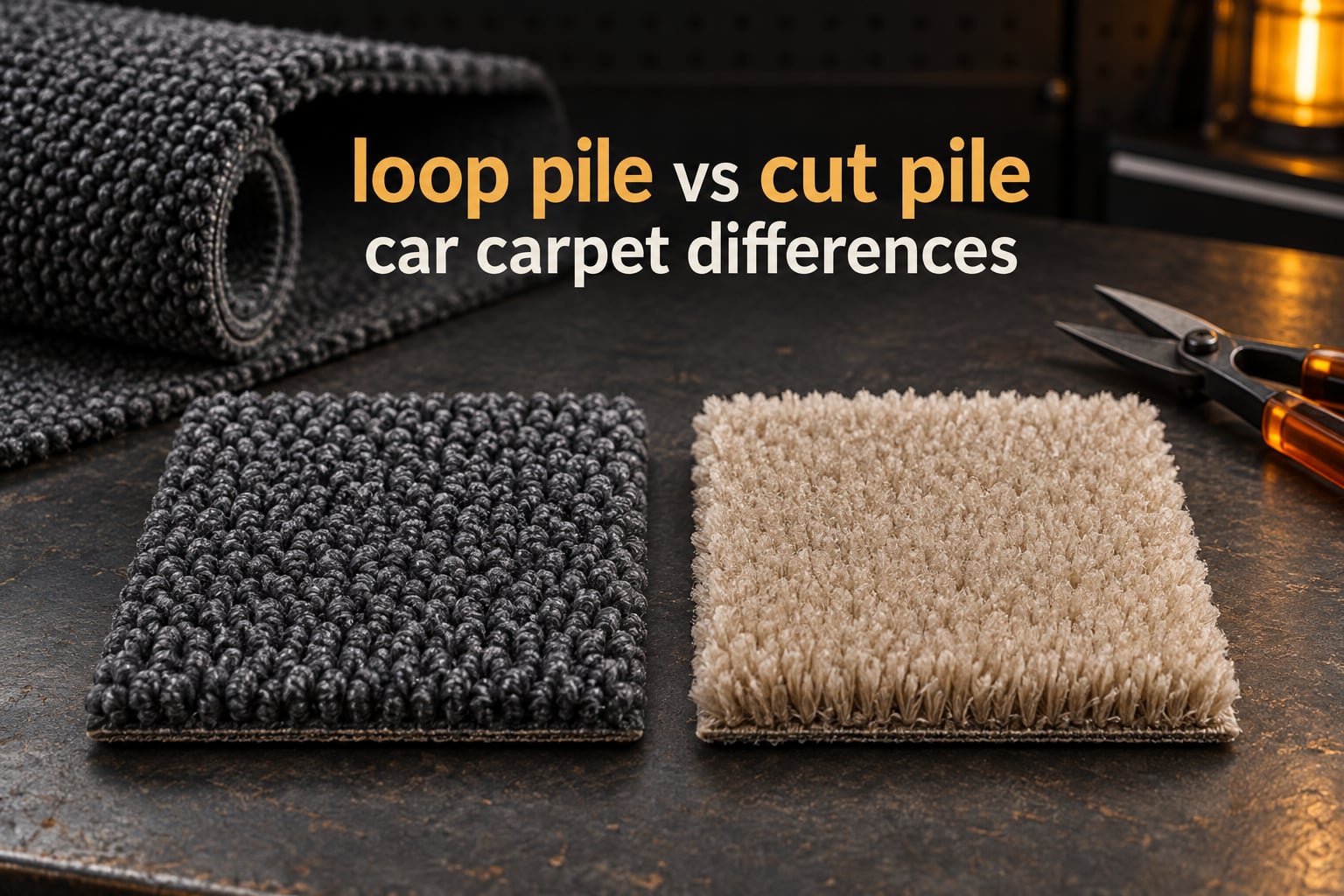
Loop pile vs cut pile car carpet differences come down to one manufacturing step. Loop pile carpet leaves the yarn in continuous uncut loops. Cut pile carpet is the same construction with those loops sheared in half, leaving upright tufts with exposed fiber ends. That single difference changes how automotive carpet looks, wears, cleans, and handles installation stress.
A cabin is not a living room. A car’s footwell takes road grit, winter salt, spilled coffee, and the scuff of a seat rail closing a hundred thousand times, and a trunk floor takes tools and boxes. Residential carpet rules of thumb only transfer to a vehicle in part, which is why suppliers who handle automotive roll every week treat the two pile types as different products rather than two versions of the same one.
This guide covers what each construction is, how to identify it on your own car, which vehicles shipped with which pile, and where each one earns its place in a build. It is written for restorers matching a year and trim level, custom interior builders, and drivers choosing carpet for a daily-driven car versus a show build.
Table of Contents
- Quick Answer: Which Pile Should You Specify?
- What Carpet Pile Is and How It Is Made
- Loop Pile vs Cut Pile: Head-to-Head
- Loop Pile in a Car: Construction, Feel, and Best Uses
- Loop Pile’s Real Weak Spot: Fraying on Install
- Cut Pile in a Car: Construction, Feel, and Best Uses
- Essex / 80-20 Blended Carpet Explained
- Needlepunch and Mass-Backed Carpet as a Third Construction
- Which Cars Came With Which Pile?
- How to Tell If Your Car’s Carpet Is Loop or Cut Pile
- Durability and Cleaning Under Real Vehicle Traffic
- Where Each Pile Works in the Vehicle
- Roll Width, Backing, and Fiber Weight Before You Order
- Daily Driver Versus Show Build
- Frequently Asked Questions
- Which is better, cut pile or loop carpet?
- What type of carpet is best for cars?
- What are the disadvantages of loop pile carpet?
- What are the key differences between cut pile and Essex car carpet?
- Is loop pile carpet more expensive?
- What type of carpet pile is the most durable?
- How do I know if my car carpet is loop or cut pile?
- Does loop pile carpet fray?
- Is cut pile car carpet hard to clean?
- Can you use cut pile carpet in a trunk?
- Conclusion
Quick Answer: Which Pile Should You Specify?
- Daily driver, winter roads, kids and dogs: loop pile, because the closed loops resist matting, hide footprints, and pull dirt to the surface for the vacuum.
- Show build, concours-correct restoration, newer interior look: cut pile, because the upright tufts read as premium in photos and match post-1973 factory interiors.
- Restoring a car to its original specification: match the era, which for most vehicles built before 1973 means loop pile or the Essex blend.
If you are still deciding, the short version is that loop pile is the harder-wearing, easier-to-vacuum, harder-to-install material, and cut pile is the softer, better-looking, easier-to-install material that traps dirt deeper. Everything below unpacks that trade-off for a vehicle specifically.
What Carpet Pile Is and How It Is Made
Pile is the visible surface layer of any carpet, and it is what your shoes and your eyes actually touch. Without pile you have a flat sheet of backing, and that is exactly why needlepunch carpet looks the way it does.
Automotive carpet is manufactured in four steps that are worth knowing, because every difference between pile types comes out of them:
- Tufting. Yarn is pushed through a primary backing with rows of hooked needles, forming a loop on the face for every strand.
- Coating. The tufted backing is coated with latex or another adhesive, sometimes on the reverse, sometimes flooding the whole structure. That mass is the latex backing some auto carpet has and some does not.
- Shearing. On loop pile, the machine stops here and the loops stand as they are. On cut pile, a blade row shears the top off every loop, creating two upright tufts with exposed ends from one loop.
- Finishing. The carpet is dried, trimmed to roll width, and rolled. Needlepunch skips tufting and shearing entirely: fibers are punched through the backing and compressed into a felted mat.
Pile height, pile density, and yarn twist all matter as much as the construction. Two rolls of cut pile can behave completely differently if one is a fine dense Saxony twist and the other is a loose, open cut pile made for a trunk liner.
Loop Pile vs Cut Pile: Head-to-Head
Cut pile is the softer and better-looking of the two, and loop pile is the tougher and easier-to-keep-clean of the two. The table below sets all four automotive constructions side by side across the dimensions that decide a purchase.
| Dimension | Loop pile | Cut pile | Essex / 80-20 blend | Needlepunch / mass-backed |
|---|---|---|---|---|
| Construction | Yarn left in continuous uncut loops | Loops sheared in half into upright tufts with exposed ends | Loop construction using a blend of about 80 percent olefin and 20 percent other fiber, often with nylon in the blend | Fibers needle-punched and felted, no tufts, no loops |
| Surface look | Textured, granular, distinctly patterned | Uniform, plush, directional nap | Textured like loop pile, often flecked with a second color | Flat, matte, felt-like |
| Underfoot feel | Firm, resilient, slightly stiff | Soft, cushioned, warmer | Firm with a coarse hand in heavier blends | Thin, papery, no cushion |
| Durability under foot traffic | High, resists crushing and matting | Moderate to high, risk of matting if dense and plush | High, loop structure carries the wear | High against abrasion, low against tearing |
| Cleaning | Dirt stays near the surface and lifts out easily | Dirt works down between the tufts, harder to extract | Same as loop pile, two fibers to rinse | Wipes clean, no deep pile to trap soil |
| Snag and fray risk | Higher, snags and frays at seat rails and hardware | Lower, loose ends can pull but rarely unravel a loop | Higher than loop pile in some blends | Tears rather than frays, no loops to pull |
| Footprint and vacuum marks | Hides both | Shows both in a directional nap | Hides both | No pile to mark, but seams and nail heads show through |
| Common backing | Usually latex-backed on 40 inch and 80 inch rolls | Backed or unbacked, both widely available | Usually latex-backed | Mass backed, the backing is the material |
| Typical vehicle use | Floor and trunk of pre-1973 and heavy-use builds, off-road and work vehicles | Modern cabin floors, door cards, seat backs, custom show interiors | Original-spec Mopar and other restoration floors | Trunk liners, seat back panels, hat racks, speaker boxes, kick panels, headliners |
| Best for | Daily drivers in harsh climates | Appearance-led builds and newer interiors | Era-correct restoration of specific models | Flat and vertical panels, non-foot-traffic surfaces |
One line summarizes the table: loop pile buys you durability and pays in snag risk, cut pile buys you appearance and pays in cleaning effort.
Loop Pile in a Car: Construction, Feel, and Best Uses
Loop pile in an automotive roll is the same construction you find in commercial entryway carpet, and it behaves the same way. The yarn stands in closed loops, so there is no loose surface fiber to crush and no exposed end to mat down.
Inside a vehicle that gives loop pile three concrete advantages:
- Dirt stays near the surface instead of working down between tufts, so a vacuum with a crevice tool around the seat rail actually gets it out.
- No footprint or vacuum-mark lines show in the footwell, which matters if you photograph the car in a showroom or a garage with good light.
- Crushing recovery stays high through years of foot traffic, so the carpet does not develop the flat, tired patches that make a re-carpet job look cheap.
Loop pile also absorbs sound and road noise better than a thin cut pile, which is why a lot of later-model trucks and wagons kept it long after sedans moved on. The texture is firm rather than soft, and that is the honest trade a loop-pile buyer accepts.
Loop Pile’s Real Weak Spot: Fraying on Install
Yes, loop pile car carpet frays more readily than cut pile, and it happens almost entirely during installation rather than in service. That is why it is the most repeated complaint in the restoration forums we read: a loop carpet that looks perfect in the roll can look damaged on the floor of a finished car.
Restorers on Pro-Touring describe the trade directly, preferring the look of the loop style but rejecting it because it frays much easier than cut pile on the same build. The mechanism is simple. A loop is a closed structure, so when a corner catches a sharp edge the failure runs along the whole loop rather than shedding one yarn end. Three areas cause nearly all of it:
- Seat rails and the seat adjuster track. Metal rails get drilled, filed, and pushed on during a build, and that is where a snag becomes a run.
- Door hardware, striker plates, and pedal assemblies. Small hardware near a carpet edge finds a loop every time.
- Stretching technique. Over-tensioning during gluing pulls loops out of the primary backing instead of letting them relax.
Four habits prevent most of it. Trim the carpet with a sharp blade on a hard surface rather than tearing it against the rail. Cut relief notches generously at every hardware penetration. Never stretch a loop carpet as hard as a cut pile, because the loop has nowhere to give. And stretch from the center outward in stages, letting each area settle before the next is pulled.
Cut Pile in a Car: Construction, Feel, and Best Uses
Cut pile in an automotive roll is made by shearing the loops in half, so every tuft stands upright with two exposed fiber ends where the blade passed. Those open ends are why it feels softer, why it shows a nap, and why soil eventually works deeper than it does in a loop.
Inside a vehicle, cut pile wins on three things:
- Appearance. Upright tufts catch light evenly and produce the deep, uniform interior look that reads as higher trim. That is exactly the point restorers make when they say cut pile creates a high-end look in any vehicle.
- Install forgiveness. A snagged cut pile tuft usually just pulls a yarn end. The base stays intact and the area can be trimmed back without a visible scar.
- Era match for later cars. Tri-Five restorers put it plainly: cut pile, where the ends of the yarn are cut, is what you see in most modern cars.
Cut pile also stretches and conforms more readily than loop pile, which makes it forgiving when you are contouring it around a transmission tunnel or a raised firewall.
The cost is cleaning. Owners in the same threads call cut pile much harder to clean, and in a cabin with kids, dogs, or track-day grit that is a real burden. The exposed ends also create a direction, so vacuum lines and traffic patterns appear in a way loop pile never shows.
Essex / 80-20 Blended Carpet Explained
Essex carpet is the name that fills the gap in almost every restoration question about Mopars and their contemporaries, and no general carpet page explains it. The key differences between cut pile and Essex car carpet come down to construction, fiber content, and the era it belongs to.
Essex, usually written or spoken as 80-20, is a loop-style construction made from a blended yarn rather than a single fiber. The traditional recipe is roughly 80 percent olefin (polypropylene) with about 20 percent of another fiber, commonly nylon, chosen because olefin alone cannot be cleaned aggressively enough for a car interior and nylon alone was too costly for volume production.
Practically, Essex sits between the two main pile types:
- It is loop construction, so it shares the wear resistance and low-shed behaviour of loop pile.
- Its blend gives it different cleaning chemistry from a pure olefin loop, and better resistance to the solvents and hot water a car interior sees.
- Its texture and flecked color look different from a plain loop roll, which matters when you are trying to match a specific year.
If a restoration calls for original-spec flooring, an Essex or 80-20 loop roll is usually the correct answer for a lot of 1960s and 1970s Mopar-family cars, and a plain modern loop is not. That is a common and expensive discovery made late in a project.
Needlepunch and Mass-Backed Carpet as a Third Construction
Needlepunch carpet skips tufting entirely, so it is neither loop nor cut pile and should not be judged against either. Fibers are punched through a backing with barbed needles and compressed until they mat together into a felted sheet. The underside is then coated so the mass itself becomes the backing, which is what the term mass-backed means.
Needlepunch is sold in fiber weights such as 12oz and 18oz, and heavier is not automatically better. Choose weight for the panel rather than for the car.
Inside a vehicle it is the sensible answer for surfaces that take abrasion but not foot traffic:
- Trunk and cargo liners, where a mat that wipes clean beats a pile that holds grit.
- Seat back panels and rear package trays.
- Kick panels, hat racks, and speaker box covers.
- Headliners and pillar trim on builds that want the low-profile look.
Because there is no pile, needlepunch offers no underfoot cushion and almost no sound absorption, and it tears rather than frays. On a cabin floor it feels thin next to a real pile carpet, which is why restorations usually reserve it for panels.
Which Cars Came With Which Pile?
Most vehicles built before 1973 came with loop pile or the Essex blend, and most vehicles built after came with cut pile. That era split is the single most useful fact for anyone matching a car to its original interior.
The two independent sources that support it agree. Albright’s Supply describes loop carpet as a traditional choice for vehicles manufactured before 1973, and restorers on For A Bodies Only reached the same conclusion from a different direction, theorizing that cut pile has something to do with the interior trim level of the car because it creates a higher-end look in any vehicle.
Read together, those two observations explain a lot of what people find under their own floors:
- Pre-1973 cars across most makes: loop pile, frequently an Essex or 80-20 blend, coarse and utilitarian by design.
- Base and work trim of later cars: loop pile and needlepunch panels, because they were built to survive.
- Mid-range and higher trim, especially through the 1980s onward: cut pile, chosen for the appearance it buys.
Treat that as a strong pattern rather than a per-model guarantee. Cars change mid-year, trim packages swap materials, and a car that was resprayed or re-carpeted thirty years ago may not match its own build sheet. If the goal is concours correctness, the reliable check is the trim tag or a known-good car of the same year, model, and trim.
How to Tell If Your Car’s Carpet Is Loop or Cut Pile
You can identify your own carpet in under two minutes without a product listing, because pile type is visible in three places. This matters because most listings simply say carpet, and most buyers cannot tell what they already have.
Step 1: Look at the surface in raking light. Squeeze the pile between your fingers and release it. Loop pile springs back showing a pebbled, granular texture made of small round dots. Cut pile shows upright tufts with visible open ends, a nap, and a brushed direction that catches the light in bands. A fuzzy, brushed look with directional streaks is cut pile.
Step 2: Bend a cut edge toward the light. Pick a cut corner near a door sill or a tailgate edge. Loop pile shows a rounded arch of yarn, the closed loop cut in cross-section. Cut pile shows individual straight fibers with open tips. This is the most reliable read, and it is the one to trust if the surface view is ambiguous.
Step 3: Press and release, then drag a finger. Loop pile springs back quickly and holds a shallow, even compression. Cut pile stays down longer, feels softer and warmer, and shows a nap line in the direction you drag. If the pile feels papery with no give and no visible tufts at the cut edge, you are looking at needlepunch.
Two quick additions. A two-tone flecked surface with a coarse hand is usually the Essex blend rather than a plain loop, and a completely flat felted sheet with no pile at the edge is mass-backed needlepunch.
Durability and Cleaning Under Real Vehicle Traffic
Loop pile is the most durable of the constructions listed for a footwell, because a closed loop has no exposed ends to twist together into a mat. Corvette Forum owners put the trade the other way in a single line, noting that loop pile wears better while cut pile carpet can be cleaned easier, and that durability-versus-cleanability is the actual decision being made.
What that looks like in practice:
- Footwell traffic favours loop and Essex, which resist crushing and recover their height. Dense cut pile can mat under sustained load, and once it mats the flattening is permanent.
- Spills and grit favour loop, because soil stays on top. Cut pile lets debris travel between the tufts, where a shop vac wand will not reach it.
- Sun and heat hit a folded or backed carpet in a parked car. Olefin loops handle heat well; a high nylon content in a blend improves cleaning chemistry but needs heat consideration.
- Under-seat and seat-rail debris is where a mat-only job fails. Carpet left exposed behind and under the seat collects grit, and that grit is what wears the pile and cuts the backing.
Vacuum technique matters more than most people expect. On loop pile, use the crevice tool along the rails and a beater bar or brush agitator on the open floor. On cut pile, vacuum in the nap direction only, brush the pile back up after, and never scrub an area aggressively, because the twist is what you are trying to preserve.
Both constructions clean with the same chemistry: hot water plus a mild automotive-safe detergent, extracted rather than soaked. Soak is what damages an automotive carpet, because water carries dirt into the latex backing and the backing never fully dries.
Where Each Pile Works in the Vehicle
You can use cut pile carpet in a trunk, and you can use loop pile in a cabin, but matching the construction to the panel is how a good install stays good. Here is the working order most shops follow.
- Cabin floor and front footwells: loop pile or Essex for a driver, cut pile for a show build or a later-model interior.
- Trunk floor: cut pile works and looks good on a show car, but needlepunch or a mass-backed liner is the practical choice because it wipes clean and takes tools.
- Seat back panels and package trays: needlepunch first choice, cut pile if it must match a carpeted floor.
- Kick panels and door lower panels: needlepunch or a thin cut pile, both of which stretch into a radius without pulling.
- Headliners and pillar trim: needlepunch or a dedicated headliner cloth, never heavy pile, because weight and stiffness fight the headliner bow.
- Floor mats: rubber or needled mat in a driver, carpet cut from a leftover of the floor material in a show build so the pattern matches.
- Firewall and transmission tunnel covers: cut pile stretches and conforms best around a radius; loop pile resists the stretch and can lift at the corner.
Mats do not replace a floor. A mat-only purchase leaves the trunk, rear footwell, and seat backs exposed and mismatched, and that is usually where a build looks unfinished in photos.
Roll Width, Backing, and Fiber Weight Before You Order
Pile type is the interesting decision, but roll width and backing are the ones that stop a project. Automotive carpet is commonly sold in 40 inch and 80 inch rolls, and the wider roll means fewer seams across a floor, which matters more in a car than in a room because a seam under a seat rail still has to look right.
Backed versus unbacked is the other decision. Latex-backed carpet arrives with a coating that makes it heavier, stiffer, and easier to stretch and glue, and it resists moisture. Unbacked carpet is lighter, drapes more readily around tight radii, and is often the better choice when you are following a contour that will not lie flat, provided you use the right adhesive and give the backing time.
Fiber content changes the durability verdict more than most buyers expect:
- Olefin / polypropylene: the automotive default, inexpensive, colourfast, low moisture absorption, mild solvent resistance.
- Nylon 6 / 6,6: best abrasion and cleaning chemistry, higher cost, the usual partner in an 80-20 blend.
- Polyester / PET: good colour range and stain resistance, a common choice in later-model OEM floors.
On needlepunch, match the fiber weight to the panel. Lighter material suits headliners and speaker covers, heavier material suits trunk liners and package trays.
Daily Driver Versus Show Build
For a daily-driven car, choose loop pile or Essex, plan on a full carpet rather than mats, and accept a firmer texture as the price of a floor that still looks right after three winters of salt. Cleanability in a messy cabin is worth more than softness.
For a show build, choose cut pile, match the era, and accept that it needs a disciplined vacuum routine and a gentle touch with water. The appearance gain is the entire point, and photographs reward it more than any other material decision you make in an interior.
For a concours restoration, the era decides and your wallet can argue later. Pre-1973 means loop or Essex, and a modern cut pile floor on a 1967 car is the single most visible anachronism in most builds we see described online.
Frequently Asked Questions
Which is better, cut pile or loop carpet?
Loop pile is better for durability, matting resistance, and easy cleaning in a daily-driven car. Cut pile is better for appearance, softness, and easier installation. Most restorers match the pile to the vehicle era, so pre-1973 cars use loop pile and later cars use cut pile.
What type of carpet is best for cars?
It depends on the car and how it is used. Loop pile or an Essex blend suits a daily driver, a work vehicle, and a pre-1973 restoration. Cut pile suits a later-model interior or a show build where appearance matters most. Needlepunch suits trunk liners, seat backs, and kick panels.
What are the disadvantages of loop pile carpet?
The main disadvantages are snag and fray risk during installation, especially at seat rails, door hardware, and pedal assemblies, plus a firmer, less comfortable feel underfoot than cut pile. Over-stretching during gluing can also pull loops out of the primary backing.
What are the key differences between cut pile and Essex car carpet?
Essex carpet, also called 80-20, is a loop-style construction using a blend of roughly 80 percent olefin and 20 percent nylon or similar fiber. Cut pile is a separate construction where the loops are sheared in half. Essex is denser and more stain resistant, while cut pile is softer, plusher, and shows a nap.
Is loop pile carpet more expensive?
Price depends less on pile type than on fiber content, roll width, backing, and weight. A backed 80 inch roll in a premium nylon blend costs more than a 40 inch unbacked olefin roll of either pile type. Specify fiber, width, and backing first, then compare available constructions.
What type of carpet pile is the most durable?
Loop pile is the most durable under foot traffic because a closed loop has no exposed ends to crush or mat. Among the other constructions, Essex and 80-20 blends are next, cut pile is moderate to high, and needlepunch resists abrasion well but lacks any pile to protect the backing.
How do I know if my car carpet is loop or cut pile?
Look at the surface in raking light, then bend a cut edge toward a light. Loop pile shows a pebbled texture of small round dots and a rounded yarn arch at a cut edge. Cut pile shows upright tufts, open fiber ends, and a visible nap direction. Flat felted material with no pile is needlepunch.
Does loop pile carpet fray?
Yes, loop pile frays more readily than cut pile, mostly during installation rather than in service. A snag runs along the whole closed loop instead of shedding a single end. Trim with a sharp blade, cut generous relief notches, avoid over-stretching, and pull from the center outward in stages.
Is cut pile car carpet hard to clean?
It is harder to clean than loop pile. The exposed fiber ends let dirt work down between the upright tufts, where a vacuum wand will not reach it. Vacuum in the nap direction, brush the pile back up afterward, and extract with hot water and a mild detergent rather than soaking.
Can you use cut pile carpet in a trunk?
Yes, cut pile works well in a trunk and is common on show builds where the trunk is part of the visual scheme. For a daily-driven car, a mass-backed needlepunch liner is the better choice because it wipes clean, takes tools, and does not hold grit.
Conclusion
Loop pile vs cut pile car carpet differences reduce to what the machine did to the yarn, and everything else follows from that. Loop pile keeps closed loops, so it resists matting, hides marks, cleans easily, and frays on install. Cut pile is sheared, so it looks better, stretches easier, cleans harder, and matches later-model interiors.
Match the pile to the year of the car first, pick a width and backing that fit the panels, and treat flat surfaces as needlepunch. Get those three right and the rest of the interior falls into place. For anything else, 2026 is a good year to look at what your own car is wearing before you replace it.