
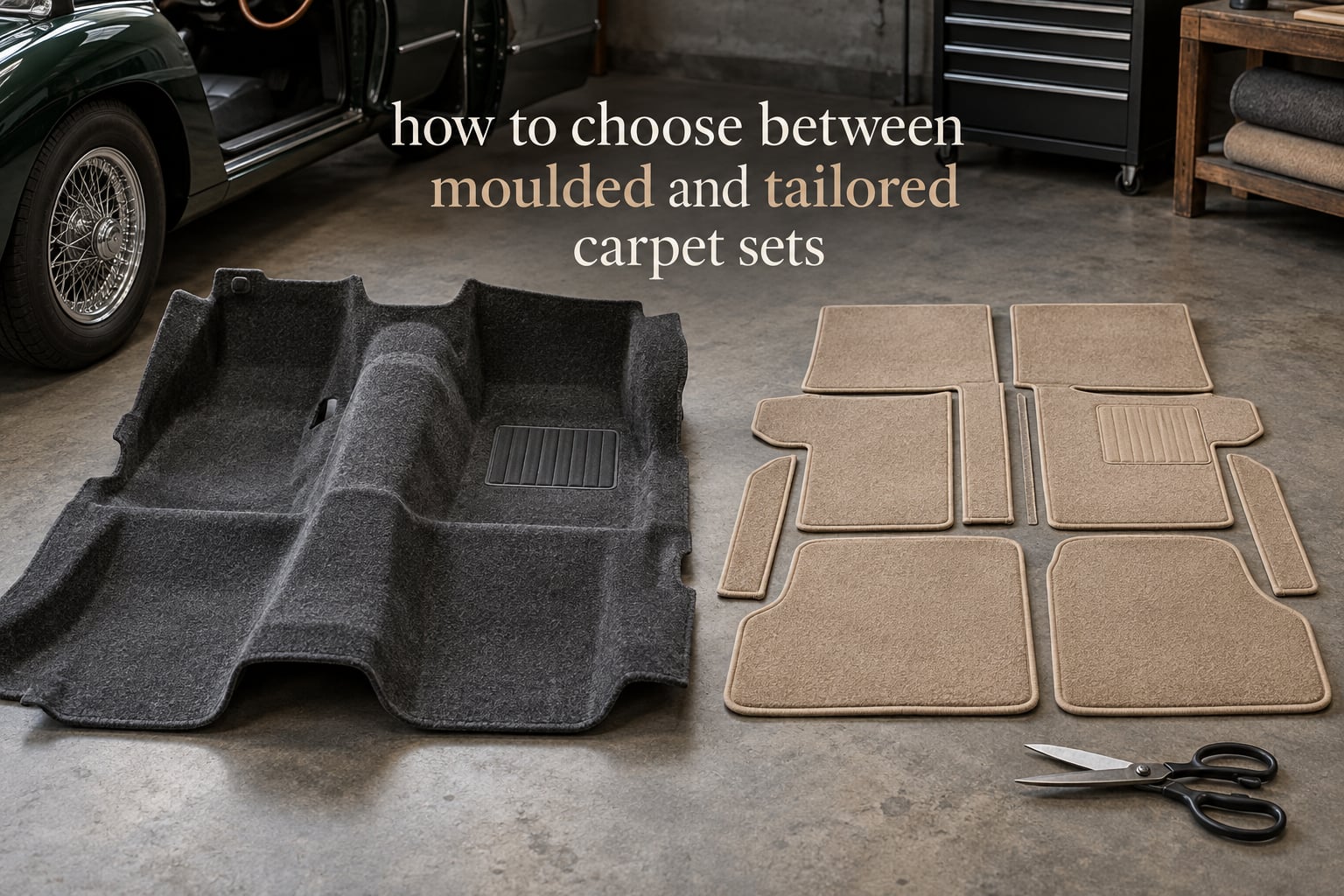
If you are working out how to choose between moulded and tailored carpet sets, the short answer is that both end up glued to the same steel floor pan. The difference is where the shaping happens. A moulded set arrives already contoured to your car’s transmission tunnel, footwells and wheel arches. A tailored set arrives as flat, bound panels that you cut and stretch into shape on the car itself.
That single difference cascades into everything else: how long the job takes, how much trimming is involved, how close the finished interior looks to factory, and how much of the cabin noise and heat the new carpet kills. Get it right and the interior looks like a factory job. Get it wrong and you will spend a weekend chasing wrinkles in a footwell.
We have watched this decision play out over and over in restoration work, and the same pattern holds: people who rush the choice end up buying twice. So this guide walks through what each construction actually is, then gives you a numbered process for deciding, and finally covers the third option most guides never mention.
One note on spelling before we start. We use the UK “moulded” throughout because that is the term the UK trade uses, but the same carpet is sold as “molded” in North America. If you are searching US listings, both spellings describe the identical product.
Table of Contents
- Moulded vs tailored car carpet sets: what is the difference?
- What a moulded carpet set actually is
- What a tailored carpet set actually is
- How to choose between moulded and tailored carpet sets
- Step 1: Look at the condition of the floor pan
- Step 2: Decide what the interior has to look like
- Step 3: Be honest about your skill and your tools
- Step 4: Set the budget, then look at what it includes
- Step 5: Check the production time against your schedule
- Step 6: List every modification to the cabin
- Step 7: Decide what happens when something goes wrong
- What a complete carpet set actually includes
- Backing and insulation: poly, underlay or mass EVA
- Loop pile vs cut pile: getting the period-correct finish
- Modified cars and non-original floor pans
- The third option: local steam-moulded and one-off tailored carpets
- Installing a moulded or tailored set: realistic skill and time
- Cost: where the money actually goes
- Colour matching: always order a physical sample
- Pitfalls: why aftermarket carpet disappoints
- Frequently Asked Questions
- Conclusion: making the call
Moulded vs tailored car carpet sets: what is the difference?
A moulded carpet set is heat-formed in a factory mould taken from an original floor pan, so it drops into the car’s contours already shaped, with the heel pad and underfelt bonded in. A tailored set is cut and sewn from flat carpet roll and shaped on the car during installation. Moulded suits a factory-accurate finish; tailored suits a budget job or a modified floor pan.
Here is the full comparison, factor by factor:
- Construction. Moulded: heat-formed under pressure in a vehicle-specific mould, often a two-stage process with underfelt bonded in. Tailored: panels cut from a carpet roll, edges bound and sewn, delivered flat.
- Fit accuracy. Moulded: close to the shape of the pan it was made from, minus the buffer margin. Tailored: depends entirely on the panels being oversized enough to trim yourself.
- Trimming on the car. Moulded: minimal, mostly around retainers and hardware. Tailored: every edge, every contour, every fixing point.
- Install time for a competent DIYer. Moulded: shorter, because the shape is already there. Tailored: longer, often a full weekend.
- Skill needed. Moulded: steady trimming and gluing. Tailored: pattern reading, stretching, relief cuts, no slack allowed.
- Relative cost. Moulded: higher. Tailored: lower.
- Insulation. Moulded: usually arrives with underfelt already attached. Tailored: underlay bought and fitted separately.
- Finished appearance. Moulded: close to a factory installation. Tailored: depends on the fitter, and mistakes show.
- Repairability later. Moulded: harder to patch, panels are shaped. Tailored: easier, flat offcuts match flat panels.
- Best suited to. Moulded: concours-level builds, unrestored original pans, cars kept as daily drivers. Tailored: budget re-trims, modified cars, non-original or previously repaired floor pans.
One forum regular put the fit difference more bluntly than any spec sheet: with sectional carpets, “you will never achieve the professional look, it’s like putting in a bunch of throw rugs.” That is the core trade-off in one sentence.
What a moulded carpet set actually is
A moulded set is carpet that has been pressed, under heat and pressure, against a mould taken from a real factory floor pan. The pile takes the shape of the tunnel, the transmission hump, the footwell walls and the wheel arch tops before the set ever reaches your garage.
Good manufacturers run a two-stage process. The carpet is first formed to shape, then a layer of underfelt is bonded into the back during a second pressing. That is why the finished piece feels substantial in the hand rather than like a stretched sheet, and why it stays put after it is glued down.
Several quality markers tell you whether a moulded set was made properly:
- Deep pile, tufted rather than printed, with the pile direction running consistently across every panel
- Sewn bound edging on every exposed edge, not a raw cut edge
- Latex rot-proof backing so the underside does not degrade in a damp footwell
- An integrated heel pad on the driver’s side, or a heel mat protector supplied in the kit
- Moulded wheel arch pieces that actually follow the arch contour
Now the honest part. Aftermarket moulds are taken from a reference vehicle, and the reference vehicle is not always identical to yours. On a clublexus thread, an experienced upholsterer explained that all aftermarket carpet kits have to be glued down and cut to shape once installed, and that the companies deliberately leave some extra material along the edges as a buffer.
That buffer exists because cars of the same model are not identical. Panels flex in the wind, floor pans get repaired, and a shell that looked straight when the mould was taken may have a gentle twist by the time it reaches you. Anyone selling you a moulded set that claims zero trimming is overselling it.
What a tailored carpet set actually is
A tailored set, in trade vocabulary, is carpet that has been flat-cut from a roll and finished by sewing. Edges are bound with a tape or strip, sometimes with a contrasting colour, sometimes matching. Nothing is formed to a vehicle shape, because the panels are meant to be cut on the car.
The defining feature is surplus material. Cut panels arrive deliberately oversized so the fitter has something to trim back, and more importantly something to hold on to while pulling the carpet tight into a valley. Experienced fitters tell us the buffer margin is not waste, it is the only thing that makes a clean installation possible.
To read a vendor spec sheet you need to know the vocabulary:
- Flat-cut and sectional mean the same thing, panels rather than a formed piece
- Universal describes a kit that is not modelled on one specific vehicle, so more trimming is expected
- Pre-molded describes a set formed against a vehicle mould, and is not the same as a universal sectional kit
- Bound or sewn edging means the cut edge is finished, which is what stops the pile unravelling
- Deluxe and tailored are tier names used by UK suppliers for their higher-specification sets
Tailored is not a lesser option in the way the word suggests. On a car with a modified floor pan, a cut-and-sew set is frequently the better engineering choice, because you are fitting to what is actually there rather than fighting a contour that was never yours.
How to choose between moulded and tailored carpet sets
Work through these seven steps in order. The order matters, because an answer to an early step often settles a later one without you needing to think about it.
Step 1: Look at the condition of the floor pan
Pull the old carpet back and inspect the pan. If the metal is original, unrepaired and free of previous welding, a moulded set is likely to drop into shape. If the pan has been seam-welded, patched, or previously covered in a different carpet that left adhesive residue and contour impressions, a tailored set that you can shape to the actual metal will serve you better.
Step 2: Decide what the interior has to look like
Be honest here. A moulded set gets you closer to a factory installation with less risk, particularly when the car is a concours build, a show car, or something you plan to sell. A tailored set can look equally good in skilled hands, but skill is the variable, and on a car you care about the moulded route removes that variable from the equation.
Step 3: Be honest about your skill and your tools
Moulded still needs trimming around floor mat retainers, seat rails and hardware, and it still needs glue. Tailored needs all of that plus pattern work, stretching and relief cuts. Install guides describe both as straightforward, but owners push back on that, describing the process as “not really geared for the novice.” A first-ever carpet job is a poor project for learning on a car you care about.
Step 4: Set the budget, then look at what it includes
Compare two quotes line by line rather than comparing headline figures. A cheaper set that excludes the underlay, heel pads, arches and fixing clips can cost more once the missing pieces are added. Kit contents are covered in detail below because this is where most of the misleading comparisons happen.
Step 5: Check the production time against your schedule
Made-to-order sets are made for your car after the order is placed, so they sit at the end of a production queue. That is fine if you are running a long restoration, and awkward if you want the interior finished this weekend. Ask for a realistic time before you commit, and factor it into the order of work on the car, because a car waiting on carpet cannot be reassembled.
Step 6: List every modification to the cabin
Roll cages, relocated shifters, modified transmission tunnels, seat brackets moved inboard, a different handbrake layout. Any of these push you toward tailored panels, because a mould formed from a standard pan will fight you over the modified area. Manufacturers that genuinely supply modified and non-original pans will say so plainly, and that is worth asking before you order.
Step 7: Decide what happens when something goes wrong
If a footwell panel tears in five years, a flat tailored panel can be patched with an offcut of the same material. A moulded panel has to be replaced or carefully patched from underneath. For a car driven hard, that repairability is a quiet but real advantage to the flat option.
What a complete carpet set actually includes
Most disagreements about which type is better value come down to comparing two different-sized boxes. Here is what a genuinely complete set should contain, so you can lay two quotes side by side:
- Tunnel carpet strip running the length of the transmission hump
- Sill carpet, both sides, cut and shaped for the door aperture
- Footwell panels or mats for front and rear
- Load area or boot carpet, including the back seat area
- Wheel arch pieces, formed or pre-shaped where the construction allows
- Heel pad or heel mat protector for the driver’s side
- Underfelt or jute underlay, bonded in for moulded sets or supplied separately
- Carpet fixing clips or retainers
- A paper layout or template guide showing which panel goes where
- Adhesive and, ideally, a sequence guide for the order of application
Two things are commonly missing or overstated. Cutouts for floor mat retainers and seat hardware are often not pre-made, even when the listing implies they are, so ask. And included underlay is frequently thinner than the original, with one reviewer describing a supplied underfelt as a joke because it did not cover the whole floor the way the factory item had.
Backing and insulation: poly, underlay or mass EVA
The backing under the pile is what separates a thin carpet from one that feels like a factory installation. It is also the single most misunderstood item on a spec sheet, because fibre quality is identical between standard and mass-backed versions. Only the backing changes.
There are four constructions you will meet in the trade:
- Poly-backed, a polyethylene layer roughly 1/16 inch thick bonded to the pile. Flexible, light, and the easiest to fit on an irregular pan
- Underlay-backed, a thin carpet with jute or felt underlay added during fitting. Quiet and warm, but the underlay is a separate job
- Mass-backed, an EVA layer approximately 4.5mm thick fused to the carpet during moulding. Substantial, insulating, and it removes the separate underlay step entirely
- Vinyl-backed, a waterproof sealed layer used where moisture is a concern, though it is less common in classic interiors
A mass-backed set is the simplest way to get both sound deadening and heat insulation in one piece, and owners using it report a noticeable drop in road noise and exhaust heat coming up through the floor. Standard poly-backed carpet is roughly half that thickness, so if your car runs hot or is loud, this is where the money is better spent than on a fancier pile.
On underlay specifically, jute is the traditional choice. It absorbs noise, blocks vibration and heat, and it is the source of the new-car smell most people remember. If a set arrives without underlay and you want the full factory effect, budget for a separate sheet of jute rather than leaving the bare floor exposed.
Loop pile vs cut pile: getting the period-correct finish
Pile type is a period decision, not a preference. Loop pile, where the loops are left uncut, reads as tighter, flatter and more hard-wearing, and it is generally right for cars built before the late 1970s. Cut pile, also called plush or cutpile, has the loops sheared to create a soft velvet-like surface, and it matches later cars and later trim codes.
Getting this wrong is more damaging than choosing the wrong carpet construction, because pile height changes the look of the door cards, headliner and rear deck as well as the floor. If you are retrimming, the whole interior should move together.
One simple rule: match the pile to the trim cards you already have. If your door cards are loop, the floor should be loop. If they are cut pile, do not put loop carpet under them.
Modified cars and non-original floor pans
This is the case where the usual advice inverts. A moulded set is formed from a standard pan, so on a car with a roll cage, a relocated shifter, a modified tunnel or a welded-in seat bracket, the carpet will be shaped correctly everywhere except exactly where you needed help.
Tailored panels give you the freedom to build up extra material where a cage tube passes through, and to cut relief notches around a lever that sits higher than the original. That is a real advantage, not a compromise.
The one thing to avoid is buying a moulded set and then fighting it with a trimming knife. Ask the supplier directly whether they can supply a set for a non-original pan. If the answer is vague, you are being told what you need to hear.
The third option: local steam-moulded and one-off tailored carpets
There is a third route that almost never appears in vendor guides, and forum regulars raise it often: have a local trim shop steam-form a one-off carpet in your car. In the right hands it can be both better and cheaper than either a moulded kit or a DIY tailored set. In the wrong hands it is worse than both.
The process, in outline:
- The old carpet is stripped and the pan is cleaned and repaired until it is bare, sound metal
- Template material is laid into the car and the contours are marked and cut
- Carpet is cut slightly oversize from the chosen material, backing facing down
- Steam and heat are used to form the carpet to the marked contours, often over a board or a former taken from the car
- The formed carpet is dry-fitted, then trimmed at retainers and hardware and glued down
- Bound edging is applied to every cut edge, then clips and the heel pad go back on
The catch is entirely about the shop. A trimmer who regularly forms carpets in situ will do this well. One poster described the value proposition neatly: a good local shop that can steam-mould a custom carpet “may be better and cheaper.” A mediocre shop is worse than either kit type, because you have paid for a one-off service and got a bad result.
If you are considering this, ask to see a car the shop has already done. Photos of a finished interior, not studio shots of a mould.
Installing a moulded or tailored set: realistic skill and time
Glue is required whichever type you choose. Moulded does not mean glue-free, and carpet that is not fixed down will lift in the valleys, move underfoot and wrinkle across the tunnel.
Before anything goes down, prepare the pan:
- Strip every trace of old carpet, adhesive and underlay, then degrease the surface
- Inspect for rust, repair or treat it, and check that previous repair panels are sound
- Mark the transmission tunnel line and any wheel arch lips so you can align panels to the metal
- Lay out every panel and compare it to the template guide before cutting anything
- Dry-fit the main floor panel first, checking alignment at the tunnel before committing
Relief cuts are the technique that separates a good fit from a bad one. Small triangular cuts in slack areas let the carpet move into a valley without bunching, and they are far better than one large cut, because each edge of a small cut can be pulled in a different direction. Owners fighting a badly fitting set usually need more relief cuts, not more glue.
Common failure modes to expect on either type: exposed metal where a panel was cut too tight, wrinkles across pre-pressed contours, bunching where the carpet meets the firewall, and lifting in the valleys. Each one traces back to rushing the dry fit.
Allow the adhesive to cure properly before rebuilding the interior, and before refitting seats and trim. A carpet disturbed while the adhesive is still moving will never lie flat again.
Cost: where the money actually goes
Without quoting figures, the pattern is consistent: a moulded set costs more because a vehicle-specific mould has to be made and the pressing process runs, while a tailored set costs less because it is cutting and sewing from a roll. The gap is significant but rarely as large as buyers expect once the kits are compared like for like.
What actually moves the total is the extras and the labour. If one quote includes arches, heel pads, underlay, clips and a layout guide and the other does not, the difference in your wallet is much smaller than the headline comparison suggests.
Then there is the cost of doing it twice. A badly fitted tailored set that wrinkles across the tunnel and lifts in the footwell comes out, comes up with adhesive, and goes back in. That labour usually costs more than the difference between the two constructions in the first place.
My rule of thumb: buy a tailored set when the car is a driver and the budget is fixed. Buy a moulded set when the interior is the centre of the project.
Colour matching: always order a physical sample
Screen colour is unreliable, and every attempt to match a classic car shade from a product photograph on a monitor has ended in disappointment. Batches vary slightly too, so a colour that matched last year’s set may not match this year’s.
Ask for a physical swatch and hold it against your existing trim, ideally in daylight rather than under showroom lighting. If the carpet is going in with new door cards, ask the supplier to match against those cards, because a mid-grey floor with a warmer door card is a very visible mismatch.
One more detail worth checking: whether the carpet is supplied as a continuous dye lot with your arches and sill pieces. Mixed lots on a full kit are the usual reason a colour-accurate job still ends up with one panel that looks different.
Pitfalls: why aftermarket carpet disappoints
- Cars of the same model are not identical. A mould is made from one reference shell, and yours will differ somewhere. Expect to trim, and expect a buffer margin to be left for you.
- The included underlay is often thinner than the original. Check coverage and thickness before you assume the sound and heat problem is solved.
- Retainer and hardware cutouts are frequently not pre-made, even when the description suggests they are.
- Pre-pressed contours can arrive with light wrinkles in the pile. These are storage marks rather than defects, and they usually settle after fitting.
- Install guides call everything easy. Owners regularly describe the opposite. A moulded set on a first-time job is realistic; a tailored set on a first-time job is a gamble.
- A cheaper set is not always better value for the car. One reviewer called a molded kit too expensive for what it is, noting it looked good at first but was not good quality carpet. Fibre quality is worth checking independently of backing type.
One last trap: buying a used original carpet and having it professionally steam cleaned. It comes up repeatedly on forums as a cheaper, closer-to-factory route, and it works well when the original carpet is complete and unrotted. It fails when the previous carpet has gone at the edges, when the backing has perished, or when the colour has faded too far to match new trim.
Frequently Asked Questions
What is the best carpet for cars?
For a factory-accurate result, a moulded carpet set heat-formed to your specific floor pan is the best carpet for cars. It arrives shaped to the tunnel, footwells and wheel arches with the underfelt bonded in, so it looks correct without hours of trimming. A tailored cut-and-sewn set is the better choice for a budget re-trim or a modified floor pan.
Is there a moldable carpet available for cars?
Yes. Moulded and molded car carpet sets are made for most classic models, formed under heat and pressure in a factory mould taken from an original floor pan. Modified and non-original pans are harder, so ask a supplier directly whether they can supply a set for a car whose floor pan is not standard before you order.
How to mould car carpet?
A trim shop forms a one-off carpet in four stages: strip and clean the pan, mark the contours from a template taken in the car, cut the carpet oversize from roll, then use steam and heat to form it to those contours. Finally trim around retainers and hardware, glue it down and bind the cut edges. A shop that does this regularly will beat either a kit or a DIY attempt.
Is Essex or cut pile better?
Neither is better in general, because each matches a different period. Essex and other loop pile carpets suit cars built before the late 1970s and read tighter and flatter, while cut or plush pile suits later cars and feels softer. Match the pile to your existing door cards and headliner so the whole interior reads as one set.
What are the pros and cons of felt-backed carpet?
Felt and jute underlay is the traditional factory choice, and it is excellent at blocking road noise, vibration and heat. The cons are that it is a separate step, it adds labour, and the thin sheets supplied with some kits do not cover the floor as well as the original. Mass-backed carpet with a fused EVA layer of around 4.5mm delivers the same benefits in one piece.
What are the four types of car carpet backing?
The four backing constructions are poly-backed, with a polyethylene layer roughly 1/16 inch thick; underlay-backed, where jute or felt is added during fitting; mass-backed, where an EVA layer of approximately 4.5mm is fused to the carpet during moulding; and vinyl-backed, a waterproof sealed layer used where moisture is a concern.
Conclusion: making the call
Working out how to choose between moulded and tailored carpet sets comes down to three questions. Is the floor pan original and sound? Does the interior need to look factory-fresh, or is it a working car on a fixed budget? And are there modifications that a factory mould will not account for?
Answer original, factory-fresh and unmodified, and a moulded set is the right purchase, particularly with mass backing if noise or heat is the main complaint. Answer modified or budget, and a tailored cut-and-sewn set built around a proper underlay will serve the car better and let you fit to what is actually there.
Either way, order a physical colour sample, compare two quotes line by line against the kit contents checklist, and ask the supplier what is not pre-cut before you pay. Those three steps prevent almost every carpet job from going wrong. Updated for 2026, this guide reflects what we have seen repeatedly on real cars, where the finish is decided in the first ten minutes of stripping the interior, not at the checkout.