
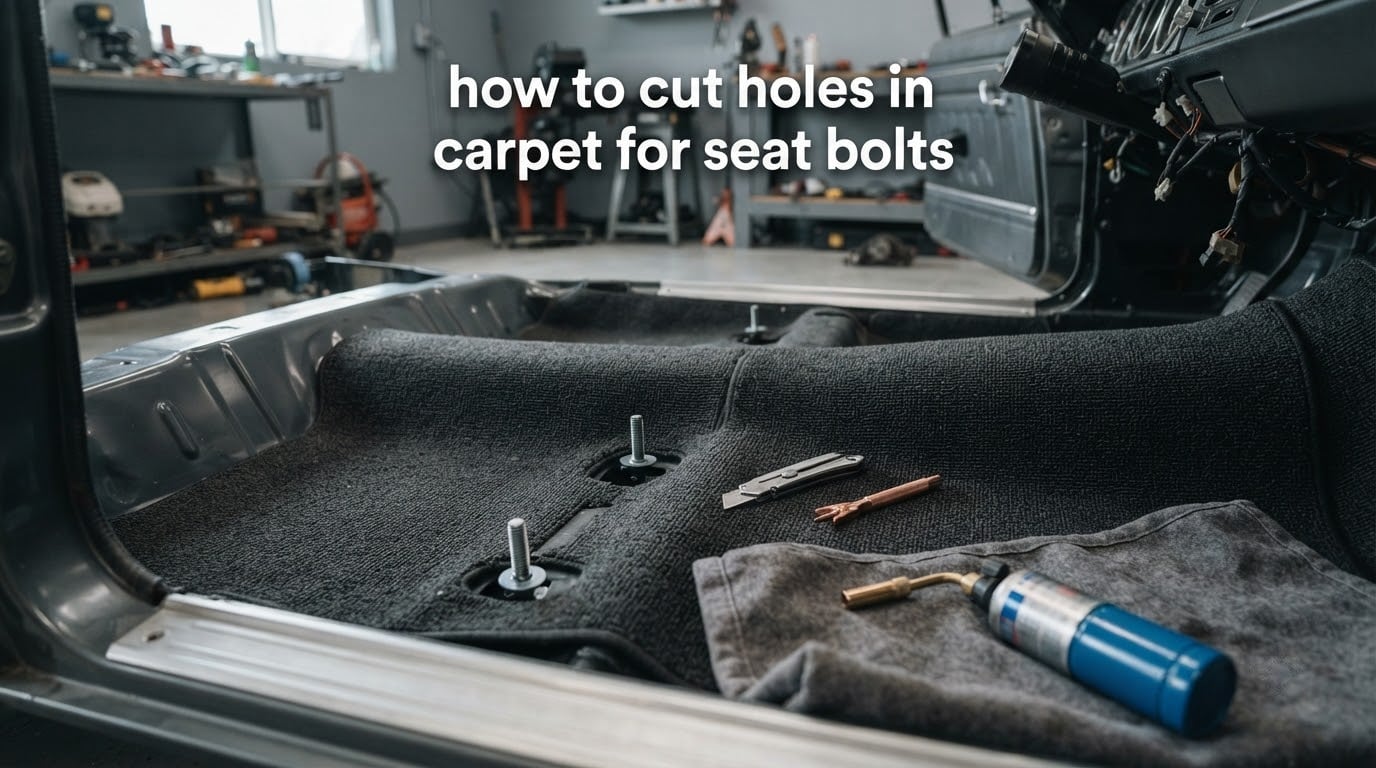
To cut holes in carpet for seat bolts, thread every bolt back into the floor pan and leave them in place, lay the carpet down over them, then cut an X over each bolt head and pull the bolt up through the opening. The carpet is pinned by the hardware itself, so the holes cannot be in the wrong spot.
That is the method most restorers land on, and it takes about an hour for a full car. The details underneath it are what separate a clean factory-style interior from one with ragged edges and bolts that will not tighten.
Cutting a bolt hole sounds trivial until the cut is undersized and tears when the seat goes back down, or the edge frays and pulls into a runner that snags your ankle every time you get in. Almost every thread on this topic describes the same two failures, and both come from cutting before thinking.
This guide covers the five working methods, how to find the bolts under a carpet that is already down, the sizing rule that keeps holes from tearing, and how to hide the bolt heads the way the factory did.
Table of Contents
- What Tools Do You Need to Cut Bolt Holes in Carpet?
- How Do You Locate the Bolt Holes Under New Carpet?
- The Five Ways to Cut a Bolt Hole in Carpet
- Which Cut Method Should You Use?
- How Big Should the Hole Be for a Seat Bolt?
- How Do You Stop Cut Carpet Edges From Fraying?
- How Do You Cut the Factory Flap and T-Pattern?
- How Many Bolt Holes Do You Actually Need to Cut?
- Is a Heat Tool Safe on Car Carpet?
- How Do You Fix a Hole Cut in the Wrong Place?
- Carpet Bolt Hole Mistakes to Avoid
- Frequently Asked Questions
- How do I find the bolt holes under new carpet?
- How big should the hole be for a seat bolt?
- How do I stop cut carpet edges from fraying?
- What is the best tool to cut a round hole in carpet?
- Should I cut a hole in the carpet for seat bolts?
- How do I repair a hole in car floor carpet?
- How do I cut a car floor mat?
- What is the best tool to cut carpet padding?
- Conclusion
What Tools Do You Need to Cut Bolt Holes in Carpet?
You do not need a specialty tool. Everything below is a standard shop or garage item, and you only need the set that matches the method you pick.
- Utility knife or box knife for the X-cut and for trimming carpet to shape. A fresh blade matters more than the brand, because a dull blade drags fibers instead of parting them.
- Work gloves and a utility knife with a retractable blade for handling cut edges before they are seated.
- Awl, ice pick or cotter pin tool for finding bolt centers from underneath and for piercing the pile.
- Socket and a length of extension bar for the heated socket method, and as a sizing template for the copper punch.
- Propane torch and a striker to heat the socket or the copper tube. Never a plastic lighter for ignition.
- Soldering iron or wood burning tool for melting a clean hole straight through the pile.
- Copper tubing, a file or sander, a wood block and a hammer if you want to build your own punch and die.
- Chalk, a paint marker and painter’s tape for marking hole locations on the carpet pile without cutting through it by accident.
- Mask or respirator and ventilation for any heat method, since automotive carpet backing and old padding produce smoke you do not want to inhale.
Carpet construction decides how hard the job is. Molded carpet has a thicker pile, a rubber or heat-shrink backing and often foam padding underneath, so it resists a knife and absorbs heat differently than flat carpet. Flat carpet with a jute backing cuts easily but frays just as readily.
How Do You Locate the Bolt Holes Under New Carpet?
Leave the bolts threaded into the floor and lay the carpet over them. This is the most reliable locating method by a wide margin, and it is why the procedure in step form always starts by reinstalling the hardware.
- Thread the bolts in first. Run each seat, seat belt or console bolt into the floor pan and stop before the head sits proud. On many cars the captured nut or nut plate stays in the pan, so the bolt simply has to be turned in.
- Lay the carpet down and align it. Push the carpet into the corners and along the tunnel, then smooth from the center outward.
- Check each bolt location with a finger. You can feel the raised head under the pile. Mark it with chalk or a paint marker on the surrounding fibers rather than on the spot itself.
- Pull the bolt up through the cut. Cut the opening, thread the bolt through the carpet, and only then remove it to finish tightening.
Three alternatives exist when the bolts cannot stay in the floor. A cotter pin tool or awl pushed up from underneath pierces the carpet from below and leaves a visible point to cut around. Chalk rubbed onto the bolt head from under the carpet transfers a mark to the underside fibers that you can feel from above. And on some cars it is easier to install studs or threaded rod in the pan, lay the carpet on the studs, then make a short slit and push the carpet down around each one.
Whichever you use, find every bolt before you cut the first one. Marking the full set in one pass means you are not hunting for a fastener with a half-installed seat in the car.
The Five Ways to Cut a Bolt Hole in Carpet
These five methods cover essentially every hole anyone cuts in automotive carpet. The first is the default choice for most DIY work, the second is the cleanest result, and the rest exist for specific situations.
1. Cut an X over each bolt
With the bolt still threaded into the floor, use a fresh utility knife to cut two straight slits in an X across the bolt head, each slit reaching well past the head. Lift the four flaps, push the bolt up through the center, and fold the flaps back down under the seat bracket or washer.
The result is a four-cornered opening that stretches flat when the bolt seats. The edges stay raw, so the fray risk is real, but the flap layout hides the cut almost completely once the seat is bolted down. This is the fastest method and the right default for a car that gets driven.
2. Melt a hole with a soldering iron or wood burning tool
Hold the iron tip vertically over the marked point and press straight down, turning the tool slowly in your fingers to widen the opening as it goes through. A basic soldering iron punches the pile and fuses the surrounding fibers into a sealed edge in one motion, and once you are through you can trace a larger circle on the inside of the tip to size the hole up.
Several regulars on the StangNet Mustang forum use exactly this as a permanent method, pointing out that a hot tip cauterizes the edge so it cannot fray. The tool also works for enlarging a hole after the fact, which makes it the tool to have when a hole was cut undersize.
Watch the smoke. Hit the foam padding or the rubber backing and the pile can scorch in a ring wider than the hole you wanted.
3. Press a heated socket into the carpet
Fit a socket one size larger than the bolt onto a length of extension bar and heat it with a propane torch until the walls are hot enough to glow faintly. Press the socket straight down at the mark and twist slightly. The socket cuts a perfectly round hole of consistent diameter, and because the walls hold heat the melted edge fuses as it goes.
This technique comes straight from a popular Classic Car Restoration Club video on making holes in car floor carpet, where the presenter heats the socket on an extension bar and presses it into position. It is the fastest route to a round hole in thick molded carpet, and it repeats exactly the same diameter every time.
Never point the flame at the new carpet while heating. Heat the socket with the carpet well clear of the torch, then bring the tool to the work.
4. Build a copper tubing punch and die
Cut a length of copper tubing slightly larger than the bolt in outside diameter, file or grind one end to a sharp bevel, and stand it on the end grain of a wood block. Set the carpet on the block, line the tube up over the bolt, and strike the top of the tube with a hammer.
The edge cuts the pile and the block acts as the die half, leaving a clean round hole with a melted, sealed edge. This shop method appears on The Garage Journal, where a member uses the same tube and block for seat belt bolts and notes that the copper edge dulls quickly and needs resharpening on larger holes.
Build the tube slightly longer than the carpet is thick so the wood block supports the back. A short tube bottoms out on the pile and tears instead of cutting.
5. Pierce the pile with an awl and a mallet
Hold the awl vertically over the mark and tap it with a rubber mallet, rotating it a quarter turn between strikes until it passes through the pile and backing. Then open the opening with a utility knife along the mark. A tan awl works well because the color reads against most carpet colors and the point stays centered.
No heat, no scorch risk, and the awl finds and reuses old holes. StangNet members favor it for exactly that reason, and it is a sensible choice on cars where the hole is only being opened enough to pass a bolt through a rubber or foam-backed carpet.
The limitation is fray control. Nothing seals the fibers, so the edge has to be bound or trimmed afterwards.
Which Cut Method Should You Use?
Here is how the five methods compare across the variables that actually matter on a carpet job. No forum thread on this topic lays the methods side by side, so this is the comparison worth keeping open while you work.
X-cut with a utility knife — Tool: box knife. Hole shape: four-cornered opening. Size control: easy, enlarge anytime. Fray control: poor, edges stay raw and are hidden under the bracket. Skill: beginner. Expense: lowest. Best when: you want speed and the cut stays covered.
Soldering iron or wood burning tool — Tool: hot point tool. Hole shape: round. Size control: fixed at the tip, enlarge by tracing the inside. Fray control: excellent, the edge fuses solid. Skill: beginner to intermediate. Expense: low. Best when: you want a clean permanent hole with no extra steps.
Heated socket — Tool: socket, extension bar, propane torch. Hole shape: perfectly round. Size control: fixed by socket choice, repeatable. Fray control: excellent, walls stay hot. Skill: intermediate. Expense: low. Best when: cutting many identical holes in thick molded carpet.
Copper tubing punch and die — Tool: copper tube, wood block, hammer. Hole shape: perfectly round. Size control: fixed by tube diameter, resharpen between cuts. Fray control: very good, the cutting edge sears the pile. Skill: intermediate. Expense: low, one-time jig. Best when: you cut repeated holes and want a durable shop tool.
Awl and mallet — Tool: awl, rubber mallet, knife. Hole shape: starts round, opened to any shape. Size control: total. Fray control: poor, must be trimmed or bound. Skill: beginner. Expense: lowest. Best when: the carpet is rubber-backed, or you need to find and reuse existing holes.
How Big Should the Hole Be for a Seat Bolt?
Cut slightly larger than the bolt, not to the bolt. A snug hole is the single most common reason a carpet tears during reassembly, because the bolt has to pass through the same opening twice.
- Front and rear seat track bolts: add about a quarter inch of clearance over the bolt shank. The washer and the seat bracket cover the opening, so a modest oversize is invisible.
- Seat belt anchor bolts: plan roughly half inch of clearance. These bolts pass through a reinforced area and are often the one hole people forget.
- Console and sill plate fasteners: cut a little under the fastener head, since the cap or plate hides the edge.
- Never cut to the thread diameter. Threaded fasteners are slightly larger than the bolt shank and will drag as they pass through carpet.
Oversizing is safe up to the point where the opening stops being hidden by the washer. Beyond that, the empty space becomes visible when the seat is slid back, which is where the factory flap technique earns its keep.
How Do You Stop Cut Carpet Edges From Fraying?
A carpet runner is a curl of loose pile that forms at a raw cut edge and grows with every entry and exit until it stretches into a long strand. Fraying is the cause, and almost every thread on this topic describes the same outcome.
Four techniques prevent it:
- Melt the edge. A soldering iron, wood burning tool or heated socket fuses the fibers into a solid edge that will not fray.
- Cut slightly oversize. A bigger opening means the fibers are not stretched taut at the edge, which is where fraying starts.
- Bind the cut. Trim the raw edge back with a knife, or run a bead of seam sealer along it once the carpet is down.
- Leave no runner. Cut flaps flush where they will be covered, and never leave a long tail of carpet that can be stepped on and pulled.
For rubber-backed or heat-shrink vinyl carpet, steam makes the backing pliable and the fibers cooperate, which also lets the carpet conform to wheel wells and the transmission tunnel before you cut anything.
How Do You Cut the Factory Flap and T-Pattern?
Cut a flap that slides under the seat track so the bolt head ends up hidden. This is the factory look on most cars, and it is the difference between a job that reads as original and one that reads as a repair.
- Position the seat the way it will sit. The flap only works if the seat is where it belongs when you cut.
- Use the steel seat plate as a straightedge. Lay its inner horizontal edge along the carpet and cut back roughly two inch from the bolt line with the knife held square to the plate.
- Cut the vertical leg down to the width of the plate, forming a T or a rectangular flap that opens toward the seat.
- Slide the track foot under the carpet and set the bolt through the flap, so the washer clamps the carpet down over the track.
- Repeat on the second side and on the rear bolts.
The seat track bracket covers a great deal of the front holes, which is why a CorvetteForum thread notes that only the two rear holes often need cutting at all. One exception: power seats have slide tracks and motor hardware that do not always allow the carpet to tuck under, and those cars usually take a round or X-cut hole instead.
How Many Bolt Holes Do You Actually Need to Cut?
Fewer than most people assume. On many cars the front seat track bracket sits on top of the carpet and covers the front fasteners completely, so only the two rear holes require cutting. The same logic applies to seat belt anchors, where the anchor bracket and its webbing usually hide the opening.
Mark every bolt location first, then decide which ones are actually visible once the seat is in place. Cutting extra holes you then have to hide is how a clean job turns into a patch job.
Is a Heat Tool Safe on Car Carpet?
Heat is the most effective fray control and the fastest way to damage a new carpet. These rules keep it safe.
- Light a propane torch with a striker. A plastic lighter near the fuel valve is the one warning that repeats across the community, and it is worth taking seriously.
- Ventilate the car. Heated rubber backing, foam padding and old underlayment all produce smoke and fumes. Open the doors, run a fan, and wear a mask.
- Keep heat off foam padding and the vapor barrier. On modern cars a moisture barrier under the carpet can be damaged by a hot tool, and foam padding melts long before the carpet pile is cut.
- Never aim the flame at the new carpet. Heat the tool first, with the carpet well away, then bring the tool to the mark.
- Let the edge cool before seating the bolt. A hot edge and a cold bolt can distort the hole you just made.
- Have a damp rag within reach and keep a fire extinguisher in the garage when torching indoors.
On old cars with unknown flooring, probe carefully with a blunt tool before applying heat. Knowing what is under the carpet matters more than the tool you use.
How Do You Fix a Hole Cut in the Wrong Place?
Most mistakes can be covered rather than undone. Pulling the whole carpet out to correct one hole is the outcome everyone wants to avoid, and it is rarely necessary.
- Oversized hole: cut a matching piece from a scrap of donor carpet or heavy vinyl, glue it over the opening from underneath, and trim the edge flush.
- Wrong location: leave the old hole open if a bracket, sill plate or seat belt anchor covers it. An invisible hole costs nothing.
- Ragged edge: melt the edge with a soldering iron to stop it fraying further, then trim it back with a sharp knife.
- Corner or tunnel area: use a stitched-in grommet or a bonded patch, which survives flexing better than a flat piece of carpet.
If the damage is on a visible stretch of carpet, a section replacement is the clean answer. Cut the new piece slightly larger than the damaged area, align the pile direction, and butt the seam under the seat or sill trim where it will not be seen.
Carpet Bolt Hole Mistakes to Avoid
These are the failures that come up again and again, with the fix for each.
- Cutting before the carpet is positioned. The carpet shifts as it is stretched into the corners and along the tunnel, so a hole cut in the wrong sequence ends up a quarter inch off. Position and pin the carpet first.
- The carpet moves between cuts. Install one bolt with an oversized washer and tighten it down before cutting the remaining holes. That single bolt locks the carpet so every later cut lines up.
- Cutting the hole to the bolt. A snug hole tears as the fastener passes through twice. Add a quarter inch, or half an inch for a seat belt anchor.
- Drilling straight through carpet. The underlay wraps the bit and drags the pile upward. Cut or melt instead, or use a heated tool.
- Leaving a raw edge exposed. Frayed fibers become carpet runners. Melt the edge, bind it, or hide it under a bracket.
- Forgetting the passenger seat belt hole. Seat belt anchors are easy to miss because the webbing hides them. Mark every anchor on both sides before the first cut.
- Over-cutting. Cutting holes that a bracket already covers is extra risk for no benefit.
- Torquing over an uncooled or unsupported edge. The bolt head needs a flat bearing surface. If the carpet is not clamped down under a washer, the bolt pulls the carpet into a cone and the hole tears.
One habit prevents most of these at once: install one bolt with a large washer, tighten it, and use that as a fixed reference point for every cut that follows.
Frequently Asked Questions
How do I find the bolt holes under new carpet?
Thread the bolts back into the floor pan and leave them in place, then lay the carpet over them. You can feel each head through the pile, mark it with chalk, cut the opening, and pull the bolt up through it before removing it. If the bolts cannot stay in the floor, push a cotter pin tool or awl up from underneath to pierce the pile from below and give you a point to cut around.
How big should the hole be for a seat bolt?
Cut about a quarter inch larger than the bolt shank for seat track bolts, and roughly half an inch for seat belt anchor bolts, since those pass through the carpet twice during reassembly. Never cut to the thread diameter. A snug hole is the most common reason carpet tears when the seat is bolted back down.
How do I stop cut carpet edges from fraying?
Melt the edge with a soldering iron, wood burning tool or heated socket, which fuses the fibers into a solid border. Cut slightly oversize so the fibers are not stretched at the edge, trim the raw edge flush with a sharp knife, and run seam sealer along the cut. Raw fibers left at an exposed edge curl into a carpet runner over time.
What is the best tool to cut a round hole in carpet?
For a clean round hole, heat a socket on an extension bar with a propane torch and press it into the carpet, or build a punch from copper tubing sharpened on a file and driven into a wood block with a hammer. Both cut a round hole and seal the edge. A soldering iron is the simplest option and can enlarge a hole by tracing the inside of the tip.
Should I cut a hole in the carpet for seat bolts?
Only where the hardware passes through the carpet. On many cars the front seat track bracket sits on top of the carpet and covers the front fasteners, so only the two rear holes need cutting. Mark every bolt location first and cut the ones that are not covered once the seat is in place.
How do I repair a hole in car floor carpet?
Glue a matching piece of donor carpet or heavy vinyl over the opening from underneath and trim it flush, or use a bonded patch on areas that flex. If the original hole is in the wrong place, cover it with a bracket, sill plate or seat belt anchor rather than pulling the carpet out. Melt a ragged edge with a soldering iron to stop it fraying further.
How do I cut a car floor mat?
Lay the mat flat and mark the cut line, then use a sharp utility knife with the mat supported on a wood block so it does not flex. Cut rubber-backed mats slightly undersize and let them stretch onto their studs, which grips better than an oversize cut. A heated tool is not needed on a mat, and it will deform the rubber backing.
What is the best tool to cut carpet padding?
Use heavy shears or a very sharp utility knife on foam padding, supported so it does not compress under the blade. Keep heat tools off padding, since foam melts and scorches long before it separates. Cut padding slightly undersize and trim it to shape after the carpet is down, because a compressed foam pad cuts ragged.
Conclusion
How to cut holes in carpet for seat bolts comes down to three rules: leave the bolts in the floor so the carpet is pinned, cut the hole a quarter inch or more oversize, and melt or bind the edge so it cannot fray.
Start with the X-cut if the bracket covers the opening. Reach for a soldering iron or a heated socket when you want a permanent clean round edge, and use the factory flap cut when the bolt heads need to disappear under a slid-back seat.
Mark every bolt location, including both seat belt anchors, before you make the first cut. Then set one bolt with a large washer to lock the carpet in place, and everything after that lines up on the first try.