
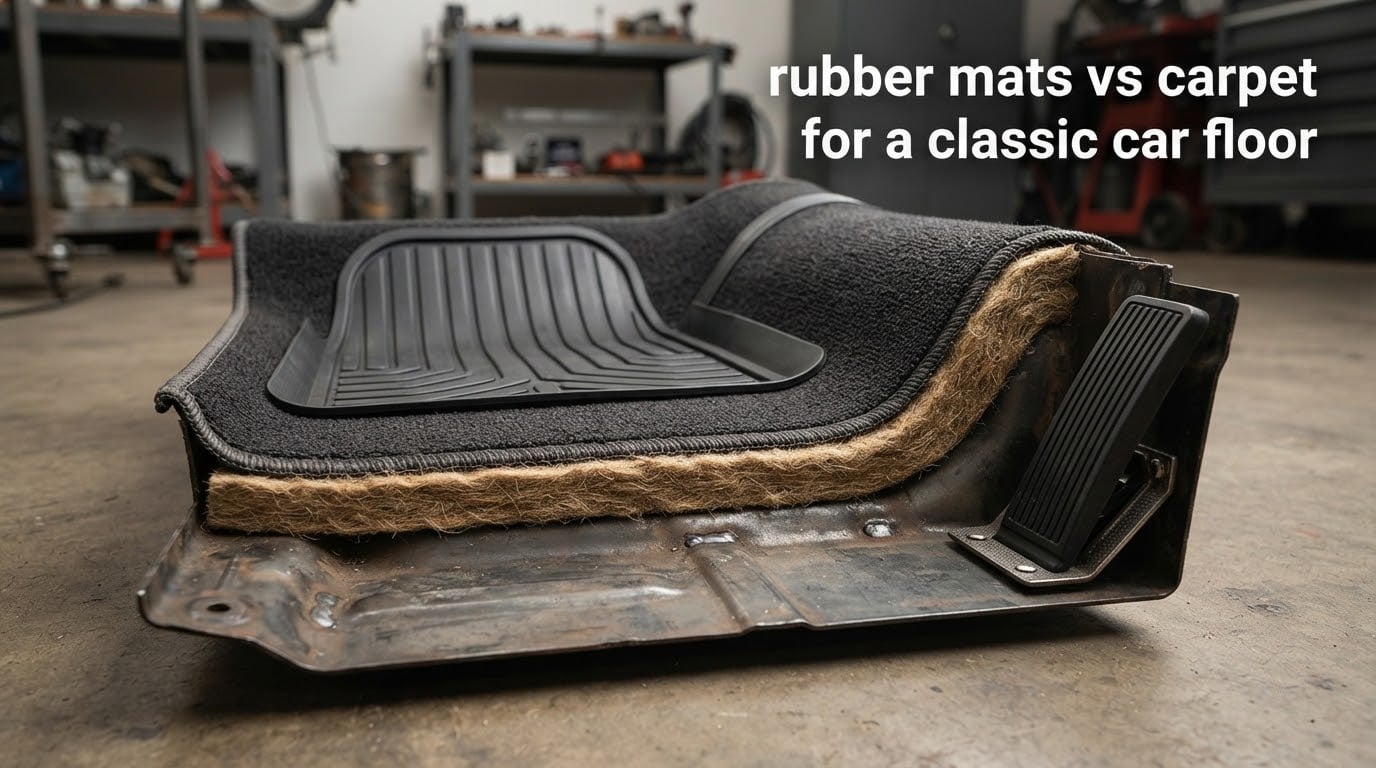
If you have been reading the forum threads arguing about rubber mats vs carpet for a classic car floor, you already know there is no consensus answer. There also is not supposed to be one. The same molded rubber floor pan that is the right call for a car that lives in the rain is the wrong call for a car going to a concours field, and the same carpet kit that wins a judging sheet will smell in a wet winter.
We have pulled together what owners actually report across the Alfa Romeo Board, the 190SL Group forum, For B-Bodies Only, Chevrolet Message Forum, the Oldsmobile forum, and a couple of Reddit threads, then laid it against the factory documentation logic that decides the question. The result is a decision framework rather than a verdict, because a verdict is exactly what the forums keep failing to give you.
Three things shape everything that follows: how often the car is driven, what the weather is like where it is driven, and what your particular car originally shipped with. Get those three answers and the material choice takes about five minutes. Skip them and you will be back on the forum asking the same question next spring.
Table of Contents
- Rubber vs. Carpet Floor Mats: The Short Answer
- What Your Car Originally Came With
- Head-to-Head Comparison: Rubber Floor Mats vs. Carpet Floor Mats
- When Rubber Wins for a Classic Car Floor
- When Carpet Wins for a Classic Car Floor
- The Middle Ground: Molded Rubber Floor Pan With Carpet Mats Over It
- How to Tell What Your Specific Car Originally Had
- Installation and Care: Rubber Pans, Carpet Kits, and Storing Both
- Frequently Asked Questions
- Which is better for my car, carpet or rubber floor mats?
- Are rubber floor mats better than carpet?
- Are carpeted floor mats worth it?
- Can you put carpet floor mats over a rubber floor pan?
- Were classic car rubber floor mats factory original or an option?
- What material is best for car floor mats?
- How do I know what floor my car came with from the factory?
- Does carpet or a rubber floor mat protect the floor pan from rust?
- Conclusion
Rubber vs. Carpet Floor Mats: The Short Answer
It depends on how the car is used, not on which material is better in general. Fit rubber floor mats for a car that gets driven in rain, snow, or road salt, because they keep water off the steel floor pan. Fit carpet floor mats for a show car or a numbers-matching restoration. For a driven car that still gets displayed, fit a molded rubber floor pan and lay removable carpet mats over it.
That third option is the one almost nobody mentions, and it is the one most weekend cars should end up with. It protects the metal, it looks correct in a parking lot, and both layers come back out when the car is sold.
What Your Car Originally Came With
The first question is not which mat is better. It is what came under the carpet when the car left the assembly line, because that answer is your baseline for everything else.
Why some classics shipped with rubber and some with carpet
Factory flooring was not a single decision applied to a model line. It varied by year, by trim level, and by market. Some cars got a molded rubber or vinyl floor pan covering the full footwell and transmission tunnel, complete with the raised dead pedal area over the brake and accelerator. Others got carpet over jute padding, sometimes as the standard and sometimes as a special-order extra.
A thread on the 190SL Group forum asks the ratio of carpet to rubber in those cars and presumes carpet was an extra. That assumption is the right instinct and it is also wrong in places, which is why guessing is a poor substitute for documentation. On plenty of American cars of the 1960s and 1970s, carpet was the default and a rubber full-floor covering was the cheaper configuration. On plenty of European cars of the same era, the hardened rubber pan was closer to standard and carpet appeared on higher-spec examples.
Owners on For B-Bodies Only point out something useful about why the rubber pans feel wrong when fitted later: reproduction ACC vinyl is noticeably thicker than the original material and often lacks a molded pad. That thickness difference is a fitment problem, not an opinion problem. If the replacement mat sits proud of the sill plate, the trim will not go back on correctly.
Rubber aging: UV degradation and vinyl checking over decades
Rubber and vinyl do not last forever, and a 30-year-old rubber mat that lived in a hot, dry garage can be worse than the carpet it replaced. Two failure modes show up repeatedly. The first is ultraviolet degradation, where the surface hardens, goes chalky, and starts cracking along the molded ribs. The second is vinyl checking, a fine cross-hatch pattern that appears when a flexible PVC skin loses its plasticizers and becomes brittle.
One poster on Chevrolet Message Forum wrote that the rubber floor mat fell apart and they carpeted the car. That is the counterexample to the idea that rubber is automatically the more durable choice on a very old car. Durable against water, yes. Durable against twenty years of sunlight in a garage with the door open, not always.
So before you fit anything, pull the existing mat up and look at the rubber. If it is still supple and dark, you are looking at good material. If it is pale, crazed, or shedding chalk onto the sill, it has already lost the property that made it worth choosing.
Head-to-Head Comparison: Rubber Floor Mats vs. Carpet Floor Mats
The table below is the shortest honest form of the argument. Each row is a real decision, not a marketing point.
| Attribute | Rubber or Vinyl Floor Mat | Carpet Floor Mat |
|---|---|---|
| Water resistance | Non-porous; water sits on the surface and can be rinsed off before it reaches metal | Porous; water soaks through the pile into the jute padding beneath |
| Odor and mildew | Dries fast, little odor risk, easy to air out | Traps moisture that breeds mildew and a persistent swamp smell |
| Cleaning effort | Hose or wipe out, soap and a brush, back in service the same day | Vacuum and spot treat, deep clean periodically, slow to dry fully |
| UV and fade | Prone to checking, hardening and cracking after decades of sun | Fades and crushes underfoot; loop pile mats traffic out visibly |
| Floor pan protection | Direct barrier between wet feet and the stamped steel pan | Whatever gets through the pile still wets the pan and the hidden seams |
| Comfort and noise | Hard, colder underfoot, transmits road noise | Jute padding plus pile dampens sound and insulates against heat |
| Appearance and judging | Usually not factory-correct on a carpeted car | Correct on a carpeted car; a wrong-looking covering at a judged show |
| Installed cost | Cheap part, more labour if the pan must be cut and fastened | Kit is parts and sewing time, less disassembly to reach the pan |
Read the water row twice. Every other difference in this table is a matter of taste. That one is a matter of whether the steel pan under your car survives.
When Rubber Wins for a Classic Car Floor
Rubber wins when the car is a daily driver, the forecast includes rain, or anything else in the cabin regularly puts liquid on the floor.
Owners of rain-exposed daily drivers on the Alfa Romeo Board reach the same conclusion with almost the same words: carpeting gets stinky and damaged from the water, and rubber cleans up easily. The point is not that carpet is a bad material. It is that carpet plus jute plus a stamped steel pan is a system designed to stay dry, and a car that lives outside in winter breaks that assumption every time it is driven in.
Why water is the deciding factor
Rubber and vinyl are non-porous. Water beads on them and either evaporates or gets wiped away. Carpet is porous by design, so water migrates down into the jute padding and into the seams where the carpet is bound to the edges of the pan. That layer does not dry in a parked car. It dries over days, in a car that is not being dried, underneath a mat that is blocking the airflow.
The three consequences owners report, in order of frequency:
- A musty or swamp odor that returns within days of a shampoo
- Mildew spotting that reappears no matter how often the carpet is cleaned
- Corrosion on the floor pan discovered only when the mat or carpet is lifted, usually along the tunnel and the seam lines
That third item is the expensive one. A pan that has been quietly wet under a carpet for a season may need patching or a complete replacement, and the labor involved dwarfs the cost of the flooring decision you made two years earlier.
Fixing a water-logged or moldy carpet floor first
If the car already has a musty carpet, changing material without treating the floor is the most common mistake in this whole decision. Five signs mean you have a remediation job, not a mat swap:
- The odor returns within a week of a professional shampoo
- Dark spotting or a greenish tint on the jute padding where the carpet was bound
- Any rust bloom or bubbling on the pan surface or along the floor seams
- Carpet that feels spongy or cool to the touch in dry weather
- Mold visible on the underside of the carpet when it is pulled up
Work through it in order. Pull the carpet and any existing padding out entirely, and do not put a soaked mat back over damp material. Dry the pan and treat any corrosion before anything goes down. Clean or replace the jute padding, since odor lives in that layer more than in the carpet pile itself. Only then choose a covering. Fitting rubber last means the water problem is solved permanently; fitting carpet last means you are choosing to manage moisture by hand for as long as you own the car.
When Carpet Wins for a Classic Car Floor
Carpet wins when appearance and factory accuracy outrank weather protection, which in practice means show cars, judged restorations, and dry-climate weekend cars.
At a judged show, the floor covering is part of the interior, and an interior that does not match the factory specification is hard to defend. A rubber full-floor covering in a car that left the plant with carpet reads as a downgrade, whether or not it is a better mat. A car aiming for top placement is judged on correctness, and a trim decision made for convenience is exactly the kind of thing a judge notices.
There is a real comfort argument too, and the rubber-advocacy pages ignore it. A carpet floor over jute padding absorbs road noise and insulates against hot pavement in summer, in a way that a hard rubber pan never will. On a car with a thin body and a lot of glass, the difference in perceived refinement is noticeable within a few minutes of driving.
The Reddit threads on why car interiors have carpet at all make the engineering case for the material: sound dampening, covering dirt, and the historical shift away from vinyl floors as manufacturers improved noise control. That reasoning still holds. Carpet is not the nostalgic choice. It is still the quieter one.
Carpet mat construction: molded vs. bound, loop vs. cut pile, and the heel pad
Not all carpet mats are the same, and on a show car the construction is visible in person even if it is not on a judging sheet.
- Molded vs. bound: A molded mat is shaped to the footwell and transmission tunnel, usually with the dead pedal area raised. A bound or cut mat is a flat carpet piece with the edges bound and the shape cut by hand. Molded fits better. Bound looks more like a flat factory-style carpet.
- Loop vs. cut pile: Loop pile resists matting and wears evenly, and it holds its shape in traffic. Cut pile feels plush underfoot but shows a worn path under the pedals faster, which reads as wear at a show.
- Heel pad: The reinforced zone on the driver-side mat where the heel wears through. On a driven car it saves the mat. On a numbers-matching restoration, check whether the car originally had one before adding it.
- Backing and retention: Non-skid backing and correct grommet or clip placement keep the mat from creeping. A mat that slides is a mat that ends up folded against the dead pedal at speed.
Owners on the Oldsmobile forum also make a practical point in favor of carpet kits that many rubber comparisons miss: reproduction carpets are pre-cut and sewn, so they go in without cutting and binding in your garage. That is a genuine advantage over trimming a mat to fit a non-standard footwell.
The Middle Ground: Molded Rubber Floor Pan With Carpet Mats Over It
The hybrid approach solves the conflict rather than picking a side. Fit the molded rubber floor pan exactly as you would in a driven car, then lay removable carpet mats on top of it.
What you gain is straightforward. The steel pan gets a permanent non-porous barrier against water, and there is no jute padding anywhere in the car to hold moisture. When the car is driven in the rain, you can rinse the rubber pan and dry it. When the car is at a show, the carpet mats go on and the interior looks factory-correct. When you sell, the carpet mats come off in a minute and the car goes back to how it is meant to look.
Two things to plan for. The rubber pan sits under the carpet, so the carpet layer is effectively an unattached mat rather than a fixed covering; it needs to be a good fit and it needs friction points so it does not creep. And the pan plus carpet stack is thicker at the sill, so check that the kick panel and sill trim still install without being forced.
Forum consensus treats reversibility as a deciding factor in itself. Being able to say the original rubber can go back in is what makes a compromise feel safe to a lot of owners, and the hybrid is the version of that idea that actually works.
How to Tell What Your Specific Car Originally Had
This is the question the top forum threads are actually asking, and it has four real answers. Work down the list until one settles it.
- Read the body number. The body number identifies how the specific car left the plant, and on many models it distinguishes floor configurations. Check the plate location for your year, which is commonly on the body shell, a pillar, or the trim tag area, then look up what the number indicates for flooring.
- Find the build sheet or window sticker. If the car is original or has a data plate, the build sheet lists the interior trim group, which usually includes the floor covering option. Data plates are often missing on cars that have been repainted, and window stickers fade badly in sun, so treat a blank plate as no information rather than as evidence.
- Check the trim code and the interior trim tag. Interior trim tags stapled under the seat, in the door jamb, or behind the quarter trim list the trim group and date. The floor covering is specified by that group rather than listed separately, so the tag alone does not answer the question; it tells you where to look.
- Ask the judging standard or the club. If the car is headed to competition, the ruleset tells you which specification governs. For a car being restored to factory configuration, the factory documentation is the standard, and the honest answer is sometimes that the car’s specific unit cannot be proven.
If none of those produce a document, the surviving hardware becomes your evidence. Look at the shape of the transmission tunnel covering, the sill plate profile, the kick panel and quarter trim fasteners, the weatherstrip and its channel depth, and the dead pedal area. A recessed tunnel and a flat quarter trim suggest a carpeted floor. A raised, ribbed covering and different trim return suggest a rubber pan. It is weaker evidence than a build sheet, but it is real.
Installation and Care: Rubber Pans, Carpet Kits, and Storing Both
Fitting a molded rubber floor pan
Remove the sill and kick trim carefully, because the fasteners on cars of this age are usually one-use and often seized. Expect the old mat or carpet to be hiding water, and check the pan and its seams as it comes up. Clean any drain holes in the pan before you cover it again, because a rubber pan will trap water that a carpeted floor would have wicked away.
Position the pan and fasten it in the factory locations, working from the center outward so the material is stretched evenly. Do not overtighten, and do not stretch a reproduction part that fits a footwell smaller than it was molded for. A pan that has to be pulled to fit will never lie flat afterward.
Cut-to-fit rubber is a different job. It needs a template, clean curves, and a non-skid backing so it does not move. Universal mats are the weakest option in a classic footwell, because the curve of a tunnel-side footwell is not a rectangle and the corners will bunch or curl.
Cutting and fitting carpet
Reproduction kits arrive pre-cut and sewn, which removes most of the difficulty. Lay the kit in dry and check the coverage at the transmission tunnel, the dead pedal, and the quarter trim before you commit. Stretch it evenly, working front to back, and refit the kick panel and sill trim before the adhesive sets fully.
If you are carpeting over a bare pan, use proper padding, not carpet adhesive alone. The jute or foam underlay is not decoration: it is the sound deadening and thermal layer, and it is also the layer that traps water if the carpet is ever soaked.
Cleaning routine by material
Rubber needs almost nothing. Vacuum out grit, wash with soap and water, and dry it before laying the carpet over it. That is a five-minute job after a wet drive, which is the entire argument.
Carpet needs more attention. Vacuum regularly with a brush attachment, spot treat spills before they set, and deep clean on a schedule rather than when the odor appears. Keep the jute dry, and treat the first signs of damp under the carpet as a leak to find, not a stain to scrub.
Seasonal swapping and how to store rubber mats
If you run both sets, the storage details decide whether the swap survives. Roll a rubber mat rather than folding it, because a permanent crease is a crack waiting to happen. Keep it out of direct sunlight in a cool, dry space; ultraviolet exposure is what turns supple rubber into brittle, cracking rubber. Keep carpet mats clean and dry, and do not compress them under anything heavy.
Take the rubber out and dry it fully after every wet drive rather than storing it damp under the carpet. Damp rubber against damp jute reproduces exactly the problem the rubber pan was meant to solve.
Frequently Asked Questions
Which is better for my car, carpet or rubber floor mats?
It depends on use. Rubber for a car driven in rain, snow, or salt, because it keeps water off the steel floor pan. Carpet for a show car, a numbers-matching restoration, or a dry-climate weekend car. A molded rubber floor pan with removable carpet mats over it is the compromise most driven-and-shown cars should use.
Are rubber floor mats better than carpet?
Better for water resistance, cleanup, and protecting the floor pan, which is why owners of daily-driven cars in wet climates choose them. Not better for appearance, comfort, or originality, and not always better for durability: rubber and vinyl on a 30-year-old mat can harden, check, and crack from ultraviolet exposure. It is a use-case decision, not a quality ranking.
Are carpeted floor mats worth it?
Yes for a car that is shown rather than driven regularly. Carpet over jute padding dampens road noise, insulates against heat, and matches the factory specification on cars that shipped with a carpeted floor. It is worth it if the car stays dry, the floor underneath is sound, and you accept periodic cleaning and eventual traffic wear in the footwell.
Can you put carpet floor mats over a rubber floor pan?
Yes, and it is a deliberate strategy rather than a hack. The molded rubber pan gives a permanent non-porous barrier over the steel, the carpet layer goes on top for looks, and the carpet comes off for judging or for sale. Plan for the extra thickness at the sill and use a mat with grip so it does not creep underfoot.
Were classic car rubber floor mats factory original or an option?
Both. Flooring was configured by year, trim level, and market, so the same model line could leave the plant with a molded rubber or vinyl floor pan or with carpet over jute padding. On some cars rubber was the base configuration and carpet the extra, and on others it was the reverse. Documentation is the only reliable answer for a specific car.
What material is best for car floor mats?
For a driven classic, a molded rubber or vinyl floor pan covering the full footwell and transmission tunnel. For a garage-kept show car, a bound carpet kit matched to the factory trim color, with a heel pad if the car originally had one. Fit a custom or molded part rather than a universal mat, which will bunch and curl in a curved footwell.
How do I know what floor my car came with from the factory?
Work from documentation down to hardware. Start with the body number, then look for a build sheet, data plate, or window sticker listing the interior trim group, then the interior trim tag that identifies that group. If documentation is missing, the shape of the transmission tunnel cover, the sill profile, the kick and quarter trim, and the dead pedal area are weaker but real evidence.
Does carpet or a rubber floor mat protect the floor pan from rust?
Rubber, and by a wide margin. It is non-porous, so water sits on the surface and can be wiped or rinsed away before it reaches metal. Carpet and jute hold water against the pan and its seams, which is how the swamp odor and the hidden corrosion get started. If you already have a musty carpet, treat the floor before fitting anything.
Conclusion
Rubber mats vs carpet for a classic car floor comes down to water, weather, and what your car shipped with. Driven in rain or salt, fit a molded rubber floor pan. Shown, judged, or restored to factory configuration, fit carpet over proper jute padding. Driven and shown, run the rubber pan with removable carpet mats over it and take both layers out when the car sells.
Before you order anything, pull up the existing mat, check the body number and any surviving build sheet, and look at the pan for corrosion. Those three checks take an afternoon and they settle the question faster than another forum thread will.