
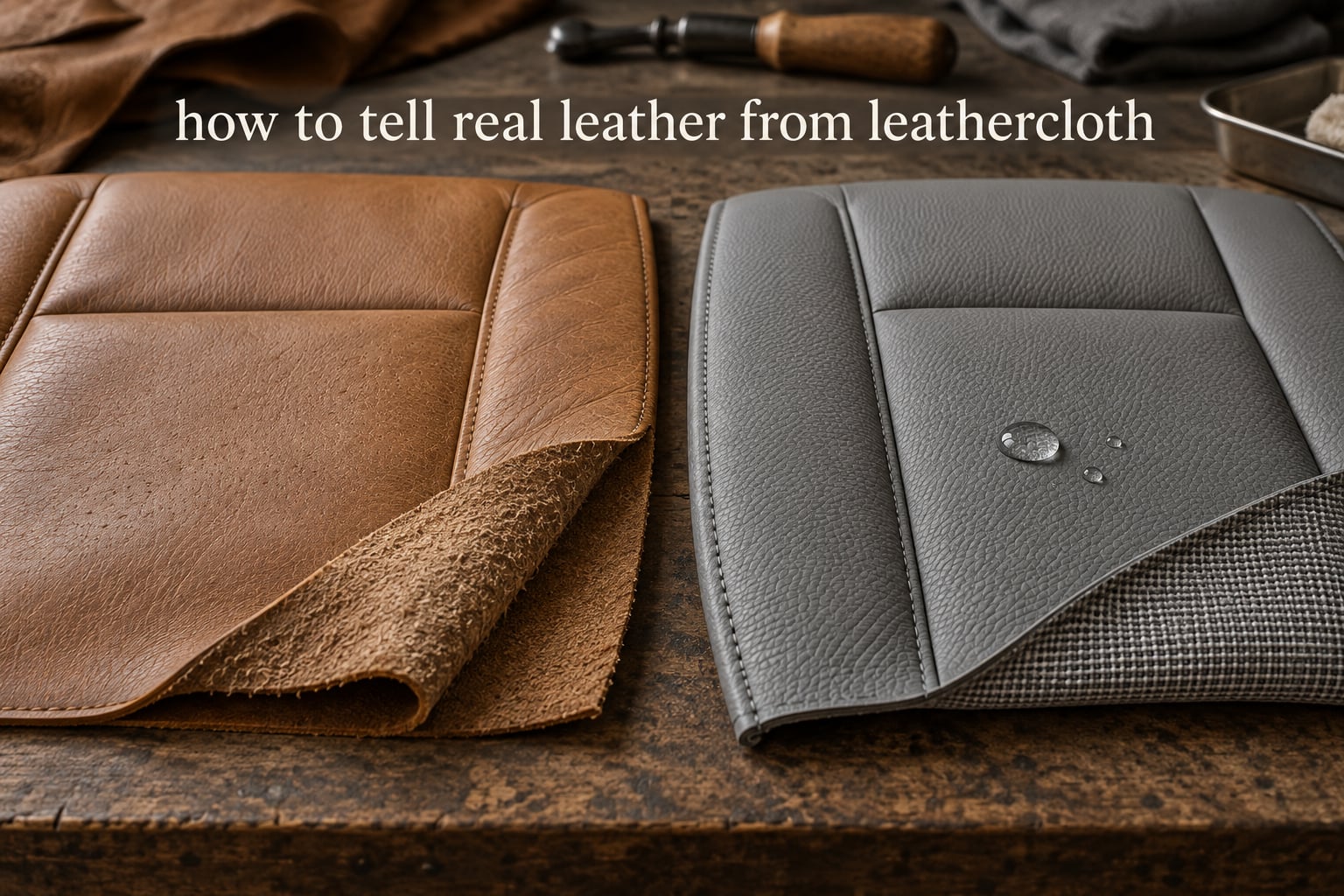
Leathercloth is a woven or nonwoven fabric coated with polyurethane or PVC and printed or embossed so it looks like the grain of animal hide. It is a synthetic imitation. Real hide is a three-dimensional collagen structure with irregular pores, so it absorbs water, warms to the touch, wrinkles and softens. Leathercloth sits cold, beads water and creases sharply instead. That difference is the whole question, and the rest of this guide is how to read it in a car, a chair, a bag or a wallet.
Knowing how to tell real leather from leathercloth matters more in an automotive cabin than anywhere else. A window sticker will happily say leather seating surfaces when the genuine hide covers only the middle panel of the cushion. Everything around it can be textured plastic. Buyers routinely pay a premium for a mostly synthetic interior, then watch a PU coating flake three summers later.
I’ve spent years working with automotive upholstery suppliers, cutting panels and matching hides, and the same handful of checks come up on every job. None of them require a lighter, a knife or a bottle of acetone. All of them take about two minutes if you know where to look. This guide was updated for 2026 and covers what each test actually proves, where the tests are unreliable, and how to confirm a seller’s claim against the vehicle’s own paperwork.
A note before we start: leather is a byproduct of the meat and dairy industry rather than something harvested for its own sake, and several modern synthetics are made partly from recycled or bio-based feedstocks. Faux is not a synonym for cheap, and neither material is automatically the greener choice. The question is simply which one is in front of you.
Table of Contents
- Quick Test: How to Tell Real Leather from Leathercloth
- Master Comparison Table: Test Results Side by Side
- What Leathercloth Actually Is: Leatherette, Pleather, PU and Vinyl Explained
- The Label, Product Name and Specification Check
- The Smell Test
- The Touch and Temperature Test
- The Water Drop Test
- The Grain and Pore Test
- The Pinch, Wrinkle and Press Test
- The Backside Test: Fleshy Hide or Woven Backing
- Edges, Seams and Cross-Sections
- Leather Grades Explained: Full-Grain, Top-Grain, Genuine, Split and Bonded
- Which Surfaces Inside One Car Are Real Leather?
- Verify Before You Buy: Window Sticker, Build Sheet, VIN Glass and Door-Jamb Label
- OEM Branded Synthetics: SensaTec, Dinamica, WeaveTech and Vegan Leather
- Destructive Tests: Flame, Acetone and Ink, and Why to Skip Them on a Car Interior
- Why Colour and Price Are the Two Weakest Signals
- What Your Verdict Means for Daily Driving and Replacement Covers
- Frequently Asked Questions
- How can I tell the difference between real leather and faux leather?
- How to tell leather from leatherette?
- How do I know if my dashboard is leather?
- Is leather in cars real leather?
- How to tell if leather is real with a lighter
- How to test real leather with fire?
- What is leathercloth made of?
- How to tell leather from pleather?
- Genuine leather vs real leather: what is the difference?
- Is SensaTec real leather?
- What is the downside of faux leather?
- Should I buy real leather or faux leather?
- Conclusion
Quick Test: How to Tell Real Leather from Leathercloth
Eight checks, ordered so the least invasive come first. Stop as soon as you have two clear answers, because a single test can lie.
- Read the name. Full-grain, top-grain, aniline, semi-aniline, Nappa and vegetable-tanned mean hide. Leatherette, pleather, PU, PVC, vegan, artificial, SensaTec, Dinamica and WeaveTech mean synthetic.
- Smell it. Hide gives an earthy, woody, burnt-hair scent. Leathercloth gives a chemical, sweet or rubbery smell, often strongest in a warm cabin.
- Feel the temperature. Real leather warms toward your hand within seconds. A synthetic surface stays close to the ambient temperature of the car.
- Drop water on it. A drop soaks in slowly and leaves a dark patch that dries from the edges inward. On leathercloth it sits on top as a bead.
- Look at the grain. Hide shows pores of different sizes, healed scars, colour variation and no repeating pattern. Printed PU grain repeats identically, often with a visible seam every few inches.
- Pinch and roll it. Hide creases softly, holds the crease briefly, then relaxes. Leathercloth springs back instantly, feels rubbery and makes a faint squeak against itself.
- Turn over an edge. A finished leather edge shows a fibrous suede-like core. A synthetic edge shows a flat cross-section and a clean woven or nonwoven fabric backing.
- Check the paperwork. The window sticker, build sheet, VIN glass and door-jamb label tell you what the factory claimed, which is the baseline everything else is measured against.
Steps two through seven are physical checks. Step one and step eight are documentary, and on a car they are often faster than touching anything at all.
Master Comparison Table: Test Results Side by Side
This is the table none of the advice pages we studied bother with. Read across a row and you can usually decide within one line.
| Test | What real leather does | What leathercloth does | How reliable |
|---|---|---|---|
| Label and naming | States full-grain, top-grain, Nappa, aniline or semi-aniline | States leatherette, pleather, PU, PVC, vegan or a brand name | High when present, no signal when absent |
| Smell | Earthy, woody, oaky, burnt-hair | Chemical, sweet, plastic or rubbery | High on new material, low after years of use |
| Touch temperature | Warms to skin temperature quickly | Stays cold or ambient | Medium, climate dependent |
| Water drop | Absorbs in seconds, spreads, dries from the edge | Beads on the surface, wipes off intact | High on uncoated hide, fails on heavy topcoat |
| Grain and pores | Irregular pore sizes, scars, natural variation | Identical repeating embossed pattern | High |
| Pinch and wrinkle | Soft creases that relax slowly | Resists, then springs back like rubber | Medium, confused by seat foam and quilting |
| Backside | Fibrous, fleshy, suede-like | Clean woven or nonwoven backing | Very high, the definitive check |
| Cut edge and cross-section | Rough, fibrous, layered | Smooth machine cut, film over fabric | Very high when an edge is exposed |
| Long-term behaviour | Wears in, develops patina, creases soften | Coating cracks, flakes, peels at seams | High over years, no signal on a new seat |
| Colour and price | Wide range, wide price range | Wide range, wide price range | Very low, treat as noise |
Read the reliability column before you argue with a row. The smell and water tests fail on heavily finished leather, and the pinch test fails on a quilted seat cushion where the foam underneath does most of the work.
What Leathercloth Actually Is: Leatherette, Pleather, PU and Vinyl Explained
Leathercloth is a colloquial word, and sellers use it loosely enough that it has no fixed technical meaning. In practice it covers several different synthetics, and the differences matter because they age differently.
| Term | What it is | How it behaves |
|---|---|---|
| Leathercloth | Generic English term for coated imitation leather | No fixed standard; assume a coated fabric or film |
| Leatherette | Coated fabric, often PVC or PU over polyester | Embossed grain, cold, non-absorbent |
| Pleather | PU-coated fabric, a soft polyurethane film | Softest synthetic to the touch, peels at creases first |
| PU leather | Polyurethane film bonded to a backing | Breathable feel, dries to a matte finish, cracks with age |
| PVC vinyl | Heavier plasticised vinyl, often in a solid colour | Cold, stiff, embossed, the most durable synthetic |
| Vegan leather | Any animal-free substitute, including PU, PVC and bio-based films made from cactus, mushroom or mycelium fibre | Behaves like its coating, not like hide, regardless of the story behind it |
| Bonded or reconstituted leather | Real leather fibre offcuts and shavings pressed together under adhesive and backed with fabric | Contains hide but behaves like a coated composite; splits at the edges |
Bonded leather is the one that confuses people. It is genuinely made from leather particles, which is why it can be sold legally as leather in many markets. It still beads water, still peels, and still has a fabric underside, so the physical tests treat it as leathercloth.
The Label, Product Name and Specification Check
Start with the words, because they cost nothing and settle a surprising number of arguments. A manufacturer naming a material properly will say full-grain, top-grain, Nappa, aniline or semi-aniline for hide, and leatherette, pleather, PU, PVC, artificial or vegan for synthetics.
The wording on the other side of the coin is where red flags live. Words containing luxe, ultra, tec, tex or soft-touch are marketing, not material descriptions. Leather-touch, leather-look and leather-feel describe appearance and nothing else.
On a car, the wording is deliberately vague. Leather seating surfaces, leather-trimmed and leather-appointed legally describe only part of the seat, and the rest is synthetic. Read the wording literally, then verify it against the surfaces themselves.
The Smell Test
Real hide carries an earthy, woody or oaky scent that leatherworkers describe as burnt hair, and it comes from the tanning and finishing process rather than the animal itself. A new genuine seat has that note even after months in a showroom.
Leathercloth smells of chemicals: a sweet solvent note from polyurethane, or a rubbery plastic note from PVC. The scent is strongest in a warm, closed car, which is why a quick sniff on a sunny day settles the question faster than a showroom visit on a cold morning.
Two caveats. After a decade of sunlight and a garage, genuine upholstery can smell faintly of the dashboard polymers around it, so smell alone is not enough. And a repainted or heavily coated seat can be nearly odourless, which is not proof of hide.
The Touch and Temperature Test
Real leather is a poor conductor compared with coated synthetics, so it warms toward your hand quickly. Press the back of your hand flat against a seat centre panel and within a few seconds hide feels closer to body temperature, while a synthetic surface stays noticeably cooler against the same skin.
Texture is the second half of this test. Hide has slight tooth and irregularity, and it changes as it warms. Coated fabric feels consistently smooth and uniform, like a rubber skin laid over foam, and it will feel the same cold or warm.
Careful with the steering wheel and the driver’s seat bolster on a hot day, where ambient temperature flattens the difference. Test a shaded door panel or the seat back as a cross-check.
The Water Drop Test
Put a few drops of plain water on an inconspicuous spot and watch what happens. Genuine leather absorbs slowly, spreading outward into a darker patch with a soft edge that dries from the rim inward. The mark fades within minutes and the surface returns to normal.
Leathercloth holds the water in a bead. It sits on top, can be traced with a fingertip, and wipes away leaving a faint greasy ring, because the coating has simply pushed the liquid back.
Where this test misleads: a heavy pigmented or polyurethane-coated finish on real automotive leather is nearly waterproof, and a heavily perforated panel routes the water into the foam. Use it on a solid, unperforated panel such as the seat back or armrest, and expect a slow darkening rather than an instant soak on any factory-finished hide.
The Grain and Pore Test
Hide has pores of visibly different sizes scattered across the surface, along with healed scars, growth marks, colour variation and a natural flow that never quite repeats. Look across a large panel and your eye should keep finding small irregularities.
Printed or embossed synthetic grain repeats. The same motif appears every few inches, the pore pattern is identical each time, and a repeat line is often visible in raking light across a seat centre. Some of the better modern synthetics use multi-scale patterns to disguise this, which is why the pattern alone is not proof.
The strongest version of this test is directional. Tilt the panel under a light source and move your head slightly. Hide shows depth, with the light breaking differently on every square centimetre, because the surface is genuinely three-dimensional. A coated film shows a flat sheen that changes uniformly.
The Pinch, Wrinkle and Press Test
Take a corner of the panel between thumb and forefinger and roll it. Hide compresses, forms a soft crease and holds it for a second or two before relaxing, and the surface will show fine radiating lines as it folds. Synthetic material either resists the pinch or folds along a single sharp line, then springs straight back with a rubbery snap.
The press test works the same way on a flat panel. Push firmly with a fingertip. Genuine hide creases around the finger and relaxes slowly as you release. A coated surface dimples briefly and pops back immediately, like pressing a balloon.
Owners in the detailing communities call this the press test, and it is the most-cited quick check among people who work on these materials daily. Two limits are worth stating: seat cushions and quilting underneath can mask the result, and perforated panels behave differently from solid ones. Test a solid unperforated area such as the seat back or a door insert.
The Backside Test: Fleshy Hide or Woven Backing
This is the most definitive non-destructive check available, and it is the one most often missed. Turn the material over at an edge, at an unfinished seam allowance, or at any spot a cover can be lifted. Real hide has a fibrous, fleshy, suede-like underside with a fine nap, because collagen fibres run right through the material.
Leathercloth shows a clean woven or nonwoven textile backing, a uniform grey or beige knit, or a smooth film with a foam layer behind it. Nothing fibrous, nothing fleshy. Bonded leather shows a granular composite core with fabric on the back, which is different again from the nap of a finished hide.
On a car, the places to look are the underside of a seat cover hem at the door sill, the back of a headrest, and the underside of a dashboard trim piece that lifts without tools. On a bag or wallet, the underside of a flap or the inside of a card slot is enough.
Edges, Seams and Cross-Sections
Look at any cut or finished edge. Leather is a dense fibre mat, so its cut edge is slightly rough, fibrous and layered, and you can often see a subtle difference between the finished surface and the interior colour. Synthetic edges are smooth, straight and machine-cut, with a visible film thickness and a fabric layer behind it.
Turned and stitched edges are the usual place to look, because a cover has to fold the material and that fold is where the two behaviours separate. Hide folds and holds a soft crease along a seam. A coated panel develops a pale stress line or a hairline crack where it has been bent repeatedly, especially at perforation edges and where upholstery is stitched tight.
Stitching itself is a supporting tell rather than a proof. Genuine automotive work uses a saddle stitch or a locked seam with an even stitch length, and synthetic covers often show shorter, tighter, more uniform stitching with thread ends trimmed close.
Leather Grades Explained: Full-Grain, Top-Grain, Genuine, Split and Bonded
Even when the material is real, the grade changes what you will observe in the field. Knowing the grade tells you which tests are most useful.
| Grade | What it is | How it behaves in a car |
|---|---|---|
| Full-grain | The top of the hide, sanded on the flesh side only, with the natural grain and pores intact | Shows scars and pores clearly; absorbs water; develops patina; the most responsive to the grain and water tests |
| Top-grain | Full-grain with the surface sanded and finished for uniformity | Smoother and more even, pores shallower; still absorbs slowly and wrinkles naturally |
| Aniline | Top-grain with a translucent dye and no pigmented surface coat | Warm, soft, highly absorbent, shows every mark; the fastest water response of any real grade |
| Semi-aniline | Aniline with a light pigmented coat for durability | The common automotive grade; still absorbs, still creases softly |
| Genuine or corrected grain | Split or lower layers finished with an embossed artificial grain | Real leather fibre, but the printed grain can mimic synthetic uniformity, so judge by touch and backside |
| Bonded or reconstituted | Shaved fibre pressed with adhesive over fabric | Peels, cracks at folds, has a fabric back; treat it as a leathercloth substitute |
The word genuine is the one that causes the most confusion. Genuine leather is a real but lower grade, roughly equivalent to corrected grain, not a synonym for the best hide. Nappa refers to a soft, fine-grained, usually full-grain or top-grain leather, and semi-aniline describes the finish, not the animal.
Which Surfaces Inside One Car Are Real Leather?
Half-leather construction is the norm, not the exception. Owners on owner forums consistently report that only the panels the body touches are hide, and everything else is textured plastic or vinyl.
| Surface | Typical material on a leather-trimmed car | Confidence level |
|---|---|---|
| Seat centre panel | Usually genuine hide, often semi-aniline or perforated | Most likely to be real |
| Bolsters and side wings | Frequently the same hide, sometimes synthetic to save cost | Check individually |
| Seat back panel | Often textured plastic or vinyl with a printed grain | Assume synthetic until proven otherwise |
| Head restraint sides | Mixed; frequently synthetic even when the centre is hide | Check individually |
| Door panel insert | Usually synthetic, even in a leather-trimmed car | Assume synthetic |
| Dashboard upper surface | Vinyl or PU over foam; genuine hide only on higher trims | Assume synthetic |
| Steering wheel rim | Perforated hide on luxury cars, synthetic on most others | Check individually |
| Centre armrest and console lid | Hide on some trims, vinyl on others | Check individually |
Test each surface rather than generalising from the seat centre to the whole cabin. The door panel and the seat back are where synthetic is most common, and both are easy to reach without tools.
Verify Before You Buy: Window Sticker, Build Sheet, VIN Glass and Door-Jamb Label
Documentation beats persuasion. A salesperson’s answer is a memory; a build sheet is a record. Buyers on owner forums treat paperwork as the only reliable baseline, and they are right.
- Read the window sticker line item. Leather seating surfaces or leather-trimmed describes part of the seat, not all of it. Genuine leather or leather-trimmed with no qualifier is a different claim from the vague form.
- Pull the build sheet or window build record for the VIN. This lists interior codes and trim combinations and is the document that shows whether leather was an option on that specific car rather than a range-wide description.
- Read the door-jamb and VIN glass labels. These confirm the vehicle identity and sometimes carry interior material information on certain markets.
- Ask the seller which panels are hide, and how they know. A seller who points at the seat centre and names the bolster as synthetic is telling you the truth about a normal half-leather car. A seller who claims the whole seat is real is describing very few cars.
If the history report says leather was installed at a previous dealership, remember that upholstery replacements and add-on installs are recorded differently from factory equipment. A VIN history showing leather does not prove the leather is genuine hide, only that someone fitted a seat described that way.
OEM Branded Synthetics: SensaTec, Dinamica, WeaveTech and Vegan Leather
Manufacturers stopped calling synthetics vinyl years ago, and the branded names now make the label check harder rather than easier. Knowing them is worthwhile.
| Branded synthetic | What it is | Genuine name it is not |
|---|---|---|
| BMW SensaTec | PU-coated synthetic leather used across BMW seating; replaced the older leatherette and vinyl descriptions | Not full-grain, Nappa or semi-aniline |
| Mercedes Dinamica | Recycled microfibre suede-style covering | Not suede, not nubuck |
| Polestar WeaveTech | Woven bio-attributed covering over a synthetic base | Not a woven textile, not hide |
| Audi vegan leather | PU or PVC-based animal-free covering offered on some models | Not a genuine leather grade |
Modern branded synthetics have closed much of the gap. A good PU panel with a matte finish can warm slowly, absorb a little at a seam, and wrinkle without snapping back, so the cheap heuristics fail on new cars. The backside, edge and paperwork checks are what still separate them reliably.
Destructive Tests: Flame, Acetone and Ink, and Why to Skip Them on a Car Interior
Do not flame-test, acetone-test or scratch a car interior. A seat contains heating elements, occupancy sensors, side-impact airbag stitching and trim clips that are not visible. An open flame in a cabin is a fire risk, acetone attacks plastics, finishes and adhesives throughout the trim, and any of it can void a warranty. Both tests are also permanent. The honest answer is that they have no place in a vehicle.
For completeness, since the question comes up constantly: a real hide char and curls, producing a burnt-hair smell, while a synthetic coating melts, catches fire and gives off a chemical smell. A drop of acetone on a coated surface lifts colour or print, while on unfinished aniline hide it may darken temporarily and recover. Both results are only meaningful on a scrap offcut, never on an installed seat.
If you are ordering a material, ask the supplier for a physical swatch and test that. A swatch has no airbags attached to it, which is the entire argument for testing samples rather than interiors.
Why Colour and Price Are the Two Weakest Signals
Most advice pages put price near the top of the test list. It does not belong there. Synthetic upholstery is cheap per square metre and real hide is expensive, but luxury synthetic bags routinely cost more than genuine leather ones, and a bargain hide seat can appear on a low-spec trim. Price tells you about the market, not the material in your hands.
Colour is worse. Synthetics dye evenly and come in any colour a manufacturer wants, including tan and cognac tones indistinguishable at a glance. The only reliable colour tell is variation within a single panel, where real hide shows tonal drift between adjacent cuts and printed synthetic does not.
Two other signals that get over-trusted. A certificate of origin proves where a hide came from, not that the item finished in your hands was made from it. And a soft, pleasant handle can be a well-made PU coating, not hide.
What Your Verdict Means for Daily Driving and Replacement Covers
Once you know what you are looking at, the decision changes shape. If the seat centre is genuine semi-aniline, it will crease and soften with use, show wear at the driver bolster and heel pad, and want conditioning a couple of times a year. Sun and heat accelerate drying, so shade matters more than any product.
If it is leathercloth, you are dealing with a coating with a service life, not a hide. PU in particular tends to stiffen and flake along crease lines first, which is why owners notice it as peeling at the bolster edges. PVC vinyl lasts longer and tolerates sun better but feels cold in winter and stiff in cold weather. Cleaning is simpler, with a damp cloth and a mild interior cleaner, and there is no conditioning step.
Owners of synthetic-seat cars often report less maintenance and no cracking, and many in hot climates say they would choose synthetic again. That is a reasonable position, and it only becomes a problem when it was sold as hide.
When you are ordering a replacement cover or a full retrim, the questions worth asking a supplier are short: what is the substrate, is the coating PU or PVC, what is the hide thickness in millimetres if it is real, where does the material come from, and can I have a swatch before the full set is cut. Any hesitation on the swatch question is itself an answer. Red flags in a listing are stock photography that does not match the product, a thickness given in microns for something described as leather, and a refund policy that disappears once you ask about the backing.
Frequently Asked Questions
How can I tell the difference between real leather and faux leather?
Use touch, smell and water in that order. Real leather warms to your hand, smells earthy or woody, and soaks a water drop in slowly leaving a dark patch. Faux leather stays cool, smells chemical or rubbery, and holds water as a bead on the surface. The most reliable single check remains the backside: real hide has a fibrous suede-like underside, while a synthetic has a clean woven or nonwoven backing.
How to tell leather from leatherette?
Leatherette is a coated fabric, usually PVC or polyurethane over polyester, printed or embossed to imitate grain. The distinction shows up in four places: it stays cool to the touch, beads water, has a fabric backing on the reverse, and its edge is a smooth machine cut rather than a fibrous cross-section. Leatherette also peels and flakes with age, while hide wears in and develops patina.
How do I know if my dashboard is leather?
Check the surface rather than the spec sheet. Dashboards are almost always vinyl or polyurethane over foam, even in a leather-trimmed car. Warm it with your hand, drop water on an out-of-sight area, and look for repeating embossed grain and a plastic edge where the trim meets the windscreen or a vent surround. A genuine hide dashboard is rare and appears only on high trims.
Is leather in cars real leather?
Usually only on the seating surfaces the body touches. A window sticker reading leather seating surfaces legally describes part of the seat, and the seat back, head restraint sides, door panels and dashboard are commonly textured plastic or vinyl. Confirm the factory claim against the build sheet for the VIN, then physically test the seat centre, bolsters, door insert and wheel individually.
How to tell if leather is real with a lighter
Real leather chars and curls with a burnt-hair smell, while a synthetic coating melts, ignites and gives off a chemical odour. That is the only useful result, and it permanently damages the material. Never flame-test a car interior: seats contain heating elements, sensors and airbag stitching, and the risk of damage or fire is not worth a definitive answer. Test a supplier swatch instead.
How to test real leather with fire?
On a scrap offcut, hold a flame to the underside. Genuine hide chars, curls and smells of burnt hair, while polyurethane or PVC coating melts and burns with a chemical smell. On a car interior, do not do this at all. Use the water drop, grain, pinch and backside checks instead, all of which are non-destructive and equally conclusive.
What is leathercloth made of?
Leathercloth has no fixed standard, but in practice it is a woven or nonwoven polyester base coated with polyurethane or PVC, then printed or embossed with a grain pattern. It is the same family of material as leatherette, pleather and vinyl upholstery. Some modern versions use partially bio-based or recycled feedstocks, but the coating still behaves like plastic: cold, non-absorbent, and prone to peeling.
How to tell leather from pleather?
Pleather is polyurethane-coated fabric, so it behaves like other synthetics. It warms slowly, beads water, shows a repeating embossed grain and has a textile backing underneath. The one difference from PVC vinyl is hand feel: pleather is softer and more pliable, and it is also the first synthetic to crack, because the flexible coating hardens and splits along creases.
Genuine leather vs real leather: what is the difference?
They are the same thing, which is part of the problem. Genuine leather is a real but lower grade, roughly equivalent to corrected grain, not a premium descriptor. Above it sit top-grain, semi-aniline and full-grain, with aniline the softest and most absorbent. Below it sits bonded leather, which is leather fibre pressed with adhesive and behaves much like a synthetic.
Is SensaTec real leather?
No. BMW SensaTec is a polyurethane-coated synthetic that replaced the leatherette and vinyl descriptions BMW used earlier. It warms more slowly than hide, beads water and has a fabric backing. It is also a good demonstration of why smell and touch alone are not enough on modern cars, since a well-finished SensaTec panel can be difficult to call by hand.
What is the downside of faux leather?
Coated synthetics do not breathe or absorb moisture the way hide does, so they feel cold and can feel sticky in humid weather. The coating is the weak point: PU in particular hardens and flakes along creases, and vinyl can crack after repeated sun exposure. Both are easy to wipe clean and need no conditioning, which many owners in hot climates prefer to the maintenance hide requires.
Should I buy real leather or faux leather?
For a car, the honest answer depends on your climate and how you feel about maintenance. Genuine semi-aniline hide wears in, softens and looks better with age, but needs periodic conditioning and suffers in strong sun. A good synthetic is easier to live with, cheaper to replace and does not crack, and the gap has narrowed considerably. What matters most is that the label and the paperwork say what you are actually buying.
Conclusion
To tell real leather from leathercloth, work from the paperwork inward. Read the material name, then run two or three physical checks that suit the surface, and finish with the backside or the cut edge, which is where the answer is hardest to argue with.
On a car, remember that half-leather is normal and that the phrase leather seating surfaces was never a promise about the whole cabin. If you are ordering covers or planning a retrim, ask for a swatch, check the substrate, and test that instead of a fitted seat. That combination will tell you what you are paying for before anyone cuts a panel.