
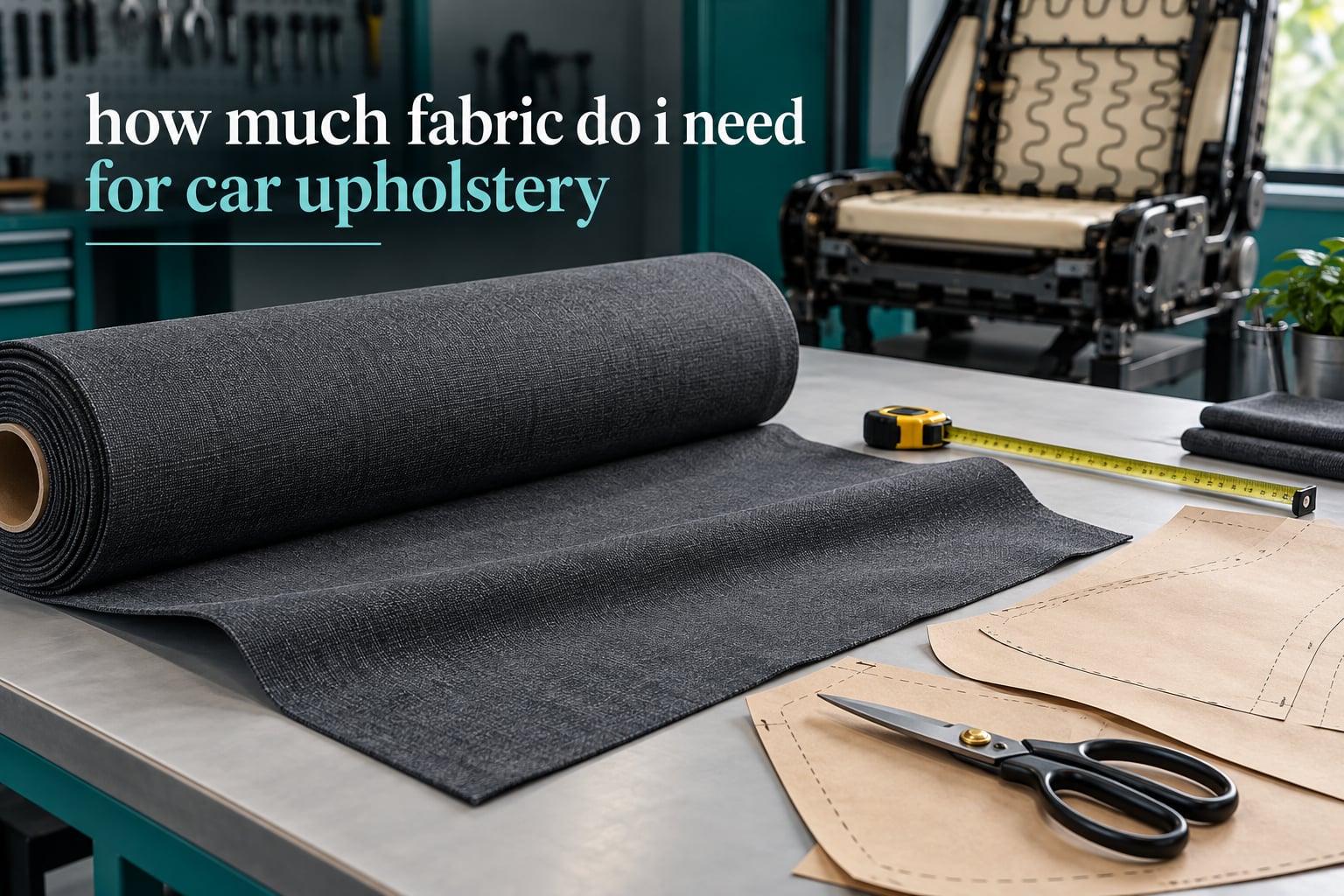
A single front bucket seat takes 3 to 5 linear yards of automotive upholstery fabric. A rear bench seat takes 5 to 8 yards, each door panel takes 1.5 to 2.5 yards, and a headliner takes 4 to 6 yards from a completely separate bolt. A full interior on a four-door car lands somewhere between 20 and 30 yards once carpet, bolsters and headrests are counted. Those numbers assume 54-inch-wide cloth, which is the industry standard.
Getting this right matters more in a car than in any other upholstery project. Run half a yard short on a sofa and you order more the same afternoon. Run half a yard short on a retrimmed door panel you have already cut open, and the piece is scrap. Automotive material is also woven and dyed in limited lots, so a re-order days later often arrives in a slightly different shade.
We work through the numbers below so you can order once, order enough, and understand exactly where every yard goes.
Table of Contents
- How Much Fabric Do You Need for Car Upholstery?
- Understanding Auto Fabric Widths (54 Inch, 60 Inch, 62 Inch)
- How to Calculate Car Upholstery Yardage Step by Step
- Material Differences That Change Your Yardage
- Grain Direction and Why It Adds Yardage
- Worked Example: Full Interior of a Four-Door Car
- Why Forum Estimates and Supplier Numbers Disagree
- If You Run Short Mid-Project
- DIY vs Professional: When to Hire a Trimmer
- Frequently Asked Questions
- How many yards of fabric to reupholster a car seat?
- How do I calculate fabric for upholstery?
- How much will 1 yard of fabric cover?
- What type of fabric is best for car interior upholstery?
- How much will 3 yards of fabric cover?
- How much should it cost to reupholster a car seat?
- Is it cheaper to reupholster or buy new?
- Conclusion
How Much Fabric Do You Need for Car Upholstery?
The short answer for most people: measure your panels, not the car. Use the chart below as a sanity check, then run the four-step calculation for your specific vehicle.
| Vehicle part | Cloth or vinyl (54 inch wide) | Alcantara or suede | Notes |
|---|---|---|---|
| Front bucket seat, per seat | 3 to 5 yards | 3.5 to 5.5 yards | Includes cushion, back, bolsters, headrest |
| Rear bench seat, per bench | 5 to 8 yards | 6 to 9 yards | Largest single piece of the job |
| Door panel, per side | 1.5 to 2.5 yards | 1.5 to 2.5 yards | Two panels, one per side |
| Headliner | 4 to 6 yards | Not recommended | Separate headliner cloth, usually perforated |
| Center console lid | 0.5 to 0.75 yard | 0.5 to 0.75 yard | Small piece, easy to forget |
| Carpet, per square yard | 1 yard covers 1 square yard | Not applicable | Carpet is sold by the square yard, not the linear yard |
| Full interior, four-door car | 20 to 30 yards | 22 to 32 yards | Seats, panels, headliner, console |
Two line items get forgotten constantly: the headliner and the console lid. The headliner comes on its own bolt, usually a perforated cloth that is nothing like the body fabric, and it should never be cut from upholstery cloth. One poster on the ih8mud forum was quoted 10 yards for front and rear seats plus extra for door cards, which is a seat-only figure rather than a whole-car number.
Understanding Auto Fabric Widths (54 Inch, 60 Inch, 62 Inch)
One linear yard is 36 inches long, and it is sold by the linear yard across a fixed width. So one yard of 54-inch automotive cloth gives you 54 by 36 inches, or about 13.5 square feet, and that number is what the rest of this calculation is built on.
Three yards of that same 54-inch cloth gives you 162 linear inches of material. Laid out flat, that is 4.5 feet by 13.5 feet, roughly 61 square feet, which covers two front bucket seats with a small remainder or one rear bench comfortably.
Width matters because the wider the bolt, the fewer pieces fit per row.
| Fabric width | Pieces per row, by panel width | Effect on yardage |
|---|---|---|
| 54 inch | 22 inch panel: 2, 30 inch panel: 1 | The industry default for automotive cloth |
| 60 inch | 22 inch panel: 2, 30 inch panel: 2 | Noticeably better nesting on seat pieces |
| 62 inch | 22 inch panel: 2, 30 inch panel: 2 | Widest common automotive width |
Community consensus on the pelicanparts and chevelles forums is consistent on this: automotive upholstery fabric is generally 54 inches wide, some automotive cloth comes 62 inches wide, and the width can change your yardage by a small amount. In our experience the 6 inch difference between 54 and 60 inch is worth roughly 5 to 10 percent on a full interior, which is enough to matter on a large job but rarely enough to chase down a special bolt.
How to Calculate Car Upholstery Yardage Step by Step
This is the method every supplier calculator runs, and it takes about ten minutes with a tape measure.
Step 1: Measure each panel, then add the seam allowance
Measure the finished width and finished length of every panel you plan to cover: cushion top, cushion front and back, seat back face, back rest, two bolsters, headrest, door card. Add 1/2 inch to each side and 1 inch to each length for seam allowance and for the way upholstery wraps like a seat cover over foam and staples.
Step 2: Divide the fabric width by the panel width to get pieces per row
A 30 inch panel on 54 inch cloth gives you one piece per row with 24 inches of waste. A 22 inch panel gives you two per row with 10 inches of waste. Panels wider than your fabric have to be joined with a seam, which adds yards.
Step 3: Count the rows and multiply by panel length
If you need 6 pieces and get 2 per row, that is 3 rows. Multiply rows by the length of the piece in that row and you have the total linear inches you must pull off the bolt.
Step 4: Divide by 36 and round up
Three rows at 60 inches each is 180 inches. Divide by 36 for 5 yards. Round up to the next whole yard and add a buffer, which brings this example to 6 to 7 yards for those six pieces.
Reddit upholstery users almost universally add at least an extra half yard to cover cutting error, and we go further: add 1 to 2 yards minimum on any job with a pattern, and 3 to 4 yards on a pattern with a directional repeat. Over-ordering costs you a fraction of the material; under-ordering costs you a rebuilt panel.
Material Differences That Change Your Yardage
Same panel, different material, different result. This is the adjustment most guides skip.
| Material | Sold by | Yardage effect | Key consideration |
|---|---|---|---|
| Polyester cloth or tweed | Linear yard on 54 inch bolt | Baseline | Cheapest to calculate, cut dry with shears |
| Vinyl with fabric backing | Linear yard | 5 to 15 percent lower | Cuts tighter because it stretches, but allow for stretch-back at seams |
| Leather | Hide, then square foot | 20 to 28 percent shaped waste | 8 to 12 hides at 40 to 45 square feet each, 350 to 500 square feet total |
| Alcantara or suede microfiber | Linear yard | 15 to 20 percent higher | Pile direction must match across every panel |
Leather is the big adjustment. You are no longer buying by the yard, you are buying hides and counting square feet, and a hide is a shaped natural skin with a belly, a shoulder and leg sections that most panels cannot use. Assume 8 to 12 hides and 350 to 500 square feet for a full interior, then add the 20 to 28 percent shaped-waste allowance on top.
Vinyl cuts the other way. It stretches, so experienced trimmers cut pieces noticeably smaller, which can drop yardage 5 to 15 percent below the cloth estimate. The catch is seam allowance: stretched vinyl pulls back toward its original dimensions, so seams need more allowance than cloth or they will pucker when stapled.
One more thing on material. Automotive-grade fabric is tested to FMVSS 302, the federal flammability standard that applies to vehicle interiors. Residential furniture upholstery fabric is not, and it will fade and abrade quickly under direct sun through a windshield.
Grain Direction and Why It Adds Yardage
Grain direction is the single biggest reason your yardage beats the numbers a shop quotes over the phone, and it is worth 10 to 28 percent of your total.
Every woven fabric has a warp direction, running lengthwise along the bolt, and a cross direction. On a car seat the grain runs consistently: seat faces typically run horizontal, door panels run vertical, and headrests match the seat back. When every panel shares one direction, pieces cannot be rotated to fill each other’s gaps, so nesting stops working and your cut layout wastes material.
The industry standard for seat faces is a horizontal grain, door panels vertical, headrests matching the seat back. Follow it and you pay in yardage. Ignore it on a spotted or tweed material and the finished seat will read as visibly mismatched from the door card.
Pattern repeat adds on top of grain. A tweed or houndstooth with a 2 inch repeat needs an extra inch per seam, because each piece has to align with its neighbor. A large repeat of 12 inches or more can add 2 to 3 yards to a full interior on its own.
Heated seats are worth a caution. Thick foam-backed fabric reduces how effectively a heating element reaches the occupant, and re-covered seats often feel cooler than stock even when the element still works.
Worked Example: Full Interior of a Four-Door Car
Here is a 2008 sedan with two front bucket seats, a split rear bench, four door panels, a headliner and a console, using 54-inch polyester cloth.
Two front bucket seats at 4 yards each is 8 yards. The split rear bench at 6.5 yards is 6.5 yards. Four door panels at 2 yards each is 8 yards. The headliner is 5 yards from a separate headliner bolt, and the console lid is 0.75 yard.
That totals 8 plus 6.5 plus 8 plus 0.75, or 23.25 yards, plus the headliner. Add a 3 yard buffer for grain direction and cutting error, and you order 26 to 27 yards of body cloth and 6 yards of headliner material. Carpet is bought separately by the square yard.
Now the sanity check. A bimmerforums poster who did a full reupholstery reported using about 6 to 7 yards for the whole car. Both numbers can be right, and the gap between them is the most common source of confusion on this topic.
Why Forum Estimates and Supplier Numbers Disagree
When people say 6 to 7 yards for a whole car, they usually mean seats only, sometimes only front seats, on a wide-body car, with the door cards and headliner sourced separately or reused. When a supplier quotes 20 to 30 yards, they usually mean a complete interior including carpet, headliner, console and all four panels.
Here is how to read a quote before you commit to it:
- Ask whether the number includes door cards. They are frequently quoted as a separate line item.
- Ask whether it includes the headliner, which is a different bolt and a different price.
- Ask whether it includes carpet, and remember carpet is measured in square yards.
- Ask how many seats the quote covers. Ten yards for front and rear seats is a reasonable seat-only figure.
- Ask whether the quote is priced per linear yard on 54-inch cloth, or per hide.
When those three questions come back clearly, a quote is easy to sanity-check against the chart at the top of this guide. When they do not, the number is not wrong, it just does not describe the same job yours does.
If You Run Short Mid-Project
It happens to experienced trimmers, not just beginners. The recovery plan matters more than the estimate.
Before you start, buy the whole job from one dye lot if the supplier allows it. Bolt-to-bolt shade variation is the real reason a re-order does not match, not the fabric itself. If you must re-order, ask the supplier to pull from the same lot and tell them which bolt number you started with.
If a matching lot is gone, the recovery options in order of preference are: a donor vehicle of the same year, make and model with the original cloth still on a seat or door card; a second supplier carrying the same OEM-match reference number; or, as a last resort, cutting the replacement piece from a less visible panel position so the shade difference has somewhere to hide.
Keep a paper pattern of every panel before you cut. If you are short, a saved pattern lets you re-cut on new material rather than re-measure a cushion you have already stapled.
DIY vs Professional: When to Hire a Trimmer
Doing seats yourself is realistic for a patient beginner. Doing a whole interior with bolsters, a headliner, carpet and four door panels is a different level of skill, mostly around patterning and stapling tension rather than sewing.
Where professionals earn their fee is pattern-making a contoured seat with bolsters. First-timers consistently underestimate the shape complexity, and a bolster is not a flat panel. Leather and suede work raises the stakes further, since a mis-cut hide section is not recoverable.
Ask for a written quote broken down by part, and check it against the chart above. Any quote that is more than 25 percent above the chart range for a part is worth a conversation about scope.
Frequently Asked Questions
How many yards of fabric to reupholster a car seat?
A single front bucket seat takes 3 to 5 linear yards of 54-inch automotive fabric. A rear bench seat takes 5 to 8 yards, and a headrest or single door panel is often included in that seat figure. Add 1 to 2 yards for cutting error.
How do I calculate fabric for upholstery?
Measure each finished panel and add 1/2 inch per side and 1 inch per length for seam allowance. Divide the fabric width by the panel width for pieces per row, multiply the number of rows by panel length, divide by 36 to convert to linear yards, then round up and add a buffer.
How much will 1 yard of fabric cover?
One linear yard of 54-inch automotive cloth measures 54 by 36 inches, which is about 13.5 square feet. On 60-inch or 62-inch cloth, one yard covers 15 to 15.5 square feet.
What type of fabric is best for car interior upholstery?
Automotive-grade polyester cloth or vinyl is the practical default for most vehicles because it meets the FMVSS 302 flammability standard and resists UV and abrasion. Leather suits premium and classic restorations, and Alcantara or suede is common on performance cars but needs consistent pile direction across every panel.
How much will 3 yards of fabric cover?
Three linear yards of 54-inch cloth gives you 162 linear inches, which laid flat is 4.5 feet by 13.5 feet, or roughly 61 square feet. That covers two front bucket seats with a remainder, or one rear bench seat comfortably.
How much should it cost to reupholster a car seat?
Cost splits into material and labor, and labor is usually the larger half. A professional single-seat retrim typically runs several hundred dollars, with leather pushing higher than cloth. Automotive material is also priced well above residential furniture fabric by the yard, which surprises first-time buyers. Get a written per-part quote and check it against the yardage chart rather than comparing yardage alone.
Is it cheaper to reupholster or buy new?
For a single torn or worn seat on an otherwise sound car, reupholstering almost always wins, since the foam, frame and mechanism are usually still good. For a full interior on a vehicle with failing foam, failed wiring and worn carpet, buying complete seats or a donor car can cost less than the material alone. Judge by the condition of the structure underneath, not by the fabric.
Conclusion
To recap the answer to how much fabric do I need for car upholstery: 3 to 5 yards per front bucket seat, 5 to 8 yards for a rear bench, 1.5 to 2.5 yards per door panel, 4 to 6 yards of separate headliner material, and 20 to 30 yards of body cloth for a full four-door interior.
Three actions get you a correct order. Pattern your panels and measure them with seam allowance included, run the four-step calculation on your own numbers, and add 1 to 2 yards for grain direction and error. Keep the chart handy at the supplier counter so every part of the job gets quoted separately.