
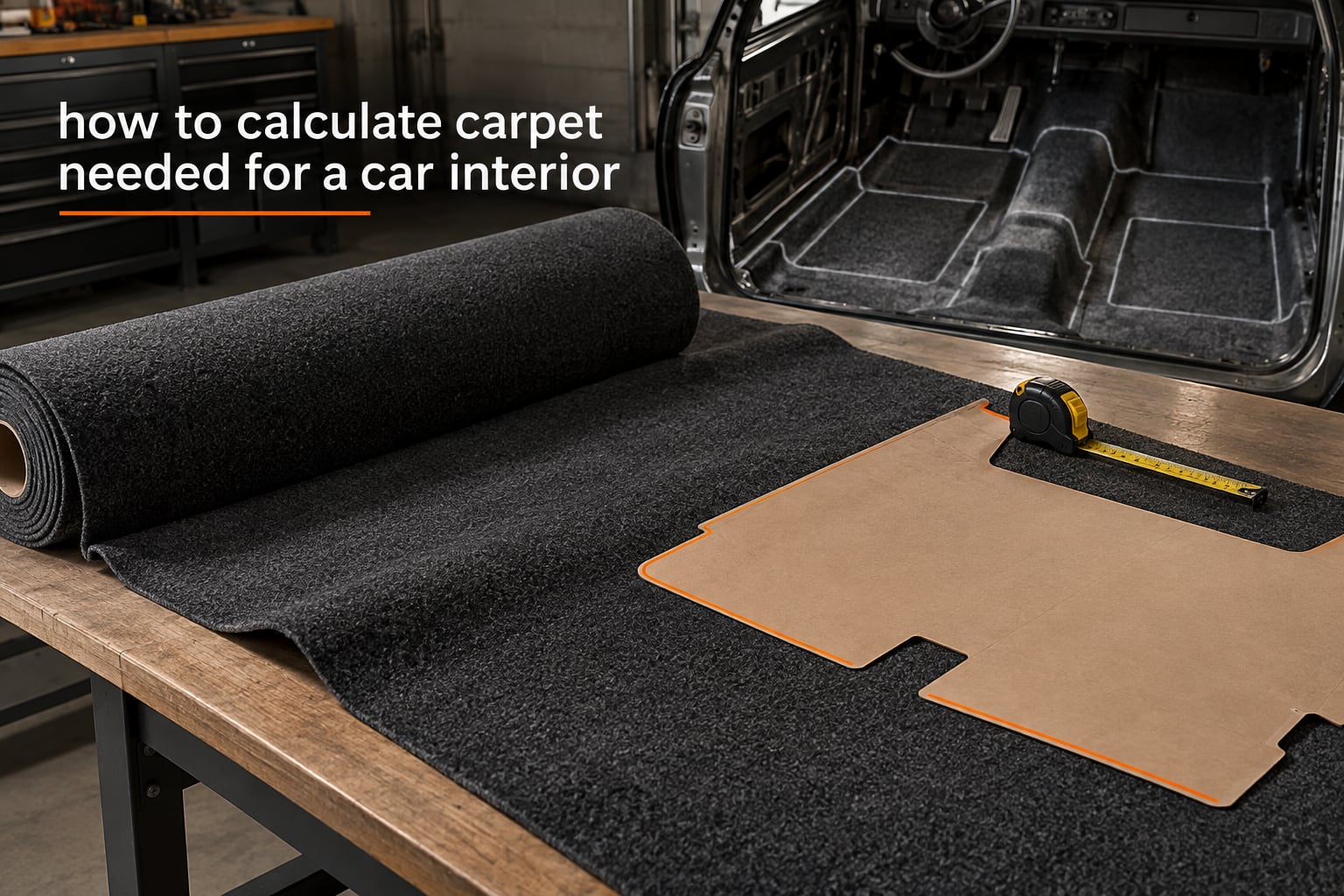
Almost every car carpet question we get starts the same way: someone has pulled up the seats, popped the sill plates, and is staring at a bare floor pan with no idea how much material to order. The tape measure is in one hand and the supplier’s phone number in the other, and the whole job depends on a number that is much simpler to get right than most people expect.
This guide walks through how to calculate carpet needed for a car interior, section by section, with the arithmetic written out so you can reproduce it. We will cover what to measure, how much extra to allow on each part, how to convert square feet into linear yards off a standard roll, and why a pre-molded kit removes the calculation entirely. Updated for 2026, this is the process our shop uses before we cut anything.
Quick Answer: A full car interior needs roughly 30 to 40 square feet of floor carpet, or 3.5 to 4.5 square yards, which works out to about 7 to 9 linear yards of a standard 72 inch automotive roll once you add 15 to 25 percent for cutting and fitting waste. A molded pre-cut kit is already sized to the floor pan and needs no extra material.
That range covers everything from a compact coupe to a full-size sedan cabin plus trunk. The number moves with vehicle size, how much of the interior you are redoing, and whether you count kick panels and door cards as separate pieces. The rest of this guide shows you how to replace a range with your own measurement.
If you only have one damaged section rather than the whole cabin, you can cut the job down to a single piece. A trunk-only replacement on a sedan is usually 10 to 14 square feet, and a single front or rear floor section runs 8 to 12 square feet once the tunnel rise is included.
Table of Contents
- How Do You Calculate the Carpet Needed for a Car Interior?
- What to Measure on Every Car
- How to Convert Square Feet to Linear Yards
- How Much Carpet Does Your Vehicle Actually Need?
- Molded Pre-Cut Kit or Flat Roll: Which One Do You Measure?
- The Template Method: Using Your Old Carpet as a Master Pattern
- Tools and Materials for Measuring and Cutting Car Carpet
- How Heat and Stretch Change the Cut
- Common Mistakes That Ruin a Carpet Job
- Frequently Asked Questions
- How much carpet material do I need for my car?
- How do I measure my car for carpet?
- How to form carpet for a car?
- Is it hard to recarpet a car?
- How hard is it to recarpet a car?
- How much to replace interior carpet in car?
- How much does it cost to put carpet in a car?
- How to cut a car floor mat?
- Is there a moldable carpet available for cars?
- Can I use my old carpet as a template for new carpet?
- How to calculate carpet needed for a room?
- Conclusion
How Do You Calculate the Carpet Needed for a Car Interior?
The calculation has five steps. Strip the interior, measure every carpeted section, multiply and sum, add a waste factor, then convert to linear yards of the roll width you plan to buy.
Step 1: Strip the interior down to bare metal
You cannot measure a floor pan through seat pads and trim, so remove the seats, center console, sill plates, kick panels, door cards, scuff plates, and any seat belt anchor covers. Take photos as you go, because the anchor points and hardware locations are easy to forget once everything is out.
Unscrew the seat rails, note which bolts go where, and unplug or unbolt the shifter and hand brake. Pull the sill plates and kick panels last, since they usually hold the carpet edge down at the door opening.
Step 2: Measure each carpeted section separately
Work in rectangles and trapezoids rather than trying to eyeball one overall figure. Measure the front floor pan at its longest point from the firewall to the front of the rear footwell, and at its widest point from the door sill to the transmission tunnel. Do the same for the rear footwell, the transmission tunnel, the rear riser behind the back seat, the trunk or cargo area, and each kick panel.
Measure height on any surface that rises or drops. The transmission tunnel adds length you would otherwise miss, and the riser behind the rear seat is a wall of carpet that has nothing to do with floor area.
Step 3: Multiply and sum
For each section, multiply length by width in inches, then divide by 144 to get square feet. A 46 inch by 50 inch front footwell is 2,300 square inches, or about 16 square feet once the tunnel side is included. Add every section, and keep a running list as you go so nothing gets counted twice.
Measure everything twice. A tape read in the wrong place on a curved floor pan costs you a second trip, and no supplier is impressed.
Step 4: Add a waste factor of 15 to 25 percent
Flat roll goods always need extra. A 20 percent allowance is the middle of the road and covers pattern shifts, seam placement, trim errors, and the piece you ruin while learning where the shifter hole goes. Sections with a lot of geometry, such as the rear corners behind the seats, deserve more than sections that are plain rectangles.
A molded pre-cut kit needs no waste factor at all, because the pieces are already shaped. That single fact is often what decides which route you take.
Step 5: Convert to linear yards
Automotive carpet is sold by the linear yard off a roll, not by the square yard, so your square foot total has one more division in it. The full arithmetic is in the next section, and it takes about thirty seconds.
What to Measure on Every Car
Most people underestimate the total by measuring only the two floor pans. Here is the full checklist, with the extra allowance we give each section.
| Section | How to measure it | Extra allowance |
|---|---|---|
| Front floor pan | Firewall to front of rear footwell, door sill to tunnel edge | 10 percent |
| Rear footwell | Front edge of rear floor to rear bulkhead, sill to riser | 10 percent |
| Transmission tunnel | Full length front to rear, plus the rise in height on each side | 20 percent |
| Center console area | Length and width of the console footprint, including shifter opening | 15 percent |
| Rear riser | Bulkhead width by the height of the panel behind the seat | 15 percent |
| Kick panels | Each one individually, sill height to top edge, plus the door opening return | 20 percent each |
| Door cards, if carpeted | Full panel length and height, plus the fold-over at the armrest | 20 percent each |
| Trunk or cargo area | Length, width, and both wheel well humps | 15 percent |
| Sill plate areas | Where carpet wraps up under the plate, measured as a return flap | 10 percent |
The rear riser is the most commonly forgotten piece, and it is a real panel of carpet rather than a floor. A sedan riser is typically 50 to 55 inches wide by 12 to 16 inches tall, which is close to 8 square feet on its own.
Do not forget that carpet wraps upward at every sill and door opening. Those returns are small in area but they decide whether the piece has enough material to tuck and staple without a seam.
Tip: Mark the outline of the floor pan on the bare metal with a marker or chalk line before you measure. It gives you a second reading to check against, and it makes the shape obvious when you later transfer the pattern to paper.
How to Convert Square Feet to Linear Yards
Square feet measure area. Linear yards measure length along the roll, and the difference between them is the width of the roll. Automotive carpet is most commonly sold 72 inches wide, which is 6 feet, or 2 yards.
Here is the arithmetic, written out so you can run it yourself:
Square yards = square feet ÷ 9
Linear yards = square yards × (roll width in inches ÷ 36)
With a 72 inch roll, the multiplier is exactly 2, so linear yards is simply your square yardage doubled.
| Total square feet | Square yards | Linear yards from a 72 inch roll |
|---|---|---|
| 20 sq ft | 2.2 sq yd | 4.4 linear yd |
| 25 sq ft | 2.8 sq yd | 5.6 linear yd |
| 30 sq ft | 3.3 sq yd | 6.6 linear yd |
| 35 sq ft | 3.9 sq yd | 7.8 linear yd |
| 40 sq ft | 4.4 sq yd | 8.8 linear yd |
| 45 sq ft | 5.0 sq yd | 10.0 linear yd |
A worked example for a midsize sedan
Say you measure a 4 door sedan and arrive at 34 square feet of bare carpet area across the floor pans, tunnel, riser, kick panels, and trunk. Add 20 percent waste and you get 40.8 square feet. Divide by 9 and you have 4.5 square yards. Multiply by 2 for the 72 inch roll and you get 9 linear yards of material.
Nine linear yards of a 6 foot wide roll is 54 square feet of material on the roll for 34 square feet of floor, which sounds wasteful until you look at how the pieces nest. The main floor piece is cut on the full 6 foot width, the riser and kick panels come out of the leftover strip, and the trunk nests under the tunnel cut. That is exactly why the waste factor exists and why it is not a guess.
When you order, round the linear yardage up to the next purchasable increment rather than down. Nine yards and change is not a figure you can buy, and rounding up costs far less than a second order with mismatched dye lot.
How Much Carpet Does Your Vehicle Actually Need?
Use this table as a sanity check once you have your own measurement. If your number sits far outside the range for your vehicle type, go back and look for a missing section before you order.
| Vehicle type | Typical carpet area | With 20 percent waste | Linear yards from a 72 inch roll |
|---|---|---|---|
| Compact coupe | 22 to 26 sq ft | 26 to 32 sq ft | 6 to 7 |
| Sedan, full interior | 30 to 36 sq ft | 36 to 44 sq ft | 8 to 10 |
| SUV, two row | 40 to 50 sq ft | 48 to 60 sq ft | 11 to 14 |
| Pickup truck, standard cab | 30 to 38 sq ft | 36 to 46 sq ft | 8 to 11 |
| Van or minivan | 50 to 65 sq ft | 60 to 78 sq ft | 14 to 18 |
| Trunk or cargo area only | 10 to 14 sq ft | 12 to 17 sq ft | 3 to 4 |
These are full-interior figures, which means they include the trunk, riser, and kick panels. If you are only replacing the cabin and reusing the trunk, take about 6 to 10 square feet off the total.
Classic and vintage cars tend to sit at the wide end of their class range. Long wheelbases, deep footwells, thick pile, and separate molded floor pans all push the area up, and there is usually no vehicle-specific kit to shortcut the process.
Molded Pre-Cut Kit or Flat Roll: Which One Do You Measure?
This decision comes before the tape measure, because it determines whether you need a calculation at all. A molded pre-cut kit is carpet already formed to the shape of a specific floor pan, complete with cutouts for the shifter, seat mounts, and console. A flat roll is yard goods you cut yourself.
If a kit exists for your year, make, and model, take the kit. There is no measurement, no waste factor, and no math to get wrong, and it is typically the faster path even though the material looks expensive per square foot.
| Factor | Molded pre-cut kit | Flat roll, cut by hand |
|---|---|---|
| Calculation needed | None | Full measure, sum, waste, convert |
| Fit at rear corners | Factory shaped | Depends entirely on your pattern |
| Waste factor | None, though trimming is still common | 15 to 25 percent |
| Color and density match | Matched to the vehicle | You choose from available roll goods |
| Best for | Any car with a kit available | Section repairs, classic cars, odd shapes |
Even with a molded kit, trimming is usually still required. Kits frequently arrive a little oversize in one area, and the pre-cut shifter and seat mount openings are deliberately conservative, so expect to enlarge a hole by a quarter inch to a half inch during fitting.
A flat roll makes more sense when you are replacing one section, when your car has no kit, or when you want a color and pile you cannot get as a kit. It also makes sense for anyone comfortable with a cardboard pattern and a sharp blade.
Warning: Ask the supplier whether the carpet is moldable before you commit. A carpet with a mass-loaded or heavy sound-deadening backing holds a shape badly and fights you every time you try to form it around the tunnel and the rear corners.
The Template Method: Using Your Old Carpet as a Master Pattern
Measuring with a tape gives you numbers. A template gives you a shape, and the shape is what actually has to match. That is why the most reliable method in this whole process is the one that skips measurement almost entirely.
Building a cardboard or paper pattern
Do not cut the new carpet straight from a tape measurement. Make an intermediate template instead, in cardboard or kraft paper, and let it prove out the geometry before you touch expensive material.
Lay the old carpet section flat on your work surface, pattern side up. Place a sheet of cardboard or kraft paper on top and trace the outline with a fine marker. Cut roughly a half inch outside the traced line, because a pattern that is slightly larger than the original is the safe direction to be wrong in.
Now transfer the details. Mark the shifter opening, the seat mount holes, the seat belt anchors, and the door opening returns while you still have the old piece in front of you. Note the fold lines where the carpet turns up at the sills, and cut relief slits at every inside corner so the pattern can open up flat without buckling.
Check the pattern against the car before you cut carpet. Hold it in place, line up the tunnel edge and the door opening, and confirm nothing is short. This ten-minute check is where nearly every beginner saves themselves a ruined piece of material.
Using the old carpet directly as the master template
When the old carpet is still in good shape, skip the cardboard and lay the new material directly on top of it. This is the method long-time restorers use, and it is described in detail in a Turbo Buick forum install thread that has been circulating for years: lay the new carpet over the old one, leave both in the sun until the new piece relaxes and begins to form to the shape underneath, then trim the excess with the old piece as the pattern.
That thread’s author reported the finished fit as excellent, and the same advice appears across classic car forums. Cut a hair larger than the old piece rather than matching it exactly, since a slightly oversize piece can be trimmed back later and a slightly undersize piece cannot be recovered.
The folded half-pattern for one-piece carpet
A one-piece carpet covering the whole floor pan will not lay flat on a table, and that is a real problem when you are trying to trace it. The workaround is a half-pattern: fold the old carpet along the center console line, trace only one side, and then mirror the cut when you lay it on the new material.
Mark the fold line clearly on both the old piece and the new material before you start. The fold is the reference, and losing it halfway through a cut is how symmetric mistakes happen.
Verifying before you commit
Once the carpet is cut, test fit it dry before any adhesive goes down. Sit it in the floor pan, walk on it, and look for tension lines, especially at the rear corners behind the seats, which are the most commonly reported trouble spot on one-piece installations. A carpet that has to be forced will not sit flat once you drive away.
Tools and Materials for Measuring and Cutting Car Carpet
You do not need many tools, but the right ones make the difference between a clean edge and a ragged one.
- Tape measure with a wide blade, so the tape does not sink into a curved floor pan and give you a short reading
- Cardboard or kraft paper for the intermediate template
- Fine marker for tracing, plus a heavier marker for marking the roll and the fold line
- Carpet shears for the long cuts, which are faster and safer than a knife on a long run
- Utility knife with fresh blades for cutouts, the tunnel edge, and final trimming
- Trim removal tool to get sill plates and kick panels off without marring the paint
- Spray adhesive for bonding carpet to pan and to jute or felt padding
- Jute padding or felt underlay under the carpet, cut to the same sections
- Hair dryer for forming the carpet warm
On padding, order it to the same sections as the carpet rather than as one piece. Jute padding that runs continuously across the tunnel buckles when the carpet is formed over it, and you end up chasing a wave you created yourself.
On pile direction, run every piece the same way. Cut-pile carpet has a nap, and sections cut in opposite directions read as two different colors under the same light. Lay the roll out, decide on one direction, and keep it.
How Heat and Stretch Change the Cut
Carpet that arrives folded is stiff, and cold carpet fights you. Heat changes the equation more than any other single factor, which is why so much of the accumulated advice on these forums centers on warmth rather than measurement.
Sit the roll in the sun for a few hours before you cut, or warm it indoors if you do not have sunlight. The material relaxes and re-forms instead of springing back against your blade. For installation, a hair dryer on low heat while you work the material into the tunnel and around the corners is the difference between a carpet that lies flat and one that stays wavy.
Stretch matters too. A cut that is exactly the size of the opening will tighten as the material is worked into place, and a tightened carpet buckles at the seams. Cut about a quarter inch oversize on every dimension and trim to fit once the carpet is warm and stretched into position.
That quarter inch is the same principle as the waste factor in your square foot total, applied at the cutting stage instead. The two allowances stack on purpose, and a job that has both usually fits on the first try.
Common Mistakes That Ruin a Carpet Job
These are the errors we see most often, and all of them are avoidable before the first cut.
- Measuring only the floor pans. The tunnel, riser, trunk, and kick panels together are often a quarter of your total area.
- Cutting tight. A snug cut tightens further as the carpet is formed, and there is no way to add material back.
- Forgetting the trunk. The cargo area is part of the interior carpet on most vehicles and is measured separately.
- Missing the tunnel rise. Measure the height, not just the length, or the piece will not reach over the hump.
- Leaving out cutouts. Mark the shifter, seat mounts, and seat belt anchors while the old piece is still in place.
- Mixing pile directions. Sections cut in opposite directions do not match in color.
- Cutting cold carpet. Stiff material cuts ragged and springs away from the line.
- Skipping the dry fit. Adhesive makes a bad fit permanent. Test first, trim second.
- Ignoring inside corners. Without relief slits, a traced pattern will not open up flat.
- Rounding down on yardage. Round up to the next purchasable increment, every time.
Frequently Asked Questions
How much carpet material do I need for my car?
A full car interior needs roughly 30 to 40 square feet of floor carpet, or 3.5 to 4.5 square yards, which equals about 7 to 9 linear yards from a standard 72 inch roll once you add 15 to 25 percent waste. A trunk-only replacement is 10 to 14 square feet.
How do I measure my car for carpet?
Remove the seats, console, sill plates, kick panels, and door cards first. Then measure the front floor pan, rear footwell, transmission tunnel including its rise, rear riser, trunk, and each kick panel separately. Multiply length by width for each section, divide by 144 for square feet, and sum the total.
How to form carpet for a car?
Warm the carpet before and during fitting. Sit the roll in the sun for a few hours so it relaxes, then use a hair dryer on low while working the material over the transmission tunnel and around the rear corners. Carpet that is worked warm conforms to the floor pan instead of holding waves.
Is it hard to recarpet a car?
The measuring and cutting are straightforward once you have a pattern. The hard parts are the outer corners behind the rear seats on a one-piece carpet, and trimming around the shifter and seat mounts. Budget a full weekend for a sedan cabin and trunk, and expect to redo one cut.
How hard is it to recarpet a car?
It is moderate DIY work rather than advanced. Stripping the interior and making a cardboard template are the easier halves. Fitting and forming the carpet around the tunnel and rear corners takes patience, warmth, and a sharp blade.
How much to replace interior carpet in car?
Measure first, because the material count depends on whether you are doing the whole interior, the cabin only, or a single section. A full interior measures 30 to 40 square feet; a trunk only job measures 10 to 14 square feet; a single floor section runs 8 to 12 square feet.
How much does it cost to put carpet in a car?
Cost tracks the route you take rather than the vehicle. A molded pre-cut kit plus jute padding, adhesive, and trim hardware is one figure, and flat roll goods plus a full day of your own labor is a different one. Get the material number right first, then price the route.
How to cut a car floor mat?
Make a template first. Trace the old mat or the floor pan outline onto cardboard or kraft paper, cut about a half inch outside the line, add relief slits at inside corners, and test fit the pattern in the car. Then cut the new material a quarter inch oversize and trim to fit once it is warm and stretched.
Is there a moldable carpet available for cars?
Yes. Automotive carpet can be warmed and formed to fit floor pan contours, and heat is the tool that makes it work. Check the backing first, since a mass-loaded or heavy sound-deadening backing holds its shape poorly and is harder to form than a lighter cut-pile material.
Can I use my old carpet as a template for new carpet?
Yes, and it is the most reliable method available. Lay the new carpet over the old one, leave both in the sun until the new piece relaxes, then trim the excess using the old piece as the pattern. Cut a hair larger than the original rather than matching it exactly, and a Turbo Buick install thread documents the technique with a successful result.
How to calculate carpet needed for a room?
The rule is the same as for a car. Measure the floor area, multiply length by width for each section, add a 10 to 15 percent waste factor, then divide square feet by 9 for square yards. For a car, use a higher 15 to 25 percent waste figure because of the tunnel, riser, and corner geometry.
Conclusion
Working out how to calculate carpet needed for a car interior comes down to four numbers and one conversion. Measure every carpeted section including the tunnel, riser, and trunk, multiply and sum to get square feet, add 15 to 25 percent for waste, then divide by 9 for square yards and multiply by the roll width over 36 for linear yards.
For most cars that lands somewhere between 30 and 40 square feet, or roughly 7 to 9 linear yards of 72 inch roll goods. Check that against your own measurement and against the vehicle table before you order, and make a cardboard template before you cut anything.
Once you have the number, the next question is whether a molded kit exists for your car. If it does, take it and skip the calculation entirely.