
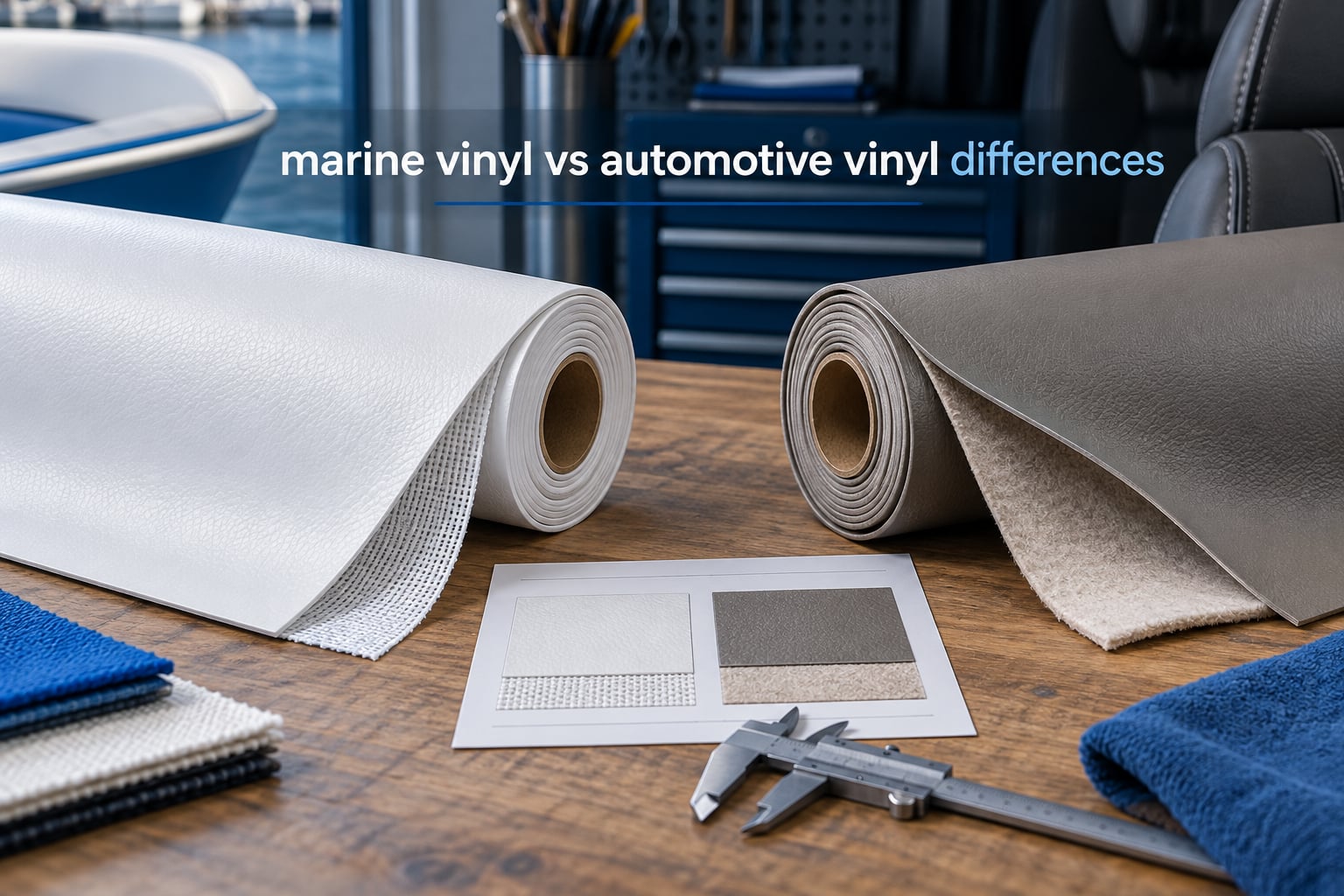
If you have ever had two shops quote wildly different prices to re-cover the same seat, the difference was almost never the labour. It was the vinyl. One quote is normally built around a marine grade upholstery fabric and the other around an automotive vinyl, and the two materials are engineered for completely different jobs.
Marine vinyl is built to survive a cockpit: standing water, salt, mildew and years of direct ultraviolet light. Automotive vinyl is built to survive people: constant getting in and out, clothing abrasion, and a heat cycle inside a closed cabin.
I have pulled spec sheets for both categories side by side for this guide, and I keep coming back to the same conclusion. Neither material is better. They are built for different failures, and choosing the wrong one guarantees a predictable failure of the other kind. Here is the honest breakdown, including the numbers most suppliers leave off their sales sheet.
Table of Contents
- What is the difference between marine vinyl and automotive vinyl?
- What marine grade vinyl actually is
- What automotive vinyl is built to do
- The five specification differences that matter
- Why the backing is the difference you can feel
- Weight, thickness and what sits under the vinyl
- Can you use automotive vinyl on a boat, or marine vinyl in a car?
- How to verify a marine-grade claim before you order
- Recognised brands and where each one sits
- Marine vinyl is not vinyl wrap film
- Cleaning and maintenance differences
- Choosing marine vinyl or automotive vinyl: a buying guide
- Frequently Asked Questions
- What is the difference between marine vinyl and automotive vinyl?
- What does marine grade vinyl mean?
- Is marine vinyl faux leather?
- Is marine vinyl fabric legit?
- What is the best vinyl fabric for car upholstery?
- What is the best marine vinyl fabric for upholstery?
- Does Hobby Lobby sell marine grade vinyl?
- Which is better, marine grade vinyl or leather seating in a Ford Bronco?
- Conclusion
What is the difference between marine vinyl and automotive vinyl?
Marine vinyl is a PVC or polyurethane coated upholstery fabric with UV stabilisers, antimicrobial treatment and a water-resistant polyester or foam backing. Automotive vinyl is a supple PVC upholstery fabric with a cotton-polyester blend backing, built for abrasion against passenger movement rather than for sun, salt and standing water.
That is the whole answer. Everything below it is the detail: how the two differ in UV rating, abrasion rating, backing, weight, cold crack behaviour and cleaning.
Marine vinyl vs automotive vinyl at a glance
| Specification | Marine vinyl | Automotive vinyl |
|---|---|---|
| Face layer | PVC or polyurethane coated, typically 100 percent PVC over a knit or woven substrate | PVC coated, softer hand for in-cabin comfort |
| Backing | Polyester Dacron or expanded foam, little or no cotton | Cotton and polyester blend, sometimes foam |
| UV rating | 500 to 1,500+ hours with stabilisers in the top PVC layer | Rated for cabin light, not open-air sun |
| Abrasion rating | 100,000 to 250,000+ double rubs | Comparable double rub range, tested differently |
| Water | Waterproof backing, water-shedding foam recommended | Not waterproof; cotton content absorbs moisture |
| Mildew | Antimicrobial and mildew inhibitor treatment standard | Not required, not treated as standard |
| Cold crack | Published figures, commonly -10F to -25F | Varies by maker, less often published |
| Typical weight | 20 to 36 oz, 0.5 to 1.5mm thick, 28 to 32 oz is the working sweet spot | Lighter, 15 to 25 oz typical |
| Drape and stretch | Stiffer, holds a shape, harder over compound curves | Supple, more draw, stretches over dashes and pillars |
| Where it belongs | Boat seats, helm chairs, sun pads, marine headliners | Car seats, door cards, dashes, pillar covers, roof linings |
Read that table once more and the pattern is clear. Marine vinyl spends its durability budget on the environment. Automotive vinyl spends it on the occupants.
What marine grade vinyl actually is
Marine grade vinyl is a coated upholstery fabric whose top PVC layer carries additives designed for outdoor exposure: UV inhibitors and stabilisers that slow fading and brittleness, plus mildew and antimicrobial treatment. The backing is polyester Dacron, expanded foam, or a combination, chosen because it does not hold water the way cotton does.
That last point is the one people miss. A cotton-rich backing is a liability on a boat, because a saturated cushion takes days to dry, develops odour and eventually breaks down the foam underneath. That is precisely why automotive vinyl, which relies on cotton for suppleness, is a poor choice for an open cockpit.
Is it faux leather? In the way most people use the term, yes. It is a synthetic coated fabric that imitates leather, and it is not a natural material. But the useful comparison is not leather versus vinyl. It is marine vinyl versus automotive vinyl, because those are two different synthetic products that people routinely mistake for each other.
Typical marine material runs 0.5 to 1.5mm thick and 20 to 36 oz, with 28 to 32 oz landing in the range most installers pick for seat work. A widely sold premium product is quoted at 0.95mm and 250,000+ double rubs, and installers who work with it regularly put a serviceable life of 7 to 10 years on a well-kept boat with sensible cover discipline.
One more practical note: adhesive matters. Marine vinyl bonds reliably with a vinyl cement such as HH-66, while a general-purpose contact adhesive can creep or fail to grab a polyurethane-coated face. Ask your upholsterer which adhesive they plan to use.
What automotive vinyl is built to do
Automotive vinyl answers a different problem. A car seat takes a moving load of one to two people, day after day, with jeans hardware, zips, belt buckles and pet claws dragging across the grain. The automotive formulator spends the formulation effort there, which is why the surface coatings and backings are tuned for suppleness and drape instead of for sun and salt.
The backing on automotive vinyl is usually a blend of cotton and polyester. Cotton gives the material its soft hand and its stretch. Polyester holds the dimension. That blend is exactly what makes automotive vinyl the better material for a dashboard, a pillar cover or a door card, where the material has to pull around compound curves and form panels without wrinkling. Vinyl has more draw than leather, and trimmers rely on that.
Automotive vinyl also arrives in OEM colours and patterns, so a restorer can match an original interior that a marine catalogue simply does not stock. The trade-off is that the material is not formulated for the two things a boat exposes it to hardest.
As one trim publication put it plainly: automotive vinyl is made to take a lot of movement from the occupants, while marine vinyl is formulated to deal with UV exposure. That sentence is the shortest accurate summary of the entire subject.
The five specification differences that matter
1. UV resistance, measured in hours
Marine vinyl carries UV inhibitors and stabilisers in the top PVC layer. Published figures across the marine range run from 500 to 1,500+ hours, and a common mid-to-premium spec sheet states 1,000 hours. Automotive vinyl is not sold on an equivalent open-air figure, because it is not engineered for a windscreen-free seat in August.
Here is the translation that matters. A 500-hour rating works out to roughly 120 hours per month if the seat takes 4 hours of direct exposure every day through summer. A boat moored in full sun can burn through a lower-rated vinyl in a couple of seasons. Bright reds, oranges and pinks show sun damage faster than neutrals, which is worth remembering if you are choosing a colour.
Owners confirm this in practice. A poster on a boating forum described two years of use on a covered boat with no evidence of fading or cracking, which is the outcome the additive package is designed to produce.
2. Abrasion, measured in double rubs
The double rub count is a laboratory test where a fabric is rubbed back and forth under a defined load. Marine vinyl on the market commonly runs 100,000 to 250,000+ double rubs, and a common premium spec sheet states 175,000+ with 35 lb seam strength. The figure matters most where there is friction: sun pads, cockpit seats, door cards and the step edges people scuff with their boots.
Here is the trap. A double rub number on a marine sheet and a double rub number on an automotive sheet are not always the same test. The industry has also used a cotton-abrasion test for some marine materials. If you are comparing two spec sheets and the test method is not stated on either, the numbers are not comparable and neither is the conclusion you would draw from them.
3. Water resistance and the backing
Marine vinyl has little or no cotton in the backing because the material is likely to get wet. The backing is waterproof, and the cushion beneath it should be a high-density foam chosen for shedding water and holding its shape. Automotive vinyl, with its cotton content, will absorb moisture, and a soaked cushion is where odour and foam failure begin.
4. Mildew and antimicrobial treatment
Antimicrobial and mildew inhibitor treatment is standard in marine vinyl and effectively absent from automotive vinyl. A cockpit seat that stays damp for hours is the exact scenario the treatment addresses. Owners on a restoration forum noted that generic fabric-shop vinyl on a boat cracked and was falling apart within two years, while the marine-grade material on another build held up.
5. Cold crack and temperature extremes
Cold crack is the temperature at which a coated material becomes brittle and starts to fracture, and it is the specification most often missing from a sales sheet. Published marine figures commonly sit between -10F and -25F, with one widely shared premium spec sheet at -10F and a Morbern Seabrook figure quoted at -25F. Impressively low numbers are good news; a missing number means you do not know.
Why the backing is the difference you can feel
Backing construction is where the two categories diverge most visibly, and it is the easiest way to tell what you are holding. Automotive vinyl is usually a cotton and polyester blend, which feels softer and more pliable. Marine vinyl uses polyester Dacron or expanded foam, because cotton would hold water and go soft in a wet cockpit.
There is a fast identification test that works on any offcut. Turn the material over. A white woven or knit backing indicates vinyl. A fibrous, suede-like backing indicates leather. That single look tells you which world you are in, before any sales conversation happens.
Finish is the second clue. Marine material is often supplied in a shine-free or matte finish because a gloss surface in full sun is uncomfortable and a glare problem. Automotive vinyl is more often finished to match an interior, and it will look shinier by design. Gloss is not a quality signal either way.
Backing type also explains a comparison people find confusing online. One upholsterer recommended the marine vinyl carried at a general fabric retailer, noting that the other material with the more expanded backing is not as good and will not hold up as long. Expanded foam backing is common in cheaper products on both sides, and it is a legitimate reason for two materials at similar weight to behave very differently in service.
Weight, thickness and what sits under the vinyl
Marine vinyl typically runs 20 to 36 oz and 0.5 to 1.5mm, with 28 to 32 oz a common choice for seats. Thickness alone does not make a material marine grade, but it does track with durability within a category.
Read the unit carefully when you compare two spec sheets. The premium sheet in common circulation lists 32 oz per linear yard at 54 inches of width, while the Seabrook figure is quoted as 20.5 oz. Those are different units and different products, and treating them as a direct comparison is the most common mistake made when people try to rank marine vinyl online.
Then look below the vinyl. Boat owners on a hull forum pointed out that there are big differences in foams, with some shedding water and holding shape while others break down and hold water forever, and that the foam substrate is a bigger durability factor than the vinyl itself. An upholstery job is a system, and the material you can touch is only the top layer.
Can you use automotive vinyl on a boat, or marine vinyl in a car?
Both are possible. Neither is a free upgrade, and here is the honest verdict on each.
Marine vinyl in a car is the safer swap of the two. You gain the UV package, the antimicrobial treatment and a waterproof backing, which matters enormously in an open-top truck, a convertible or a boat-themed build. What you give up is suppleness. Marine vinyl is stiffer, it is less breathable in a hot cabin, and it is harder to pull over a complex dashboard or pillar shape. On a project where the shape work matters more than the sun, auto vinyl remains the better material. Marine vinyl is worth the extra cost in a vehicle mainly when the vehicle is open to the sky or parked outdoors in full sun.
Automotive vinyl on a boat is the riskier swap. It will look excellent and drape beautifully, and it will be the wrong choice if the seat lives in an open cockpit. The cotton in the backing absorbs water, there is no UV package sized for direct exposure, and there is no mildew treatment. Expect fading, drying out and cracking, plus waterlogged foam behind the cushion, within a few seasons.
There is one marine application where automotive vinyl is genuinely reasonable: an enclosed helm, a hardtop cabin or an interior liner that never sees direct sun or spray. Under those conditions you are closer to a car interior than to a cockpit, and the supple backing is an advantage.
A recurring owner point applies to both directions: workmanship matters more than the material label. The same people who argue hardest about brand also state plainly that the labour is where all the money is. A better vinyl installed badly will fail sooner than a mid-grade vinyl installed properly.
How to verify a marine-grade claim before you order
The word marine grade is used loosely, including by some vehicle manufacturers, where it can describe stitch and seam construction that keeps water out rather than any difference in the material chemistry. There is a counter-view worth hearing: on some vehicles the term refers mainly to how the seams are built rather than to what the topcoat contains. That is not marketing nonsense, but it does mean the label alone proves nothing.
Ask for four numbers before you commit:
- UV resistance in hours. A specific figure, not the phrase UV resistant. If the seller cannot name the number, the material is not spec’d.
- Double rub count and the test method. 100,000 is entry, 175,000 is solid mid-range, 250,000+ is premium. Know which test produced it.
- Cold crack rating. You want a temperature, typically between -10F and -25F. Silence here is a warning.
- Flame rating. FMVSS 302 for automotive interiors, ASTM E84 or IMO A.652 for marine applications. Recognised brand names such as Naugahyde, Morbern, SeaQuest, Sunbrella Horizon and Sergeants publish these figures; unknown marketplace listings generally do not.
Two supporting habits. Ask for a free physical sample from the supplier and handle it before ordering, which experienced buyers treat as the only reliable way to choose. And if the quote is for a boat, ask what adhesive is being used and what foam goes underneath, because those two answers tell you more about the life of the job than the vinyl brand does.
Recognised brands and where each one sits
Names come up constantly in owner discussions, and they cluster in predictable groups.
| Brand | Primary orientation | Typical positioning |
|---|---|---|
| Naugahyde | Both | Long-established marine and automotive name, widely specified by OEMs and repair shops |
| Morbern | Both, marine-leaning | Seabrook and related patterns commonly quoted with published cold crack and weight figures |
| SeaQuest | Marine | Frequently named first in owner spec-sheet comparisons |
| Sunbrella Horizon | Marine | Positioned alongside the coated vinyl range for boat interiors |
| Sergeants | Both | Frequently recommended in owner threads for marine work |
Owner consensus is blunt: buy the better, thicker, properly backed material and it will last, while unbranded marketplace listings attract complaints about cracking and peeling inside two years. That feedback cost someone a full reupholstery job and hours of labour, which is the real argument for a named brand.
One more warranty detail that experienced buyers value: defective fabric has been replaced under warranty by its supplier. A published warranty is worth more to you than any adjective on a listing.
Marine vinyl is not vinyl wrap film
Boat owners posting on wrapping forums often ask whether automotive film will work on a hull with an edge sealer added, and the answer requires a category correction. Vinyl wrap film is a thin cast calendared film made to stretch over paint and take a crease. Upholstery vinyl is a heavy coated fabric made to be sewn, stapled and stretched over foam. They share a colour palette and almost nothing else. The confusion costs people money because a film quote and an upholstery quote are not comparable.
Cleaning and maintenance differences
Both materials clean well, and both punish the same mistakes. Mild soap and water is the safe routine for either. Avoid bleach, solvents and oil-based cleaners, which strip the topcoat and dull the finish permanently.
Marine vinyl is where maintenance discipline pays the most. Rinse salt off rather than letting it sit, dry cushions before re-covering them, and use a marine vinyl protectant to keep the topcoat supple. Let water into the seams and the foam underneath will waterlog, hold odour and lose its shape, and no amount of surface cleaning fixes that from underneath.
Automotive vinyl needs less. Interior dust, crumbs and a damp wipe take care of most of it. The real risk in a vehicle is heat rather than water, and light colours in a parked cabin get hot enough to be uncomfortable on contact.
Choosing marine vinyl or automotive vinyl: a buying guide
Pick by exposure, then by fit, then by price. In practice that means answering four questions in order.
Where does the material live? Open cockpit, helm seat, sun pad or any saltwater application means marine vinyl, no exceptions. A closed cabin, dash, door card or pillar means automotive vinyl. An enclosed helm on a boat is the grey zone, and it usually goes either way depending on whether the seat gets direct sun.
How much sun does it take? Multiply the exposure in hours by how bright the colour is. Light neutrals hide fade better than bright reds, oranges and pinks, which show sun damage fastest. A low UV-hour rating in a direct-sun spot is a false economy, because the labour is the expensive part.
How complex is the shape? Compound curves on a dash, pod or pillar suit supple automotive vinyl. Flat panels, box cushions, bolsters and sun pads suit marine vinyl, which holds a shape and resists the memory that makes auto vinyl look tired after years of folding.
What is going underneath? Specify high-density foam that sheds water and holds shape for a boat. This is the layer that decides whether a seat still looks right in year five, and it is the one most often overlooked.
Finally, ask for samples and ask for the numbers. Our rule at the trim shop is simple: if the supplier cannot tell you the UV hours, the double rub count and the cold crack rating, we are not buying the material. And because labour dominates the total cost of any of these jobs, the correct move is to spend the material budget where the environment attacks hardest, and to keep the supple material for the shapes that need it.
Frequently Asked Questions
What is the difference between marine vinyl and automotive vinyl?
Marine vinyl is a PVC or polyurethane coated upholstery fabric with UV stabilisers, antimicrobial treatment and a water-resistant polyester or foam backing, built for sun, salt and standing water. Automotive vinyl is a supple coated fabric with a cotton-polyester blend backing, built for abrasion against occupant movement and for draping over complex trim shapes.
What does marine grade vinyl mean?
It means the top PVC layer carries UV inhibitors and stabilisers, the backing is waterproof polyester or foam with little or no cotton, and the material is treated against mildew and antimicrobial growth. Published marine specs commonly show 500 to 1,500+ UV hours and 100,000 to 250,000+ double rubs.
Is marine vinyl faux leather?
Yes, in the everyday sense. It is a synthetic coated fabric that imitates the look and feel of leather rather than a natural hide. The more useful comparison for a trimmer is marine vinyl against automotive vinyl, since those are two different engineered products that are routinely confused for one another.
Is marine vinyl fabric legit?
It is a real, long-established material category, not an invented label. Additives are put into the top PVC layer to resist UV, mildew and general wear, and long-running owner reports show two years with no fading or cracking on a covered boat. Verify it by asking for UV hours, double rub count and cold crack rating.
What is the best vinyl fabric for car upholstery?
For a closed interior, a supple automotive vinyl with a cotton and polyester blend backing is the right answer because it takes occupant movement and pulls cleanly over dashes, pods and pillar covers. For an open-top or a vehicle parked in full sun, marine vinyl is the better choice for its UV package and waterproof backing.
What is the best marine vinyl fabric for upholstery?
Look for 28 to 32 oz, 0.5 to 1.5mm thickness, 175,000 double rubs or better, a published cold crack rating, and 1,000 UV hours or more. Recognised names such as SeaQuest, Morbern, Naugahyde, Sunbrella Horizon and Sergeants publish these figures. Always handle a free physical sample before committing.
Does Hobby Lobby sell marine grade vinyl?
A general fabric retailer may stock a marine-labelled vinyl, and owner reports suggest the marine-grade product there works well. What you still need to check before buying is the specification: UV hours, double rub count, cold crack rating, flame rating and the backing type. A retailer label alone does not tell you any of those things.
Which is better, marine grade vinyl or leather seating in a Ford Bronco?
Marine grade vinyl wins for an open-air Bronco because the UV package, antimicrobial treatment and waterproof backing handle sun and water that leather will not. The trade-off is that it is stiffer and less breathable, so a hot cabin in dark colours can get uncomfortable. Genuine leather wins on feel and on matching a factory interior.
Conclusion
The marine vinyl vs automotive vinyl question comes down to where the material will spend its life. Marine vinyl carries UV inhibitors, antimicrobial treatment, a waterproof backing and published cold crack figures, which makes it the correct answer for a boat cockpit, a helm seat or an open-top vehicle. Automotive vinyl carries a cotton-polyester backing tuned for suppleness and occupant abrasion, which makes it the correct answer for a dashboard, a door card and any closed, low-sun interior.
Ask for the numbers before you buy: UV hours, double rub count, cold crack rating and flame rating, plus the foam and adhesive going underneath. Match the material to the exposure, spend the material budget where the sun and salt are, and you will get years of service out of either one.