
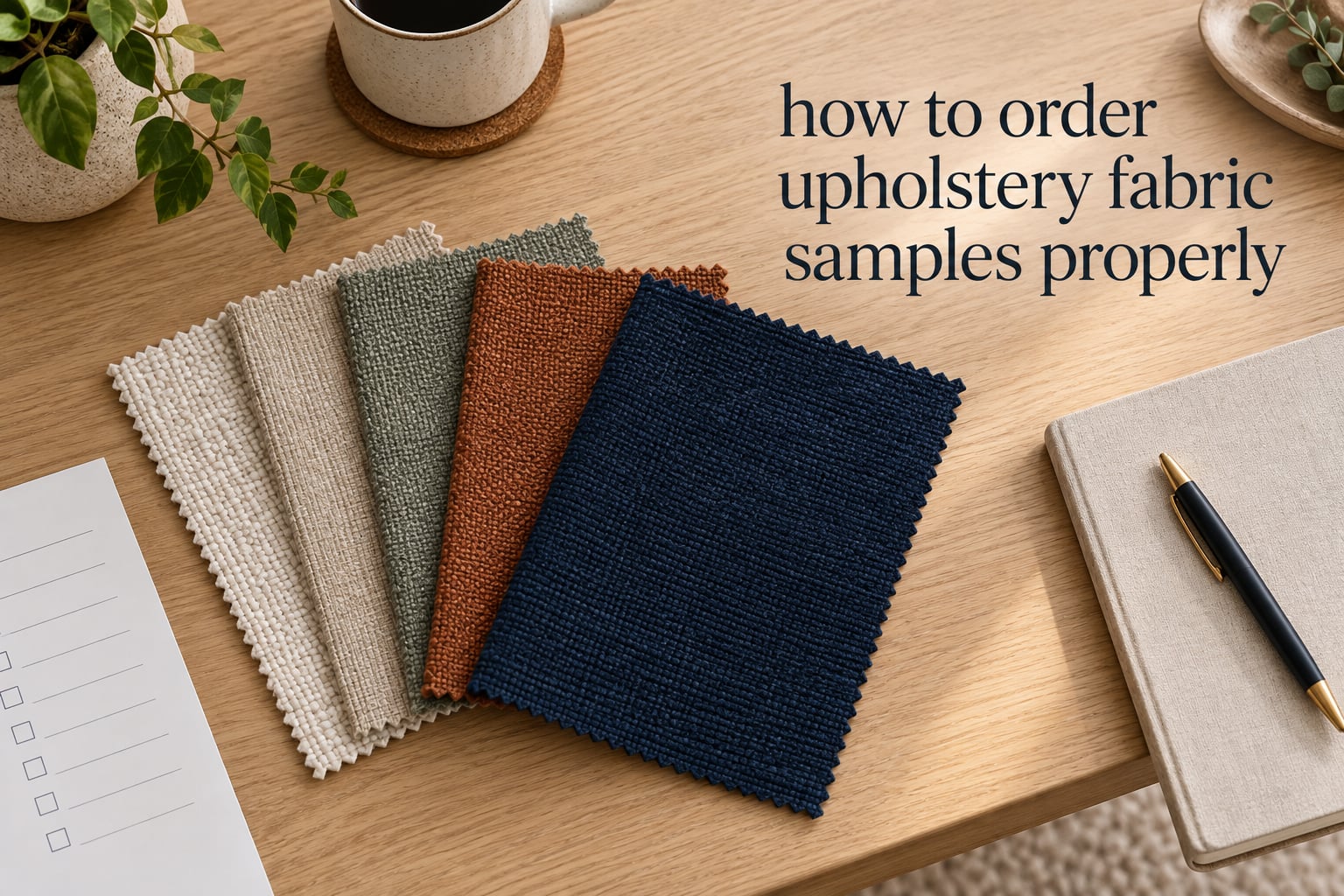
Most people order upholstery fabric samples backwards. They tap a color on a screen, buy three or four swatches, and then discover in their own living room that the fabric reads pink under warm light and dusty under cool light. The cloth feels stiff, the pattern scale is enormous, and the pile runs the wrong way across a curved seat cushion. Now they have a stack of swatches and no idea how to turn them into a decision.
Ordering upholstery fabric samples properly is a process, not a shopping trip. You narrow the field before you spend anything, you pick a sample size that can actually answer your question, you record the details that let you re-order the exact same cloth later, and you test the swatch under the light it will live in. This guide walks that process end to end, including the automotive and marine angles that furniture-only sampling guides leave out.
One note before we start: no small swatch can tell you how a fabric drapes over eighteen inches of armrest. Sample first, decide quickly, and buy yardage only after a swatch has passed in your room. That single habit is the difference between a five-minute order and a four-week do-over.
Table of Contents
- How Do I Order Upholstery Fabric Samples? The 7-Step Process
- What Upholstery Fabric Samples Can and Cannot Tell You
- How to Choose the Right Sample Size for Your Project
- How Many Samples Should You Order?
- Where to Order Upholstery Fabric Samples
- Free vs Paid Samples: Where to Get Each
- How to Read a Fabric Spec Sheet Before You Order
- How to Order Leather, Vinyl, and Faux Leather Samples
- How to Order Samples for Vehicle, Boat, and RV Interiors
- How to Evaluate a Sample Once It Arrives
- What to Do When a Sample Arrives and Fails Your Test
- Sending Samples to Your Upholsterer or Workroom
- Frequently Asked Questions
- Where can I get upholstery fabric samples?
- Where can I get fabric samples for free?
- How much do fabric swatches cost?
- How big are fabric samples usually?
- Do fabric sample colors match the real fabric?
- Can I order fabric samples before buying yardage?
- How long do upholstery fabric samples take to arrive?
- What to do with upholstery fabric samples?
- How many upholstery fabric samples should I order?
- Conclusion
How Do I Order Upholstery Fabric Samples? The 7-Step Process
Here is the short answer: order upholstery fabric samples by identifying the fabric by name and number, choosing the sample size that matches what you need to judge, ordering through the vendor site, a mill account, or a showroom, then evaluating the swatch in your own light before buying yardage. The numbered version below is what most people actually need.
- List your project in writing first. Note the furniture piece, the room, the light conditions, who will use it, and what has to be cleaned. Pet owners, families, and anyone with a sunny window should write their constraints down before they open a single fabric site.
- Shortlist to five or six fabrics by name and number. Do not order everything you like. Every sample you take creates a decision you have to make later, so narrow by color family, fiber, and construction before you spend.
- Pick the sample size that answers your question. A small square handles color. A large cut handles texture, scale, and pattern repeat. A memo set handles colorway exploration across a whole collection.
- Order through a channel that gives you a fabric number. Vendor websites, mill accounts, and showroom sample desks all work. The fabric number and colorway code are what let you re-order the identical cloth weeks later.
- Record the details at the moment you order. Fabric name, fabric number, colorway, width, pattern repeat, and whether the fabric is railroaded. Add the date and your dye lot if the vendor lists one.
- Test the swatch in the room, in real light. Hold it flat, then drape it over the arm. Look at it in the morning and again in the evening. The top-voted advice on r/furniturerestoration is simply to decide in your own space rather than under showroom lighting.
- Make an audition piece, then commit. A widely shared habit among r/upholstery regulars: cut one small test piece from your leading candidate and use it on a real cushion or a scrap frame before you buy the full yardage.
What Upholstery Fabric Samples Can and Cannot Tell You
A swatch is a small cut of the actual upholstery cloth, usually sold as a 4 inch square, a 6 inch square, a 13 inch square, or a full pattern repeat. It is a real piece of the goods, not a rendering, which is the whole point.
What a sample answers well
- Color under your specific light, which is the single biggest reason people sample at all.
- Hand and texture: crisp, soft, slubby, brushed, pebbled, or slick.
- Sheen and luster, and how a velvet or chenille behaves when you change the angle.
- Pattern scale, once the cut is large enough to show more than one repeat.
- Backing and stability, including whether the cloth is knit, woven, coated, or non-woven.
What a sample cannot answer
- Drape over a large surface. A 4 inch square is telling you nothing about how eighteen inches of fabric falls over an arm.
- Durability in use. A swatch tells you nothing about a decade of seat cushions.
- Color after cleaning, or color after a summer in direct sun.
- Exact match to an existing piece. Nobody dyes two rolls identically.
Say the limitation out loud before you buy, because it is the part people forget. A 4 inch solid swatch is a color chip. It is not a texture sample and it is not a drape sample. We have seen buyers lose a month because they expected a postage-stamp square to answer a question only a 13 inch cutting could answer.
How to Choose the Right Sample Size for Your Project
Most people order the smallest available cut because it is the fastest and cheapest option, then wonder why the fabric looks wrong on the furniture. Match the size to the question you are asking instead.
| Sample size | Typical use | What it can show you | What it cannot show you |
|---|---|---|---|
| 4 inch square | Solid fabrics, first-pass color screening | Color family, tone, brightness in daylight | Texture scale, repeat, drape, pile direction |
| 6 inch square | Standard residential reupholstery, dining chairs | Hand, weave visibility, a partial repeat | Full pattern scale, how a print reads across a seat |
| Full repeat | Large-scale prints, wallpaper-type patterns, statement sofas | The complete motif and true pattern scale | Drape over deep curvature |
| 13 inch square | Finalists, audition pieces, client presentations | Scale, drape, texture, and enough cloth to build a test cushion | Nothing major, which is why it is the final-stage size |
| Memo set | Exploring an entire collection of colorways at once | The full palette of one pattern in a single order | Drape and hand, because every piece is the same modest size |
Kovi Fabrics lets you choose between a 6 inch square and a full repeat at order time, which is a good pattern to copy. Revolution Fabrics takes the opposite approach and sells a memo set with a 13 inch square of every colorway in a pattern, so you can see the whole collection in one shipment.
A practical rule: screen with the small size, then re-order your two finalists in the larger size before you commit. You are not double-paying for nothing, because the second cut is the one you actually test on furniture.
How Many Samples Should You Order?
Order between four and eight samples for a single furniture piece. Fewer than four and you are choosing blind. More than eight and you will stall out because every new swatch reopens a decision you already made. This is the most-asked question in upholstery forums, and the honest answer is that the number matters less than the shortlist behind it.
| Project | Samples to order | Why that number |
|---|---|---|
| One accent chair or dining chair | 3 to 4 | A single silhouette shows scale and drape quickly |
| Dining set or two chairs | 4 to 5 | Add one darker neutral as a fallback |
| Sofa or sectional | 5 to 8 | Large surface area, so color and pattern scale both have to work |
| Headboard and ottoman pair | 4 to 6 | Two pieces plus a wall behind them means contrast matters |
| Full room, multiple pieces | 6 to 10 | Coordinate across everything, plus one safe neutral |
| Vehicle seat, door panel, or boat interior | 2 to 4 | The cabin is a small, bright, UV-exposed space, so fewer options are easier to judge |
Notice the last column. The right method is not a bigger order, it is a better shortlist. Write down your three constraints, for example warm neutral, wool blend, thirty thousand double rubs or better, and then choose fabrics that already satisfy them.
Sort every swatch you receive from light to dark as they arrive. That simple habit, shared widely on r/crafts and r/sewing, turns a scattered pile into a comparison instead of a heap.
Where to Order Upholstery Fabric Samples
You have four main channels, and each one gives you a different kind of information. The channel determines how precisely you can re-order the same cloth later, so pick based on how much detail you need.
| Channel | Best for | What you get | Watch for |
|---|---|---|---|
| Retailer or vendor website | Most home projects | A cut with a fabric number, colorway code, and a repeatable order page | Confirm the cut size and whether the swatch fee is credited toward yardage |
| Mill or direct supplier | Trade work, large yardage, unusual widths | Full spec data, dye lot information, and the exact roll you will receive | Often a deposit rather than a purchase, and lead time runs longer |
| Trade or designer program | Workrooms, designers, repeat work | Account pricing, memo samples on a flat fee, and a named contact | Requires enrollment and a business identification |
| Showroom sample desk | Immediate decisions, in-person handoff | Real cloth you can hold, often same-day to take home | Some shops expect you to buy their materials if you sit and sample in their space |
| Marketplace listings | Hard-to-find discontinued patterns | Low cost per swatch, sometimes a whole box | Condition varies, and the seller may not know the dye lot |
The showroom gatekeeping problem is real and worth naming. Users on design forums describe walking into a shop, handling their samples, and then being expected to buy foam from that same shop. Ask up front for the swatch and offer to buy the yardage through them. Shops that have sample desks are usually happy to hand over a cut when you are direct about it.
Free vs Paid Samples: Where to Get Each
Free samples exist, but they come with conditions. Paid samples exist everywhere and they come with far fewer strings. Knowing which one you are dealing with prevents most of the disappointment.
Where free samples show up
- Mill and manufacturer programs that offer a free cut mailed through the postal service, often limited to solid fabrics and small squares.
- Trade programs that credit memo samples against a flat handling fee once you have an account.
- Showrooms, where handling a sample in person is free even though the cut is not free to take home.
- Promotional campaigns, which arrive as unexpected single swatches with no ordering record.
One verified vendor mails free solid samples through the postal service, and their solid fabric samples are a 4 inch square. That is a useful test of what a free program actually gives you: enough for color, not enough for texture.
When a paid sample is worth it
Paid samples are worth it whenever you are choosing an expensive print, anything with pile, or anything going on a large surface. A few dollars buys you a bigger cut, a documented fabric number, and a supplier who knows the goods. Sunbrella charges a flat per-sample fee with no extra charge for delivery, which is a reasonable benchmark to compare other programs against.
Ask one question every time: is the sample fee credited against a yardage order? Many are. If yours is, sampling is effectively free in the only scenario that matters, the one where you go on to buy the fabric.
How to Read a Fabric Spec Sheet Before You Order
The spec sheet tells you things a swatch never will. Read it before you order, not after you have already committed emotionally to a color.
| Spec term | What it means | What to look for |
|---|---|---|
| Double rubs (Wyzenbeek) | How many back-and-forth abrasion cycles the fabric survives before a thread breaks | Thirty thousand or more for everyday residential seating; forty thousand or more for family rooms, rentals, pets, or kids |
| Cleaning code | Which cleaning method the surface tolerates | W for water-based cleaner, WS for water or solvent, S for solvent only. A dining chair should never require a solvent-only fabric |
| Pattern repeat | Vertical and horizontal distance of the motif | The bigger the repeat, the more yardage and the harder the match across a cushion |
| Railroaded | Whether the pattern is designed to run horizontally across the furniture | Railroaded goods can change your yardage and eliminate matching entirely on wide pieces |
| Fabric width | The cut width of the roll, commonly 54 inches | A standard three-cushion sofa at 54 inch width takes roughly fourteen to eighteen yards |
| Solution-dyed fiber | Color added to the fiber before it is woven | Strong fade and bleach resistance, which matters for sunrooms, vehicles, and rentals |
| Pile direction | The direction the nap runs | Velvet, chenille, and mohair read differently when reversed, so cut every piece the same way |
Two of those rows change how you sample, not just how you buy. A railroaded fabric wastes far less yardage, and a solution-dyed fabric will not fade the way a surface-dyed one does, so your color decision is more durable than you think.
Leave a ten percent overage in any yardage estimate you pass along. Workroom and calculator estimates commonly include it, and it absorbs pattern matching across a seat and back.
How to Order Leather, Vinyl, and Faux Leather Samples
Non-cloth materials are sampled differently because the questions are different. A leather swatch is not judged on color alone, it is judged on grade, and a vinyl swatch is judged on how it handles a fingernail.
Ask for a hide grade, not just a color name. Leather swatch packets often include several grades side by side so you can see how the same dye looks on a full grain surface and on a corrected one. If a supplier sends only one cut, ask which grade it is and how thick it is at that point, because two hides with the same color name can sit at noticeably different thicknesses.
For vinyl and faux leather, specify the backing and the coating. Marine-grade and automotive-grade vinyl differ from upholstery-grade vinyl in UV stability, and a coated fabric with a textile backing behaves differently from a solid vinyl. If a car or boat is involved, say so at order time rather than at installation time.
Check scratch resistance with a fingernail and a key in front of the seller or over the phone. Check color fastness by rubbing the swatch vigorously with a dry cloth and looking for dye transfer. Both tests take ten seconds and both prevent an expensive return.
How to Order Samples for Vehicle, Boat, and RV Interiors
Automotive interiors are the harshest upholstery environment most people will ever put cloth into. Direct sun through a windshield, heat cycling, UV exposure, constant flexing at seams, and cleaning with products nobody tested for the surface. Sample like the environment is hostile, because it is.
- Order two to four swatches only. A cabin is a small, bright space. Fewer options are easier to judge under a windshield than a wall of twenty on a work table.
- Read for UV and stain performance, not just rub count. A performance vinyl or a solution-dyed textile will outlast a beautiful cotton blend in a parked car every time.
- Test in the vehicle, not in the driveway. Hold the swatch against the existing interior, then leave it on the dash through a full day of sun before you commit.
- Ask for matching materials across panels. Seat, door panel, and headliner often use different textiles with a coordinated color. A vinyl swatch tells you the color, but a textile swatch tells you the wear story.
- Confirm the supplier can match a previous job. If you are redoing one panel and keeping the rest, give the trimmer the original material number and the vendor the swatch.
The same rules apply to boat and RV interiors, with one addition: saltwater and UV together are harder on fabric than either one alone. A swatch left on a dock for a week tells you more than a week of specification reading.
How to Evaluate a Sample Once It Arrives
Unboxing is not the evaluation. Here is the sequence that gets you a real answer.
- Check condition first. A crushed, creased, or permanently folded swatch has already lost information. Photograph any damage before you contact the supplier.
- Look at it flat, in indirect daylight, away from a white wall. A swatch held against a bright wall reads lighter than it is.
- Look at it again in the room at the hours you actually use that room. Morning light and lamplight at night are the two extremes, and most color arguments happen in one of them.
- Hold it vertically, then drape it. Vertical shows the true color. Draped over the arm shows the sheen, the scale, and the way it falls.
- Run your hand across the pile one way, then the other. Velvet, chenille, and mohair change appearance when reversed. That is pile direction, and it has to be cut consistently.
- Match the pattern. Lay the swatch against the existing piece if this is a repair and note that exact matching across dye lots is not realistic.
- Check the fabric number against the spec sheet before you fall in love with it. That is the number your upholsterer will quote.
Test for cleaning before you commit, using a method appropriate to the cleaning code. A spot clean on a scrap corner tells you more about bleach tolerance and dye bleed than any photograph. Put the swatch on the candidate cushion, live with it for a week, and decide then.
What to Do When a Sample Arrives and Fails Your Test
Sometimes the swatch is wrong. Not the fabric, the sample. Here is the order I would work through it, and it has solved most of the complaints that show up in upholstery forums.
- The color is not what you expected. Ask whether the swatch and the roll share a dye lot, and ask for a photograph of the current roll next to a light source. Screen color is unreliable. A vendor who answers that question with a real photo is one you can order yardage from.
- The sample is too small to judge. Request the next size up before you decide. Nearly every supplier offers a 6 inch square, a 13 inch square, or a full repeat, and many will send a second cut once you explain what you are trying to see.
- The wrong item arrived. Send a photo of the swatch with a ruler beside it. Swatches are unlabeled often enough that this is common, and a clear photo usually produces a replacement quickly.
- The swatch arrived crushed or creased. Photograph it in the packaging. A rigid mailer matters, and damage in transit is a fair reason to ask for a re-cut.
- Nothing arrived at all. Contact the supplier with your order reference and date. Postal deliveries occasionally go missing, and a replacement request is more productive than a second order.
- You matched a discontinued pattern badly. For upholstery, the r/upholstery consensus is to buy new fabric in a similar pattern and hire an upholstery shop to handle the matching. Fighting a discontinued dye lot on your own rarely works.
Keep every order confirmation and every photograph. If a fabric turns out to be discontinued later, the fabric number and the colorway code in your notes are the only things that let you hunt for the identical roll years from now.
Sending Samples to Your Upholsterer or Workroom
Bring your swatches to the shop. This step is skipped constantly, and skipping it is how people end up with a sofa that is technically the right fabric and visibly the wrong one.
When you hand the swatch over, hand over the details at the same time: fabric name, fabric number, colorway, width, repeat, railroaded or not, and how many yards your quote covers. Houzz users have described exactly this habit, photographing the name and number off the showroom tag and sourcing independently, and it is the most useful habit in this whole guide.
Ask the shop to order from the roll, not from their own stock, and ask them to confirm the yardage before cutting. Standard guidance for a three-cushion sofa at 54 inch width is fourteen to eighteen yards, plus the ten percent overage. Verify with your upholsterer before ordering, as trade professionals consistently advise.
Leave one swatch with the shop and keep one at home. That way both of you are referencing the same piece of cloth for the duration of the job.
Frequently Asked Questions
Where can I get upholstery fabric samples?
Four channels cover almost everyone: vendor and retailer websites for home projects, mills and direct suppliers for trade and large yardage, trade or designer programs for workrooms, and showroom sample desks for in-person decisions. Marketplace listings exist for hard-to-find discontinued patterns. Choose the channel that gives you a fabric number and colorway code, because that is what lets you re-order the identical cloth later.
Where can I get fabric samples for free?
Free samples come from mill programs that mail a small cut, trade programs that include memo samples once you have an account, showrooms where handling in person is free, and occasional promotions. The catch is size: one verified vendor mails solid fabric samples as a 4 inch square, which is a color chip rather than a texture sample. Always ask whether a paid sample fee is credited against a yardage order.
How much do fabric swatches cost?
Single swatches usually run a few dollars each, and verified examples range from well under a dollar on marketplace listings to around five dollars at retail vendor sites. Flat-fee programs with no extra delivery charge sit in the middle. Full memo sets of every colorway in a pattern cost more because you receive many cuts at once. Ask about the yardage credit, since many suppliers apply the sample fee to your fabric order.
How big are fabric samples usually?
Four sizes cover most needs: a 4 inch square for solids, a 6 inch square for standard residential work, a full repeat for large-scale prints, and a 13 inch square for finalists and audition pieces. Memo sets give you a 13 inch square of every colorway in one pattern. A 4 inch square cannot show drape, scale, or texture, so re-order your two finalists in a larger cut before you buy yardage.
Do fabric sample colors match the real fabric?
A swatch is a real cut of the goods, so the hand and texture are accurate. The color can still surprise you because of the light in your room, the dye lot, and the finish of the roll. Compare against a white wall rather than a painted one, check the swatch in the morning and again in the evening, and ask the supplier whether the yardage will come from the same dye lot.
Can I order fabric samples before buying yardage?
Yes, and that is the intended order of operations. Every mill, vendor, and trade program builds its sample program for exactly this reason. Sample first, evaluate the swatch in the room where the furniture will live, then buy yardage. A standard three-cushion sofa at 54 inch width takes roughly fourteen to eighteen yards, so testing before that order is worth the small cost of a few swatches.
How long do upholstery fabric samples take to arrive?
Mailed samples move at postal speed, so treat them as a planning item rather than a same-day errand. Trade and mill accounts often process faster because they are set up for repeat business, and picking up at a showroom is the only truly immediate option. If you are on a project timeline, order the small screening cut first and the larger finalist cut at the same time to save a round trip.
What to do with upholstery fabric samples?
Sort them from light to dark, staple each one to an index card, and write the fabric name, number, colorway, and date on the card. Store the cards upright in a box file or milk-crate style stack so you can flip through them later. Keep your two or three finalists, cut an audition piece from the leader, and repurpose the rest for cushion backs, drafting a client mood board, or matching a small repair.
How many upholstery fabric samples should I order?
Four to eight for a single furniture piece. Three or four is enough for one accent or dining chair, five to eight for a sofa or sectional, and six to ten when several pieces need to coordinate. For a vehicle seat, door panel, or boat interior, two to four is plenty because the cabin is small and brightly lit. The number matters less than narrowing your shortlist to fabrics that already meet your constraints.
Conclusion
Ordering upholstery fabric samples properly comes down to four habits: shortlist before you spend, match the sample size to the question you are asking, record the fabric number and colorway at the moment you order, and test the swatch in the light it will actually live in. Everything else, from memo sets to full-repeat cuttings, is a variation on those four moves.
Do the small screening order today, keep your notes, and let the room make the final call. When you are ready to move from swatches to cut fabric, a trimmer or workroom can quote from the same swatch and the same numbers, which is where projects go smoothly. If the job is a seat, a door panel, or a boat interior, the same discipline applies with a heavier emphasis on UV, stain resistance, and hide grade.