
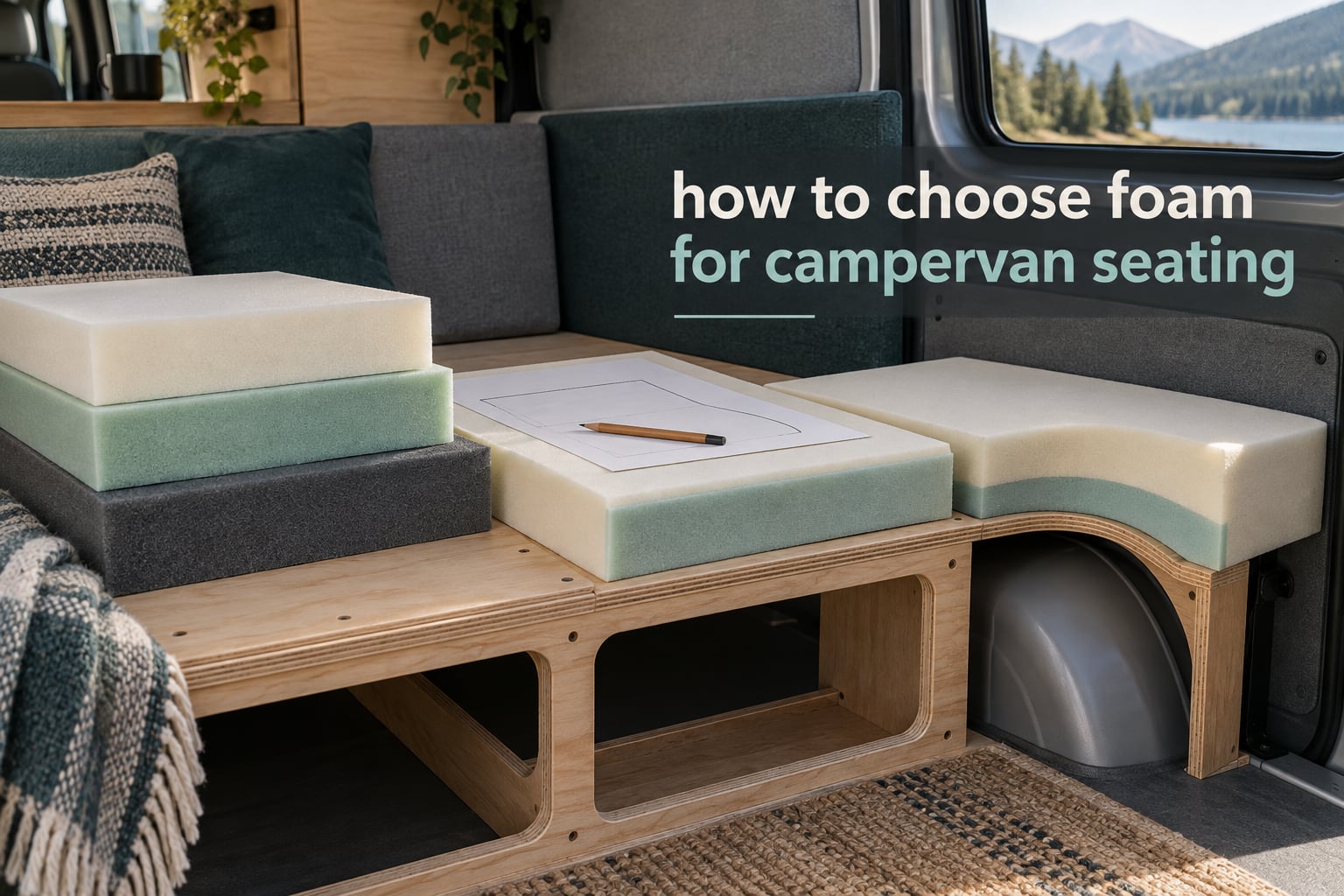
Most campervan seating problems trace back to one number on a foam quote, and that number is usually density. Learning how to choose foam for campervan seating means understanding that every cushion is described by two independent specs: density, which tells you how long the foam will last, and firmness or ILD, which tells you how it feels under you. Get the first one right and a cheap cushion can still be a bad cushion, but get density wrong and no amount of comfort tuning will rescue it.
Factory-installed van foam is usually the softest, lightest material the manufacturer can legally fit. Forum builders describe sitting on plywood after two seasons, which is why so many van owners re-upholster the dinette and rear lounge long before anything else on the conversion needs attention.
By 2026, the specification conversation has become much less murky. Density labels are still inconsistent between suppliers, but the grades that survive daily use are well understood. This guide walks through those grades, the thickness and ILD numbers that suit each cushion role, how to measure before you order, and the fire-safety questions worth asking a supplier before a single sheet is cut.
Table of Contents
- Quick Answer: What Foam Should Campervan Seats Use?
- Density vs Firmness: The Two Specs Everyone Confuses
- The Foam Label Decoder: PCF, HR Grades and 70D/90D
- Every Foam Type, Ranked for Campervan Seating
- Low-density conventional foam – avoid
- High-density polyurethane – weekend and budget builds
- Premium polyurethane – seasonal and light use
- High-resilience foam – the best all-round choice
- Latex foam – premium and full-time only
- Closed-cell foam – the moisture-proof base layer
- Memory foam – a topper only, never the main layer
- Choosing Thickness and Firmness for Each Cushion
- Vehicle Fire Safety: What to Ask Your Foam Supplier
- Measuring Your Seats Before You Order
- Should You Re-Cover or Replace? Three Tests
- Moisture, Condensation and Keeping Foam Fresh
- Frequently Asked Questions
- What type of foam is best for campervan seating?
- What is a good density of foam for seat cushions?
- Which is better, 32 density foam or 40 density foam?
- What is the best thickness for seating foam?
- What type of foam is best for RV dinette cushions?
- What is the firmest cushion filling?
- Why are people no longer buying memory foam?
- What is the recommended thickness of foam for a campervan bed?
- The Bottom Line
Quick Answer: What Foam Should Campervan Seats Use?
For campervan seating, specify high-resilience polyurethane foam at 2.5 to 3.0 lb per cubic foot, which is 40 to 48 kg per cubic metre. Use ILD 35 to 45 for seat bases, 4 to 6 inches thick, and 3 to 4 inches at ILD 28 to 35 for back cushions. If the same cushion also has to sleep two people, go slightly firmer and thicker.
That is the whole answer in three sentences. The tables below expand it.
| Cushion role | Density | Firmness (ILD) | Thickness |
|---|---|---|---|
| Seat base, sitting most days | 2.5-2.8 lb/ft3 (40-45 kg/m3) HR | 35-45 | 4-6 in (100-150 mm) |
| Seat base, part-time use | 2.0-2.4 lb/ft3 (32-38 kg/m3) HD | 33-40 | 4-5 in (100-125 mm) |
| Back cushion | 2.2-2.5 lb/ft3 (35-40 kg/m3) HR | 28-35 | 3-4 in (75-100 mm) |
| Dinette that converts to a bed | 2.5-2.8 lb/ft3 (40-45 kg/m3) HR | 35-42 | 5-6 in (125-150 mm) |
| Cab-over or low-clearance bunk | 2.2-2.5 lb/ft3 (35-40 kg/m3) HR | 30-38 | 3-4 in (75-100 mm) |
| Floor and wet-area base | Closed-cell EVA or equivalent | Firm, no ILD | 1-2 in (25-50 mm) |
A Sportsmobile builder’s spec is a useful sanity check on the table above: 4 inches of 1.88 lb and 45 ILD foam for the seat base, with 2 inches of the same for the back, which they described as just perfect. That is a lower density than we would specify for full-time use, but the principle of a thicker base and a thinner back holds across builds.
Density vs Firmness: The Two Specs Everyone Confuses
On a T@B Forum thread about uncomfortable cushions, the advice that gets repeated is simple: foam has two specs, density and firmness, and they are not the same thing. Builders who treat them as one number end up ordering a cushion that feels wonderful for a month and flat within two years.
What density means (PCF and kg/m3)
Density is how much polymer is packed into a cubic foot of foam, measured in pounds per cubic foot (PCF) in North America and kilograms per cubic metre in the UK and Europe. It is a measure of material, not of comfort. A block of 1.2 PCF foam and a block of 2.8 PCF foam can be cut to exactly the same shape and feel identical on day one.
Density is what predicts service life. Low-density foam has more air and fewer load-bearing cell walls, so repeated sitting crushes those walls permanently. That permanent loss of thickness is called compression set, and it is the reason cheap cushions feel like plywood after a season of use.
What ILD and firmness mean
ILD is Indentation Load Deflection, the force required to press a circular indenter a set distance into the foam. It is measured in pounds per square inch on a 36 square inch indenter, and it is the number that describes how the foam feels. A low ILD feels plush, a high ILD feels firm and springy.
Feel is the least durable part of a foam specification. Two foams with identical ILD can behave very differently over time, because HR foam is built with a cross-linked lattice that pushes back, while conventional foam of the same ILD simply compresses and stays compressed.
Why you should spec density, never shop by feel
Feel can only be judged in person, and a showroom sample has been handled, sat on, and stored for weeks. Density is written on the spec sheet, is comparable between suppliers, and does not change between batches. Once density is specified, firmness becomes a preference you can tune with an ILD number.
The useful order of decisions is density first, then ILD, then thickness. Many suppliers will happily let you pick a firmness and thickness from a menu while quietly substituting whatever density they have in the warehouse, which is exactly the substitution that produces a cushion that fails early.
The Foam Label Decoder: PCF, HR Grades and 70D/90D
Three labelling systems describe the same physical property, which is why the same foam appears as 2.5, as HR40 and as 90D in different parts of the world. This is the single most repeated source of confusion on camper forums, and the table below is the fix.
| PCF | kg per m3 | Approx. HR grade | Approx. 70D/90D style label | Verdict for van seating |
|---|---|---|---|---|
| 1.2 | 19 | HR25-30 | 50D | Below usable range |
| 1.5 | 24 | HR30-35 | 60D | Below usable range |
| 1.8 | 29 | HR35-40 | 70D | Part-time builds only |
| 2.0 | 32 | HR40 | 70D-80D | Weekend and seasonal use |
| 2.2 | 35 | HR40-45 | 80D | Acceptable for back cushions |
| 2.5 | 40 | HR45-50 | 90D | Sweet spot for automotive seats |
| 2.7 | 43 | HR50 | 90D-100D | Strong all-round choice |
| 3.0 | 48 | HR50-55 | 100D+ | Durable, firmer than most people expect |
| 4.0 | 64 | Latex range | Not applicable | Premium, heavier, less comfortable as a seat |
Two caveats. HR grade numbers are a grading scale, not a density measurement, so a supplier’s HR40 may be 2.0 PCF and another supplier’s HR40 may be 2.2 PCF. Always ask for the PCF or kg/m3 figure alongside any grade name, and ask for the ILD too.
The 70D and 90D labels come from Asian manufacturing conventions where the number refers to a density class. They correlate well with the North American figures in the table, but a 90D from a discount supplier is not always the same polymer as a 90D from a foam factory, so treat those labels as a starting point rather than a spec.
Every Foam Type, Ranked for Campervan Seating
The ranking below runs from the foam that fails fastest to the foam that lasts longest, with a note on what each grade is genuinely useful for in a van.
| Foam type | Typical density | Expected service life | Campervan verdict | Best use |
|---|---|---|---|---|
| Low-density conventional | Under 1.5 PCF (under 24 kg/m3) | 1-2 seasons | Avoid | Nothing structural |
| High-density (HD) polyurethane | 1.5-2.0 PCF (24-32 kg/m3) | 2-4 seasons | Budget option | Occasional use, spare cushions |
| Premium polyurethane | 2.0-2.4 PCF (32-38 kg/m3) | 4-6 seasons | Seasonal use | Winter rigs, part-time vans |
| High-resilience (HR) polyurethane | 2.5-3.0 PCF (40-48 kg/m3) | 8-12+ seasons | Best all-round choice | Everything in the living area |
| Latex foam | 3.0-5.0 PCF (48-80 kg/m3) | 10-15+ seasons | Premium, full-time only | Beds, not seats |
| Closed-cell (EVA, Minicel, Softek) | Not ILD-rated | 10+ seasons, will not absorb water | Base layer only | Floors, under-seat boxes, wet areas |
| Memory (viscoelastic) foam | 2.0-3.0 PCF (32-48 kg/m3) | 4-8 seasons | Topper only | 1-2 inch comfort layer on top of HR |
Low-density conventional foam – avoid
Anything under 1.5 PCF is filler-grade material. It feels generous on the day it is unpacked and it is the material most likely to be in a factory van. If a quote comes back at 1.2 or 1.4 PCF for a seat you intend to sit on daily, ask what the real foam is.
High-density polyurethane – weekend and budget builds
HD polyurethane in the 1.5 to 2.0 PCF band is a legitimate choice for a van used a few weekends a season. The Sportsmobile spec of 1.88 lb and 45 ILD fits here and was reported as comfortable. It will not, however, hold its shape under daily use or under two adults.
Premium polyurethane – seasonal and light use
At 2.0 to 2.4 PCF you get noticeably better recovery and less compression set than HD, at the cost of weight and cost. This is the sensible pick for part-time vans, and it is a perfectly good back-cushion density for a heavier HR base below it.
High-resilience foam – the best all-round choice
HR foam is the grade most builders land on and the one an upholstery forum described as the sweet spot for automotive seats, with 3 lb considered more industrial than a vehicle interior needs. HR foam is manufactured with a cross-linked lattice structure that resists fatigue, and it returns quickly after being compressed, which is what keeps a seat base from turning into a hammock.
HR foam also handles temperature better than conventional polyurethane of the same density. That matters in a van, where a dashboard in summer can reach temperatures that stiffen or soften lesser grades unpredictably.
Latex foam – premium and full-time only
Latex sits at the top of the density range and lasts the longest of any common cushion foam. It is also heavy, expensive, and often firmer than people expect in a seat. For a full-time van where a bed cushion doubles as the main sleeping surface, latex is defensible. For a dinette bench that has to feel comfortable after a long drive, most builders choose HR instead.
Closed-cell foam – the moisture-proof base layer
Closed-cell foam such as EVA and the Minicel and Softek grades is a different category of material, and no vendor guide in the editorial set covers it. Its cells are sealed, so it does not absorb water and it works as a vapour barrier, which is why it is the standard choice for a van floor and for under-seat storage boxes.
Expedition Portal members source Softek and Minicel type-T EVA as a cost-effective closed-cell option, with standard and flame-retardant grades available. As a seating material it is too firm to sit on directly, but it makes an excellent structural base: closed-cell at 1 to 2 inches, HR comfort foam above it, and a washable cover over the whole assembly.
Memory foam – a topper only, never the main layer
Memory foam is temperature sensitive. It softens dramatically in a warm cabin and stiffens in a cold one, so the same cushion feels different on a summer afternoon in a lay-by and on a winter morning at a campsite. On r/VanLife, builders reported memory foam as not very cushy at 3 and 4 inches thick, which is the opposite of the expectation that motivates people to buy it.
There is also a durability problem. Viscoelastic foam crushes under repeated load and takes a long time to recover, so a seat base made from it is tired before the trip ends. Use 1 to 2 inches of memory foam as a comfort topper over an HR base, and never as the structural layer.
Choosing Thickness and Firmness for Each Cushion
Thickness is a clearance decision before it is a comfort decision. Measure the space first, then pick the thickest foam that fits with room for the cover, the frame lip, and anything that has to pass over the cushion.
Seat base cushions
Four to six inches at ILD 35 to 45 is the working range for a base you sit on daily. Below four inches you feel the frame, and above six inches the cushion lifts your hips enough to change the driving position. Exploroz builders, who grade firmness on a 30 to 75 scale, land on roughly 3 inches of medium density for an average build, which is thinner than we would specify for a daily-use seat base.
Back cushions
Backs are usually three to four inches at ILD 28 to 35, so they are softer and thinner than the base. A back that matches the base exactly feels like a slab, because the lumbar area needs to give slightly more than the seat. If headroom is tight, a three-inch back with a firmer ILD beats a two-inch back that has to be compressed to fit.
Cushions that convert into a bed
A dual-use cushion has to work in two positions, and that pushes the spec in two directions. Sitting wants a slightly softer, thicker foam; sleeping wants support at the hips and shoulders without the pressure points that a soft foam creates over hours. The compromise is a 5 to 6 inch HR base at ILD 35 to 42 with a 1 inch comfort topper, all inside a zip-off cover that can be changed for bedding.
Build it as two layers rather than one. Foam adhered in layers stays stable and can be recovered with a new topper later, whereas a single thick slab that has lost its shape has to be replaced entirely.
Cab-over and low-clearance bunks
Headroom is the constraint here, and it is a hard one. Three to four inches at ILD 30 to 38 gives a usable sleeping surface within a tight bunk, and anything thicker will cost you head clearance that you cannot get back. Measure lying down, not sitting, before committing to a thickness.
Matching the spec to your body weight
Firmness should track the load, because ILD is a force measurement. A cushion that is comfortable for a lighter occupant can be bottoming out for a heavier one, which is where the compression set that shortens foam life actually starts.
| Rider weight | Seat base ILD | Back cushion ILD | Density floor |
|---|---|---|---|
| Under 120 lb (55 kg) | 30-38 | 24-30 | 2.2 PCF (35 kg/m3) |
| 120-200 lb (55-90 kg) | 35-45 | 28-35 | 2.5 PCF (40 kg/m3) |
| Over 200 lb (90 kg) | 45-55 | 35-42 | 2.7 PCF (43 kg/m3) |
If two people of very different weights share a cushion, spec for the heavier of them. A firmer base at the higher end of the range is easier to live with than a soft base that one person has already destroyed.
Vehicle Fire Safety: What to Ask Your Foam Supplier
Foam inside a vehicle interior is a regulated surface, and this is the part of the topic that no vendor guide we reviewed covers. Seat foam in road vehicles falls under FMVSS 302, the US federal flammability standard for interior materials, which tests flexible cellular materials against the burn-rate criteria in FM 585. A van used for passenger carriage for hire or reward is held to stricter furniture rules, including UNECE Regulation No. 118 in Europe and the UK.
Three questions are worth asking before you order:
- Is the foam supplied with a certificate or declaration referencing FMVSS 302 and FM 585, and can I see it before the sheet is cut?
- For closed-cell EVA, is the specific grade flame retardant, and is that stated on the documentation rather than assumed from the product name?
- Does the certification cover the finished cushion with its cover and adhesive, or only the bare foam block?
A supplier who answers those three questions in writing has already told you something useful about how they work. Flame-retardant closed-cell options are treated as a genuine differentiator in expedition circles for that reason.
Measuring Your Seats Before You Order
Measure the frame you have, not the plan you drew. The most common ordering mistake in van builds is sizing a seat and its backrest as one piece, then discovering the foam arrives too tall for one and too short for the other.
The paper template method
This five-step method handles any shape you will meet in a van interior:
- Clear the frame and remove the old foam completely, including any plywood base.
- Lay a sheet of thin cardboard or kraft paper over the finished frame and trace the outline, including every cutout and notch.
- Mark a 1 inch overlap onto the paper beyond the frame edge so the cover can be pulled under and stapled underneath.
- Label each template with the piece name, the thickness you have chosen, and which side faces the occupant.
- Send the paper to the supplier instead of a list of numbers, and keep a copy for the upholstery stage.
Give every piece its own dimensions
A dinette is a set, not a single cushion. On the sportsmobile build the same spec applied to the 4 inch base and the 2 inch back, and on forum builds the same discipline applies: two seat pieces and two back pieces, each with its own number. A rear lounge with a wheel arch is usually three or four pieces, not one slab.
Subtract the backrest from the seat depth
When a backrest stands upright against the rear of the bench, the usable sitting depth is the frame depth minus the thickness of the back plus its angle. Get this wrong and cushions arrive too deep to close, or too shallow to sit properly. Lay the backrest in place and measure the gap it leaves.
Notch wheel arches and odd shapes
Draw the wheel arch on the paper and cut the notch before the foam is cut, not after. Foam cut freehand to fit a curve always ends up slightly undersized, and a notch that is too shallow means the cushion lifts every time someone sits down.
Cutting and shaping foam on site
An electric carving knife with a long blade makes curved notches and bevelled edges cleanly and is worth owning for a single build. A long serrated knife will get you through straight cuts, but keep the blade moving in one direction to avoid tearing the cell structure. Cut from the underside of the piece so the visible face stays flat.
Should You Re-Cover or Replace? Three Tests
Before ordering new foam, decide whether the existing cushion needs it at all. Re-covering is a half-day job; a full replacement is a rebuild.
Test one, the recovery test. Press a fist hard into the centre of the foam and time how long the surface takes to recover. Under about five seconds means the cell structure is still healthy. If it takes twenty seconds or never recovers, compression set has already begun and a new cover will hide a problem that will get worse.
Test two, the thickness test. Measure the foam at the centre and at both front corners. More than half an inch of variation across a single piece means the fill has slumped, usually because the density was too low to begin with.
Test three, the dust test. Rub a thumb across the foam surface. If it leaves grey powder behind, the cell walls have been crushed and broken off, which is the final stage of the same failure. That cushion is finished.
If all three pass, the foam is fine and the problem is the cover, the support board, or the frame. Re-covering with a washable, zip-off cover in a breathable fabric is the sensible move, and a lot cheaper than new foam.
Moisture, Condensation and Keeping Foam Fresh
Put a moisture barrier under the foam
A vapour-impermeable or vapour-open membrane between the frame and the foam, matched to your climate, stops condensation reaching the cushion from the floor. Under closed-cell base foam this is less critical, but the membrane is still worth having under any open-cell layer.
Use washable removable covers
Every living-area cushion should have a zip-off, machine-washable cover. Foam in a van collects condensation, road dust, spillages and sunscreen, and a fixed cover turns all of that into permanent odour inside the cell structure.
Ventilate and store between trips
A closed van in warm weather is the worst case for foam, because the temperature swing drives moisture into the cushions and the airflow stops. Crack a window, run a fan, or leave a dehumidifier running if the van is parked for weeks. Between trips, take the cushions out and stand them on edge so air can move through them.
Frequently Asked Questions
What type of foam is best for campervan seating?
High-resilience polyurethane foam at 2.5 to 3.0 lb per cubic foot, which is 40 to 48 kg per cubic metre, is the best all-round choice. Use ILD 35 to 45 and 4 to 6 inches for seat bases, and 3 to 4 inches at ILD 28 to 35 for back cushions. Closed-cell foam makes a good structural base under the comfort layer.
What is a good density of foam for seat cushions?
For a seat cushion used daily, 2.5 to 2.8 lb per cubic foot (40 to 45 kg per cubic metre) is the target. Below about 2.0 PCF the cushion loses its shape within a few seasons of regular use. Builders on upholstery forums consistently name 2.5 lb as the sweet spot for vehicle seating, with 3 lb generally more than an interior needs.
Which is better, 32 density foam or 40 density foam?
Forty density. In the PCF system 32 density is about 2.0 lb per cubic foot and 40 density is about 2.5 lb per cubic foot, so the 40 is the denser and more durable of the two. The numbering also appears as kg per cubic metre in Europe, where 40 kg per cubic metre is the more common van seating spec and 32 kg per cubic metre is a part-time grade.
What is the best thickness for seating foam?
Four to six inches for a seat base and three to four inches for a back cushion is the working range. Cushions that double as a bed want five to six inches so two people do not compress through to the frame. Measure your available clearance first, because a 4 inch cushion in a bench with 3.5 inches of space will not work no matter how good the foam is.
What type of foam is best for RV dinette cushions?
High-resilience polyurethane at 2.5 to 2.8 lb per cubic foot, ILD 35 to 42, 5 to 6 inches thick, built as a base layer with a thin comfort topper. A dinette is the hardest cushion job in a van because the same piece has to be comfortable under two people by day and firm enough to sleep on at night. Softer foam looks luxurious and fails both jobs.
What is the firmest cushion filling?
High-density and closed-cell foam are the firmest common cushion fillings, and latex sits at the firmest end of the open-cell range at 3.0 to 5.0 lb per cubic foot. Closed-cell EVA and similar materials do not have a meaningful ILD because they compress very little. Firmest is rarely what you want in a van, where ILD above about 55 becomes uncomfortable to sit on for any length of time.
Why are people no longer buying memory foam?
Memory foam is temperature sensitive, so it softens in a warm cabin and stiffens in a cold one, and it takes a long time to recover after being compressed. Van builders report it as not very cushy at 3 and 4 inches thick, and the lack of recovery means a seat base made from it tires before the trip ends. Most now use 1 to 2 inches of it as a topper over high-resilience foam.
What is the recommended thickness of foam for a campervan bed?
Four inches of high-resilience or latex foam is the usual starting point for a fixed bed platform, and five to six inches if the same piece also has to serve as a seat. Add one inch of comfort topper rather than making the whole thing thicker. Anything beyond six inches rarely improves comfort and always costs headroom and payload.
The Bottom Line
Choosing foam for campervan seating comes down to three decisions, in this order. Density first: 2.5 to 3.0 lb per cubic foot, or 40 to 48 kg per cubic metre, in high-resilience polyurethane. Firmness second: ILD 35 to 45 for seat bases, 28 to 35 for backs, scaled up if you are a heavier occupant. Thickness third, within whatever clearance your frame allows, with 4 to 6 inches for bases and 3 to 4 inches for backs.
Everything else is refinement. Closed-cell foam under the frame keeps water out, a 1 inch memory topper adds pressure relief on long drives, and a washable zip-off cover keeps the whole thing serviceable. Get the density right and the rest is tuning. Get it wrong and you will be re-covering the same cushion in a couple of years.