
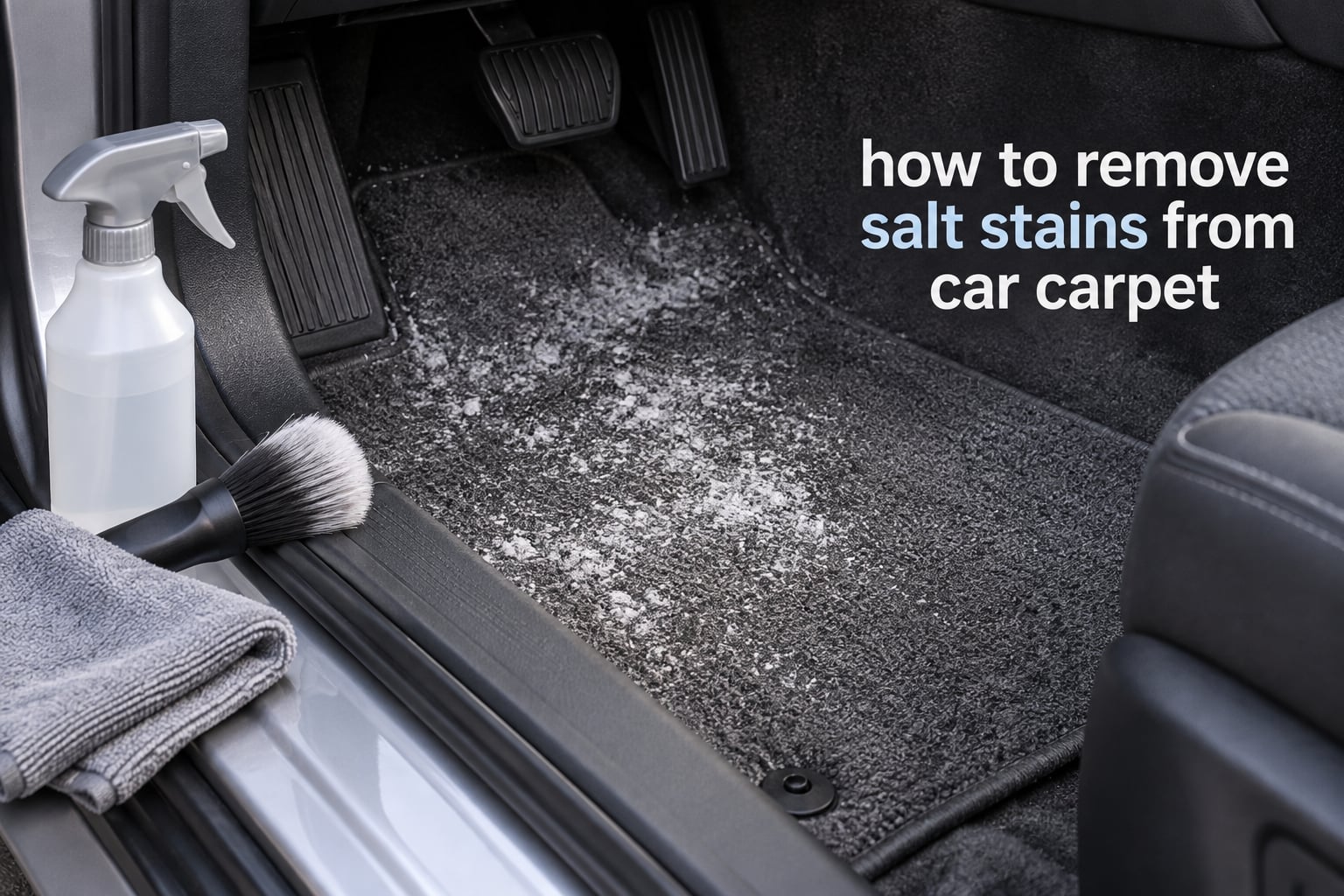
To remove salt stains from car carpet, dry-vacuum every crystal you can lift, pre-soak the pile with genuinely hot water, apply a neutraliser or a 1:2 white vinegar solution, let it dwell, work it in with a soft brush, then extract until the water runs clear and dry the carpet completely. Salt is a mineral crystal, not grease, so it cannot be scrubbed or soaped out. It has to be dissolved, given time, and physically pulled back out before the carpet dries.
I have cleaned salt out of enough winter-driven footwells to know where most guides go wrong. They stop at the vinegar step, they blot instead of extract, and they dry the car in the sun. All three leave you with a brighter white crust than you started with.
The reason is chemistry and timing working against you. Road salt and de-icing salt are mineral crystals that melt into the pile with every bit of meltwater, then re-crystallise as that water evaporates. If you clean the surface and walk away, you have simply moved the salt deeper. If you clean it and the carpet dries with dissolved salt still in it, you have built a new stain that looks exactly like a fresh spill.
What follows is the full process, the honest failure cases, and the two situations most guides never mention: hardened mounds that have been there for years, and floor mats that hold far more salt than the carpet does.
Table of Contents
- Salt Stain Removal in 6 Steps
- What You’ll Need to Remove Salt Stains from Car Carpet
- How to Remove Salt Stains from Car Carpet: The 7-Step Method
- What Dissolves Road Salt Fastest?
- Why Vinegar Alone Fails on Hardened Salt
- How to Remove Salt Stains Without Vinegar
- Are Salt Stains Permanent?
- What Salt Does to Carpet Fibres and Foam Backing
- Salt Stains on Floor Mats vs. Carpet: Two Different Jobs
- Common Mistakes That Push Salt Deeper
- Drying the Carpet So the Salt Does Not Return
- Low-Pile, Worn and Classic Carpet Considerations
- When to Call a Professional Detailer
- Preventing Salt Stains Next Winter
- Frequently Asked Questions
- Your Salt Stain Action Plan
Salt Stain Removal in 6 Steps
- Vacuum dry first. Up to half the salt in a badly tracked car is sitting loose on top of the pile. Lift it before you add any water, or you turn it into mud.
- Pre-soak with hot water. Water hot enough to hold a bare hand for a few seconds, not warm tap water. This is the single most important step and the one most skipped.
- Apply a neutraliser or 1:2 white vinegar. One part distilled white vinegar to two parts water, sprayed lightly until the pile is damp, not soaked.
- Dwell for 5 to 10 minutes. Fresh salt needs 5. Hardened salt needs 10 or more. Dwell time does the work that scrubbing cannot.
- Agitate with a soft detailing brush. Short, gentle strokes in one direction. Never a brass brush, never a stiff nylon brush, never a drill attachment.
- Extract and dry fully. Wet/dry vac or hot water extractor, repeating until the recovery water runs clear. Then 4 to 6 hours of moving air.
What You’ll Need to Remove Salt Stains from Car Carpet
You do not need a dedicated salt product. You need water, mild acid, suction and patience. This is the working kit I use.
- Vacuum with a crevice tool and brush attachment. The crevice tool gets salt out of the seat rails, the door jambs and the gap between the carpet and the sill plate.
- Wet/dry vacuum or shop vac with a clean water tank. This is the highest-value tool in the whole job. Suction removes what chemistry can only loosen, and it is the step most people skip in favour of blotting with towels.
- Hot water extractor if you do not own one. Rentals are common and let you clean a whole cabin in an afternoon.
- Spray bottle for diluting vinegar and mixing your rinse.
- White distilled vinegar. Cheap, pH acidic, and it dissolves carbonate mineral well. Distilled rather than cider, so it does not leave an odour.
- Soft detailing brush. Nylon bristle, rounded head. A toothbrush works in tight spots.
- Microfiber cloths for blotting the surface before you extract.
- Box fan or air mover, plus a portable dehumidifier if you have one. Also gloves and a ventilated workspace.
Spot test first. Hidden carpet under the seat or behind a trim panel, an hour before you start. On older and dyed interiors, an acidic solution can shift colour on wool, low-pile and aftermarket carpet, and you want to know that on a scrap of pile rather than on a footwell.
How to Remove Salt Stains from Car Carpet: The 7-Step Method
Work from the front of the car towards the back on the first pass, then reverse direction on the second. Bouncing between dirty and clean areas is what spreads salt into carpet that was already fine.
- Dry-vacuum thoroughly. Crevice tool along the seat rails, door jambs, the pedal area and under the mats. Go over the pile slowly with the brush attachment. Empty the vacuum between passes if the load is heavy.
- Pre-soak the pile with hot water. Water hot enough to be uncomfortable after a few seconds. Pour or spray it across the whole stained zone, not just the centre of the stain, and let the carpet sit for 5 minutes. You are re-dissolving crystal that has hardened inside the pile. Cold water barely touches it.
- Apply your neutraliser. Diluted white vinegar at 1:2 with water, sprayed to damp saturation, or a purpose-made road salt neutraliser used according to its own directions. Work over an area slightly larger than the visible stain. That margin is what stops a ring.
- Dwell for 5 to 10 minutes. Keep the area damp; a light mist of plain water on top if it starts to dry out. This is where the acid does its work on the mineral.
- Agitate gently. A soft detailing brush, short strokes, one direction. Your goal is to loosen crystal from between the fibres, not to scrub the pile down to the backing.
- Extract or blot, then extract again. With a wet/dry vac, run the extraction tip over the damp carpet and pull the dirty water back out. With no machine, lay microfiber cloths down, press, lift, and repeat with clean cloths. Wet paper towels or a dry cloth rubbed across the pile smear the salt and push it down. You need suction, not pressure.
- Dry completely, then inspect. Moving air, doors open, 4 to 6 hours in a cool shaded space. Touch the pile when you are done: any stiffness means mineral is still in there, and the stain will return.
Expect two or three rounds on heavy contamination. Work until the water coming out of your extraction tip is clear, then dry and look again under good light. Detailers on r/Detailing describe this as the moment the job is actually done.
What Dissolves Road Salt Fastest?
What dissolves salt in carpet is warm water combined with mild acid, given dwell time and then extracted. Hot water alone gets most of it, because salt is highly soluble once it is loose and warm. What neutralizes road salt chemically is a pH-acidic solution such as white vinegar or a commercial salt neutraliser. Note the distinction: vinegar does not neutralize the salt, it dissolves the crystal and lets you flush it out.
| Method | Dwell time | Fresh salt | Hardened salt | Fibre risk |
|---|---|---|---|---|
| Hot water pre-soak and extraction | 5 min soak | Excellent | Good alone, better paired with a neutraliser | Low if you do not saturate |
| Diluted white vinegar, 1:2 | 5-10 min | Good | Weak alone on old mounds | Low, spot test on wool and dyed pile |
| Commercial salt neutraliser | Per label, often 5-10 min | Very good | Good | Low, follow the label |
| Enzymatic or citrus cleaner | 10-15 min | Fair | Weak, enzymes target organics not minerals | Low |
| Steam cleaner | Slow pass | Very good | Very good on crusts | Moderate, steam swells and relaxes fibres |
| Hot water extractor alone | Continuous | Fair on its own | Poor, extraction without pre-treatment just moves the problem | Low |
If you are weighing tools rather than chemistry, a shop vac or wet/dry vac is where your money goes. Forum users describe the suction as doing the work the chemistry cannot. A steam cleaner is the second most-cited tool for crusts; r/Detailing threads report it fully dissolving dried salt, sometimes with an all-purpose cleaner mixed into the steam for extra kick.
Why Vinegar Alone Fails on Hardened Salt
Hardened salt does not come out because most people spray the carpet, give it a minute, blot, and assume the job is finished. Old salt has had weeks or months of freeze-thaw cycles inside the pile and has bonded to the fibre surface. It needs more water, more heat, more time and mechanical dislodge.
A poster in Quebec described the version everyone hits: deep mounds of salt that survived vinegar, hot water, a dedicated salt eraser, a brass brush, a vacuum extractor, all-purpose cleaner and a standard carpet cleaner, with no meaningful result. That is not a technique failure. It is a fresh-salt method applied to a hardened-salt problem.
How to get hardened salt off car carpet
- Re-dissolve before you neutralise. Soak the zone with genuinely hot water and wait a full 5 to 10 minutes before any chemical. Let it penetrate the full depth of the pile.
- Double the dwell time. With the pile saturated, apply your neutraliser and give it 10 to 15 minutes rather than 60 to 90 seconds. Keep it damp the whole time.
- Dislodge mechanically, but gently. A soft nylon detailing brush with moderate pressure, or a steam pass over the crust to soften it first. Brass and stiff brushes permanently damage worn pile, and a rotary drill brush is reported on r/AutoDetailing to leave mats looking whiter once dry, not cleaner.
- Extract repeatedly. Two or three passes with the wet/dry vac. You are looking for clear recovery water, not a damp carpet.
After a full dry-down, check the feel of the pile. Stiffness means residual crystal. Repeat the hot-water cycle on that spot only rather than re-treating the whole footwell, because repeat saturation is what causes the over-wetting problems below.
Realistically, salt that has been sitting for years in a neglected car is significantly reduced rather than like new. Detailers say this out loud, and it is the honest expectation to set.
How to Remove Salt Stains Without Vinegar
You can remove salt stains from car carpet without vinegar. Hot water with a mechanical action and good suction does most of the work, because salt is a water-soluble mineral rather than an oily or protein deposit.
- Hot water extraction. Soak with hot water, dwell 10 minutes, then extract. On fresh to moderate salt this alone is enough.
- Steam. The most reported single tool for dried crusts. Keep the head moving.
- Citrus or enzymatic cleaner. Helps with the oily carrier that holds salt to the fibre, not with the mineral itself. Expect a partial result.
- Purpose-made road salt neutraliser. Formulated for mineral deposits, and the direct vinegar replacement if you want chemical assistance.
Also worth knowing: baking soda. It will not dissolve salt, but a dry baking soda application before the wet step lifts moisture and gives you something absorbent to lift with. Several r/AutoDetailing threads recommend the dry pass before wetting.
Are Salt Stains Permanent?
Salt stains are usually not permanent, but they can become permanent in two specific ways. If the mineral has been sitting long enough to discolour or physically degrade the fibre, that damage does not reverse. And if you let the carpet dry with dissolved salt still in it, the deposit re-crystallises and bonds more tightly than it did before.
The honest answer for long-neglected salt in an old interior is that you can get a large improvement, sometimes close to clean, without getting a like-new result. Fresh to recent salt on sound carpet is close to fully reversible.
What Salt Does to Carpet Fibres and Foam Backing
Will salt ruin carpet? It will, given enough time. The mineral is hygroscopic, so it pulls moisture out of the air and holds it against the fibre, which keeps the pile damp and encourages musty odour. The repeated freeze-thaw that happens in a car parked outdoors all winter breaks down and discolours the fibre surface. Salt also pulls water through the pile into the foam backing, where it attacks the pad and the floor pan metal underneath.
On classic and vintage interiors with low-pile carpet and ageing foam, the foam is often already close to end of life. Once that padding is saturated it dries slowly, and you can trade a white stain for a sour smell that takes days to clear. Treat the water volume as the constraint, not the chemistry.
Salt Stains on Floor Mats vs. Carpet: Two Different Jobs
Mats hold the heaviest salt load in the car, and they can be cleaned with far more water and force than carpet can take. Taking them out of the vehicle is the single most effective thing you can do for this stain type.
- Remove both mats. Rubber trunk mats and carpet mats get separate treatment.
- Rubber mats. Hose or rinse thoroughly, scrub with a stiff brush and a little dish detergent, then rinse again until the water runs clear.
- Carpet mats. Beat out loose dry salt outdoors first, then hose, then apply neutraliser and scrub.
- Work the pile. A stiff brush is acceptable here because mats tolerate far more mechanical action than a fixed carpet. Still keep strokes in one direction.
- Rinse until clear. This is the stopping rule that prevents re-crystallisation. If the runoff is not clear, salt is still leaving the fibre.
- Hang to dry. Both types, off the ground, in moving air. Rubber mats dry in under an hour; carpet mats take several hours.
- Reinstall dry. Do not put a damp mat back over carpet, or you create the damp-trapped-odour problem you were trying to avoid.
| Surface | Best first move | Water allowed | Brush | Key risk |
|---|---|---|---|---|
| Carpet mat | Dry beat or shake outdoors | Unlimited, outdoors | Stiff brush acceptable | Slow drying if reinstalled damp |
| Rubber trunk mat | Hose and detergent | Unlimited, outdoors | Stiff brush | Creases if dried folded |
| Fixed carpet | Dry vacuum then hot pre-soak | Limited, extract it back out | Soft detailing brush only | Saturating the foam backing |
| Door jambs and trim | Crevice vacuum and damp wipe | Minimal | Microfiber | Water tracking into the door mechanism |
Common Mistakes That Push Salt Deeper
- Cleaning in direct sun. Heat forces the water out of the pile before you can extract it, so the salt re-crystallises in place. Work in shade, doors open, cool conditions.
- Skipping the dry vacuum. Loose crystal plus water equals mud pressed into the backing.
- Scrubbing too hard or with brass brushes. This permanently damages worn pile and does not remove the salt that is deeper down.
- Treating only the visible stain. The classic ring artefact comes from a defined edge. Always work 15 to 20 cm beyond the visible mark.
- Blotting with dry cloths and calling it done. Towels move dissolved salt to the surface; they do not remove it.
- Over-wetting. The single worst outcome. Saturating the foam backing leaves moisture in a metal box that will smell, not just look.
- Stopping at the first clear-looking pass. Always extract until the recovery water is clear, then dry and confirm.
- Pressure washing or hosing mats in place in the driveway. That drives salt and dirt deeper into the pile and into the sill area. Take mats out.
Drying the Carpet So the Salt Does Not Return
Dry-down is where a good salt job is won or lost. As the water evaporates, any mineral still dissolved in the pile crystallises around the fibres and reappears as a white crust that reads as a brand new stain. One r/AutoDetailing user scrubbed mats with a drill brush and microfiber towels and found the salt came back whiter once dry. That is re-crystallisation, not residue surviving the scrub.
Here is the drying checklist.
- Extract until the water runs clear before you start drying. This is the single most effective anti-re-crystallisation measure.
- Move air across the carpet. Box fans in the footwells, doors and hatch open, 4 to 6 hours. Airflow over the pile matters more than ambient temperature.
- Run the HVAC on recirculate with the fan on high. It pulls moisture out of the cabin rather than exchanging it with cold outside air.
- Add a portable dehumidifier if the car is in a garage or the weather is humid.
- Never use a space heater or a hair dryer aimed at the pile. Direct heat dries the surface while trapping moisture at the backing, and it is a fire risk in a car.
- Touch test before you close it up. Run a hand across the pile. Cool and damp means keep going. Any stiffness means mineral remains and you need another extraction pass, not another dry-down.
In damp weather or heavy salt conditions, budget overnight. A car dried in a hurry will re-crystallise and you will be back at step one.
Low-Pile, Worn and Classic Carpet Considerations
Older and classic interiors are the hardest case. Low-pile carpet has less fibre depth for the solution to reach into and less structure to hold the crystal clear of the backing, so dwell time matters more and the touch test is less reliable. Worn pile has shorter, frayed fibres that trap salt at the surface where extraction is harder. And aged foam backing saturates and stays damp for a very long time.
For these cars, cut the water budget rather than cutting the steps. Fewer, more concentrated applications with a longer dwell and thorough extraction beat a single soaking pass. Keep the number of extraction passes high and the volume per pass low. A shop vac lets you work in small sections repeatedly, which fits old interiors better than a rented machine that floods the whole floor at once.
Where pile is already thinning or discoloured, no cleaning method restores the fibre, and further agitation risks making it worse. Photograph the area before you start so you can tell later what was original wear rather than damage you caused.
When to Call a Professional Detailer
Do it yourself when the carpet is intact, the backing is not already compromised, and you can give the job a full dry-down window. Professionals are worth it in a handful of situations.
- Salt is throughout the cabin, in the seat backs, headliner edges and the boot, rather than localised in the footwells.
- Saturation has already happened and you are dealing with a musty or sour smell rather than a visible stain. That needs a truck-mounted extractor and hours of drying with air movers.
- Foam backing is old or already waterlogged. Extraction at a controlled flow rate is safer than a saturating DIY pass.
- The carpet is dyed, wool or low-pile vintage pile where you want tested chemistry rather than a diluted household acid.
- Salt is on structural or trim areas you would rather not risk, or the car is a collector vehicle you are not going to experiment on.
Get a quote for interior extraction as a separate line item from an exterior wash. If a shop bundles it in, ask what extractor they use and whether they will do a second pass until the recovery water runs clear.
Preventing Salt Stains Next Winter
- Fit all-weather mats with a raised edge. They intercept the bulk of what gets tracked in. A carpet mat on top of a rubber mat works well, and both are easier to clean outside than the carpet is.
- Remove salt weekly in winter, or at least before it bakes on in sunlight. Fresh salt comes off with a dry vacuum and hot water. Month-old salt needs the hardened-salt path.
- Have the underside of the car washed before spring. Salt on the floor pan and subframe keeps working on the metal and backs up into the carpet through the pad.
- Consider a protective treatment on clean, dry carpet. r/AutoDetailing threads treat this as worth doing for cars that sit outside in road salt, since it slows how deeply salt and grime bond to the fibre.
- Run a quick vacuum and damp wipe at the start of spring, before temperatures warm and any remaining salt starts to re-crystallise into the pile.
Frequently Asked Questions
Does vinegar neutralize salt?
Not exactly. Vinegar is acidic, and acid dissolves the salt crystal so it can be flushed out with water. It does not neutralize the chemical itself, which is why extraction matters as much as the spray.
What will neutralize road salt in carpet?
A pH-acidic solution dissolves road salt in carpet: diluted white vinegar at one part to two parts water, or a purpose-made road salt neutraliser. Both need a dwell of 5 to 10 minutes and thorough extraction afterwards to stop it re-crystallising.
Are salt stains permanent?
Usually not. Salt is a soluble mineral, so it lifts with hot water and extraction. It becomes permanent only when the fibre itself is discoloured or degraded, or when the carpet dries with dissolved salt still in the pile and it re-crystallises more tightly than before.
How do you get salt residue out of carpet?
Extract until the recovery water runs clear before the carpet dries. Anything still dissolved in the pile crystallises as it dries and reappears as a white crust. After a full dry-down, check the pile by hand: any stiffness means mineral remains and needs another extraction pass.
Will vinegar damage car carpet fibres?
Diluted white vinegar at one part to two parts water is safe on most automotive carpet, but spot test on a hidden area first. Wool, dyed low-pile and aftermarket carpets can shift colour with an acidic solution. Never use undiluted vinegar, and never use it on vinyl or leather trim.
How long does it take road salt to damage carpet?
A single winter of road salt can leave a visible residue, but visible damage accumulates. Months of damp salt held against the fibre discolours and breaks it down, and it drives moisture into the foam backing and the floor pan metal underneath. Removing salt each winter prevents most of the long-term damage.
Your Salt Stain Action Plan
To remove salt stains from car carpet, the whole job reduces to five things done in order: vacuum the loose salt dry, dissolve what is left with hot water, add a neutraliser and give it 5 to 10 minutes, loosen it gently with a soft brush, then extract until the water runs clear and dry the carpet fully. That sequence is the answer to how to get dried salt, heavy salt and salt residue out of a car carpet, because all three are the same problem at different stages of drying.
Two decisions make the difference. Use hot water and a real dwell time, because that is what separates a job that works from the failed attempts people describe in r/Detailing after trying six different products. And extract rather than blot, because suction is the only thing that physically removes the dissolved salt instead of moving it around.
Start at the carpet now if you can. Fresh salt is close to fully reversible. Salt that has been there a season is significantly reduced, not restored, and getting it out before winter returns is far easier than getting it out after.