
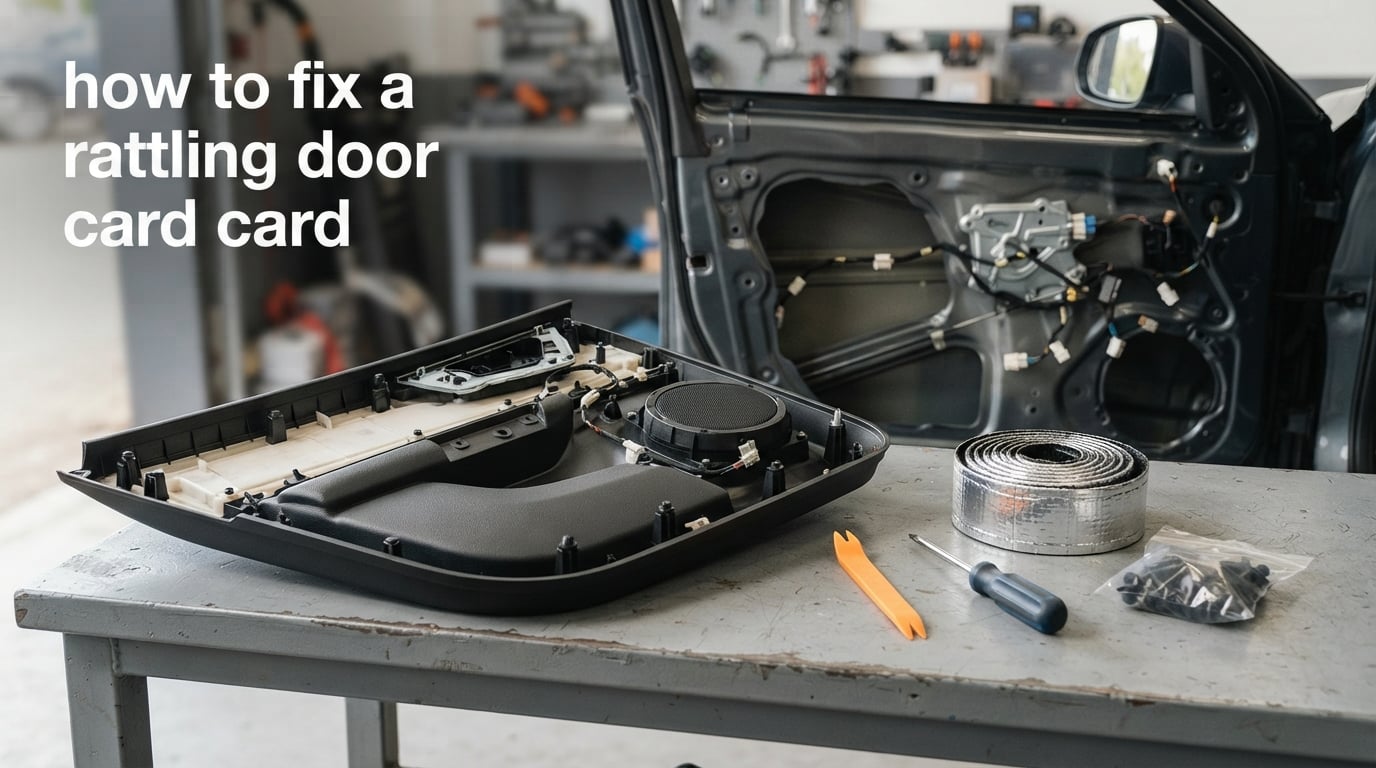
If you need to know how to fix a rattling door card, the good news is that most rattles come down to a loose fastener, a broken trim clip, or a cable tapping against the metal door shell while you drive. Nearly every rattle can be traced and fixed in an afternoon with a trim removal tool, a driver set and some damping material. The trick is finding the actual source before you start taking the card apart, because damping a noise you have not fixed only hides it for a few weeks.
We work on door cards and trim panels every week at our workshop, and the same handful of faults account for nearly every call we get. This guide walks through the full procedure, from diagnosing the noise through removing the card, fixing the cause and refitting everything so the rattle does not come back.
First, a quick note on wording. A door card, a door panel and a trim panel all mean the same thing: the interior trim shell covering the inner face of your door. British, European and Australian drivers say door card, North American drivers say door panel, and trim panel covers both. We use door card and door panel interchangeably here.
Table of Contents
- What Causes a Rattling Door Card?
- How to Find the Source of the Rattle Before You Remove Anything
- Tools and Materials You Need
- How to Remove a Car Door Card Without Breaking It
- How to Find and Fix the Rattling Component
- Damping the Noise With Butyl Mat and Foam Tape
- Reassembling the Door Card and Refitting the Service Panel
- When to Stop and See a Mechanic
- A 10-Minute Preventative Check Every 6 Months
- Frequently Asked Questions
- What causes a car door to rattle?
- How do I find the source of a rattle in my car?
- How do I remove a car door panel without damaging it?
- What tools do I need to remove interior door trim?
- How do I stop my car door from rattling over bumps?
- What is sound deadening and does it stop rattles?
- Should I take my rattling car door to a mechanic?
- Are loose trim clips dangerous to drive with?
- Conclusion
What Causes a Rattling Door Card?
A door card rattles when something inside the door is free to move and road vibration shakes it against the inner door skin. In order of frequency: loose trim clips or a missing retaining screw, a wiring harness tapping on metal, an unsecured window regulator or glass run, the check strap or latch striker, and a loose speaker basket. Worn weather seals, sagging door hinges and a rattling door frame cause creaks rather than rattles, and need different fixes.
Matching the noise to the source saves you most of the work. This table is the fastest way to narrow it down before you touch a screwdriver.
| What you hear | Likely source | Where to look | Fix |
|---|---|---|---|
| High-pitched buzz or chatter at speed | Trim clips broken or missing at the top edge of the card | Top rear corner of the card, around the mirror mount | Refit or replace the clips and the card screws |
| Low thudding knock | Door frame, hinge bolts or check strap, not the card itself | Hinge bolts, latch striker, check strap | Tighten bolts and adjust the striker |
| Rattle only over bumps, silent on smooth road | Check strap, latch mechanism or loose cavity component moving under load | Inside the door cavity and at the latch | Re-secure the strap or component, grease the latch |
| Constant rattle from one spot | Wiring harness or window regulator touching the door skin | Harness routing clips, regulator mounting bolts | Re-clip the harness, tighten regulator bolts |
| Rattle only in cold weather | Rubber seals and butyl mat contracting when cold | Weather seal, speaker surround, damping pads | Condition the seal, add closed-cell foam at the edges |
| Buzz when the radio plays | Speaker basket or grille panel not fully seated | Speaker mounting screws and grille clip | Retighten and reseat the grille |
How to Find the Source of the Rattle Before You Remove Anything
Locating the noise first means you often never need to strip the door. Sit in the driver’s seat with the engine running and the door closed, then push firmly on each part of the card in turn: the armrest, the map pocket, the handle bezel, the speaker grille and each corner. A rattle that stops or changes when you press a spot is coming from that spot or directly behind it.
Get a second pair of ears to help. Have someone stand outside the car and touch the door skin, the door frame and the check strap while you press inside. It takes a few minutes and it rules out half the door before any trim comes off.
For rattles that only appear at speed, record the cabin on your phone and play it back. Rattles are almost impossible to pin down live, because road noise buries them, but a recording isolates the frequency and the recording can be slowed down to make a regulator buzz sound like a buzz.
If the noise appears only over bumps, the cause is usually something that moves under load rather than a constant rattle source. Check the check strap, the latch and the latch striker at the body pillar before you go anywhere near the trim.
Tools and Materials You Need
You do not need specialist equipment. Everything below is available from a general tool supplier and most of it will already be in a home workshop.
| Item | What it is for |
|---|---|
| Trim removal tool or plastic pry set | Lifting the card without gouging the door skin or snapping clips |
| Phillips and flat blade screwdrivers | Removing switch panels, bezels and retaining screws |
| Torx key set | Most European and Japanese cars use Torx for the card and speaker screws |
| Socket set | Window regulator bolts and, on some vehicles, the mirror mount |
| Trim clip assortment | Replacing the push-in clips that break during removal |
| Butyl sound-deadening mat | Vibration damping on the inner door skin after the cause is fixed |
| Closed-cell foam tape | Padded contact points at the card edges and speaker surround |
| Cable ties or harness tape | Re-securing a wiring harness away from metal |
| Contact adhesive | Re-bonding a lifting card edge or loose speaker grille |
| Silicone spray lubricant | Window channels, rubber seals and the latch |
| Phone or second person | Push-test diagnosis and noise recording |
Have the replacement clips on the shelf before you start. The moment you prise a card off, one or two clips will almost certainly snap, and fitting the card back with a missing clip is the single most common reason a rattle returns within weeks.
How to Remove a Car Door Card Without Breaking It
Work on a soft surface with good light, and never force a fastener. If something resists, something else is still holding the card. Allow about 45 to 90 minutes for a first removal on an unfamiliar car.
- Disconnect the battery. This is not optional on a door with a speaker, powered mirror or airbag. Switch off, remove the key and wait a few minutes before touching the door wiring.
- Remove the window switch panel. Pry the surround up gently with a trim tool, then unplug the switch block from the harness. Do not lever on the switch block itself.
- Take off the interior door handle or armrest bezel. These are usually clipped in over a hidden screw. Lift the bezel first to reveal it rather than hunting blindly for the screw head.
- Remove the retaining screws. Expect a mix of Phillips and Torx, and check the bottom edge of the card as well as the top. Some vehicles use a screw with a plastic pin that pushes the retaining clip open as it unthreads; if you see one, pull the pin out as you undo the screw and keep it, because it is almost impossible to replace.
- Release the bottom edge first. Insert the trim tool between the card and the door skin at the bottom, lift gently, and work along the length towards the front of the door. Then move up the front edge and the rear edge. Never pull on the top edge where the mirror and window run attach.
- Lift the card away from the top. Once the bottom is free, the card rotates up and off the top of the door. Keep the card close to the door so the wiring behind it is not stretched.
- Unclip the service panel and moisture barrier. This is the black or grey plastic sheet stapled or glued to the door. Peel it back slowly from the top and fold it down; it tears easily and it is what keeps water out of the door.
- Disconnect everything electrical. Unplug the speaker, mirror, window regulator and any memory seat or door module connectors. Press the locking tab before pulling, never pull on the wire itself.
Airbag warning. Doors with a side-impact airbag have a yellow or orange connector near the mirror mount or mid-door. Never probe it, never unplug it and never let the card hang by it. If your door has an airbag warning light on the dash, stop and hand the job to a specialist.
How to Find and Fix the Rattling Component
With the card off and the service panel folded down, the source is usually obvious. Work through the components in the order below and check each one, because two rattles in the same door are common.
| Component | How it rattles | The fix |
|---|---|---|
| Trim clips and card screws | Card flexes at an unsupported corner and taps the door frame | Fit new clips in the correct hole position and re-torque the card screws |
| Wiring harness | Loose connector block swings on its wires and hits the door skin | Re-clip it to the factory holes or wrap it with tape, never cable-tie it to a moving window regulator |
| Window regulator | Motor or guide bolts backed off, or a dry guide rattling in the door | Tighten the bolts, then lubricate the guide channel with silicone spray |
| Door check strap | Strap works loose and clanks as the door moves over bumps | Re-seat and secure the strap, check for stretched or perished rubber |
| Latch and lock actuator | Dry plastic pawls knocking inside the latch body | Lubricate the latch with silicone, check the pawls return freely |
| Latch striker on the body pillar | Door frame moves as the latch engages and something taps | Tighten the striker bolts and shim the striker so the door closes flush |
| Hinge bolts | Door sags slightly, so the card bears against the frame and creaks | Tighten all three hinge bolts evenly, then re-check door sag |
| Speaker and grille | Basket touches the door skin or the grille sits proud of its clip | Retighten the speaker screws and reseat or re-bond the grille |
| Debris and water | Gravel, leaves or water sloshing in the bottom of the cavity | Drain the door through the drain holes and clear the cavity |
Replacing a broken trim clip or mounting tab
A snapped clip leaves a bare hole in the card and is the number one reason a rattly door card comes back after a repair. Match the replacement to the hole, not to the broken part: the diameter and length of the stem have to suit the panel thickness, and the head shape has to sit flush in the card. Older cars use simple push-in nylon pins, while newer vehicles often use screw-retained trim or bonded tabs.
If the mounting tab on the card itself has torn away, the card cannot be made rigid again with glue. The tab has to be rebuilt or the card replaced, and that is a trim-specialist job rather than a weekend one.
Rattles that only appear over bumps
When the noise is silent on a smooth road and chatty over bumps, the source moves under load. Check the check strap, the latch mechanism and the latch striker before anything else, and grease the striker and hinge pins at the same time. Door sag is the usual underlying cause, and it is easy to spot with the card off: look down the top edge of the door from above and see whether the gaps are even front to back.
Damping the Noise With Butyl Mat and Foam Tape
Sound deadening does not fix a rattle, it removes the vibration energy that turns a rattle into noise. Butyl mat is a thick, self-adhesive rubber sheet that bonds to the metal door skin; when the panel flexes, the rubber flexes with it and converts the vibration into heat instead of a knock. Closed-cell foam tape is softer and does a different job: it fills the gap between two surfaces so they stop touching.
Apply damping only after the loose part is fixed. Padding a rattly clip or a loose regulator bolt hides the noise for a few weeks and then the rattle comes back stronger, because the foam has compressed into a gap the hardware is still moving in.
On the inner door skin, cover as much flat metal as you can with butyl mat, working in overlapping strips from the middle outwards. Then run closed-cell foam tape along the card’s top edge, around the speaker surround and behind the handle bezel, wherever the card sits close to metal. Trim the foam so nothing fouls the window or the latch when the door closes.
Reassembling the Door Card and Refitting the Service Panel
Most new rattles are created during reassembly rather than found. The card has to be offered up square, every clip engaged before any screw is tightened, and the screws only nipped until the card is sitting correctly.
Start by refitting the service panel. Work it back up from the bottom, smoothing it flat and replacing the staples or adhesive beads as you go, and check the drain holes at the bottom of the door are not blocked by the sheet. A card refitted with a blocked drain hole will rust the door from the inside within a couple of winters.
Reconnect the harness connectors in reverse order, starting with the airbag connector if the car has one, and never route a cable across a moving window regulator. Seat the card on the top edge first, engage the bottom clips, then work upwards to the window run and mirror area. Check every clip by pressing the card firmly along its whole length, then tighten the screws evenly. A rattle that appears only after reassembly is almost always a clip that is not fully home.
Close the door, reopen it, then take a short drive over the same road that made the noise. A helper in the passenger seat with a screwdriver and a torch can check the card, the latch and the hinge area as the car moves.
When to Stop and See a Mechanic
Some rattles are symptoms of something bigger, and pushing on with them wastes an afternoon.
- An airbag warning light on the dash. Do not work on the door wiring. The module has logged a fault and needs a scan tool to clear it after the repair.
- Visible door sag or a check strap that is stretched or torn. Door alignment is a workshop job with alignment equipment, and a sagging door will damage the card, the latch and the weather seals if left alone.
- Rust perforating the inner door skin or the hinge area. Damping pads will not hold on paper-thin metal.
- A window that will not drop or rise, or a glass run that has come off its cable. A door with the glass down needs a technician, not a pry bar.
- A latch that does not catch first time, or a door that will not shut flush. This is a safety issue rather than a noise issue.
- A torn or missing mounting tab on the card. Card structure has to be rebuilt or the card replaced.
A door rattle is not dangerous to drive with in itself. The exceptions are loose trim sitting against a window or a seat belt, and anything that involves the airbag wiring.
A 10-Minute Preventative Check Every 6 Months
Rattles rarely appear overnight. They start as a small amount of movement and grow, so ten minutes twice a year is enough to catch one at the beginning. With the engine running, push each area of the card and listen for a change in tone. Pull each interior handle fully open and closed. Check the weather seal along its whole length for hardening, splits or a section that has pulled away from the frame.
Open the door and look along the top edge for even gaps from front to back, which is the quickest read on hinge sag. Run a finger along the window channel and apply silicone spray where it feels dry. That single lubrication step prevents most regulator and channel rattles before they start, and it costs almost nothing.
Frequently Asked Questions
What causes a car door to rattle?
A door card rattles when a fastener, clip, cable or internal component inside the door is free to move and road vibration shakes it against the inner door skin. The most common sources are broken or missing trim clips, a wiring harness tapping on metal, a loose window regulator, a loose speaker, the check strap and the latch. Worn weather seals and sagging hinges cause creaks rather than rattles.
How do I find the source of a rattle in my car?
Sit inside with the engine running and push firmly on each part of the card in turn: the armrest, map pocket, handle bezel, speaker grille and each corner. A rattle that changes or stops when you press a spot is coming from there or directly behind it. Ask someone outside to touch the door skin, frame and check strap while you press, and record the cabin on a phone so you can isolate the noise from road sound.
How do I remove a car door panel without damaging it?
Disconnect the battery first, then remove the window switch panel, the handle or armrest bezel, and all the retaining screws, including any screw with a plastic retaining pin. Release the bottom edge first with a plastic trim tool and work along the door to the front and up the sides, then lift the card off the top edge. Peel the service panel back slowly and unplug the electrical connectors by their locking tabs.
What tools do I need to remove interior door trim?
You need a plastic trim removal tool, a set of Phillips and flat blade screwdrivers, a Torx key set for most European and Japanese cars, a socket set for window regulator bolts, an assortment of replacement trim clips, and small quantities of butyl sound-deadening mat, closed-cell foam tape, cable ties and silicone lubricant.
How do I stop my car door from rattling over bumps?
A rattle that only appears over bumps is usually a component moving under load rather than a constant noise source. Check the check strap, the latch mechanism and the latch striker on the body pillar first, and tighten the hinge bolts evenly. If the door sags, the top edge gaps will be uneven when you look down at the door from above, and the striker needs adjusting so the door closes flush.
What is sound deadening and does it stop rattles?
Sound deadening does not fix a rattle, it removes the vibration energy that makes a rattle audible. Butyl mat bonds to the metal door skin and flexes with it, converting vibration into heat. Closed-cell foam tape fills the gap between two surfaces so they stop knocking together. Both should be applied after the loose component is secured, because damping a rattle you have not fixed only hides it for a few weeks.
Should I take my rattling car door to a mechanic?
Take it to a mechanic if an airbag warning light is lit, if the door is visibly sagging or the check strap is torn, if rust has perforated the inner door skin, if the window will not run properly or the glass has come off its cable, or if the latch does not catch reliably. A plain trim rattle is safe to drive with and is a reasonable DIY job.
Are loose trim clips dangerous to drive with?
Usually not, but a loose clip or a lifting card edge can move against the window glass or a seat belt, which is a genuine risk. Refit or replace the clips before driving properly rather than leaving the card flexing, because a card running on a few clips will eventually break more of them and crack the card around the mounting holes.
Conclusion
To fix a rattling door card, start with the noise rather than the tools: push on each area with the engine running, match the sound to the table above, and only then strip the trim. Most rattles come down to a loose clip, a loose screw or a harness tapping on metal, and those are an afternoon’s work. Damping the door with butyl mat and foam is worth doing afterwards, but on its own it only postpones the problem.
Have replacement trim clips ready before you open the door, refit the service panel and the drain holes properly, and check the whole card is clipped home before you tighten anything. If you want a second opinion, bring the car to our workshop and we will push-test the door with you before quoting anything.