
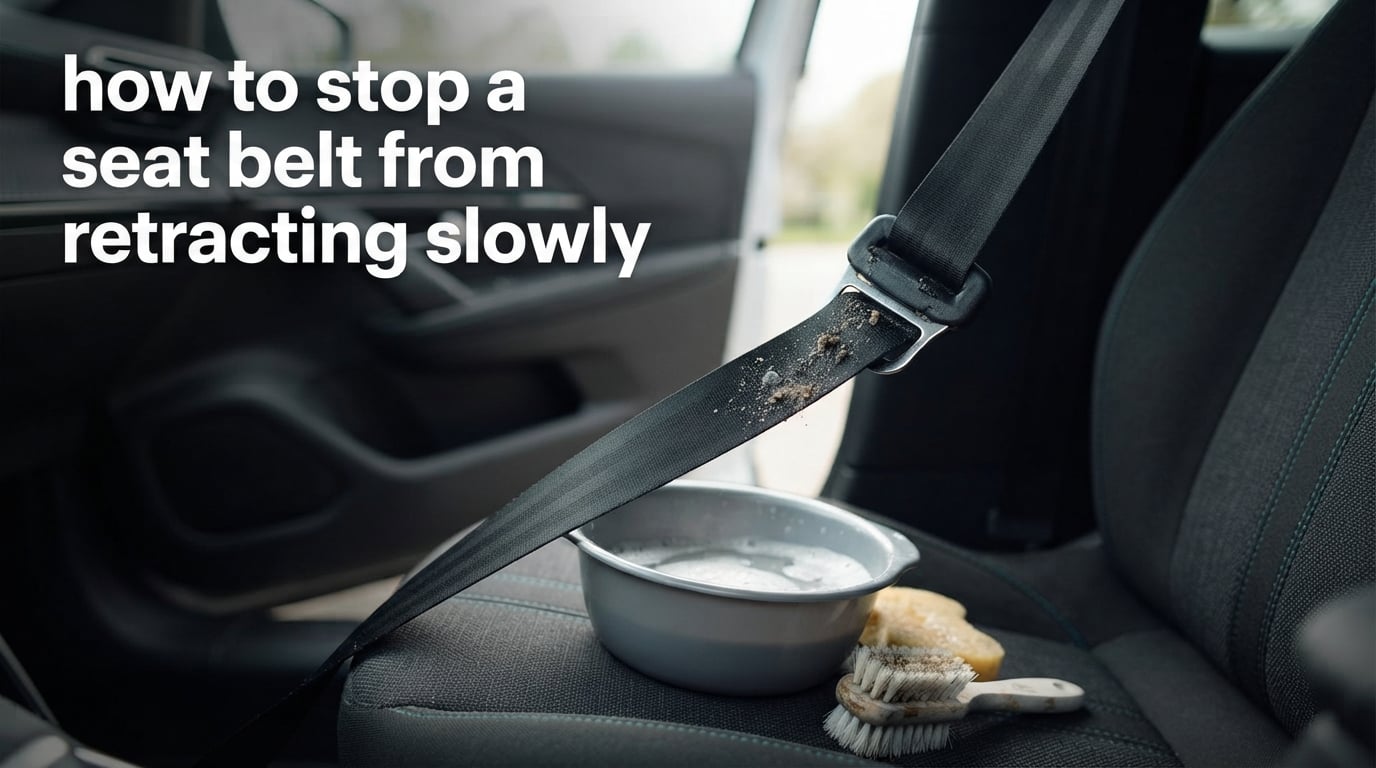
A seat belt that retracts slowly is almost always a dirty retractor, not a broken one. The fastest route is to pull the belt fully out, hold it extended, wash the webbing with warm water and a drop of mild dish soap, rinse it with a damp cloth, let it air dry completely, and check the loops and anchor points the belt runs through. That handles the majority of cases, and it costs almost nothing. This guide walks through how to stop a seat belt from retracting slowly, from diagnosis to the point where you should hand it to a professional. Updated for 2026.
The retractor is a spring-loaded spool that winds the webbing back into the pillar. When grit gets into the webbing, or the belt drags somewhere along its route, the spool has to fight the belt on the way in. The result is a belt that feeds out fine but flops back slowly and has to be hand-guided into the retractor.
On the DriveAccord forum, owners repeatedly describe exactly this: many fixed it by cleaning the belt itself, while others had to pull the retractor out, clean it, re-lubricate it and refit it. On r/subaru the accepted answer was simpler still, a thorough hot-water clean fixed the same fault on an Acura RSX.
Table of Contents
- How to Speed Up a Seat Belt Retractor: Six Steps
- Why Is Your Seat Belt Retracting Slowly?
- Step 1: Diagnose the Problem in Two Minutes
- Cold Weather Only or All the Time? What the Difference Tells You
- Step 2: Clean the Webbing
- Step 3: Clear the Friction Points Most Guides Skip
- Step 4: Untangle a Twisted Belt
- Tools and Supplies You Need
- What Not to Do: Five Things That Make It Worse
- What Each Repair Route Involves
- When to Stop and Call a Professional
- When the Answer Is Trim and Webbing Replacement
- How to Stop It Coming Back
- Frequently Asked Questions
- How to speed up a seat belt retractor?
- What are the possible reasons why my seat belt isn’t retracting?
- How to clean seat belts so they retract?
- How to fix a seatbelt that is slow to retract?
- How much does it cost to fix a seat belt retractor?
- How do I reset a seat belt retractor?
- How can I repair the webbing on my seat belt?
- What is the best solution for cleaning seat belts?
- Conclusion
How to Speed Up a Seat Belt Retractor: Six Steps
- Pull the belt all the way out and clamp it so it cannot retract.
- Wash the webbing with warm water and mild dish soap using a sponge or soft brush.
- Rinse with a damp cloth, then leave it extended to air dry for at least 24 hours.
- Check the D-ring, shoulder loop and pillar loop for grit, corrosion or a twist.
- Blow the anchor opening out with compressed air.
- Release the belt and test whether it snaps back fully and quietly.
Why Is Your Seat Belt Retracting Slowly?
Dirt and dust are the leading cause. Webbing is a flat woven strap with a nap that traps grit, and a belt that has never been cleaned in a dusty car can feel stiff and abrasive within a few years. Owners on the thenewx forum described it as the belt getting dirty and stiffening, fixed with a bucket of warm water and a small amount of Woolite.
Twists and kinks come second. A belt that folds back on itself at the D-ring or the lower anchor doubles its own thickness, and the spool cannot swallow the loop.
Third is friction at the routing points: the shoulder loop, the pillar loop, the D-ring and the lower anchor bolt. This is the failure mode that frustrates people most, because the webbing can be spotless and the belt still crawls back.
Rarer causes are corrosion or moisture damage from window tint work, a flooded footwell or a sun-baked door seal, and finally a tired retractor spring. The spring is the reason there is no user reset, and once it is weak, cleaning will not bring it back.
| Symptom | Likely cause | DIY fix | When to replace |
|---|---|---|---|
| Gritty feel when you pull the belt out | Dirt packed into the webbing | Warm soapy sponge bath, 30 minutes to overnight | Never, cleaning is enough |
| Grinds or clicks as it goes back in | Debris inside the retractor housing | Compressed air into the anchor opening | Grinding that persists after cleaning |
| Flops back and stops halfway | Twist at the D-ring or lower anchor | Untangle and feed the belt in straight | Twist keeps returning |
| Stiff only on cold mornings | Cold-stiffened webbing and condensation | Clean and dry; allow the car to warm up | Only if it never improves when warm |
| Slow every single time | Grime in the webbing or a weak spring | Full clean plus friction point check | No change once the belt is genuinely clean |
| Warning light on the dash | Fault in the belt or buckle circuit | None, do not attempt | Take it straight to a workshop |
Step 1: Diagnose the Problem in Two Minutes
- Look at the whole belt. Run it out slowly and inspect both faces for grit, dark staining, frayed fibres and any spot where the edges have rolled over.
- Check for a twist. A twisted belt lies with the dull back facing up instead of the printed face, and it will not pull in straight.
- Do the pull-and-release test. Pull the belt out about 300 mm and let go. A healthy belt retracts briskly and quietly. Drag, a stutter or a grinding sound points at the retractor.
- Listen while it retracts. Grit produces a rasping noise inside the housing. A failing spring tends to sound like a slow flutter instead.
- Test it warm and cold. If it is only slow in the morning, you are probably looking at moisture and cold-stiffened fibres rather than a mechanical fault.
- Check the anchor opening. Look into the slot where the belt disappears into the pillar. If you can see packed debris in there, that alone can hold the belt back.
YourMechanic flagged that debris entering the retractor is a genuine failure mode, which is why the anchor opening deserves its own look rather than a glance.
Cold Weather Only or All the Time? What the Difference Tells You
If the belt is slow only on a cold morning and returns to normal once the car has been warm for ten minutes, the retractor spring is almost certainly fine. Cold makes webbing stiff and slightly thicker, and any moisture trapped in the fibres freezes and adds drag. The fix is a clean and a thorough dry, not a replacement.
If the belt is slow in every condition, including a warm garage, treat it as a dirt, friction or spring problem and work through the steps below in order.
There is a third pattern worth knowing: slow in cold weather and slow again after rain, but fine when bone dry. That points at water tracked in on the belt and trapped in the fibres, and it usually clears with an overnight soak and a full day of drying.
Step 2: Clean the Webbing
This is the step that resolves most cases, and forum owners treat it as the first move rather than the last one. On YotaTech an owner soaks the belt in oxy-clean and the hottest water available overnight, then rinses. On the RAV4 forum the common method is a bucket of warm soapy water and a sponge, pulling the belt out slowly to clean the full length. The gentler version works just as well on most belts.
- Pull the belt fully out and hold it extended with a clamp or a clothespin at the B-pillar. This gives you the whole length to work on and keeps the spool from pulling the belt back in.
- Mix warm water with a drop of mild dish soap in a bucket. Woolite-class detergent is an equally good option. Avoid anything harsh.
- Wipe the webbing with a soft sponge or soft brush along the full length, working on both faces. A stiff nylon bristle brush lifts embedded grit well.
- Soak for 30 minutes for a lightly soiled belt. For a belt that has not been cleaned in years, or one that has been in a sandy car, soak overnight.
- Rinse with a damp microfibre cloth rather than soaking the retractor. Keep water out of the anchor opening where possible.
- Leave it clamped and extended to air dry for at least 24 hours before testing. Retracting damp webbing into the spool causes tangles and leaves detergent in the housing.
- Release and test. The belt should snap back fully and quietly on its own.
Hot water speeds up the clean, but keep it comfortably warm rather than boiling. Boiling water can shrink synthetic webbing and set detergent into the fibres.
Expect some water and detergent on your interior, which is the messy part owners complain about most. Laying down an old sheet first makes it a five-minute job instead of a cleanup job.
Step 3: Clear the Friction Points Most Guides Skip
No competitor page on this topic covers these, and they are the reason some clean belts still retract slowly. Work along the belt’s route from the buckle upwards and check each point.
- The D-ring and shoulder loop. The metal webbing guides at the top of the pillar corrode and catch grit. Wipe them with a damp cloth, then a dry one, and check they swivel freely.
- The pillar loop. A worn plastic loop on the trim panel can pinch the webbing. Wiggle it gently and clean out the gap behind it.
- The lower anchor bolt. Debris packs around the bolt head and under the washer. This is where a twist usually starts.
- The buckle tongue and its holder. Lint builds up around the webbing slot, and the tongue can stop seating fully.
- The anchor opening. Put the nozzle of a compressed air can into the slot where the belt retracts into the pillar and give it a few short bursts. A vacuum hose also works.
If the belt was tinted or fitted by a shop, the webbing is routed under a trim cover at the pillar base. Lift that cover and check for pinching, which is easy to miss and hard to see.
Step 4: Untangle a Twisted Belt
A twist is the one fault that makes a clean belt still retract slowly, and it is straightforward to undo. The JustAnswer expert response notes the same ladder: remove the seat belt assembly, clean the spool area with compressed air and mild cleaner, and lightly lubricate the spring with silicone.
- Pull the belt out to the point of the twist and find where the webbing crosses over itself.
- Loosen the twist at the D-ring or the lower anchor, not in the middle of the run.
- Untwist the webbing by hand until the printed face runs flat the whole length.
- Feed the belt back in slowly, letting it wind in without force, and keep tension on it as it goes.
- Test three or four times. A belt that keeps twisting usually has a burr or a deformed guide and needs a replacement part.
A light silicone lubricant on the retractor spring is a known technique among experienced owners, and it helps a stiff but healthy spring. Keep it off the webbing and off the buckle, and use very little.
Tools and Supplies You Need
You need warm water, a drop of mild dish soap or a Woolite-class detergent, a soft brush or sponge, a clean microfibre cloth, a bucket, and a clamp or clothespin to hold the belt extended. A compressed air can is worth having for the anchor opening. That is the whole list.
Seat belt scrubber attachments exist and are discussed on the Ford Transit forum, where owners dunk the webbing into soapy water for 30 minutes or more using a purpose-built tool. They work, but a sponge and a bucket do exactly the same job at no cost.
For the cleaning agent itself, mild dish soap is the best general answer. It cuts grease, it rinses clean, and it will not attack the fibres. Anything labelled for wool or delicates is a good second choice.
What Not to Do: Five Things That Make It Worse
- Never use bleach. It degrades the webbing fibres and can leave the belt weaker than when you started. Forum and video results on this query all flag the same warning.
- Stay away from solvents and harsh chemicals. Brake cleaner, degreaser and petrol-based products attack nylon webbing and can damage the retractor housing.
- Never cut, sew or glue the webbing. Webbing is load-bearing and is woven in a way your kitchen scissors cannot reproduce.
- Never disassemble a pretensioner. It is a pyrotechnic safety device, and it is not serviceable.
- Never fit a used or salvage belt. A belt that has been in a car will not have a verifiable history.
On WD-40 and similar penetrating oils, the general guidance is to keep them away from the webbing. A light silicone lubricant on the spring is the lubricant enthusiasts use, not a solvent.
What Each Repair Route Involves
If the clean does not work, there are three routes and the numbers that circulate online vary widely by vehicle and region, so treat any figure you read as a starting point for a quote rather than a fixed price.
| Route | What it involves | Who should do it |
|---|---|---|
| Clean and clear friction points | Webbing bath, friction point check, air out the anchor opening, untwist | Any owner with a bucket and a soft brush |
| Workshop clean and adjust | Assembly removed, spool cleaned, mechanism lubricated and re-tensioned | Worth it if you cannot get the retractor fully out or the belt is routed under trim |
| Retractor replacement | A new retractor assembly fitted, spring included | Technician, because the SRS circuit and anchor bolts are involved |
| Full belt assembly replacement | New webbing, D-ring, buckle and retractor as one unit | Technician, and the usual answer after a crash or a burnt belt |
The published ranges you will find online for a workshop clean or adjust and for a full replacement are rough guides from other owners rather than fixed prices, and both depend heavily on the vehicle. Get a written quote before any work beyond cleaning.
When to Stop and Call a Professional
Stop and hand it over if any of these apply.
- The belt does not retract at all, or stops halfway and will not move in either direction.
- You can see fraying, cuts, burns or a torn edge anywhere on the webbing.
- There is loud grinding or clicking that continues after a full clean.
- The SRS or seat belt warning light is on the dashboard. That signals a fault in the belt or buckle circuit, not a dirty spool.
- The belt is locked in the retracted or extended position after a collision. That is a deployed pretensioner and it needs a technician.
Driving with a slow belt is usually an annoyance rather than an immediate danger, because the belt still latches into the buckle. A belt that does not latch properly, or one with visible fraying, is a different matter and should be dealt with before you drive the car again.
When the Answer Is Trim and Webbing Replacement
Sometimes the fault is cosmetic rather than mechanical. Frayed trim, a cracked D-ring cover or a worn seat loop will not slow a belt down, but owners often discover them while working on the retractor. Re-covering trim and replacing webbing and D-ring hardware is a separate job from cleaning, and the frayed webbing should always be treated as a load-bearing part rather than trimmed to hide the damage.
If the webbing itself is damaged but the retractor is healthy, replacing the belt assembly rather than the whole assembly is often enough. That decision is worth a workshop opinion before you buy parts.
How to Stop It Coming Back
Most belts return to full speed and stay there once the webbing is clean. A few habits keep it that way.
- Let the belt wind back on its own instead of shoving it in by hand, which is what creates twists.
- Give the webbing a sponge bath with mild soapy water every few months in a dusty car.
- Do not hang heavy bags or a coat on the belt, since the load works the loops and the lower anchor.
- Keep sand, pet hair and salt off the belt, and park in a garage or under cover where you can.
- After a wet drive, run the belt out and let it dry fully rather than retracting it damp.
Frequently Asked Questions
How to speed up a seat belt retractor?
Pull the belt fully out and clamp it so it cannot retract, wash the webbing with warm water and a drop of mild dish soap, rinse with a damp cloth, let it air dry for at least 24 hours, check the D-ring and pillar loops for grit or a twist, blow the anchor opening out with compressed air, then release and test. A belt with a healthy spring will snap back fully and quietly afterwards.
What are the possible reasons why my seat belt isn’t retracting?
The usual reasons are dirt and grit packed into the webbing, a twist at the D-ring or lower anchor, friction at the shoulder loop or pillar loop, debris inside the anchor opening, and less commonly a weak retractor spring or moisture damage. Cold weather can make a mildly dirty belt feel slower without any mechanical fault.
How to clean seat belts so they retract?
Pull the belt fully out and clamp it extended, then work along the full length with a soft sponge or brush and warm water mixed with mild dish soap. Soak for 30 minutes for a lightly soiled belt or overnight for a heavily soiled one. Rinse with a damp cloth and leave the belt clamped and extended to air dry for at least 24 hours before testing.
How to fix a seatbelt that is slow to retract?
Work up a ladder. First clean the webbing and air out the anchor opening, then check the D-ring, shoulder loop, pillar loop, lower anchor bolt and buckle tongue for grit, corrosion or a twist. If the belt is already clean and the loops are clear, the retractor spring is the likely cause, and that is a technician job rather than a DIY one.
How much does it cost to fix a seat belt retractor?
Figures vary widely by vehicle and region, and the ranges published by owners online are rough guides rather than fixed prices. A DIY clean costs only a drop of detergent, a workshop clean and adjust sits well below a replacement, a retractor replacement is the mid-range option, and a full belt assembly replacement costs the most. Get a written quote before any work beyond cleaning.
How do I reset a seat belt retractor?
There is no user reset for a slow retractor. The spring is inside a sealed housing and cannot be re-tensioned from the cabin. A retractor that will not retract is either dirty, twisted or spring-failed, and cleaning addresses the first two. A belt locked after a collision is a deployed pretensioner and can only be dealt with by a technician.
How can I repair the webbing on my seat belt?
You cannot repair it. Never cut, sew or glue the webbing, because it is load-bearing and a repair will not restore its strength. If the webbing is frayed, cut, burnt or otherwise damaged, the belt assembly has to be replaced, and it should be replaced with an OEM-quality part.
What is the best solution for cleaning seat belts?
Warm water with a drop of mild dish soap, worked in with a soft sponge or soft brush, is the best general answer. A Woolite-class detergent is an equally good option. Never use bleach, solvents or harsh chemicals, since they degrade the fibres. Seat belt scrubber tools work but offer no advantage over a sponge and a bucket.
Conclusion
To stop a seat belt from retracting slowly, work the ladder in order: pull the belt out, clamp it, clean the webbing with warm water and mild dish soap, rinse, dry it for a full day, then work along the D-ring, shoulder loop, pillar loop and anchor opening clearing any grit or twist.
Most belts are fixed by that sequence. If yours is still slow once the webbing is genuinely clean and the loops are clear, the spring is the problem, and the retractor is a sealed unit that a technician should replace. Do not cut, sew or bleach anything along the way.