
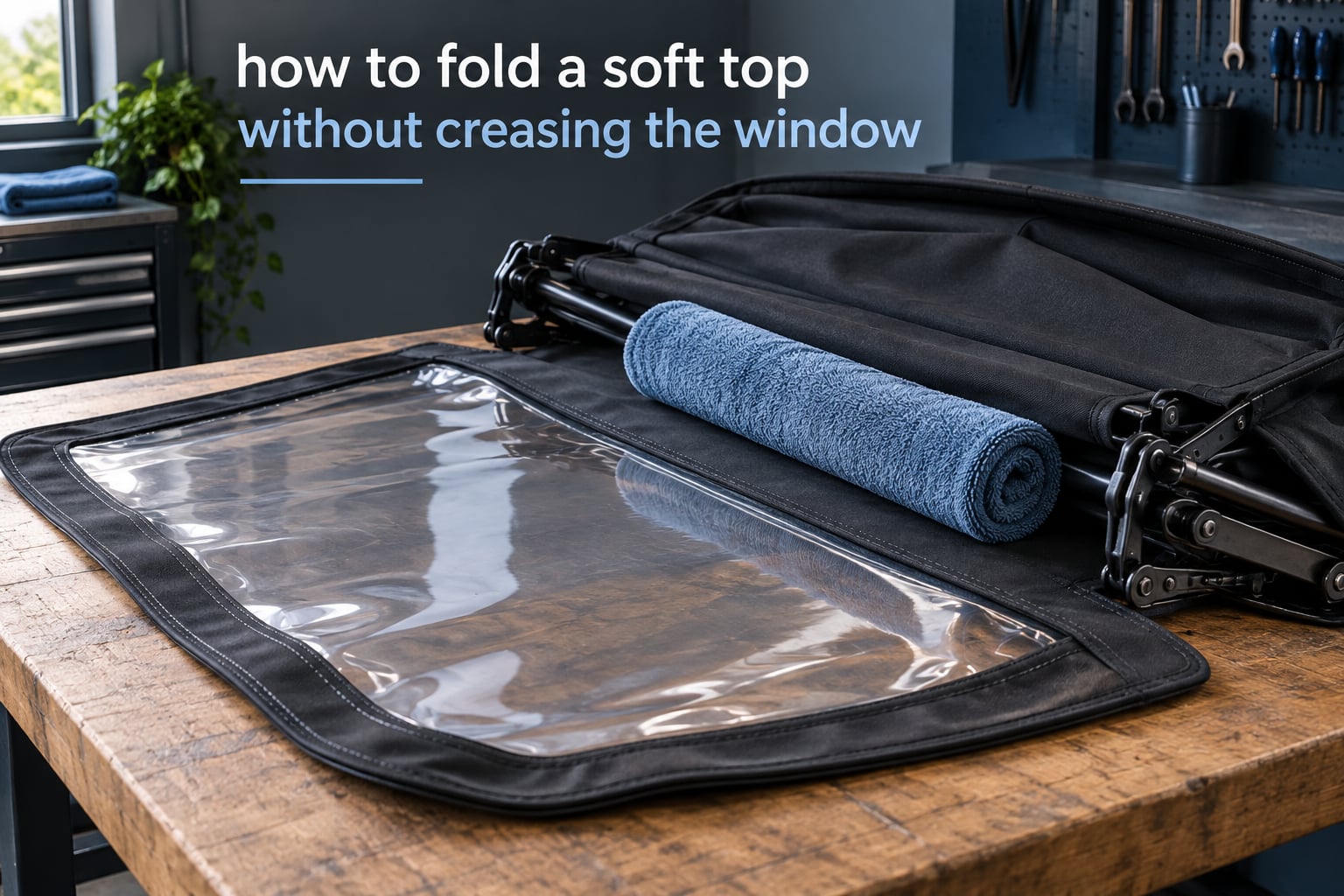
Clear vinyl and acrylic rear windows take a permanent set when they are held in a sharp fold under sustained pressure. To fold a soft top without creasing the window, release every latch, popper and Velcro attachment first, seat each bow flat against the bow in front of it so no fabric is pinched, and lay a soft non-abrasive pad along the fold line before the top closes down.
That is the whole method, and most damage happens because owners skip one of those three things. Page one of the search results for this question is almost entirely enthusiast forum threads, which tells you something useful: people want the technique confirmed by people who have done it, not a parts catalogue.
There is a correct way to fold a folding soft top, and the owner’s manual says so, often with a Technical Service Bulletin behind it. The procedure is a factory-mandated operation rather than folklore, and the reason it is specified is that folding is the single most common moment a top gets damaged. A crease is a permanent failure that never fully comes out, it cuts rear visibility, and a split vinyl window cannot be repaired reliably.
Below is the sequence we use, the mechanical reason it works, and what to do when a crease has already formed. We checked it against owner manuals, marque club knowledge bases and the recurring owner reports on folding technique.
Table of Contents
- What You Need Before You Start
- How to Fold a Soft Top Without Creasing the Window
- What Actually Causes a Creased Rear Window
- Tools and Padding: What Actually Stops Creasing
- Which Method Applies to Your Top
- Fixing an Existing Crease (and When It Is Too Late)
- Storing the Top Down Without Damaging It
- What Not to Do When Folding a Soft Top
- Frequently Asked Questions
- Should I unzip the convertible rear window before folding the top down?
- How long can I leave a convertible top folded down?
- Should I roll soft top windows or store them flat?
- Can a crease be removed from a convertible plastic window?
- Why is my rear window creasing even though I follow the manual?
- Why won’t my convertible top go down?
- How do I make a tired convertible top look new again?
- Should I run a soft top convertible through a car wash?
- Wrapping Up
What You Need Before You Start
You need very little, and none of it is expensive. Have these ready before the top comes off the frame, because the moment you start folding is the moment you stop being able to see what you are doing.
- A rolled bath towel or a soft foam-filled pillow, for the fold line across the rear window.
- A non-abrasive blanket or fleece throw, as a barrier between two window surfaces that may rest against each other.
- Your owner’s manual, open to the folding procedure, because release order differs between makes.
- A soft brush and a damp cloth, to clear grit off the rear deck and the window before it goes down.
How to Fold a Soft Top Without Creasing the Window
- Park on level ground and clear the rear deck. Grit, a spare wheel or a single stone left under the stowage lip will press a hard point straight into the vinyl.
- Warm the top before you move it. Cold vinyl and acrylic are stiff and crease far more readily, so fold on a mild morning or after the car has stood in the sun for an hour.
- Release every attachment before you push anything. Unlatch the quarter-light catches, peel back the Velcro strips along the headrail and rear deck, and unclip the poppers and tensioning hooks.
- Slide the rear bow forward until it seats tight against the bow in front of it. Sweep any fabric out from between the two bows as you go, because pinched material is what pushes the window into a fold it did not need.
- Fold the quarter lights inward along their frame seams. They should lie flat against the top body, not propped open like a tent, with the plastic resting on fabric rather than on hard frame metal.
- Lay a rolled bath towel, foam-filled pillow or non-abrasive blanket along the fold line directly across the rear window, so the crease forms in soft material instead of vinyl against vinyl.
- Push the frame back with the top laid flat, guide the hood into the stowage well, and latch the tensioning handles in order. Never force the frame past a point where it stops, because a bow that will not seat is usually telling you a catch is still fastened.
That last point is worth expanding. A frame that resists usually means a release you missed, not a mechanism that needs force. Forcing it is how a top gets creased even when the owner is following the manual, and it is why a bow that will not seat should be re-checked rather than pushed.
If the release order on your car feels unfamiliar, the manual is the authority. Some manufacturers publish a bulletin for this procedure precisely because owners were damaging the top, and a club knowledge base or marque demonstration video is often easier to follow than the printed sequence.
What Actually Causes a Creased Rear Window
Vinyl and acrylic are thin films bonded to a fabric header. Under sustained stress at a narrow bend they yield, and what they yield into is a set. Once the set forms, the window is permanently cloudy along that line and rear visibility drops every time the light hits it.
The causes are consistent across marques, and owners on Miata, Corvette and Wrangler forums report the same handful of them repeatedly.
- Fabric pinched between the bows. A Miata owner identified this as the direct cause of a creasing window: the rear bow has to slide tight against the bow in front of it, otherwise trapped material forces a fold into the window.
- Folding a cold top. Stiff vinyl has almost no give, so every small bend becomes a sharp one.
- Forcing the top down without releasing the locks and clips. Tension applied before release concentrates all of it on one place.
- Leaving it folded longer than necessary. A Wrangler owner reported a crease appearing after only a short folded period, so the answer to how long is too long is: shorter than most people assume.
- One window resting on another. The same report described permanent scratches from the side window plastic sitting on the rear window, which is a separate and equally permanent failure.
Tools and Padding: What Actually Stops Creasing
Padding is the single most repeated piece of real-world advice on this topic, and it appears on no competitor tutorial page. The principle is simple: the crease has to happen somewhere, so choose a material that creases instead of the window.
| Padding | How to use it | Good for |
|---|---|---|
| Rolled bath towel | Lay it in the crease of the back window along the fold line before the top closes | Everyday folding; a Corvette owner uses this to reduce scratching on the way down |
| Soft foam-filled pillow | Place it on the fold of the rear window, then close the top gently onto it | Longer stowage, where sustained pressure matters more than a single fold |
| Non-abrasive blanket or fleece | Drape it between the quarter light and the rear window | Stopping one window surface from scratching another |
None of these needs to be anything special. What matters is that the surface is soft and free of anything that can abrade vinyl, because a scratch and a crease are both permanent and neither one responds to the same fix.
For day-to-day care, keep the window clean before it stows and use a protectant formulated for vinyl and acrylic rather than a general interior dressing. Grit trapped under a folded window will work its way into the surface under pressure, which is why a damp wipe before folding costs nothing.
Which Method Applies to Your Top
Window design decides how much freedom you have. On some cars the rear window is part of the top and folds with it, on others it detaches and can be stored separately, and the difference changes the whole procedure.
| Top type | Can the window come off first? | Fold method |
|---|---|---|
| Clear flexible vinyl rear window, zipped into the top | Usually no | Full sequence above, with padding on the fold line |
| Unzippable or detachable rear window | Yes, on most designs | Remove and store the window flat, then fold the empty top |
| Framed quarter lights | No | Fold inward on the frame seam, keep plastic off hard metal |
| Frameless soft top with sewn-in rear glass | No | Warm it first, keep every bow seated, never force the frame |
Unzippable rear windows became standard on many later models, and the method back-fits some earlier cars with the same folding frame. If your window unzips, removing it removes the creasing problem entirely, provided you store it correctly.
Fixing an Existing Crease (and When It Is Too Late)
A fresh crease is still a stress-relief problem rather than a cosmetic one, and warmth is the accepted first response. Owners report removing creases by warming the window with a hot air gun, and the caveat they all give is the important part: keep the heat moving and never concentrate it on one area.
Move the airflow continuously, hold the gun well back, and warm the whole panel evenly rather than chasing the line itself. Direct heat on a single spot softens that spot only, and softened vinyl under a hard edge is exactly how a crease becomes a split.
Warmth alone will not fix a set crease, and it will not repair a split. Vinyl polish improves haze and light transmission on a lightly hazed window, so it is worth a try on a white line that still lets you see through. It will not restore a torn or perforated panel, and a split across your line of sight is a safety problem, not a cosmetic one, because rear visibility that varies with the light is a hazard you cannot plan around.
Seam damage is different again. A separated or lifted seam is stitched work on the top body, and it should be assessed before the fabric is allowed to pull further. A window that is still intact but a top whose seams have opened are two different repairs, and mixing them up wastes both.
Storing the Top Down Without Damaging It
The fold is the moment that decides how the window looks a month later, and stowage is where the damage accumulates. Time matters more than owners expect, because a window left folded holds its shape continuously, and the pressure never lets go.
Do not treat a stowage boot or tonneau cover as permission to leave the top down indefinitely. Use them to keep dust and water off a car that is being driven or stored for a defined period, not to replace raising the top.
For a car in long-term storage, the better answer is usually to raise the top, apply a breathable car cover, and keep the windows dry. If the top stays down, pad the fold line, keep a blanket between window surfaces, and set yourself a date to raise it again.
Removed window panels are the part owners argue about most, and the sensible rule is flat, not rolled. A rolled window puts a hard bend in it for the whole time it is stored, and rolling is only a storage method when the panel will be refitted soon. Where the panel came from matters too: lay it out on a clean flat surface, cover it so grit cannot settle on it, and keep pets and children off it, because the same permanent scratch applies.
A Wrangler owner on jlwranglerforums.com described the case worth avoiding: windows stowed where the side panel plastic rested directly on the rear window, leaving both a crease from folding and scratches that were not coming out.
What Not to Do When Folding a Soft Top
- Do not unzip the rear window and lay it down first as a shortcut. It helps a little with the immediate fold, but it does not replace releasing the frame attachments, and doing it alone leaves the original pinch point in place.
- Do not leave the quarter lights propped open. Folding them so they form a tent, as one marque guide puts it, makes a large boat of the top and guarantees the fabric never lies flat.
- Do not push the frame back with the top still attached to it. That introduces a fold before the top is ready to take one, and correct stowage becomes impossible afterwards.
- Do not force a frame that stops moving. A stuck frame is a release you have not undone, not a problem that resolves itself.
- Do not aim a heat gun at one spot to relax a crease. Moving air over the whole panel is what relaxes it; concentrated heat creates a weak point.
- Do not run a soft top convertible through a car wash tunnel. The brushes are aggressive, and a single top costs far more to replace than a wash.
None of this is fussy. The reason these matter is that every one of them produces damage the owner cannot undo, and the cost of a replacement window is a large share of what the top cost new.
Frequently Asked Questions
Should I unzip the convertible rear window before folding the top down?
Only if the window is designed to detach, and never as a substitute for the normal release sequence. Unzipping can ease the immediate fold, but the crease usually comes from fabric pinched between the bows or from a frame pushed before its catches are released. Release the attachments, seat the bows, pad the fold line, then close the top.
How long can I leave a convertible top folded down?
Less time than most owners assume, because the fold holds constant pressure. A Wrangler owner reported a crease forming after only a short folded period. For anything beyond a day or two, pad the fold line, keep a blanket between window surfaces, and plan to raise the top again. For long-term storage, raise the top and use a breathable car cover instead.
Should I roll soft top windows or store them flat?
Flat, wherever you have the space. Rolling puts a hard bend into the panel for the entire storage period, which is the same thing that causes a crease. Lay panels on a clean flat surface, cover them so grit cannot settle, and keep them away from anything that can scratch. Rolling is acceptable only for short-term storage before refitting.
Can a crease be removed from a convertible plastic window?
A fresh crease often relaxes with gentle, evenly applied heat, as owners report using a hot air gun. Keep the airflow moving and never hold it on one area, because concentrated heat softens a spot and turns a crease into a split. A crease that has already set will not fully come out, and a split cannot be repaired reliably.
Why is my rear window creasing even though I follow the manual?
Most often the rear bow is not sitting tight against the bow in front of it, so fabric is pinched between the two and forced into the window. Check the bow seating, the release catches, and whether the top was cold when you folded it. Clearing the pinched material before you close the top solves most of these cases.
Why won’t my convertible top go down?
A frame that resists is nearly always a release you have not undone, not a mechanism needing force. Re-check the quarter-light catches, the Velcro strips along the headrail and rear deck, the poppers and the tensioning hooks. If it still stops at the same point, consult the manual for your model’s release order rather than pushing harder.
How do I make a tired convertible top look new again?
Start with the fabric, not the vinyl. Clean the top with a soft brush and a product made for it, let it dry fully, then apply a protectant formulated for the material. For the window, a vinyl polish can improve light haze and transmission but will not fix a set crease. Replacement, not polish, is the answer to a split.
Should I run a soft top convertible through a car wash?
Hand wash it. Tunnel washes with spinning brushes and harsh chemistry will dull the top fabric, degrade the window plastic and can damage the seals at the rear deck, and the top is one of the most expensive single repairs on the car. If the top is down, it is also exposed for the whole wash.
Wrapping Up
Folding a soft top without creasing the window comes down to three things, and the sequence above just puts them in order: release every attachment, seat each bow tight against the one in front of it so no fabric is pinched, and pad the fold line so the crease forms in something soft.
Do it on a mild day, with the rear deck clear, and check the result before you close the top. If a crease has already set, gentle moving heat is the only realistic option, and a split across your rear view is a replacement job rather than a repair.
None of this is complicated, and all of it is in your owner’s manual somewhere. As of 2026, that manual is still the shortest route to the sanctioned method for your particular top, and the padding step is the part most guides leave out.