
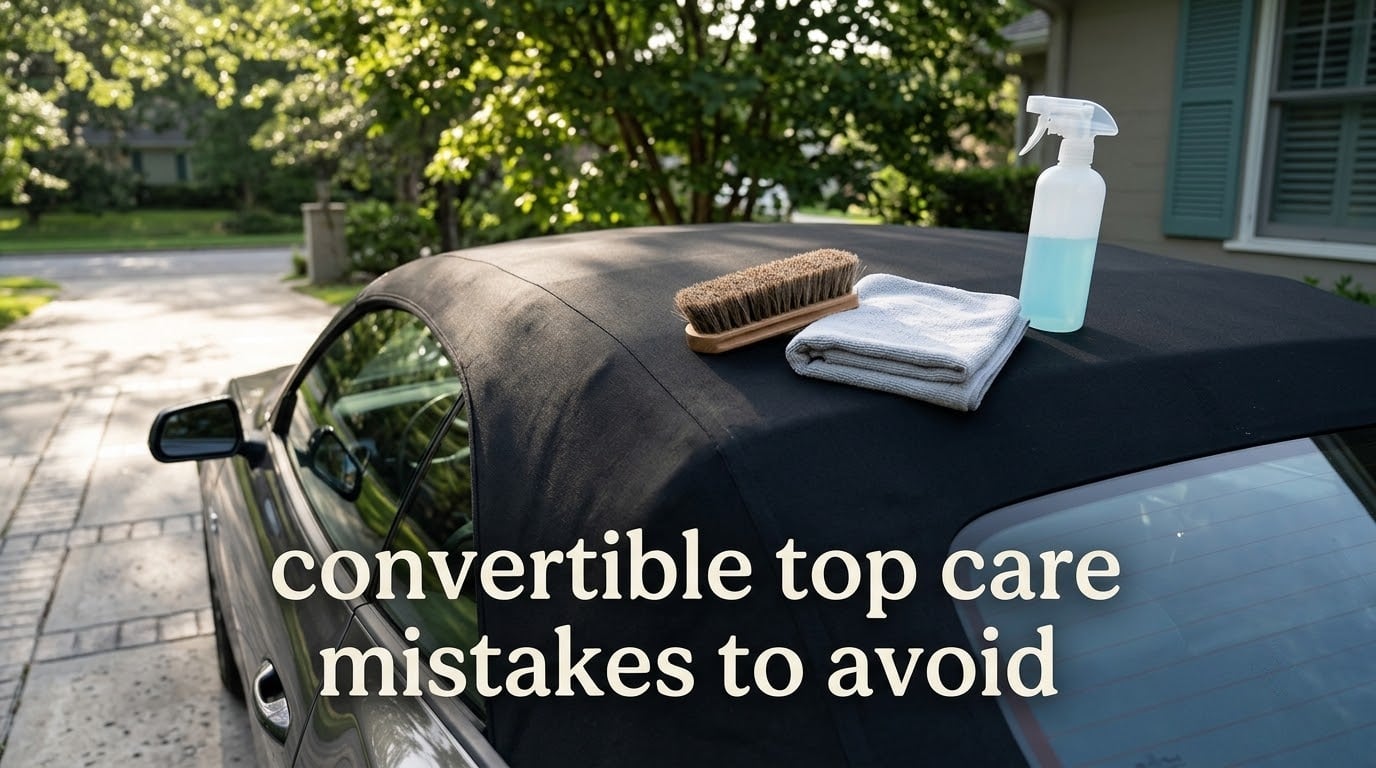
Most convertible top damage is not caused by sun and age. It is caused by a handful of handling and chemical errors that owners repeat without ever knowing it: washing fabric with soap, running the car through an automatic wash, waxing or silicone-coating a soft top, and layering protectant year after year. Those four account for most of the faded, stiff, streaked and leaking roofs we see. This guide walks through the convertible top care mistakes to avoid, what causes each one, and the correct routine that replaces them.
A convertible top, soft top and convertible roof are the same part. It is a tensioned fabric or vinyl membrane held by cables, hinges and latches over a weather-sealed frame, with a flexible plastic rear window bonded to the surrounding material. The fabric is porous and holds residue. The seams, stitching and window bond are the first things to fail when chemicals, heat or mechanical stress arrive in the wrong place.
We are a trimmings supplier, not a detailing shop, and we would rather you did less than more. Most owners need to touch their top once or twice a year, not monthly.
Table of Contents
- Start With the Material: What Your Convertible Top Actually Is
- The 10 Convertible Top Care Mistakes to Avoid
- Mistake 1: Running the car through an automatic car wash
- Mistake 2: Washing a fabric top with soap, dish soap, APC or degreaser
- Mistake 3: Waxing, silicone-coating or oiling the top
- Mistake 4: Over-waterproofing and reapplying protectant too often
- Mistake 5: Wet-cleaning a top that only needed a vacuum or lint roller
- Mistake 6: Applying protectant to a damp top
- Mistake 7: Ignoring hinges, cables, latches and drain tubes
- Mistake 8: Lowering the top with obstructions in the deck or trunk area
- Mistake 9: Storing the car with the top down for weeks
- Mistake 10: Leaving bird droppings, tree sap or pollen to bake in
- The Correct Cleaning and Protection Procedure
- Cleaning Methods Compared
- Fabric Top vs. Vinyl Top: What Changes
- Diagnosing Damage You Have Already Caused
- Do You Really Need to Clean Your Top?
- A Seasonal Convertible Top Care Schedule
- Frequently Asked Questions
- Can soft top convertibles go through a car wash?
- What is the best thing to clean a convertible top with?
- What is the best protectant for a convertible top?
- How often should I clean my convertible top?
- Should you store a convertible with the top up or down?
- What are some common problems with convertible tops?
- Final Word on Convertible Top Care Mistakes to Avoid
Start With the Material: What Your Convertible Top Actually Is
Material decides every other rule in this guide, so identify yours first. A fabric top is woven canvas, acrylic or polyester with a factory-applied water-repellent treatment. A vinyl top is a coated, non-woven material that behaves more like a car cover than like cloth. The rear window on almost every soft top is flexible plastic, not laminated glass, and cannot be treated like glass at all.
This distinction is not cosmetic. On fabric, a residue left behind by the wrong cleaner settles into the weave and becomes a dirt magnet. On vinyl, a film left behind by the wrong protectant bakes under heat and hazes the surface. The same bottle of product can help one material and permanently damage the other.
The 10 Convertible Top Care Mistakes to Avoid
Mistake 1: Running the car through an automatic car wash
No, a soft top convertible should not go through a car wash. Spinning brushes and high-pressure jets catch stitching, stress the seams and force water past the window seal into the headliner. Hand wash at low pressure, or use a rinseless wash.
Mistake 2: Washing a fabric top with soap, dish soap, APC or degreaser
Soap on a fabric top is almost always a mistake, for a mechanical reason. Surfactant rinses off a smooth panel but stays trapped in a woven pile, so the factory water-repellent stops working and the trapped residue attracts the dirt the wash was meant to remove. Dish soap, all-purpose cleaner and degreasers are worse, because their additives leave an oily film behind.
Mistake 3: Waxing, silicone-coating or oiling the top
Never wax, silicone or oil a fabric top. These products are built to sit on hard surfaces, and on a woven pile they leave streaks, blotches and discoloured chemical marks that are close to impossible to lift. BMW dealer guidance quoted in owner forums is blunt: never treat a soft top with wax. The same prohibition covers ceramic sprays.
Mistake 4: Over-waterproofing and reapplying protectant too often
More protectant is not better protection. Reapplying every few months stacks layer on layer until the fabric goes stiff and board-like, develops whitish chemical marks and takes on a plastic look. Owners on mustang7g describe this as the most common mistake on the platform. Two applications across the life of a well-kept top is closer to right than ten.
Mistake 5: Wet-cleaning a top that only needed a vacuum or lint roller
Loose sand, dust, lint and pollen come off with a vacuum and a lint roller, and that is the whole job. Wetting the top for dry debris pulls dirt down into the pile and into the stitching. Multiple Corvette owners running fleets of convertibles report vacuuming and rolling only, no soap at all, with tops that still look new.
Mistake 6: Applying protectant to a damp top
Dampness traps protectant unevenly and holds moisture in the pile, which is how mildew and musty odours start after a wash that never fully dried. Wait until the top is dry to the touch and cool, ideally overnight in shade, before any protectant goes on.
Mistake 7: Ignoring hinges, cables, latches and drain tubes
The mechanical side of the roof decides whether it still operates in year ten. Cables fray, pivots seize and latches wear, and owners typically lubricate hinges and pivot points every three to four years with a light lithium grease. The drain and weep tubes are the item almost everyone misses, and a blocked drain is why a top that seems fine on a dry day leaks over the passenger footwell in a downpour.
Mistake 8: Lowering the top with obstructions in the deck or trunk area
Clear the deck and trunk before folding. Headrests, roof bars, luggage and loose trim still in the path are pinched between the top and the frame, and that is how rear windows get cracked, webbing gets creased and paint behind the seats gets scratched. A rear window replacement is a far bigger job than clearing a boot.
Mistake 9: Storing the car with the top down for weeks
A top that sits folded for weeks takes a permanent set: fold marks across the fabric, a pinched or clouded rear window, and stitching that stays creased even after the roof goes up. Storage position matters more than storage duration.
Mistake 10: Leaving bird droppings, tree sap or pollen to bake in
These are time-sensitive, not permanent. Bird droppings are acidic, tree sap is effectively a natural adhesive, and pollen packs into the weave. All three set fast in warm weather and become a stain that no pH-neutral cleaner will fully remove. Treat them the same day you find them, with water and a soft brush, before anything else on the car.
The Correct Cleaning and Protection Procedure
Use this order. It works on both materials with small changes noted below.
- Work in shade on a cool surface. Direct sun drives protectant into the fabric before you can work it out.
- Vacuum the top with a soft brush attachment, then roll it with a lint roller. Skip this only if the top is already clean.
- Spot-treat droppings, sap and pollen first with a pH-neutral cleaner and a soft-bristle brush, then rinse.
- Dilute a pH-neutral or convertible-top-specific cleaner and apply it with a foam cannon or spray, giving it three to five minutes to dwell.
- Agitate with a soft-bristle brush in one direction so the pile does not mat.
- Rinse with a low-pressure hose. No pressure washer, and never aim water at a seam, a window edge or a drain tube.
- Dry with a dedicated chamois or towel, then leave the top fully dry before anything else. Blot water out of the weave rather than scrubbing it.
- Mask off the paint, glass, plastic trim, tonneau and rear window before protectant. Owners who lower the top partway and drape plastic sheeting over the fenders and header report this is what stops overspray problems entirely.
- Apply protectant sparingly in thin, even coats and let each one flash before the next.
- Keep separate towels, brushes and mitts for the top. Cross-contamination from the lower body of the car drags grit across the fabric and back onto the paint.
Cleaning Methods Compared
The method you choose matters more than the product brand. Here is how the common options stack up.
| Method | Pros | Cons | Recommended |
|---|---|---|---|
| Vacuum and lint roller only | Zero chemicals, zero water risk, protects the factory protectant | Will not shift grease, sap or mineral staining | Yes, for dust, lint and pollen |
| Water-only rinse and dry | Removes light road film without touching the weave | Needs a dedicated towel and a dry surface to work on | Yes, for most annual maintenance |
| pH-neutral cleaner, soft brush, low-pressure rinse | Shifts grime without stripping the top or leaving film | Slow, and needs shade, dwell time and a real dry-out | Yes, for fabric that is genuinely dirty |
| Foam cannon with pH-neutral cleaner | Good dwell coverage with minimal agitation of the pile | Over-dilution wastes product and under-dilution leaves residue | Yes, with correct dilution |
| Automatic or hand car wash | Quick and convenient | Strips protectant, stresses stitching, drives water into seams | No |
| Pressure washer | Fast for the bodywork | Forces water behind seams and into the headliner, causing trim rot and mould | No |
| Degreaser, APC, dish soap, household cleaner | Strong on grease | Leaves an oily film in the weave that attracts more dirt | No |
| Wax, silicone, oil or ceramic sealant | Works well on paint | Streaks fabric, marks vinyl, nearly impossible to remove | No |
Fabric Top vs. Vinyl Top: What Changes
Most published advice mixes both materials together and leaves owners guessing. Here is the side-by-side version.
| Material | What to use | What to avoid | Warning signs |
|---|---|---|---|
| Fabric (canvas, acrylic, polyester) | pH-neutral cleaner, soft-bristle brush, water-only rinse, sparing protectant | Soap, dish soap, APC, degreaser, wax, silicone, oil, ceramic, pressure washing | Residue in the weave, roughness, chemical marks, water no longer beading |
| Vinyl (coated, non-woven) | Diluted pH-neutral cleaner, soft brush, vinyl-specific protectant | Solvent cleaners, abrasive pads, hard wax, silicone, degreaser | Stiffening, fine cracking, hazing, chalking along seams |
| Plastic rear window | Plain water and a soft cloth | Window cleaners with alcohol or ammonia, abrasives, wax, protectant overspray | Clouding, yellowing, hazing, stress lines that spread after a knock |
Diagnosing Damage You Have Already Caused
If a mistake has already happened, work through the symptoms rather than repeating the treatment. Use a water-beading test on fabric: run clean water across a dry panel. If it sheets off in round beads, the factory protectant is still active and the top needs nothing. If it soaks in and darkens the pile, the protectant is gone and any further product is adding to a problem rather than solving one.
| Symptom | Likely cause | What to do | When it is beyond DIY care |
|---|---|---|---|
| Water soaks in instead of beading | Protectant stripped by soap or car wash | One careful clean, full dry-out, then one light protectant application | If it never beads after a second application |
| Whitish or bluish streaks and blotches | Over-application, wax or silicone residue | Stop adding product, do a gentle clean and let it cure for weeks | Streaking that persists through a full clean |
| Blue dye transfer to a white cloth | Dye has loosened from the fibre and is migrating | Stop wet cleaning entirely and use dry methods only | Transfer that continues while the car is parked dry |
| Fabric feels stiff or board-like | Protectant buildup, repeated over-application | Long gentle clean, then a single thin coat months later | Stiffness that permanently kills the fold |
| Wet patch inside the cabin after rain | Blocked drain tube or failed window seal, not fabric | Clear the weep tubes at the rear of the top and inspect the window gasket | A split gasket or torn window bond, which is a replacement job |
| Stitching or seam pulling apart | Mechanical stress, agitation or age at a high-load point | Nothing DIY restores it | Any open seam, which means a top replacement |
| Yellowed or clouded plastic window | UV exposure, and sometimes incorrect cleaner | Nothing reverses existing haze | Any loss of visibility, which is a safety limit |
Do You Really Need to Clean Your Top?
Sometimes no. Owner forums genuinely disagree on this, and the honest resolution is a decision rule rather than a schedule. If the top is parked under cover, rinsed occasionally by rain, and the weave still beads water, you do not need to clean it. Keep it dry, keep it folded or raised properly, and keep the drains clear.
Clean it when there is something to clean: visible road film, a spill, sap, droppings, an odour after getting wet, or a top that has stopped beading under normal use. That is usually one proper clean a year, sometimes two. Twice-monthly washing strips the factory protectant faster than weather does, and the top is worse for it.
The one habit worth keeping on schedule is the mechanical one. A yearly walk-through of the hinges, cables, latches and drain tubes takes a few minutes and prevents the failure that ends the top’s working life.
A Seasonal Convertible Top Care Schedule
Spring: Wash the car, not the top. Check the weep tubes at the rear of the top and clear them. Walk the hinges, cables and latches. If the top did not bead water all winter, that is the one moment a gentle clean and a single protectant coat are justified.
Summer: Vacuum and lint-roll the top. Spot-treat droppings, sap and pollen the same day. Keep the car in shade or under a breathable cover where possible. No protectant, no wax, no car wash.
Autumn: Clear leaves out of the top’s channels and the drain paths before they turn to sludge. Check the seam tape along the header and the rear corners. Store the car with the top fully up and fully latched if it is being put away for the season.
Winter: Store it with the top up, clean and fully dry, ideally garaged. If the car lives outside, use a breathable cover and never a plastic one. Do not start the car and leave the top half-raised in freezing conditions. A hard car cover is acceptable on a clean, dry top, but a dedicated convertible shelter is better where the fabric is faded or the stitching is already tired.
Frequently Asked Questions
Can soft top convertibles go through a car wash?
No. Automatic and hand car washes use spinning brushes and high-pressure jets that catch stitching, stress seams, strip the factory protectant and force water past the window seal into the headliner. Wash the body by hand instead and clean the top separately, or use a rinseless wash in a hand bay.
What is the best thing to clean a convertible top with?
On a fabric top, the best answer is often water and a dedicated towel, or a vacuum and lint roller when the debris is dry. When a real clean is needed, use a pH-neutral or convertible-top-specific cleaner, a soft-bristle brush and a low-pressure rinse. Never use dish soap, all-purpose cleaner, degreaser, wax or silicone.
What is the best protectant for a convertible top?
Look for a protectant made for the specific material: a breathable, water-repellent treatment for fabric, and a vinyl-specific conditioner for vinyl. Avoid anything wax, silicone or oil based. Apply sparingly, only to a fully dry top, and far less often than you think you should. Mask off paint, glass and the plastic rear window first.
How often should I clean my convertible top?
Once a year in most climates, and only when there is something to remove. Many owners with garaged or lightly used cars never use soap at all and simply vacuum, lint-roll and rinse with water. Clean more often only if the car sits outdoors in dust, pollen, coastal salt air or heavy tree cover.
Should you store a convertible with the top up or down?
Store it with the top up, fully latched, clean and completely dry. Leaving the top folded for weeks causes permanent fold marks across the fabric, pinched stitching and a clouded or stressed rear window. If the car must be stored outside, add a breathable cover rather than a plastic one.
What are some common problems with convertible tops?
The most common problems are faded and sun-bleached fabric, chemical streaks from wax or silicone, stiffening from over-applied protectant, mildew smells after a damp storage or wash, water entering the cabin from a blocked drain tube or failed window seal, seized hinges and frayed cables, and permanent fold marks after long periods with the top down.
Final Word on Convertible Top Care Mistakes to Avoid
The convertible top care mistakes to avoid come down to restraint. Keep the top dry, keep it clean with the least method that works, keep the mechanical parts lubricated, and keep the drains clear. Skip soap on fabric, skip car washes, skip wax and skip the urge to reapply protectant every season. A top cared for this way usually reaches the far end of its expected life with its fabric, seams and rear window still in working order, and it costs nothing but attention. If you are unsure which material you have, work that out before you buy a single product, and keep the mechanical side of the job on the same schedule as the fabric.