
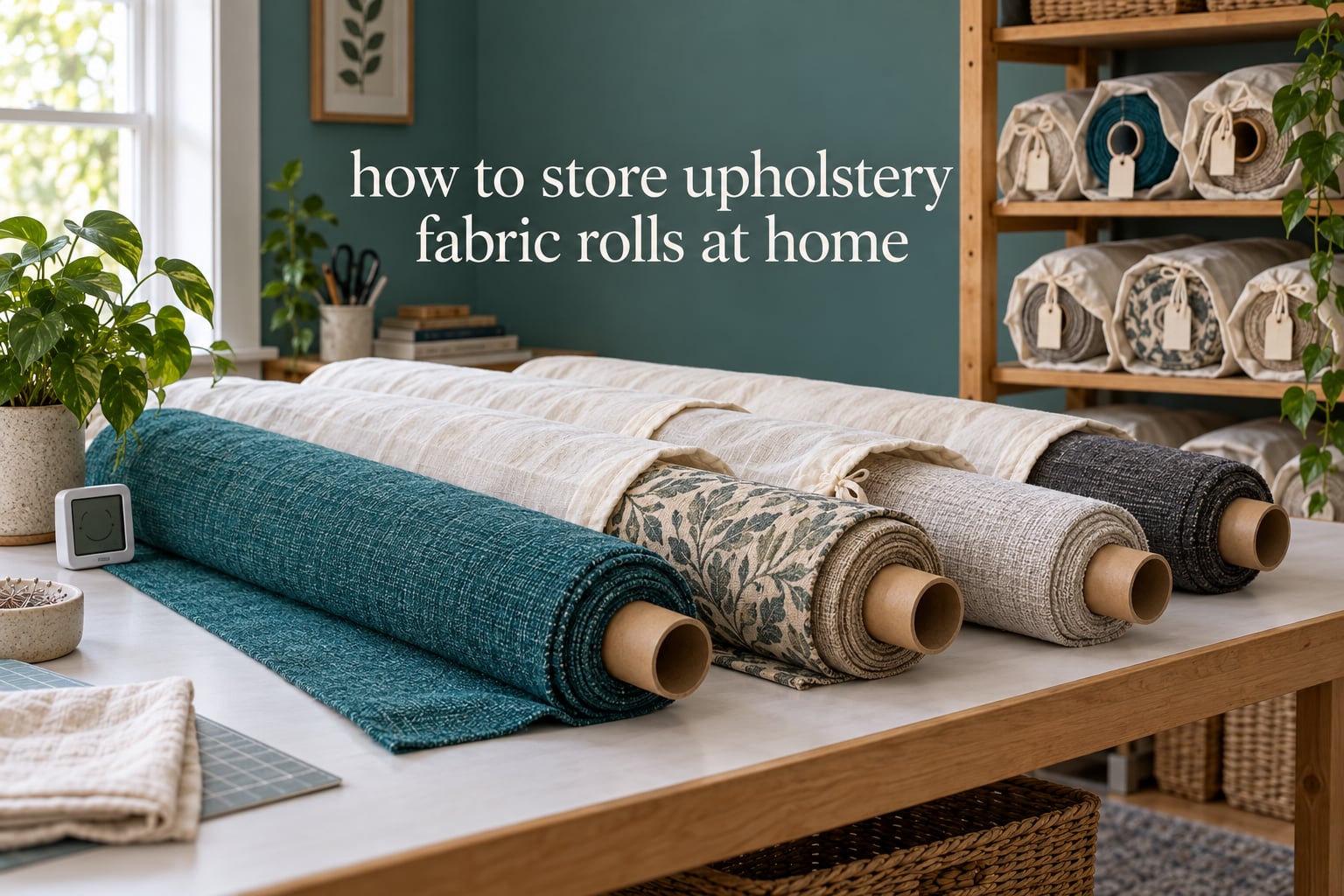
To store upholstery fabric rolls at home, always roll the fabric and never fold it, onto a rigid core such as a 3 to 4 inch cardboard tube. Keep each roll in a cool, dry, dark room off the floor, wrapped in a breathable muslin dust cover, and label it with the fabric type, width, yardage and the date you rolled it.
That is the whole method, and it takes about five minutes per bolt. The reason it matters is that upholstery fabric is wide, heavy and expensive, and it fails in storage in four specific ways: permanent creases from folding, mildew from damp, insect damage from unwashed body oils, and fading from sunlight. A bolt stored badly can be unusable, and the piece you cut into is the piece you cannot return.
I have watched perfectly good 54 inch canvas disappear because someone folded it into a closet shelf. I have also pulled a roll of marine vinyl out of a damp basement corner that smelled of mustiness within a year. Neither problem is complicated to avoid once you know what is actually attacking the fabric.
Table of Contents
- Quick Picks: 5 Best Ways to Store Upholstery Fabric Rolls at Home
- Why Upholstery Fabric Needs Different Storage Than Quilting Cotton
- Step-by-Step: How to Roll Upholstery Fabric at Home
- Core Inserts: What to Roll Onto (and What to Avoid)
- The Best Storage Locations in a Home, Room by Room
- Protecting Rolls From Moisture, Moths, Dust and Sunlight
- Storage Ideas for Small Homes and Tight Spaces
- Building a Simple Fabric Roll Inventory
- Recovering a Creased or Musty Roll Before You Cut It
- What NOT to Store with Upholstery Fabric
- How to Use Leftover Upholstery Fabric
- Frequently Asked Questions
- How to store rolls of fabric?
- What are some ways to store fabric rolls?
- What is the best way to store fabric bolts?
- How to fold fabric onto a bolt?
- How long can upholstery fabric be stored?
- Can I store upholstery fabric in the garage?
- Should I wash fabric before storing it?
- What is the best humidity for storing fabric?
- How do I keep fabric rolls from molding?
- How do I store vinyl or leather rolls?
- How do I use leftover upholstery fabric?
- Does tissue paper keep clothes from wrinkling in a suitcase?
- Final Checklist Before You Put the Roll Away
Quick Picks: 5 Best Ways to Store Upholstery Fabric Rolls at Home
These five methods cover almost every home situation, from a two roll stash to a dedicated sewing room. Each one lists who it suits best so you can pick in a few seconds.
- Cardboard core inside a lidded bin. A 3 to 4 inch tube wound with the fabric, stood upright in a plastic bin with a loose lid. Best for small apartments and for anyone storing two or three bolts. Low effort, low cost, and good pest protection as long as you do not seal damp fabric inside.
- Wall mounted dowel or pipe rack, horizontal. A cantilever style rack with arms that hold wide bolts sideways, the way a warehouse rack does. This is the single best option for 54 inch goods because the roll never carries weight on its own core. Medium effort, and it uses wall space that is otherwise dead.
- Vertical rolls in a tall deep bin. Wide-mouth bins that let a 54 inch roll stand on end. Good for cotton and canvas, poor for vinyl and anything with a nap, because the pressure of the sides can flatten the pile. Low effort and cheap.
- A spare room nook with muslin covers. Rolls stood against a wall, each one wrapped in a breathable cotton or muslin cover and labelled on the outside. This is the answer when your fabric is expensive and you want to see what you own. Medium effort, high protection.
- A climate controlled closet shelf. A shelf inside the house where temperature and humidity stay steady all year. The safest option for genuine leather, velvet and anything you plan to keep for more than a year. Highest protection, least effort once set up.
Why Upholstery Fabric Needs Different Storage Than Quilting Cotton
Quilting cotton and upholstery cloth behave like different materials in storage, and most advice on the internet is written for cotton. A roll of quilting cotton is light, narrow and forgiving. A roll of upholstery goods is 54 inches wide, often twice the weight per yard, and it will crush anything stacked on it.
Here is what actually differs.
- Width and weight. Standard upholstery goods run 54 inches wide, so the finished roll has a diameter several times larger than a quilting cotton roll of the same yardage. On a normal shelf, a heavy canvas bolt crushes the shelf below it and flattens the roll underneath.
- Heavy woven cloth behaves like a soft mass. Canvas, basket weave and heavy twill keep their own weight, so the core inside has to be stiff enough to carry that load or the roll telescopes and slumps.
- Pile direction on chenille and velvet. These fabrics have a brushed nap that must face the same direction across every piece in a project. Store them loosely and never compress them, or the pressure resets the pile and you get shading that no amount of brushing will fully fix.
- Vinyl and faux leather are non absorbent. They do not wick moisture the way woven cloth does, so condensation can sit on the surface. They need airflow more than cotton does, which is the opposite of the usual advice.
- Genuine leather cannot be rolled tightly at all. A hide or a thick leather upholstery roll cracks along the fold when it is wound on a core. Leather needs flat stacking with interleaving sheets between each piece.
| Fabric family | Roll or flat | How tight | Cover | Special handling |
|---|---|---|---|---|
| Woven cotton and canvas | Roll on a core | Snug, not tight | Muslin or cotton dust cover | Launder or steam before storage |
| Chenille and velvet | Roll on a wide core | Loose | Breathable muslin, never plastic | Keep the nap facing one direction |
| Faux leather and vinyl | Roll loosely | Very loose | Breathable cover, air flow required | Wipe clean, keep away from heat sources |
| Genuine leather and hide | Flat stack, no roll | Not applicable | Acid free tissue between pieces | Store cool, check every few months |
Step-by-Step: How to Roll Upholstery Fabric at Home
This is the procedure most guides skip, and it is the part that determines whether your roll is still usable in three years. Work on a clean floor, lay the fabric face up, and give yourself a clear 54 inch wide space.
- Clean the fabric first. Launder or steam it before it goes anywhere near storage. Moths are not attracted to wool fibres, they are attracted to body oils, food residue and starch, and washing removes the thing they are actually hunting.
- Choose a core that matches the width. For 54 inch goods use a 3 to 4 inch diameter cardboard tube. A thin core lets the centre of the roll telescope inward and push a hard crease down the middle of every layer.
- Attach the core to the leading edge. One strip of painter’s tape on the selvedge, or a single rubber band, is enough. Do not use masking tape, and never tape the face of the fabric.
- Roll with the face out and the nap consistent. Keep both selvedges running straight down the roll and aligned with each other. A crooked start becomes a spiral, and a spiral becomes a roll that unravels in the bin.
- Roll snug, not tight. You should be able to slide a finger under the outer layer without tugging. Over winding crushes the pile on chenille and pushes dye out of the core on printed cloth.
- Secure the tail without taping the face. Tuck the loose end under itself, wrap it with a muslin strap, or tie it with a length of twine. Tape on the face leaves an adhesive mark and a shadow line that shows on the finished piece.
- Label it immediately. Fabric type, width, remaining yardage, the date, and the project you bought it for. Do this at the table, not weeks later when the roll is already at the back of a bin.
- Move it straight to storage. A freshly made roll is at its most fragile for the first hour, so do not carry it across the house in an awkward grip. Two people for a full 30 yard canvas bolt is not overkill.
If the fabric is already creased before you roll it: steam it from the reverse side first, let it cool flat under a clean weight for a few hours, then roll. Rolling a crease in locks the crease in permanently.
Core Inserts: What to Roll Onto (and What to Avoid)
The core does the structural work. It holds the fabric open so nothing creases, carries the roll’s own weight, and gives you something to grip, label and hang. Match the diameter to the width of goods rather than buying whatever is cheapest.
- Cardboard tube, 3 to 4 inch diameter. The default and the best value. Fabric shops give away large tubes, and wrapping paper and carpet tubes work too. Cheap, easy to find, and easy to cut to length.
- PVC pipe. Heavier and more rigid than cardboard, so it never buckles under a heavy canvas roll. It will not absorb moisture, which makes it a good choice for vinyl and for damp climates.
- Cut pool noodle. The hobbyist favourite because it is soft, cheap and easy to cut. It is fine for cotton and canvas, and too soft for leather or anything very heavy.
- Mailing tube. Rigid, smooth and widely available, but usually only 2 to 3 inches in diameter, so it is better for remnants than for full bolts.
- Acid free tube. Worth it for silk, wool, natural dyed cloth and anything you plan to keep for years, because ordinary cardboard is acidic and will yellow the fabric over long contact.
What to avoid: newspaper print cores at long contact, because the ink transfers. Cores thin enough to telescope. A heavy bolt resting on a soft one. And never seal a roll in a plastic bag first, because the trapped moisture shows up as mildew on the inside of the fabric where you cannot see it until you unroll it.
The Best Storage Locations in a Home, Room by Room
Two variables decide whether a room works: how much the temperature swings, and how much the humidity swings. The room name matters far less than those two numbers. An unheated garage in a northern climate can swing 40 degrees or more between day and night, and that swing, not the word garage, is what grows mildew.
| Room | Temperature risk | Humidity risk | Verdict |
|---|---|---|---|
| Interior closet | Low | Low | Best |
| Spare room or sewing room | Low | Low | Good |
| Under a bed on a raised platform | Low | Medium | Good, use sealed zip bins |
| Finished basement | Low | High | Conditional, run a dehumidifier |
| Unheated garage | High swing | High | Conditional, short term only |
| Crawlspace | High swing | High | Avoid |
| Attic | Extreme | High | Avoid |
| Sunroom or porch | High swing | Medium | Avoid, sunlight fades dye |
| Closet on an exterior wall | Medium | Medium | Avoid if the wall runs damp |
| Shed or outbuilding | High swing | High | Avoid |
The interior closet wins because it shares air with the rest of the house, so temperature and humidity stay in the range fabric was made to live in. Put the rolls on the floor of the closet or on the bottom shelf, off the carpet, on a pallet or a couple of 2 by 4s so air can move underneath.
The attic is the worst room in the house and the reason is physical, not superstitious. Heat rises, so an attic in summer can sit well above 120 F, which bakes the resin out of some backings and makes vinyl and faux leather brittle and permanently creased.
The garage is conditional. A roll stored in a garage in a mild climate for a few months is usually fine. A roll stored through a northern winter is not, unless you seal it in a zip bin with a desiccant and keep the bin off the concrete floor where condensation collects.
Protecting Rolls From Moisture, Moths, Dust and Sunlight
These four threats account for nearly all fabric damage in a home, and each one has a specific, inexpensive countermeasure.
Moisture: hold 50 to 55 percent relative humidity
Target 50 to 55 percent relative humidity and 65 to 75 F, which is the range textile storage standards use. A cheap digital hygrometer in the storage spot is the only way to know what you actually have, and it is worth more than any amount of guessing.
Do: check the hygrometer twice a year, run a dehumidifier or a small desiccant pack in humid months, and keep rolls off the floor. Do not: seal damp fabric in an airtight bin, where condensation forms on the inside of the lid and sits on the roll.
Pests: wash first, then deter
Clothes moths, silverfish and carpet beetles all come for what is on the cloth, not the fibre itself. Laundering or steaming before storage removes the attractant and is the single step that prevents most infestations.
Do: steam or wash, inspect the selvedge for larvae and webbing before rolling, use cedar blocks or lavender sachets for a mild deterrent, and use zippered bins with tight seals. Do not: use mothballs. The odour permeates the fabric permanently and the residue has to be professionally removed.
Dust: cover, but breathe
Dust works its way into fibre and into pile, and on velvet it dulls the surface permanently.
Do: use muslin, cotton sheeting or a purpose made fabric dust cover, and slip the cover on after the roll is in its final position. Do not: use dry cleaning bags or sealed plastic for anything longer than a few months. Breathability is what makes a cover protective rather than destructive.
Sunlight: block it completely
UV light fades dye unevenly, which is why a sunroom roll looks great in year one and mismatched in year three. Direct light also weakens fibre, not just colour.
Do: keep rolls inside a closed cabinet, behind an opaque cover, or behind UV film if a window is unavoidable. Do not: test a light coloured fabric in a sunny spot, because checking colourfastness by leaving it in the sun is how you fade it.
Storage Ideas for Small Homes and Tight Spaces
Space is the real constraint for most people, and it is the complaint that comes up again and again in sewing forums. The standard blue plastic bin solves the visibility problem by making it worse, so here is what actually frees up room.
- Wall mounted dowel or pipe rack. Two brackets and a length of 1 inch dowel hold several 54 inch bolts horizontally, cantilever style, with no weight on the core. This is the highest capacity per square foot of any home option.
- Tension rod in a closet. A spring tension rod wedged between two closet walls takes a full length of dowel, and a bolt slides on and off the dowel rather than onto the rod. Cheap, removable, no drilling.
- Over the door. An over the door rack or a set of hooks on the back of a door holds a few rolls if the door clears the frame when it swings. Check the clearance before you drill.
- Under the bed. Works well for remnants and short bolts in sealed zip bins, and poorly for anything you need to see. Keep a written inventory for whatever lives here.
- Vertical storage in tall bins. Standing 54 inch rolls upright uses the height you already have. Work out how many fit by remembering the roll diameter grows as the yardage does, so plan on the largest roll, not the smallest.
- One shelf, sorted, not eight. Sort by fabric type, width and whether a project is planned for it, which is the habit that came out of the most practical answers in sewing forums. Colour sorting looks tidier and is useless when you need a 4 yard remnant.
On ceiling hanging: it frees a lot of floor space and it is how workshops do it, but it is only safe where the structure is designed for it. Never hang a heavy canvas bolt from a suspended ceiling tile grid.
Building a Simple Fabric Roll Inventory
An inventory is not bureaucracy. It stops you buying the same fabric twice, and it is the only way to know which rolls are worth keeping and which are just taking up a shelf.
- Label format. Fabric type, width in inches, remaining yards, date acquired, and the project it is reserved for. Write it on masking tape stuck to the core, not on the cover, so you can read it without disturbing anything.
- One phone photo per roll. Shoot it flat against a plain background before it goes away, so you have a colour and texture reference that makes ordering a repeat purchase accurate.
- Cut a swatch card. A small 4 by 4 inch piece from a hidden seam allowance, glued to card with the label. It lives in a drawer instead of a roll taking up a whole shelf.
- Rotate first in, first out. Use the oldest roll in the next project, so nothing sits for a decade. Anything past a few years unused and unlabeled is a candidate for the donation pile.
For leftover upholstery fabric specifically: the most reliable answer is that you will not store it, you will use it. Throw pillows, ottoman covers, cushion re-covers, tote bags, dog beds, headboard panels, bike covers and headliner accents are all sized for upholstery remnants.
Recovering a Creased or Musty Roll Before You Cut It
Most storage damage is discovered the moment you unroll the fabric, and most of it is recoverable if you act before you cut.
Set creases: unroll the fabric fully, steam from the reverse side, brush the pile back into direction with a soft clothes brush, and hang the length for 24 to 48 hours. Then re-roll loosely onto a fresh core. Creases that respond to steam usually disappear in one pass. Hard shiny fold lines that do not lift have compressed the fibre and no longer come out.
Surface musty smell: check colourfastness first by testing an inconspicuous spot. Then air the fabric in indirect daylight for a few hours, brush it, and re-roll. Direct sun is the last resort, and only for a colour you have confirmed will not fade.
Deep mold: a musty smell with dark speckling is usually not recoverable at home. Isolate the roll so it cannot touch the others, and plan on washing or professional cleaning. Do not roll it back into storage, because the spores go with it.
Dried water stain on chenille or velvet: take it to a professional upholstery cleaner. Velvet and chenille pile mats permanently with heat and pressure, and a home iron is the fastest way to make it worse.
What NOT to Store with Upholstery Fabric
Storage fails as often through what you put next to the fabric as through the fabric itself. Here is the selection guide, method by method.
| Storage method | Typical cost | Space used | Protection | Best fabric type | Effort |
|---|---|---|---|---|---|
| Core in a lidded bin | Low | Low, floor standing | Good against dust and pests | Woven cotton, canvas | Low |
| Wall mounted horizontal rack | Medium | High, wall space | Good, airflow around the roll | All woven goods | Medium |
| Vertical rolls in a tall bin | Low | Low, floor space | Good against dust | Woven cloth only | Low |
| Breathable muslin cover on a shelf | Low | Medium, shelf space | Good, roll stays visible | All, including velvet | Low |
| Sealed zip bin with desiccant | Low | Low, under bed or closet | Very good against pests, risky if damp | Short term only | Low |
| Flat stack with acid free tissue | Low | High, needs large flat area | Good, no creasing at all | Genuine leather and hide | Medium |
Pick breathable over sealed for anything stored longer than a few months. Sealed plastic is excellent for a dust cover and for a two week overflow, and it is the wrong choice for a bolt you intend to keep for years, because any moisture inside has nowhere to go.
Pick acid free over ordinary cardboard for silk, wool, natural dyes and anything stored past a year or two. Acid free board and acid free tissue are pH neutral and will not yellow or embrittle the cloth over long contact.
Pick cedar or lavender over mothballs, always. Mothballs leave a residue and an odour that a professional cleaner has to deal with.
Never stack a fresh heavy canvas bolt on an older compressed roll. The bottom roll takes the load for months and develops the creases you were trying to avoid. If you must stack, put the heaviest at the bottom, put boards between the layers, and never stack more than three.
Keep strong odours away from fabric. Paint thinners, motor oil, smoke and scented candles transfer into fibre and are difficult to remove. This matters more than most people expect in a garage, a workshop or a home with a vinyl or leather stash.
How to Use Leftover Upholstery Fabric
The best storage method for a remnant is to use it. Upholstery remnants are 54 inch wide, which is exactly the size of a pillow square, a tote panel or a cushion cover once you take the seams off.
- Throw pillows and cushion covers. The fastest project and the best use of a small remnant.
- Ottoman or bench re-covers. Worth it if you already have the foam.
- Headboard panels and door panels. Upholstered panels give a plain door the same look as a full upholstered wall.
- Tote bags, bike covers, saddle covers. Marine vinyl and canvas remnants are ideal for these.
- Headliner and interior trim accents. For anyone working on a car or boat interior, a stored roll of matching headliner cloth is worth far more than the new project you will want to match it to later.
- Donate or list it. Someone else is always looking for a specific yardage and colour you will never use.
Frequently Asked Questions
How to store rolls of fabric?
Roll the fabric, never fold it, onto a rigid core at least 3 inches in diameter. Store the roll standing or lying in a cool, dry, dark room off the floor, wrap it in a breathable muslin dust cover, and label it with the fabric type, width, yardage and date. Keep the room between 50 and 55 percent relative humidity.
What are some ways to store fabric rolls?
The five most reliable home methods are: a cardboard core in a lidded bin, a wall mounted dowel or cantilever rack holding bolts horizontally, vertical rolls in a tall deep bin, rolls stood in a spare room nook with muslin covers, and a climate controlled closet shelf. Each keeps the roll off the floor, off other rolls, and out of direct light.
What is the best way to store fabric bolts?
On a rigid core, in a cool, dry, dark room, wrapped in a breathable cover, with nothing heavy on top of it. A horizontal wall rack is the best option for 54 inch upholstery goods because the bolt never carries weight on its own core, which is what causes creasing and slumping in a stack.
How to fold fabric onto a bolt?
You roll it rather than fold it. Attach a 3 to 4 inch cardboard core to the leading selvedge with a strip of painter’s tape, roll with the face out and both selvedges aligned, keep the winding snug enough that a finger slides under the outer layer, then tuck and strap the tail instead of taping the face.
How long can upholstery fabric be stored?
In a cool, dry, dark interior room at 50 to 55 percent relative humidity, well rolled on a rigid core and covered, upholstery fabric keeps for many years. In a damp or hot space, expect fading and fibre weakening within a couple of seasons. Check stored rolls twice a year for musty smell, fading at the exposed edge or pest damage.
Can I store upholstery fabric in the garage?
Only for short term storage in a mild climate, sealed in a zip bin with a desiccant and raised off the concrete. An unheated garage in a northern climate can swing 40 degrees or more between day and night, and that temperature swing, not the word garage, is what causes mildew. An interior closet is always better.
Should I wash fabric before storing it?
Yes. Clothes moths are attracted to body oils, food residue and starch rather than to the fibre itself, so laundering or steaming before storage removes the attractant. It is the single step that prevents most infestations, and it is the step most often skipped. Let the fabric dry completely before rolling it.
What is the best humidity for storing fabric?
Aim for 50 to 55 percent relative humidity, at a temperature of 65 to 75 F. Put a cheap digital hygrometer in the storage spot, since indoor readings vary room by room. Above roughly 60 percent you get mildew risk, and below 40 percent natural fibres such as wool and leather can become brittle.
How do I keep fabric rolls from molding?
Keep the relative humidity between 50 and 55 percent, store rolls off the floor, give them airflow, and never seal damp fabric in an airtight bin where condensation forms on the lid. Use a dehumidifier or a desiccant pack in humid months. If you find dark speckling, isolate the roll immediately and do not roll it back into storage.
How do I store vinyl or leather rolls?
Marine vinyl and faux leather are non absorbent, so condensation sits on the surface rather than soaking in. Roll them loosely on a wide core, keep them in a breathable cover with airflow, and keep them away from heat sources. Genuine leather should not be rolled tightly at all, because it cracks along the fold, so stack it flat with acid free tissue between each piece.
How do I use leftover upholstery fabric?
Upholstery remnants are 54 inches wide, which is the right size for throw pillows, cushion and ottoman covers, tote bags, headboard and door panels, dog beds, bike and saddle covers, and headliner accents for car and boat interiors. Using the remnant is faster and cheaper than finding space to store it for a project you may never start.
Does tissue paper keep clothes from wrinkling in a suitcase?
For clothes, it helps somewhat, but the real result comes from rolling rather than folding. For upholstery fabric, acid free tissue is worth using when you must fold or flat stack, and it is unnecessary when you roll onto a core, because the roll already prevents the creasing that tissue is designed to reduce.
Final Checklist Before You Put the Roll Away
Run through this list at the table, before the roll leaves your hands, and the storage problem is solved for years.
- Rolled, never folded.
- On a rigid core sized to the width of goods.
- Faced out, nap consistent, both selvedges aligned.
- Laundered or steamed, and completely dry.
- Labelled with type, width, yardage, date and planned project.
- Wrapped in a breathable muslin cover, not sealed plastic.
- In a cool, dark room at 50 to 55 percent relative humidity, off the floor.
- Nothing heavy stacked on top, and a hygrometer check twice a year.
That is how to store upholstery fabric rolls at home: roll them on a core, cover them so they can breathe, keep them cool and dark and off the floor, label them, and check them twice a year. It takes an afternoon to set up and costs very little, which is far cheaper than re-buying a bolt you have already damaged.