
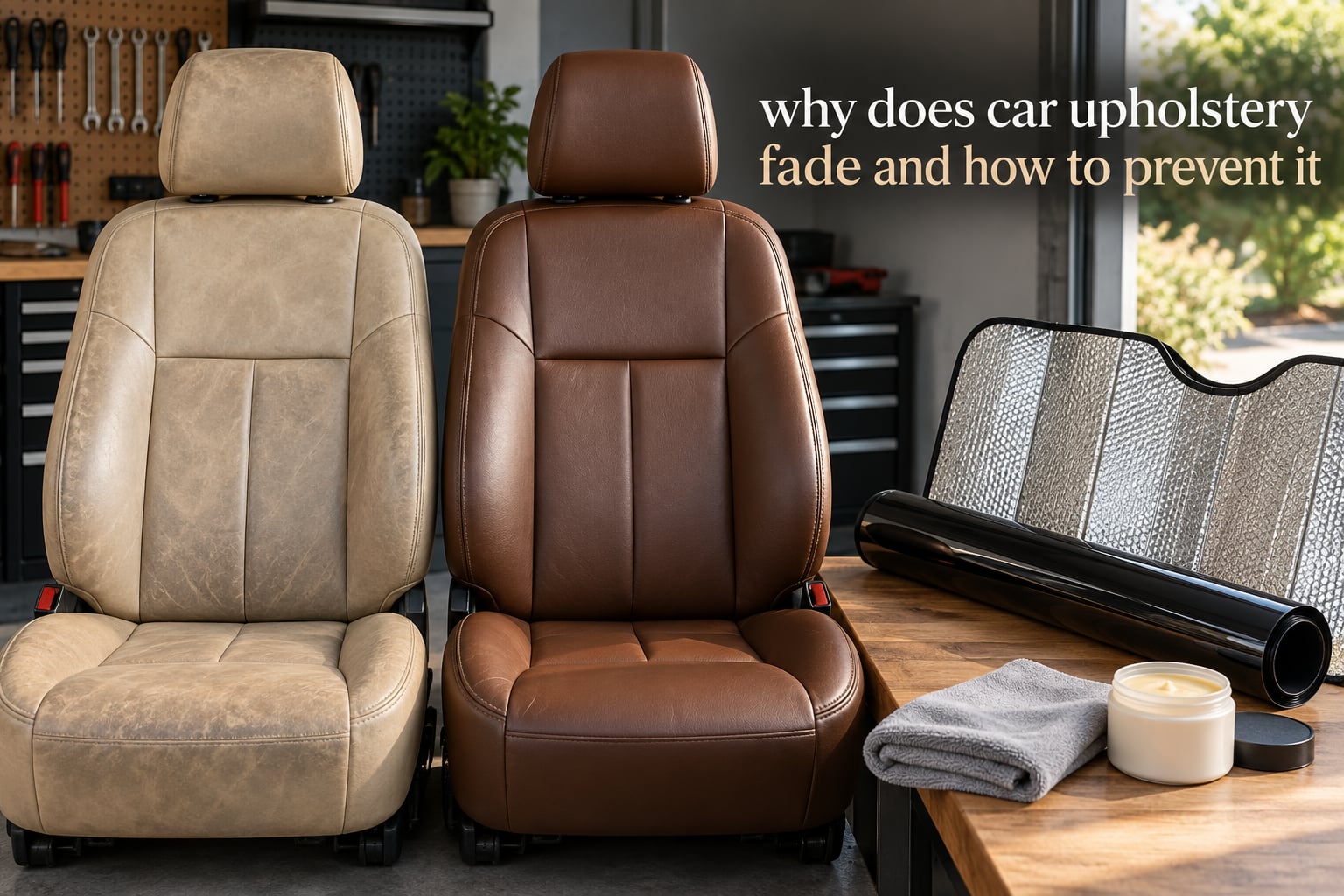
If you have ever noticed the driver’s side of your seat looking washed out while the passenger side still looks new, you already know the answer to why car upholstery fade. The short version is sunlight. Ultraviolet radiation carries enough energy to break the chemical bonds inside dye molecules, heat speeds that reaction up and pushes pigment out of the fibre, and a second set of non-sun effects adds to the dulling. The important expectation to set early: protection slows fading, it does not reverse pigment that has already left the material.
We spend a lot of our working life inside vehicles, and faded upholstery is the most visible record of accumulated sun exposure. It shows up on the door tops, the seat bolsters, the dash top and the headliner, usually in the same order every time. It also drives resale value down, and a bleached surface cracks and stains more easily than a protected one.
This guide covers the actual chemistry, the differences between leather, vinyl, cloth, Alcantara and plastic trim, a step-by-step prevention plan, and an honest look at what restoration can and cannot do. No competitor page in the results covers the non-sun causes or the material differences, so that is where most of the useful detail sits.
Table of Contents
- What Is Car Upholstery? The Materials That Fade Differently
- Why Does Car Upholstery Fade? The Chemistry in Plain English
- Upholstery Materials Fade Differently
- Signs Your Car Upholstery Is Fading
- How to Prevent Car Upholstery From Fading
- How to Protect Fabric Car Seats
- How to Protect Leather and Vinyl Seats
- Window Tint, Sunshades, Covers, and Seat Covers: What Each Actually Blocks
- Prevention Mistakes That Make Fading Worse
- Can Faded Upholstery Be Restored? What Works and What Does Not
- How Long Does Car Upholstery Last? Timelines by Material and Climate
- A Seasonal Maintenance Schedule for Your Interior
- What to Look for in UV Protection Products
- Common Myths About Car Upholstery Fading
- Frequently Asked Questions
- How to keep car color from fading?
- Can I use Scotchgard on fabric car seats?
- Is there a spray that can actually protect fabric car seats?
- How can I restore faded fabric car seats?
- Can leather discoloration be fixed?
- Why does my car seat fade on one side only?
- Which is better for car seat covers, leather or fabric?
- How long does car upholstery last in the sun?
- Final Thoughts
What Is Car Upholstery? The Materials That Fade Differently
Car upholstery is the padded, finished covering of a vehicle interior: seat surfaces, door panels, dashboard, headliner, pillars and trim. It is not a single material. Most cars combine two to five of them, and each reacts to sunlight in its own way.
- Leather – either aniline, semi-aniline, or coated (corrected-grain) finish. Colour sits in the surface pigment rather than in a woven fibre.
- Vinyl – a PVC-based synthetic leather with a colour layer and a plasticizer for flexibility.
- Cloth – woven or knitted polyester or polyester-blend, with colour locked into the fibre itself.
- Alcantara and suede – a short, raised fibre pile with a velvety surface, used on sporty and luxury interiors.
- Plastic trim and textured panels – moulded polypropylene or similar, pigmented on the surface and frequently grained to hide texture.
Knowing which of these you own changes the protection advice completely, and confusing them is one of the most common mistakes we see.
Why Does Car Upholstery Fade? The Chemistry in Plain English
Car upholstery fades because ultraviolet radiation breaks the chemical bonds inside dye and pigment molecules, destroying the colour that gives the surface its tone. Heat accelerates that reaction and drives dye out of the fibre, while secondary effects – oxidation of plastics, loss of plasticizers in vinyl, and alkaline or mineral staining – add to the washed-out look. Nearly all fading is cumulative, which is why it shows up slowly and then suddenly.
Ultraviolet radiation breaks the dye molecules
Dyes and pigments are molecules held together by chemical bonds. Absorbing a high-energy photon can break one of those bonds, and once it breaks, the molecule no longer reflects the wavelength of colour it used to reflect. The surface keeps absorbing light and returns less colour back to your eye, so it reads as faded.
Two bands matter. UVA is the longer wavelength and penetrates more deeply into the material, driving damage below the surface where you cannot see it until the top layer fails. UVB is shorter and more energetic, concentrating surface-level damage. Both contribute, and most daylight glass blocks more UVB than UVA, which is why interior glass can still pass a meaningful share of UVA.
Heat then does the second job. Hot surfaces expand slightly, which opens the fibre structure and lets dye migrate to the surface or out entirely. This is the main reason a dash that reaches high temperatures every day fades dramatically while the same dash in a shaded garage holds its colour.
Heat accelerates the reaction and drives dye out of the fibre
Sun exposure is a combination of light and heat, and the heat half is often ignored. A parked car interior can climb well above outside air temperature on a clear day, and that repeated thermal cycling does more than the light alone.
Leather takes this worst. Aniline and semi-aniline finishes have little or no protective topcoat, so heat and light hit the dye directly, and the leather dries and stiffens at the same time. Coated leather fares better but then cracks instead of fading, which is a different problem with the same root cause.
Non-UV causes: oxidation, plasticizer loss, staining, and dye bleed
Not all fading is sunlight. Several processes that have nothing to do with UV can produce the same pale, chalky look, and confusing them leads to the wrong fix.
- Oxidation – plastics and vinyl chalk as their surface polymers react with oxygen over time. They feel powdery, not merely pale.
- Plasticizer loss – vinyl relies on plasticizers to stay flexible. As they migrate or evaporate under heat, the surface stiffens, whitens and eventually cracks.
- Alkaline and mineral staining – alkaline cleaners and hard-water deposits leave a dull film that reads as fading until it is removed.
- Dye migration – dark jeans, black coats and new seat covers can bleed dye into cloth or leather. This is a stain sitting on the fibre, not pigment leaving it, and it behaves completely differently under a damp cloth.
A damp microfibre towel is the first test. If the light patch lifts, you are looking at surface grime or transferred dye. If it does not lift, the pigment itself has gone.
Upholstery Materials Fade Differently
The table below is the fastest way to work out what you are dealing with. Speed is a general pattern, not a promise; climate and parking habits move everything on this scale.
| Material | Primary fade mechanism | Typical speed | Best protection | Restorability |
|---|---|---|---|---|
| Leather (aniline) | Dye degradation plus surface drying | Fast, uneven | Garage parking, tint, pH-neutral conditioner with UV filters | Partial; recolouring by a specialist |
| Leather (coated) | Topcoat breakdown and cracking | Slow fade, faster crack | Tint plus conditioning to keep the topcoat supple | Limited; deep cracking is permanent |
| Vinyl | UV degradation plus plasticizer loss | Moderate to fast | Tint, matte vinyl protectant applied cool | Poor; whitening and stiffening are hard to reverse |
| Polyester cloth | Dye loss from fibre and heat-driven migration | Slow but steady | Fabric protectant on a schedule, seat covers | Good; dye can often be recoloured |
| Alcantara and suede | Fibre pigment loss and pile wear | Moderate | Dry cleaning only, tint, avoid water-based protectant | Poor; worn pile does not grow back |
| Plastic trim | Oxidation and chalking | Moderate | Dash cover, tint, UV-stable dressing | Partial; dressing masks chalking temporarily |
One pattern shows up constantly in our inspection work: the driver’s seat and the entry and exit bolsters fade first, and faster than the rest of the cabin. That is per-occupant sun exposure combined with abrasion at the door top, not a fault in the material.
Signs Your Car Upholstery Is Fading
- One side of the cabin or one seat is noticeably paler than the other.
- The seat is several shades lighter where you sit and darker where you never sit.
- Door tops and pocket edges have lost their colour while the lower panels have not.
- White or grey patches on bolsters and headrests that do not wipe away with a damp cloth.
- Dash and door plastics feel powdery or chalky rather than firm and textured.
- Vinyl or leather has gone stiff, pale, or slightly split along seams.
- Dark transfer marks on light cloth, or light residue on dark cloth, after wearing jeans or a new cover.
- Colour difference between a covered area and an exposed area of the same seat.
Do that damp cloth test before you spend anything. It tells you whether you are fighting a surface deposit or a pigment loss, and the two need completely different products.
How to Prevent Car Upholstery From Fading
Seven steps, in the order that returns the most protection for the least effort.
- Block the light at the glass. A quality window film is the highest-leverage single step because it reduces the exposure reaching every surface at once, not just the seat in front of you.
- Use a windshield shade every time. It costs nothing and blocks the direct overhead exposure that hits the headliner, dash and front seat tops.
- Park in a garage or under cover whenever you can. Outdoor parking in a high-UV climate is the single biggest driver of interior fade.
- Cover the highest-exposure surfaces. A dash cover and fitted seat covers break up the continuous exposure without changing the cabin’s look if you pick low-profile ones.
- Clean with the right chemistry. pH-neutral, diluted, and applied cool. Grit left in the fibres acts as a grinder against UV-damaged surfaces.
- Condition and protect on a schedule. Leather and vinyl every few months, fabric protectant once or twice a year, always on a cool, shaded interior.
- Reduce the hot-car habit. Avoid leaving thick covers, papers, or a steering wheel cover parked in direct sun, and deal with spills before they set.
Notice what is not on this list: nothing reverses lost pigment. Every step above is about reducing the rate of loss.
How to Protect Fabric Car Seats
Fabric car seats are the easiest interior surface to protect, because the colour sits in the fibre and a protectant can seal the surface against both UV and spill absorption. The routine is simple and the reapplication is the part most people skip.
- Vacuum thoroughly – grit under the seams scratches fibres that are already weakened by UV.
- Clean with a pH-neutral product – diluted, and tested on a hidden seam first.
- Let the seats dry completely – applying protectant over damp fabric traps moisture and encourages mildew.
- Apply the protectant in thin, even coats outdoors in shade, following the label cure time.
- Reapply on a schedule – protection wears off with use, not with the calendar. Expect roughly two applications a year for daily-driven cars.
On the question that comes up constantly: yes, you can use a water-repellent fabric protectant on fabric car seats, and Scotchgard-type products are the same category of chemistry. Two cautions. First, test on a hidden seam, because some leave a temporary water mark or a slightly darker patch. Second, never put a leather conditioner on cloth, and never put a water-based protectant on Alcantara or suede. On the detailing forums, a GTechniq-type fabric protectant is reported holding roughly nine months on a daily-driven car, and 303-type fabric guards have a long-standing reputation for the same job.
How to Protect Leather and Vinyl Seats
Leather and vinyl need fewer products but more consistency. The goal is to keep moisture in the material and keep the surface layer supple, because supple surfaces crack later than dry ones.
- Clean first with a pH-neutral leather cleaner, diluted, on a microfibre cloth, never a stiff brush.
- Condition every three to four months with a conditioner that contains UV inhibitors, applied thinly to a cool interior.
- Use a separate vinyl protectant for plastic panels, and choose a matte or low-gloss finish so the dash does not turn shiny and hazy.
- For aniline leather, move to a monthly routine in high-heat climates; it holds less water and dries faster.
Never apply anything to a hot surface. A dashboard at driving temperature will flash off water-based product and leave uneven patches that look worse than the untreated panel.
Window Tint, Sunshades, Covers, and Seat Covers: What Each Actually Blocks
These four get lumped together in most advice, but they block different things and have different failure modes.
| Option | What it blocks | Strengths | Limitations |
|---|---|---|---|
| Window film | UVA and UVB at the glass, across the whole cabin | Works while driving and while parked; protects every surface at once | Fixed; quality varies widely; heat rejection is separate from UV rejection |
| Windshield sunshade | Direct overhead and forward sun | Cheap, no installation, protects headliner and dash top | Only helps while parked; easy to forget |
| Breathable car cover | UV, rain, and bird droppings over the whole vehicle | Broadest coverage while parked outdoors | Awkward daily; a poor-quality cover can rub and trap moisture |
| Seat and dash covers | Direct exposure on the seat and dash surfaces only | Targets the worst-hit areas precisely | Daily on and off; fit and colour matter for resale |
Used together they compound, which is why tint vendors describe them as the highest-leverage single intervention and why the rest of this plan assumes film is already in place.
Prevention Mistakes That Make Fading Worse
These are the failure cases we see most often, and several of them start as good intentions.
- Harsh cleaners and household bleach. Bleach and alkaline products strip oils from leather, break down vinyl, and leave cloth brittle. On the Dodge Dart forum, advice ranges from a damp microfibre cloth to products like Folex to lemon juice and diluted chlorine bleach. Bleach is the one that costs you a seat.
- DIY dye and recolouring. Household dye on cloth seats takes unpredictably and permanently discolours.
- Cross-material products. Leather conditioner on cloth, or a water-based protectant on Alcantara, causes exactly the mottling people are trying to fix.
- Applying protectant to a hot interior. Product flashes off and dries unevenly, and the dash ends up blotchy.
- Skipping the cooling-down period. Cleaning a hot seat with a wet cloth pushes water and cleaner into heat-stressed fibres.
- Assuming one application lasts years. Protectant wears off with handling. A single application creates a false sense of security that ends two summers later.
The forum consensus we trust most is also the simplest: a damp microfibre towel is the first thing that visibly improves a neglected seat, and it costs nothing.
Can Faded Upholstery Be Restored? What Works and What Does Not
Partly. The honest answer is that restoration is material-specific, and the difference between a surface deposit and true pigment loss decides the outcome.
- Dye transfer and surface grime – genuinely fixable. A damp cloth lifts transfer; a proper extractor or hot-water extraction with the right chemistry handles embedded soil. This is why people report dramatic results from a portable carpet extractor on seats.
- Chalky plastics – partly fixable. A trim dressing restores colour and a matte finish temporarily, but the polymer underneath has already oxidised.
- Leather dye loss – partially fixable. Recolouring by a specialist can bring a panel close to the original, but it is a specialist job, results vary by material, and mismatched batches are common. Multiple owners report choosing recolouring over replacement, with that same caveat.
- Deep leather cracking, whitened vinyl, worn Alcantara pile – not fixable without recovering the seat. Once the surface layer is gone, products can make it look better temporarily and no more.
So can leather discoloration be fixed? Often partly, and rarely completely. If the panel is structurally sound, recolouring is worth pricing. If it is cracked through or the pile is worn off, you are budgeting for recovering or replacing the seat, and protecting the rest of the cabin so you do not repeat the expense.
How Long Does Car Upholstery Last? Timelines by Material and Climate
These are typical patterns, not guarantees. They assume average use, and they move a long way with where you park.
| Situation | What to expect |
|---|---|
| Temperate climate, garage parked, tinted | Colour largely held for the life of the car |
| Temperate climate, outdoor parking | Visible driver-side fading over roughly 5 to 8 years |
| Hot, high-UV climate, outdoor parking | Noticeable dash and bolster fading within 2 to 4 years |
| High-exposure work vehicle, all-day sun | Dash plastics chalking and door-top wear within 1 to 2 years |
| Untreated aniline leather, high-UV climate | Significant surface change within 2 to 3 years |
If your car is well past the range for its parking situation, protection is now a preservation plan rather than a prevention plan. The remaining original material is worth slowing down.
A Seasonal Maintenance Schedule for Your Interior
| Season | What to do |
|---|---|
| Spring | Full vacuum and pH-neutral clean, check the tint for edge lifting and the dash for early cracking |
| Summer | Reapply fabric protectant, condition leather and vinyl every three months, keep the sunshade in the car |
| Autumn | Detail and deep clean before the low-sun months, treat any dye transfer before it sets |
| Winter | Inspect for salt and grit, wipe plastics and check the headliner, condition lightly before storage |
The whole routine is a few hours a year. It is also the difference between protecting an interior and replacing one.
What to Look for in UV Protection Products
Skip the brand list and grade against these four criteria instead, because the wrong product for your material does more harm than no product.
- Material compatibility stated on the label. If it does not name leather, vinyl, cloth, and Alcantara separately, treat it as a general-purpose product and check with a detailer before the first coat.
- A real UV filter, not just a marketing term. Look for named UV inhibitors or a stated UVA and UVB blocking figure rather than a vague durability claim.
- Finish. Matte or low-gloss for dashboards and plastics, since gloss dressings turn hazy and then magnify the appearance of chalking.
- Reapplication interval. Any credible product has one. If the label says nothing, assume it wears off faster than you hope.
- pH-neutral cleaning chemistry as the base of the routine, since no protectant survives being coated in alkaline grime.
Getting the material right matters more than the brand on the tin. If you are not sure what your interior is actually made of, check the door jamb label or ask us before you buy a protectant for it.
Common Myths About Car Upholstery Fading
- “It just chalks because nobody cares for it.” Neglect makes it worse, but oxidation is a chemical reaction with oxygen, not a cleaning failure. A covered area and an exposed area of the same part will differ on a well-kept car too.
- “Window tint stops fading.” It reduces exposure substantially; it does not eliminate it, and lower-quality films are far less effective than good ones.
- “Leather conditioner prevents fading.” Conditioner keeps leather supple and carries UV inhibitors, but a dyed surface already losing pigment is not coming back.
- “Any spray is as good as any other.” The forum view is the fair one: protection is only as good as your application regimen, and nothing is guaranteed to stop fading completely.
- “Steam cleaning makes faded seats new.” It removes embedded soil very well, which people read as restored colour. The light patch stays light.
Frequently Asked Questions
How to keep car color from fading?
Start at the glass: quality window film reduces ultraviolet exposure across the whole cabin. Add a windshield sunshade for parked cars, use a dash cover and fitted seat covers on the worst-hit surfaces, park in a garage or under cover whenever possible, clean with diluted pH-neutral products, and condition leather and vinyl plus reapply fabric protectant on a schedule. Never apply anything to a hot interior.
Can I use Scotchgard on fabric car seats?
Yes, water-repellent fabric protectants including Scotchgard-type products are safe on most automotive cloth, but test on a hidden seam first because some leave a temporary water mark or a slightly darker patch. Let the seat dry fully, apply thin coats in shade, respect the label cure time, and reapply roughly twice a year on a daily-driven car. Never use them on Alcantara or suede.
Is there a spray that can actually protect fabric car seats?
Yes, and the protection wears off with use rather than with the calendar. A fabric protectant forms a barrier that slows ultraviolet penetration and stops spills soaking in, so the value comes entirely from reapplying on schedule. A damp microfibre cloth and a proper vacuum still do most of the work; the spray handles what cleaning cannot.
How can I restore faded fabric car seats?
First work out what you actually have. Surface grime and dye transfer lift with a damp cloth and extract very well with hot-water extraction, and the seats look dramatically better. True pigment loss cannot be lifted, but cloth can often be recoloured by a specialist, with the caveat that results vary by material and batches do not always match.
Can leather discoloration be fixed?
Often partly, rarely completely. A pH-neutral clean and regular conditioning will restore the look of a surface that is merely dirty or dry. Genuine dye loss needs recolouring by a specialist, which can get close to the original. Deep cracking, split seams, and areas where the colour layer is gone are not fixable without recovering the seat.
Why does my car seat fade on one side only?
Because exposure is not even. The driver’s seat gets the highest per-occupant ultraviolet exposure through the side glass, and the entry and exit bolsters and door tops add abrasion on top of the light. The passenger side and rear seats are shaded and rarely touched, so they hold their colour while the driver’s side goes pale first.
Which is better for car seat covers, leather or fabric?
Neither is better for fading. Leather fades through dye degradation and dries out, which is why it needs conditioning; fabric fades as pigment leaves the fibre and responds well to protectant. Leather is easier to wipe clean and harder to stain, fabric resists pet claws and grabs, and vinyl is the cheapest to replace. Choose on use and budget, then protect whichever you pick.
How long does car upholstery last in the sun?
In a temperate climate with garage parking, colour is largely held for the life of the car. With outdoor parking in a temperate climate, visible driver-side fading usually shows within 5 to 8 years. In a hot high-UV climate, dash and bolster fading can appear within 2 to 4 years, and all-day work vehicles can chalk in 1 to 2 years. These are typical patterns, not guarantees.
Final Thoughts
So why does car upholstery fade? Ultraviolet radiation breaks the chemical bonds in dye molecules, heat drives pigment out of the fibre, and oxidation, plasticizer loss, staining, and dye transfer add to the damage from everything else.
Protection slows that process and nothing more. The practical order is film first, then a sunshade, then consistent cleaning and scheduled conditioning, applied to a cool interior and matched to your material. For 2026, we would rather help you map your interior materials and build that routine than react to pale seats later.